 4 minutes to read
 Ecosystem
Across Protocol Review: The Cheapest Bridge for Ethereum L2s
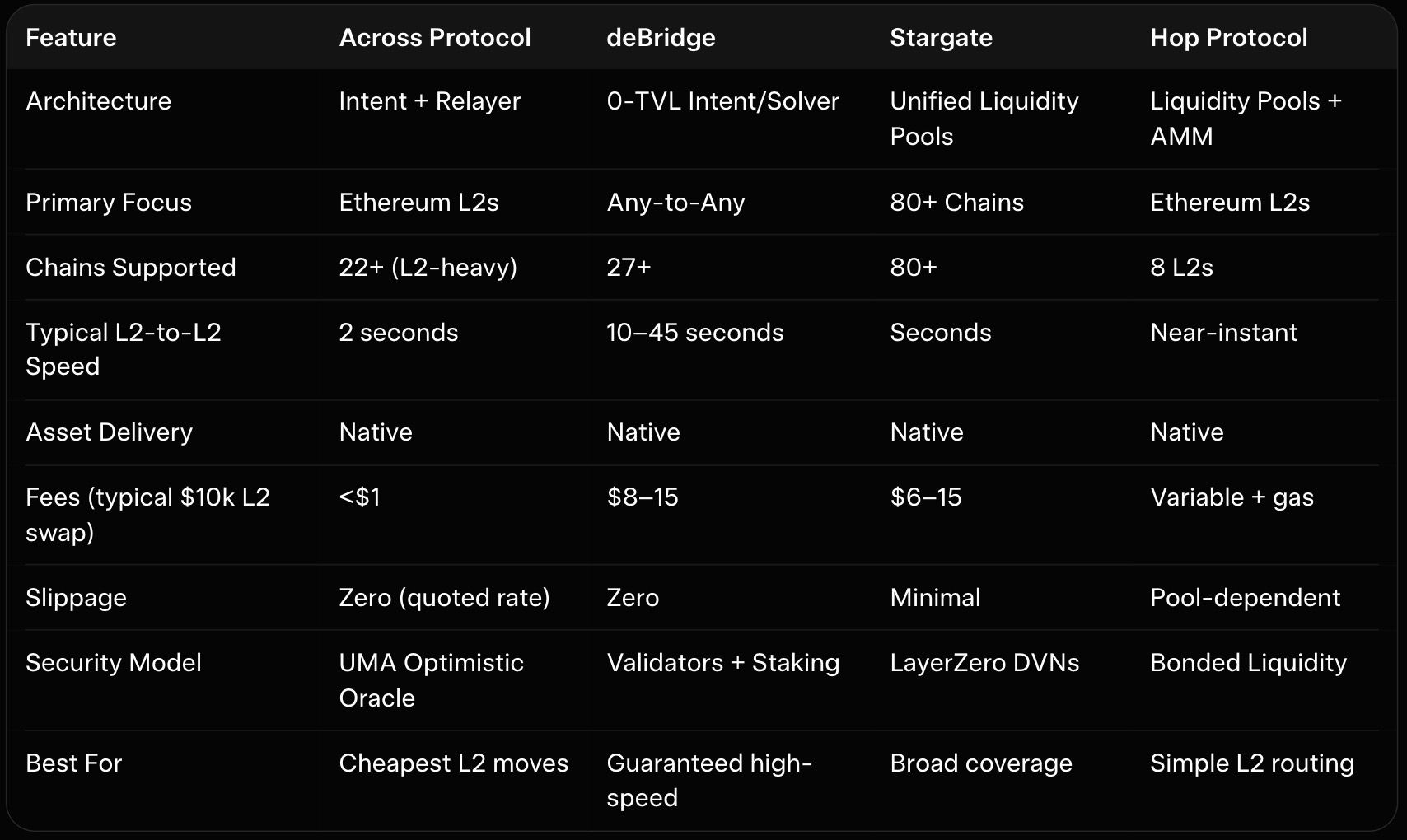
TLDR Across Protocol stands as the cheapest and fastest Ethereum L2 bridge in 2026, delivering native asset transfers between 22+ chains (heavy on Arbitrum, Base, Optimism, zkSync, Linea, and more) in as little as 2 seconds for L2-to-L2 routes with fees often under $1 and zero slippage. Its intent-based relayer model lets professional relayers front liquidity instantly while UMA’s optimistic oracle handles secure settlement later. With $36B+ lifetime volume, 23.5M+ transfers, and zero exploits, Across minimizes costs for everyday DeFi users moving USDC, USDT, ETH, or WBTC between L2s. Compared to pool-based rivals like Stargate or broader intent solutions like deBridge, it wins on L2-specific price efficiency. When paired with aggregators such as baltex.io, users unlock even wider routing and privacy options beyond pure L2 flows.
Why Across Protocol Matters for Ethereum L2 Users in 2026
Ethereum’s Layer 2 ecosystem has exploded by early 2026, with users constantly shifting capital between Arbitrum for perps, Base for social apps, Optimism for DeFi yields, and newer chains like Unichain or MegaETH for speed. Traditional bridges introduce high gas on mainnet, wrapped tokens, slippage, or multi-minute waits that erode profits on smaller moves. Across Protocol solves this by making L2-to-L2 transfers feel like same-chain swaps—native assets arrive instantly at rock-bottom cost. For yield farmers rebalancing $5k–$50k positions daily or traders arbitraging across rollups, Across delivers measurable savings and speed that compound into significant edge. Its focus on Ethereum-centric chains without sacrificing security makes it the default choice when every basis point and second counts.
How Across Protocol Works
Across operates as a production-ready cross-chain intents protocol. You connect your wallet at app.across.to, select source chain (say Base), input token (USDC), destination (Arbitrum), and amount. The interface quotes an exact output after relayer fees. You approve and deposit into a Spoke Pool contract on the source chain—this deposit acts as your intent.
Competitive relayers monitor all Spoke Pools in real time. The first to verify your deposit (via on-chain proof) immediately sends the equivalent native assets from their own inventory to your address on the destination chain, minus a small relayer fee. You receive funds in seconds—often 2 seconds on L2-to-L2 pairs. Later, the relayer submits a proof to Across’s Hub Pool (primarily on Ethereum mainnet) where UMA’s optimistic oracle verifies everything. If undisputed after the challenge window, the relayer gets reimbursed from pooled liquidity plus fees. This “fill-first, settle-later” flow removes user wait times while aligning incentives: relayers only profit when they execute correctly and efficiently.
The model guarantees native delivery—no wrapped tokens on supported routes—and zero slippage because the quoted rate is what you receive. Everything remains fully on-chain and auditable.
Supported Networks in 2026
Across connects 22+ chains with deep Ethereum L2 focus: Ethereum mainnet, Arbitrum, Base, Optimism, zkSync, Linea, Scroll, Polygon, Blast, Mode, Unichain, World Chain, Zora, Lisk, Soneium, Ink, Lens, MegaETH, Monad, Plasma, HyperEVM, BNB Smart Chain, and Solana. This coverage lets users move seamlessly across the entire rollup ecosystem plus key L1 off-ramps. Newer high-performance L2s like MegaETH and Monad were integrated rapidly in late 2025, reflecting Across’s commitment to Ethereum’s scaling frontier. Because the protocol avoids per-pair liquidity pools, adding chains requires minimal capital compared to older designs.
Core tokens include ETH/WETH, USDC, USDT, WBTC, DAI, and project-specific assets like ACX or chain-native stables. Liquidity depth is strongest on blue-chip pairs across major L2s.
Fee Structure
Across earns its “cheapest bridge” reputation through ultra-low, competitive fees. For most L2-to-L2 transfers the total cost—including relayer fee and gas—lands under $1, with many users reporting sub-$0.04 on stablecoin moves. There is no fixed percentage; relayers compete and the UI shows the exact all-in quote before you confirm. Liquidity providers earn a small cut from the Hub Pool on each successful settlement.
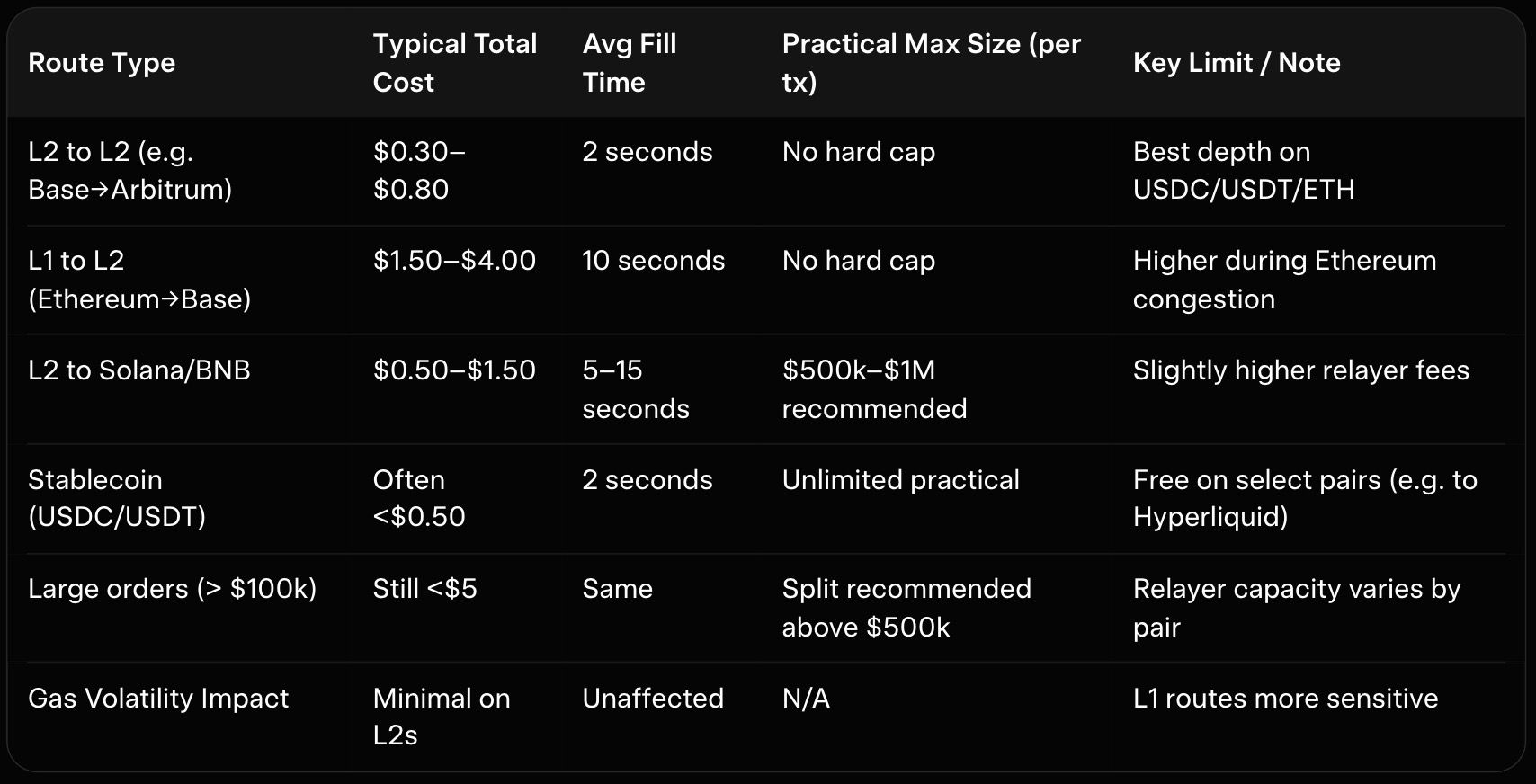
Example: bridging 10,000 USDC from Base to Arbitrum typically costs $0.30–$0.80 total. Even L1-to-L2 routes (Ethereum mainnet to Base) stay under $2–$5 during normal congestion thanks to batched settlements and efficient gas usage. Fees can rise slightly during extreme network events but remain lower than pool-based alternatives once slippage is factored. No hidden destination gas or approval fees beyond the initial transfer.
Relayer Model
The decentralized relayer network forms the engine of Across’s speed and cost efficiency. Anyone can run a relayer, but professional operators dominate because they optimize for speed, capital efficiency, and uptime. Relayers stake capital and compete via an RFQ (request-for-quote) system—effectively bidding to fulfill your intent at the best rate. This competition drives fees down and fill times to seconds. Relayers bear temporary risks (capital lockup, chain finality) but are fully reimbursed upon successful oracle verification, creating strong economic alignment. The model scales naturally: more volume attracts more relayers, tightening spreads further.
Liquidity Sources
Liquidity comes from two sources. First, Across’s Hub Pool and distributed Spoke Pools hold capital deposited by liquidity providers who earn fees on every transfer. Second, and more importantly for instant fills, relayers front their own inventory on destination chains. This hybrid approach avoids the fragmentation of pure pool models while providing virtually unlimited depth for major assets on popular L2 routes. During high demand, relayers can rebalance via the Hub Pool without users noticing any delay.
Settlement Speed and User Experience
Settlement feels instant from the user perspective. L2-to-L2 fills average 2 seconds; L1-to-L2 around 10 seconds. Full oracle settlement (reimbursement to relayer) happens in the background within minutes to hours depending on the optimistic challenge window. The interface at across.to offers clean one-click bridging with slippage protection, recipient customization, and wallet support for MetaMask, Rabby, and hardware options. Advanced users access the API or embed the widget directly into dApps.
Risk Scenarios
Across maintains one of the cleanest security records in bridging—no exploits, zero downtime since launch. Primary residual risks include:
- Relayer non-fulfillment on ultra-exotic pairs (mitigated by competitive incentives and slow-fill fallback from Spoke Pools).
- Optimistic oracle dispute (rare; UMA’s economic security has never failed in production).
- Smart-contract vulnerability in Spoke/Hub Pools (mitigated by multiple audits and gradual feature rollouts).
- Capital inefficiency during extreme congestion (users see real-time quotes and can wait or split orders).
Overall risk sits lower than many alternatives because user funds move off-source chain almost immediately.
Costs and Limits Table
How baltex.io Offers Alternative Multi-Chain Routing Beyond Ethereum L2 Bridges
While Across excels as the dedicated low-cost rail for Ethereum L2-to-L2 native transfers, baltex.io serves as a non-custodial aggregator and smart router that sits above Across and dozens of other bridges and DEXes. For users whose needs extend past pure L2 flows—perhaps moving from Arbitrum to Solana, or swapping USDC into a privacy coin on a smaller chain—baltex.io automatically scans Across routes alongside Symbiosis, deBridge, 1inch cross-chain, and direct DEX paths across 200+ networks.
Key differences versus using Across directly:
- Broader scope — Across shines inside the Ethereum L2 mesh; baltex.io stitches routes to reach non-EVM chains or exotic tokens where Across has lighter coverage.
- Intelligent optimization — One-click interface hides complexity and often blends Across for the L2 leg with another path for the final destination, delivering the absolute lowest all-in cost and slippage.
- Privacy focus — baltex.io adds transaction obfuscation tools and supports flows into privacy-preserving assets, features not native to Across.
- No artificial limits — Higher throughput for power users and no KYC or account requirements.
Many DeFi participants therefore use Across directly for core L2 rebalancing (cheapest and fastest) while routing everything else—or complex any-to-any swaps—through baltex.io. The services complement each other: Across supplies the ultra-efficient L2 highway; baltex.io supplies the global navigation system and privacy layer that makes the entire multi-chain world accessible.
FAQ
Is Across Protocol the cheapest bridge for Ethereum L2s in 2026? Yes. For most L2-to-L2 stablecoin and ETH transfers, it consistently undercuts competitors once total cost (fees + gas + slippage) is calculated.
How fast are Across transfers between L2s? Average 2 seconds for L2-to-L2 fills. You receive native assets almost immediately.
What are typical fees on Across? Most transactions cost under $1 total. A $10,000 USDC move between Base and Arbitrum often lands at $0.30–$0.80.
Is Across safe for large L2 transfers? With $36B+ processed, 23.5M+ transfers, and zero exploits, it ranks among the safest. Best practice: test with a small amount first, then split larger moves if needed.
Does baltex.io replace Across? No—it enhances it. baltex.io frequently selects Across internally for L2 segments while adding multi-path intelligence and privacy for broader use cases.
Can I integrate Across into my own dApp? Yes. The protocol offers full API and widget support for seamless embedding of fast, cheap L2 bridging.
Conclusion
In the mature multi-chain DeFi landscape of 2026, moving assets efficiently between Ethereum Layer 2 networks is no longer optional—it is fundamental. Across Protocol has established itself as the gold standard for cost-conscious users by combining intent-based instant fills, native asset delivery, and an economically secure relayer-oracle model that simply cannot be beaten on price for L2-to-L2 flows. Its 2-second execution, sub-dollar fees, and flawless security track record make every basis point saved and every second gained feel meaningful at scale.
When your workflow stays within the Ethereum L2 universe, Across is the obvious choice. When you need to venture further—into Solana, privacy tools, or complex any-to-any swaps—baltex.io provides the intelligent layer on top that keeps the entire experience seamless. Whether you are a retail DeFi power user, a professional trader, or a developer building the next L2-native application, Across belongs at the center of your bridging stack.
Visit app.across.to today, connect your wallet, and experience why so many have made the switch to the cheapest, fastest way to move value across Ethereum’s Layer 2 ecosystem. In 2026, bridging should be invisible—and with Across, it finally is.
We cover this in more detail in How to Sell ETH: Quick and Safe Methods for Ethereum Holders.
For more on this, see our guide on What Is the Arbitrum Bridge and Which Assets Does It Support.
You can read our full breakdown in Linea Bridge Tutorial: Cheapest Ways to Move ETH (July 2026).
You can read our full breakdown in Linea Bridge Tutorial: Cheapest Ways to Move ETH (July 2026).