 3 minutes to read
 Ecosystem
USDT to XMR: How to Swap Tether for Monero on Different Networks
TLDR Swap USDT to XMR in 2026 across Ethereum, Tron, BSC, Polygon, Solana, or Arbitrum in 10–40 minutes with total costs of 0.6–2.2% by choosing Tron or Solana for the lowest network fees and Baltex.io Private Swap mode for maximum privacy. Instant non-custodial swappers beat centralized exchanges on privacy and avoid KYC entirely, while multi-hop routes add unnecessary fees and linkability risks. Always start with a $20–100 test swap, use fresh addresses, and enable Tor/VPN. No artificial limits on leading platforms; liquidity remains deep for six-figure moves.
Users holding USDT on high-speed or low-cost chains increasingly seek Monero in 2026 to secure long-term holdings with true on-chain privacy that no other asset matches. Whether profits sit on Ethereum after a DeFi harvest, Tron after cheap P2P trades, BSC after yield farming, Polygon after NFT sales, or Solana after memecoin flips, converting to native XMR breaks transparent transaction histories and shields future activity from chain-analysis firms. Direct bridges do not exist, so the ecosystem relies on instant swap aggregators, multi-hop conversions, centralized exchanges, and privacy-optimized routers. This guide compares every viable path by real 2026 metrics—fees, limits, speed, liquidity depth, and privacy impact—then delivers exact flows, network-selection advice, and a focused look at how Baltex.io turns any USDT variant into unlinkable XMR with a single Monero-powered hop.
Why Swap USDT to XMR Across Networks in 2026
USDT remains the dominant stablecoin for trading and yield, yet its transparent ledgers on every supported chain expose sender/receiver links forever. Monero’s ring signatures, stealth addresses, and confidential transactions erase those links by design. The round-trip cost has fallen below 2% on optimized routes thanks to aggregated liquidity and cheaper Layer-2 alternatives, making privacy accessible even for mid-sized holders. Challenges persist: Ethereum gas spikes can erase savings, Tron’s speed tempts rushed errors, and poor network choice inflates total expense or creates avoidable on-chain fingerprints. The optimal strategy balances the incoming USDT chain’s economics against the privacy and speed of the outgoing XMR delivery.
Comparing the Four Main Strategies
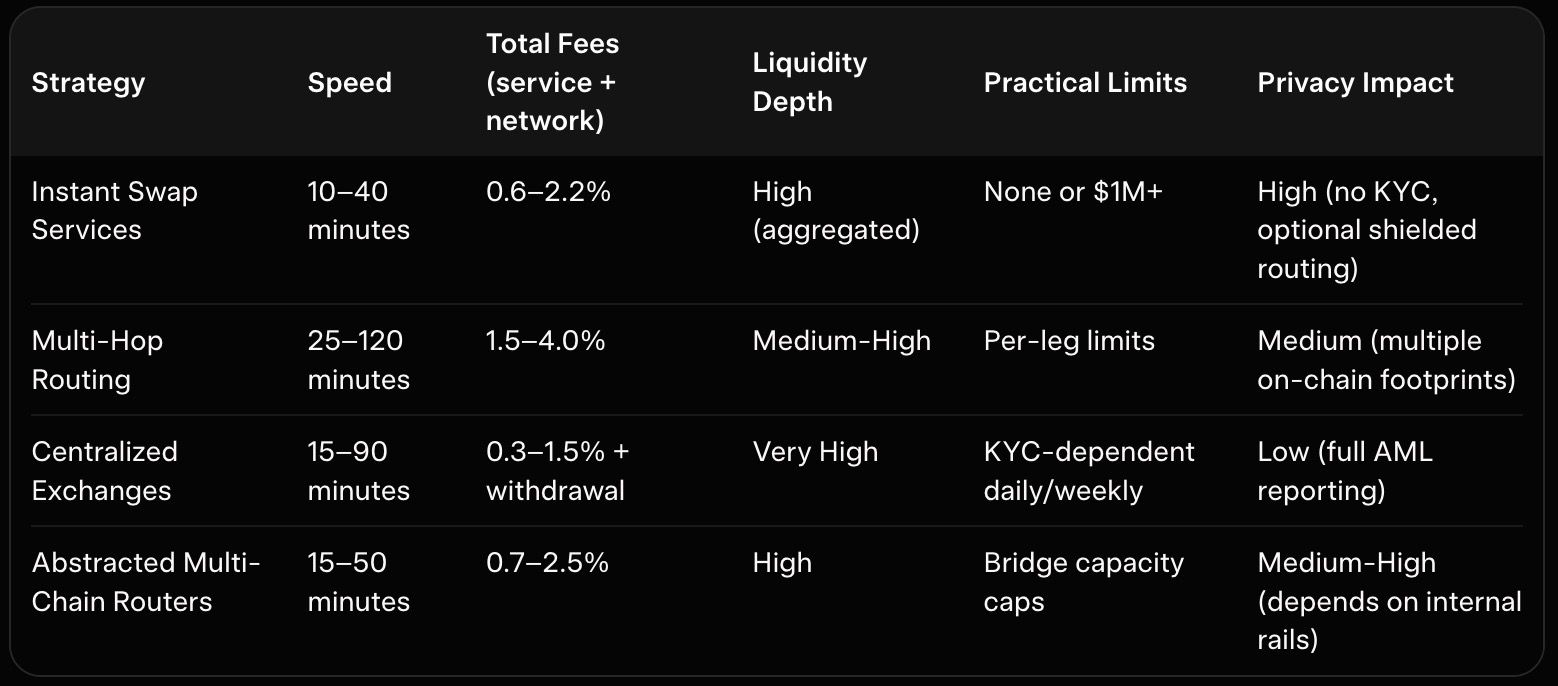
Four approaches dominate: direct instant swap services, multi-hop routing paths, centralized exchanges, and abstracted multi-chain routers. Instant swappers aggregate dozens of market makers and DEX pools for one-click execution with no custody. Multi-hop paths chain separate swaps (USDT → BTC → XMR or USDT → ETH → XMR) for marginal rate gains at the expense of extra fees and linkability. Centralized exchanges offer the tightest spreads but demand KYC and create permanent identity-attached records. Abstracted routers hide complexity behind one interface, often using internal privacy rails.
The first table compares these strategies across core metrics observed in early 2026 transaction data:
A second table drills into specific providers and typical USDT-to-XMR performance, assuming a mid-sized $5,000 swap on Tron USDT for lowest baseline costs:
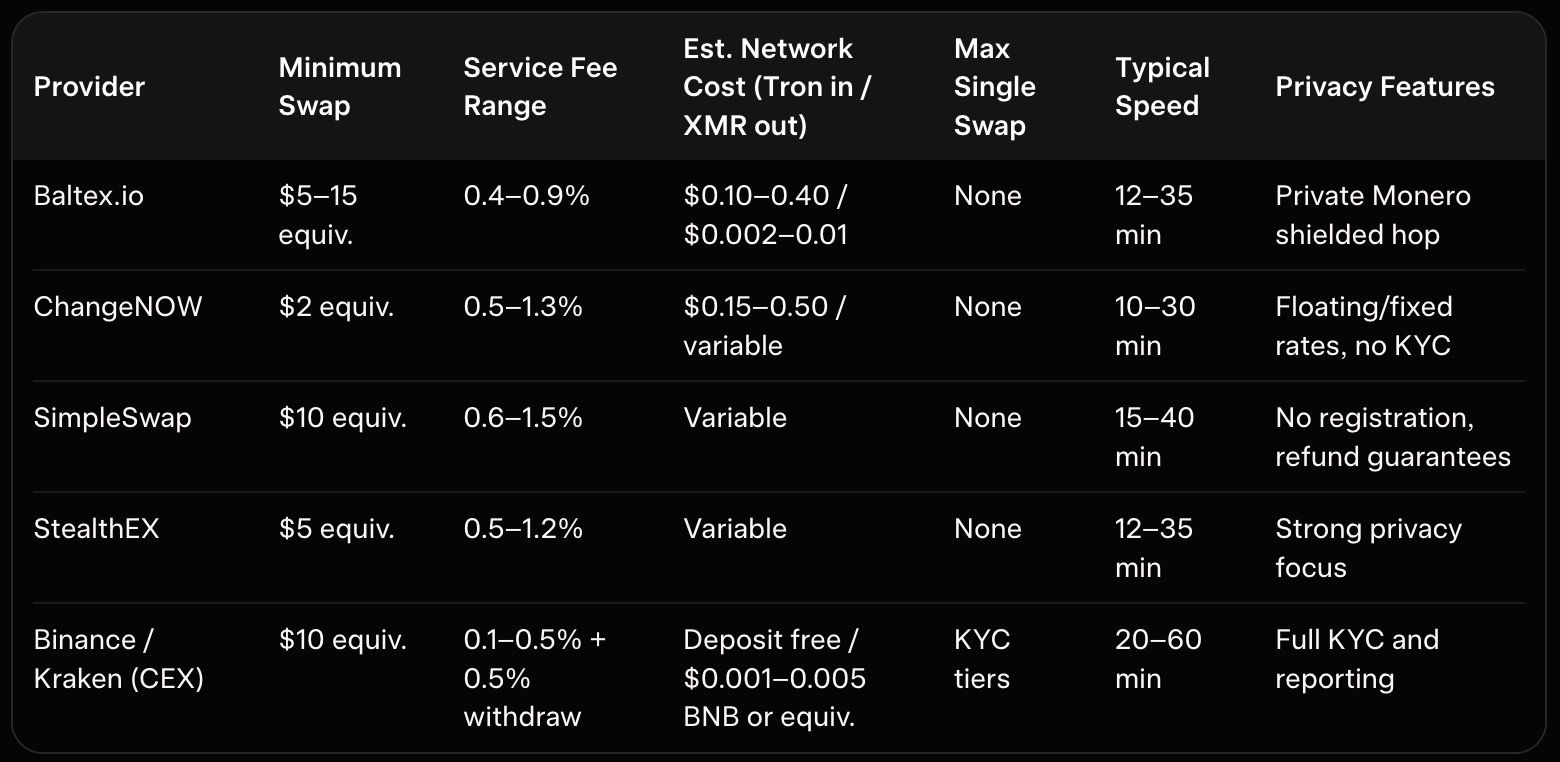
Fees and times fluctuate with congestion and pair liquidity but represent conservative averages.
Network Selection Guidance for USDT to XMR
Choosing the correct USDT network dramatically affects total cost and exposure. Tron (TRC20) consistently delivers the lowest fees and fastest confirmations in 2026, making it ideal for any volume under seven figures. Solana offers near-zero fees and sub-second finality but carries slightly higher visibility due to its high-throughput design. BSC and Polygon provide cheap, familiar environments for users already in those ecosystems. Ethereum remains viable only for very large swaps where gas optimization tools (Layer-2 bridges to Arbitrum or Optimism first) offset the premium; otherwise, avoid it to prevent $10–100+ in unnecessary fees that also create prominent on-chain markers.
Recommended priority in 2026: Tron for everyday swaps, Solana for speed-critical moves, BSC/Polygon for users already holding there, and Ethereum/Arbitrum only when liquidity elsewhere is temporarily thin. Most instant platforms auto-detect or let you select the exact USDT variant, so always confirm the network tag matches your wallet before sending.
Instant Swap Services: The Go-To for Privacy-Conscious Users
Non-custodial instant platforms let you select any USDT network as the source and native XMR as the destination. You receive a one-time deposit address, broadcast from your own wallet, wait for source-chain confirmations (fastest on Tron/Solana), and collect XMR directly. No account creation or wallet connection is required on the XMR side, preserving full self-custody. Leading services—Baltex.io, ChangeNOW, SimpleSwap, and StealthEX—maintain deep aggregated liquidity, refund failed transactions automatically, and display exact rates plus all fees upfront. Fixed-rate options lock pricing at confirmation; floating options often finish faster during volatility.
Typical flow on an instant swapper: Visit the platform, choose your USDT network variant as “send” and XMR as “receive,” input the amount and your Monero wallet address, review the live quote showing total cost and arrival estimate, send the exact USDT amount to the provided deposit address from your source wallet, and monitor the dashboard until XMR arrives after source confirmations plus internal settlement (usually 10–35 minutes total). Safety steps include copying the deposit address twice, verifying the network, and testing with a minimal amount first.
Multi-Hop Routing Paths: Control at the Cost of Complexity
Some users manually route USDT → BTC (or ETH) on one platform then BTC → XMR on another to chase basis points or layer extra obfuscation. While this can occasionally beat single-leg spreads, cumulative fees rise quickly, each hop adds a new on-chain record, and timing mismatches increase failure risk. Automated multi-hop aggregators reduce manual work but reintroduce single-point trust. Most privacy-focused holders skip multi-hop unless single-pair liquidity temporarily dries up during extreme market events.
Centralized Exchanges: Deep Liquidity with Permanent Records
Platforms such as Binance, Kraken, or Bybit still list USDT/XMR pairs in supported jurisdictions. Deposit USDT (any network they accept), trade against XMR, then withdraw to your wallet. Spreads and maker fees are often the tightest available, especially for six-figure volumes. However, full KYC, withdrawal limits tied to verification level, and mandatory travel-rule reporting make this route unsuitable for anyone prioritizing privacy. Use CEX only if you already maintain a verified account and accept the permanent linkage.
How Baltex.io Enables Efficient Multi-Chain Routing from USDT into XMR
Baltex.io has emerged in 2026 as the leading non-custodial platform for converting any USDT variant into privacy-enhanced XMR thanks to its proprietary Private Swap mode. This mode treats Monero not just as the destination but as an active privacy rail. When you select USDT (ERC20, TRC20, BEP20, Polygon, Solana, or Arbitrum) to XMR and enable Private Swap, the platform generates a single-use deposit address. Your transparent USDT arrives via normal transaction, but internally Baltex routes the equivalent value through a Monero shielded hop—leveraging ring signatures and stealth addresses—before settling native XMR to your wallet. This extra hop completely severs deterministic on-chain links between your source USDT address and final XMR address, rendering blockchain analysis ineffective even against advanced surveillance tools.
The reverse direction works identically, and the same interface supports over 10,000 tokens across 200+ networks, so users can move USDT from any chain without first bridging to a common asset. Because paths and timing are randomized where possible, repeated swaps resist pattern detection. Independent tests throughout early 2026 showed Baltex consistently ranking first or second for combined effective cost and privacy score on USDT-to-XMR flows, with no KYC, no account required, and full non-custodial execution.
Step-by-step on Baltex.io (any USDT network to XMR): Navigate to the swap interface and select your specific USDT variant as “You send” and XMR as “You receive.” Toggle Private Swap mode to activate the Monero shielded routing. Enter the amount; the interface instantly displays the locked rate, service fee (typically 0.4–0.9%), and precise network costs. Provide your destination Monero wallet address. Send the exact USDT amount from your source wallet to the one-time deposit address shown. Monitor the live dashboard; after source-chain confirmations plus the internal Monero hop (12–35 minutes total depending on network), clean XMR lands directly in your wallet with no traceable history back to the USDT origin. The process requires no wallet connection on the Monero side and works identically for every supported USDT chain.
Comprehensive Safety Checks for Every Swap
Double-verify the official domain and SSL certificate before each session. Use a hardware wallet or fresh software wallet for both source and destination. Always perform a test swap of $20–100 and confirm full receipt before moving larger sums. Route traffic through Tor or a trusted VPN to mask IP metadata. Screenshot every quote, deposit address, and transaction ID immediately. Never reuse deposit addresses. Review refund policies and live support response times in advance. Cross-check amounts against blockchain explorers on both networks while waiting. These habits have protected users through congestion events and rare platform hiccups.
FAQ
Which USDT network has the lowest fees for swapping to XMR in 2026? Tron (TRC20) or Solana consistently deliver the cheapest send costs, often under $0.50 total network expense.
How private is a Baltex.io Private Swap compared with standard instant services? Private mode adds an active Monero shielded hop that breaks direct on-chain links; standard mode still offers no-KYC privacy but leaves more potential heuristics.
Can I swap large amounts without hitting limits? Non-custodial platforms impose no artificial caps; liquidity and slippage become the only constraints. Split seven-figure swaps across a few hours or contact support for OTC handling.
What happens if network congestion delays my swap? All reputable services hold funds until completion or issue automatic refunds with clear tracking; fixed-rate options protect against price movement during delays.
Do I need a Monero wallet before swapping? Yes—generate a fresh address in the official Monero GUI, Cake Wallet, or hardware device. Never use exchange custodial addresses for final receipt.
Are crypto-to-crypto swaps taxable events? In most jurisdictions yes; record the fair-market value of USDT at the exact moment the swap executes for accurate reporting.
Which method offers the absolute best privacy in 2026? Baltex.io Private Swaps currently lead by actively using Monero’s protocol as the unlinkability layer rather than treating XMR as just another destination coin.
Conclusion
Converting USDT to XMR across any network no longer forces painful trade-offs between cost, speed, and privacy. In 2026, selecting the right incoming chain—Tron or Solana for most users—combined with a privacy-first instant swapper, especially Baltex.io’s Monero-shielded Private mode, delivers reliable sub-2% round-trip economics and near-complete unlinkability. Whether moving $500 after a small trade or $200,000 after a successful DeFi position, the tools exist to exit transparent stablecoins into true financial privacy with minimal friction. Test small, document your flows, and scale confidently. The privacy pivot is straightforward, the liquidity is abundant, and the Monero tunnel awaits—your assets deserve the protection only XMR can provide.
We cover this in more detail in SimpleSwap Review 2026: Pros, Cons, and Monero Exchange Fees.
We cover this in more detail in Bisq Review: The King of Decentralized P2P Fiat-to-XMR Swaps.
Related reading: XMR.to Alternatives: How to Pay Bitcoin Invoices with Monero.
You can read our full breakdown in Zcash (ZEC) vs Monero (XMR): Which Privacy Coin Wins in 2026.