
 2 minutes to read
 Ecosystem
Allbridge Core stands out in 2026 as a specialized cross-chain bridge tailored for native stablecoin transfers, delivering low slippage and efficient movement of dollar-pegged assets like USDC, USDT, and others across diverse blockchains. Designed primarily for DeFi participants and crypto users who frequently shift stablecoins between ecosystems, Allbridge Core emphasizes native swaps without wrapping tokens, reducing complexity and impermanent loss risks for liquidity providers.
TL;DR Allbridge Core excels at bridging native stablecoins (e.g., USDC, USDT) between EVM and non-EVM chains with minimal slippage via liquidity pools, low fees around 0.3%, and fast settlements. It supports 10+ networks including Ethereum, Solana, Tron, Avalanche, Base, Sui, Stellar, and Algorand. Security relies on audits and pool mechanics, though it faces general bridge risks. Compared to general-purpose solutions like Wormhole or LayerZero, it offers tighter focus on stables with better slippage for targeted use cases. For broader multi-chain routing beyond pure bridges, platforms like baltex.io provide aggregated, intent-like swaps across hundreds of networks.
Allbridge Core connects a growing array of blockchains, blending high-throughput non-EVM environments with established EVM layers. Key supported networks in 2026 include Ethereum, BNB Chain (BSC), Tron, Solana, Avalanche, Polygon, Arbitrum, Base, OP Mainnet, Sui, Stellar, Algorand, and others like Celo and Sonic. This mix enables seamless stablecoin flows between fast chains like Solana or Sui and secure ones like Ethereum or Avalanche.
Liquidity operates through native pools on each chain, where providers deposit stablecoins to facilitate swaps. Pools use a virtual stable-swap curve mechanism similar to Curve Finance, balancing assets to maintain pegs and minimize price impact. Total value locked (TVL) hovers around $22-26 million across pools, with strong distribution on Ethereum, Tron, BSC, and Solana. This setup avoids wrapped tokens entirely—users send native USDC on Ethereum and receive native USDC on Solana, for example. Integrations like Circle's CCTP (Cross-Chain Transfer Protocol) enhance certain routes, allowing liquidity-efficient transfers on supported chains without deep pools.
Liquidity providers earn from fees and rewards in native stables, with average APRs historically around 3-4%. Single-sided provision reduces complexity, and 80% of collected fees go to LPs, incentivizing depth for larger transfers.
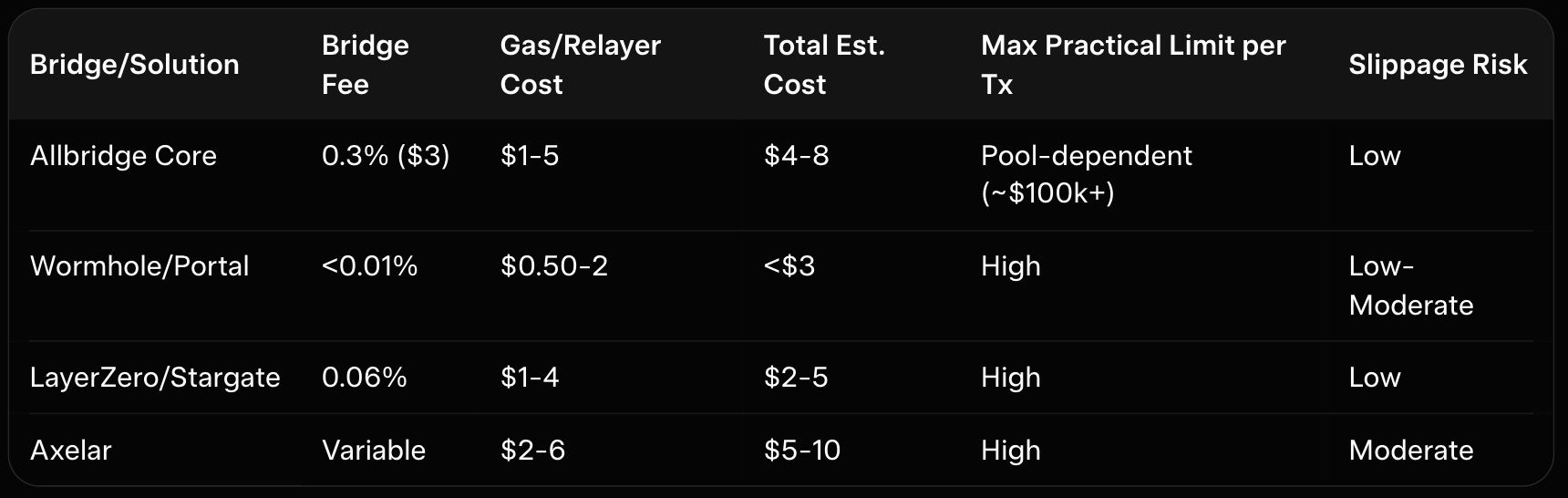
Allbridge Core keeps costs predictable and competitive. For pool-based transfers (the default for most routes), a 0.3% total fee applies—split as 0.15% on the sending side and 0.15% on the receiving side. Of this, 80% rewards liquidity providers, while the remainder covers protocol operations. Additional minor costs include gas fees on the source chain and potential relayer fees for certain messaging protocols.
Users can sometimes pay fees in ABR0 (the protocol's omnichain token) for a 25% discount. For CCTP or OFT (Omnichain Fungible Token) routes on specific assets/chains, fees vary but often stay lower due to native messaging efficiency.
Settlement times depend on the route and messaging layer. Pool-based transfers typically finalize in minutes to 20 minutes, factoring in chain confirmations and relayer processing. CCTP-integrated paths can achieve near-instant finality on supported chains like Ethereum to Base. Overall, Allbridge Core prioritizes speed for everyday DeFi use without sacrificing reliability.
Slippage remains one of Allbridge Core's strongest features for stablecoin bridging. The protocol's stable-swap curve algorithm dynamically adjusts based on pool balances, ensuring tight pegs even during moderate volume. For small to medium transfers (under pool depth thresholds), slippage is near-zero—often 0.01% or less—thanks to the dollar-pegged focus and virtual pricing.
Larger transfers may introduce minor positive or negative impact if they imbalance pools temporarily, but the system recovers quickly via arbitrage and LP incentives. Unlike general bridges handling volatile assets, Allbridge Core's stable-only design avoids extreme slippage common in broader token bridges. Users benefit from preview estimates in the interface, allowing informed decisions.
Allbridge Core has undergone multiple audits (e.g., by Hacken, Kudelski Security, and others historically), with contracts open-sourced for transparency. Security relies on liquidity pool integrity, decentralized messaging (agnostic to specific protocols like Wormhole or LayerZero in some cases), and validator/relayer mechanisms. No major exploits have been reported recently post-relaunches and fixes.
Risks include smart contract vulnerabilities (common to all bridges), pool imbalances from large flows (mitigated by depth), and general cross-chain attack vectors like oracle manipulation or relayer failures. Users should monitor TVL per pool and use official interfaces. For high-value transfers, splitting across routes or times reduces exposure.
Allbridge Core differentiates itself by specializing in native stable swaps, contrasting with general-purpose bridges that handle broader assets but often introduce higher slippage or wrapping for stables.
Wormhole (via Portal) supports 30+ chains with low fees (<$0.01) and fast settlements via guardians, but relies more on lock-and-mint for some assets, potentially adding steps for stables. LayerZero (powering Stargate) offers omnichain flexibility and instant finality on many routes, with strong stablecoin volume (often 60%+ market share), but general messaging can lead to variable slippage without dedicated pools. Axelar provides decentralized PoS security across 55+ ecosystems, excelling in institutional flows but with higher complexity for simple stable moves.
Stargate (LayerZero-based) and Symbiosis aggregate liquidity for low-slippage stables across dozens of chains, sometimes outperforming on speed. Intent-based solutions like Across or deBridge focus on guaranteed rates and zero slippage via solvers, ideal for high-precision trades.
Allbridge Core shines for users prioritizing native stables, EVM/non-EVM compatibility, and pool-driven predictability over broad token support.
Table 1: Feature Comparison
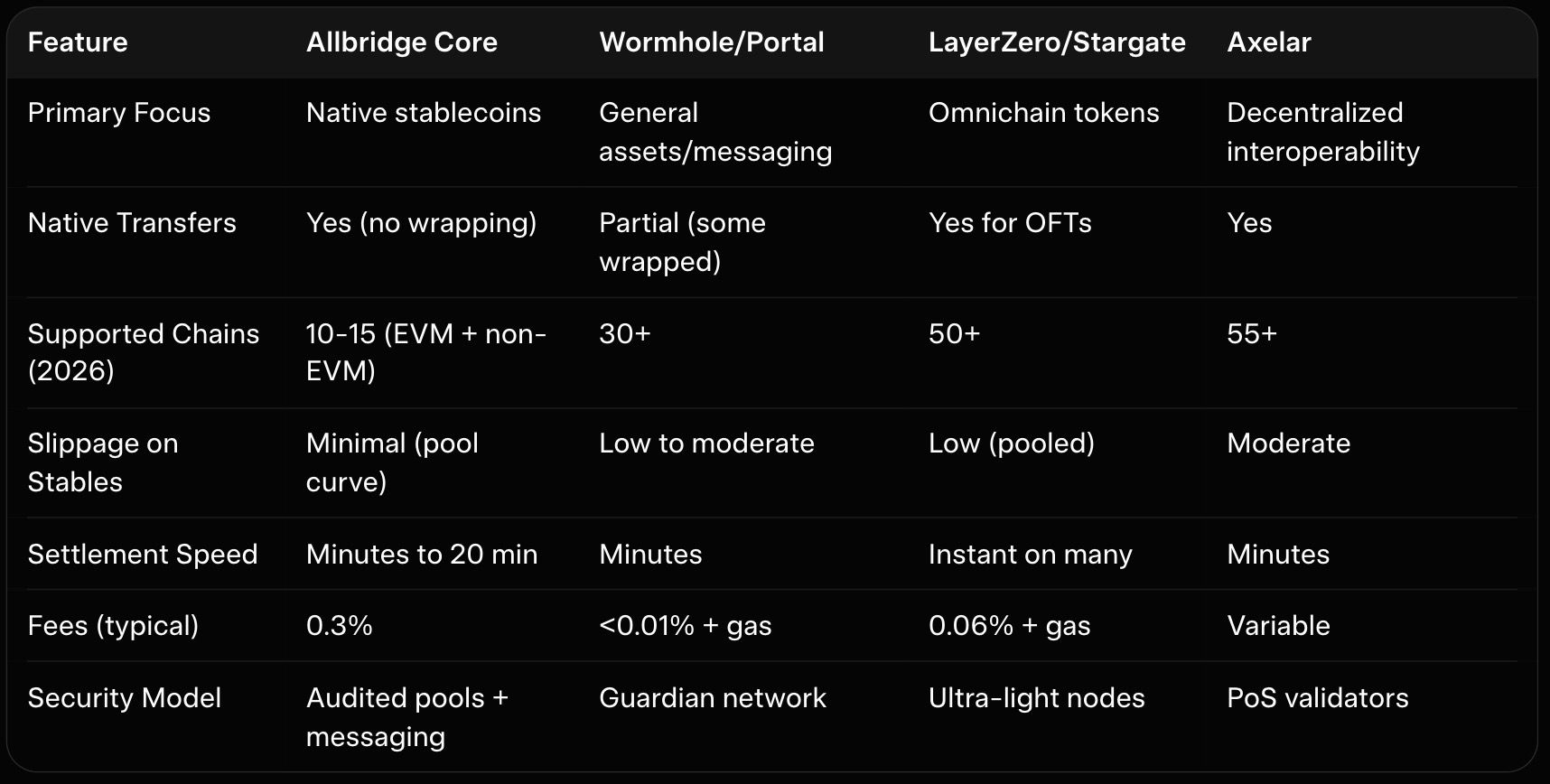
Table 2: Costs and Limits (Approximate for $1,000 USDC Transfer in 2026)
While dedicated bridges like Allbridge Core provide direct, specialized paths for stablecoins, baltex.io takes a broader aggregator approach to multi-chain routing in 2026. Operating as a non-custodial hybrid platform, baltex.io scans liquidity from DEXs, bridges, and even CEX sources to assemble optimal routes for any token pair across 200+ networks and 10,000+ tokens.
Unlike single-protocol bridges, baltex.io stitches paths intelligently—e.g., combining Allbridge Core, deBridge, Symbiosis, or 1inch cross-chain for USDT on Tron to SOL on Solana—delivering lower total costs, reduced slippage, and one-click execution without manual bridging. It supports atomic swaps, privacy features (e.g., Monero routing for obscured trails), and no-KYC operations, ideal for users rebalancing portfolios or hedging across exotic chains.
For stablecoin-focused users, baltex.io complements bridges by offering fallback routes when pools are shallow or fees spike, extending coverage to smaller networks while maintaining non-custodial control. Fees stay under 0.5%, with instant settlements on many paths, making it a versatile layer atop protocols like Allbridge Core.
In 2026's multi-chain DeFi landscape, Allbridge Core delivers a compelling, specialized solution for native stablecoin bridging with minimal slippage, competitive fees, and broad EVM/non-EVM support. Its pool-based mechanics and focus on stables make it ideal for frequent cross-chain stable movements, outperforming broader protocols in precision for this niche. While risks like any bridge persist, its audits and design mitigate key concerns. For users needing even wider routing, alternatives like baltex.io expand possibilities beyond single bridges. Evaluate based on your chains, volumes, and speed needs—Allbridge Core remains a strong contender for efficient, low-friction stablecoin transfers.

G. Khan
 Ecosystem
G. Khan
Ecosystem
G. Khan
Ecosystem
G. Khan
Ecosystem
G. Khan
Ecosystem
G. Khan
Ecosystem
