1 minute to read
 Ecosystem
TL;DR
Monero beats Bitcoin for private payments in 2026 because every transaction is unlinkable by default with perfect fungibility and consistently low fees. Bitcoin with Lightning Network wins for speed and widespread merchant acceptance when privacy is not the top priority. Most users benefit from both coins and route between them via Baltex.io for maximum payment flexibility without compromising either strength.
Monero and Bitcoin both aim to function as digital cash yet deliver dramatically different payment experiences in practice. Bitcoin dominates mainstream adoption and liquidity while Monero prioritizes financial privacy that Bitcoin cannot match on its base layer. The choice depends on whether you value anonymity or seamless merchant integration more.
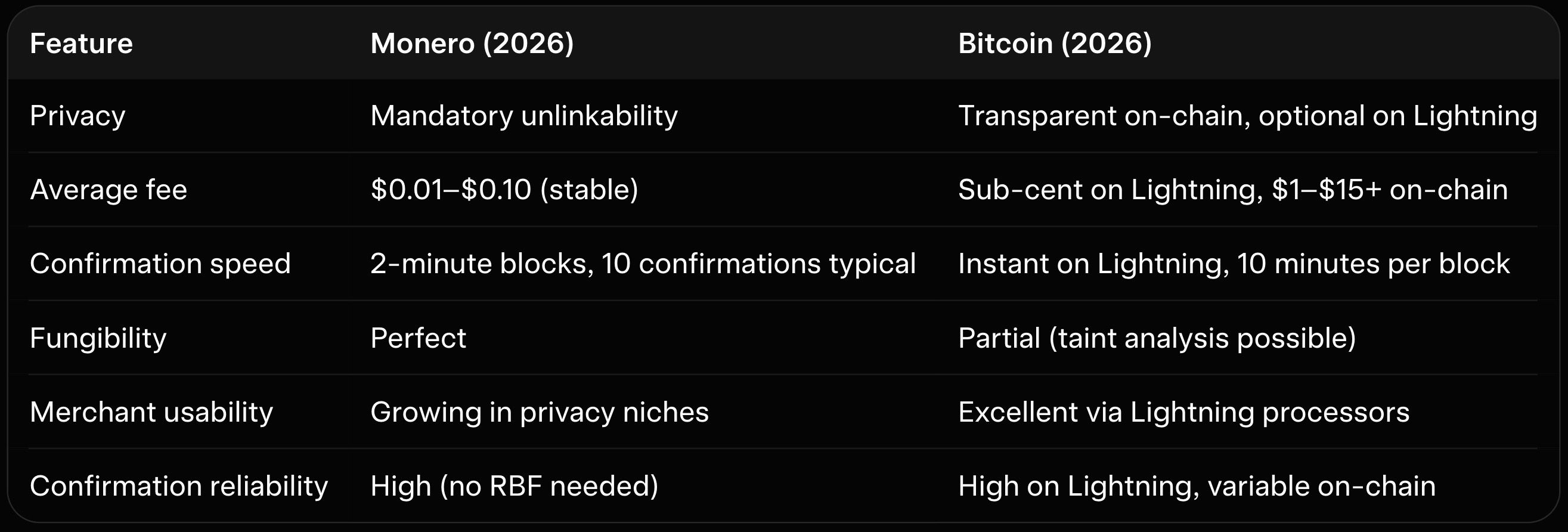
The table shows the core trade-offs merchants and users face daily. Monero protects every payment automatically. Bitcoin offers faster small-value transfers once Lightning is set up.
Monero hides the sender, receiver, and amount on every transaction using ring signatures, stealth addresses, and RingCT. This design makes chain analysis nearly impossible even for advanced firms. Bitcoin reveals everything on-chain unless users route through Lightning channels that still carry some metadata risks.
Monero delivers true financial privacy without extra steps or trusted mixers. Customers can pay merchants without creating permanent public records that could link purchases to identities. Merchants who accept Monero avoid the compliance headaches of handling tainted coins.
Bitcoin payments remain fully traceable unless wrapped in Lightning or CoinJoin tools. Many users still leak metadata through address reuse or on-chain settlements. Our Monero wallet security best practices explains why Monero’s default privacy simplifies safe payment habits.
Monero produces blocks every two minutes and recommends ten confirmations for standard privacy guarantees. The short block time gives quick initial visibility while the privacy overhead adds slight delay compared to Lightning. Most merchants accept zero-confirmation Monero for small amounts because double-spend risk stays extremely low.
Bitcoin Lightning delivers near-instant finality for small payments once channels open. On-chain Bitcoin still averages ten minutes per block with six confirmations considered safe for larger sums. Lightning works beautifully for frequent small transfers but requires channel management and inbound liquidity that Monero avoids entirely.
Monero keeps fees consistently low and predictable through dynamic block sizing that adapts automatically to demand. Even during network peaks the cost rarely exceeds ten cents. This stability makes Monero ideal for remittances, micro-payments, and frequent merchant transactions.
Bitcoin Lightning fees stay under a cent for most payments but channel opening and closing still require on-chain fees that can spike. On-chain Bitcoin becomes expensive during congestion while Lightning offers cost efficiency after initial setup. Our best no-KYC Monero swappers overview notes how Monero’s stable fees encourage more fluid cross-chain payment flows.
Every Monero coin remains identical and untainted because the protocol prevents blacklisting of specific units. Merchants never worry about receiving funds that exchanges might later reject. This perfect fungibility builds long-term trust in privacy-focused payment ecosystems.
Bitcoin suffers from partial fungibility where past transaction history can lead to blacklisting or extra scrutiny. Merchants using Bitcoin processors must sometimes deal with tainted-coin risks or additional compliance steps. Our best P2P Monero exchanges guide shows how users often convert Bitcoin receipts into Monero for cleaner merchant flows.
Real-World Scenarios
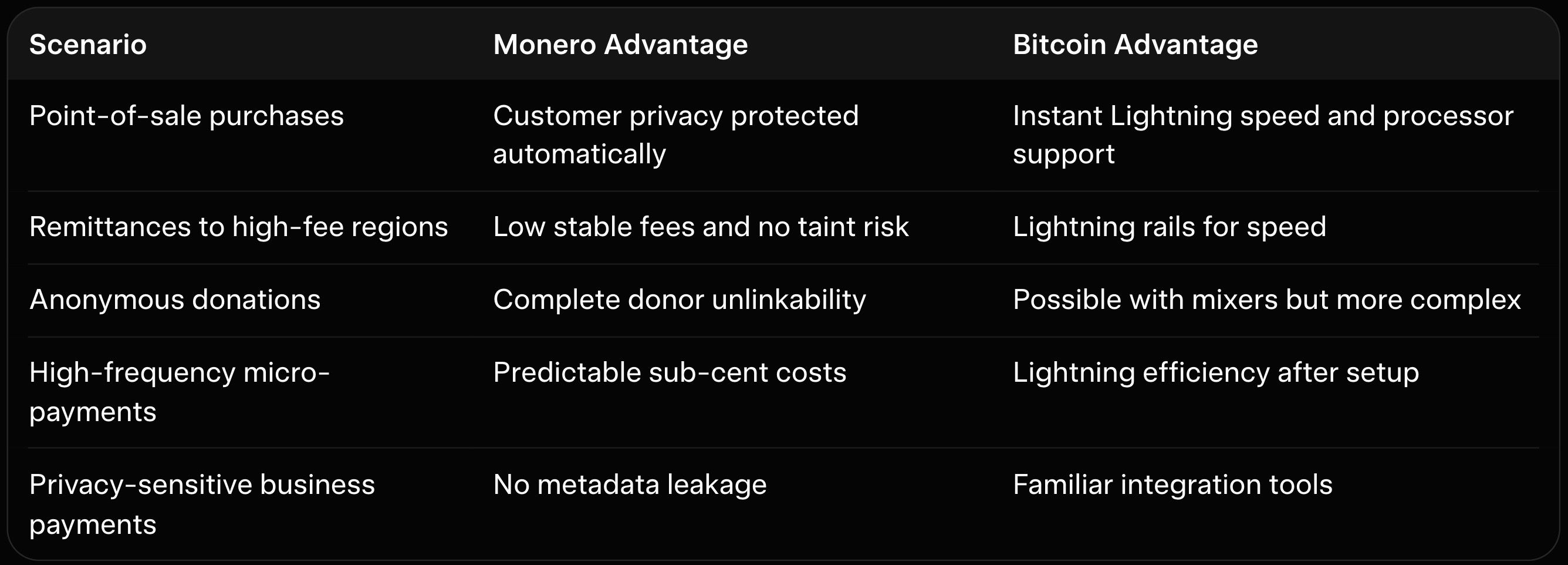
This table illustrates where each coin shines in practice. Monero protects sensitive payments effortlessly. Bitcoin powers fast everyday spending where speed trumps privacy.
Small merchants in privacy-conscious regions increasingly accept Monero through simple QR code invoices with fresh subaddresses. Larger retailers prefer Bitcoin Lightning for its integration with existing point-of-sale systems and massive liquidity. Our Cake Wallet review highlights mobile tools that make Monero payments as easy as scanning a code.
Monero’s lack of replace-by-fee means once a transaction enters the mempool it stays there until confirmed. This predictability reduces merchant risk compared to Bitcoin where RBF can create uncertainty. Both networks remain highly reliable in 2026 but Monero’s design eliminates certain edge-case headaches.
Lightning Network offers instant finality for opened channels yet requires users to monitor liquidity and channel health. On-chain Bitcoin still faces occasional congestion that delays confirmations. Monero’s dynamic blocks absorb demand spikes without the same volatility.
Merchants and users often need Bitcoin’s widespread acceptance for one transaction and Monero’s privacy for the next. Baltex.io integrates directly by accepting deposits from either coin and delivering the output to a fresh address on the other chain in one non-custodial transaction. You create the outgoing payment in your wallet, send it to a Baltex deposit address, and the platform routes privately without ever seeing your keys.
Enable Private Swap mode for extra shielded Monero legs that further obscure origins before funds reach Bitcoin Lightning or a merchant processor. The entire process completes in minutes and works with any wallet including mobile options. For readers of our Trocador review and StealthEX review, Baltex.io stands out when payment flexibility requires switching between privacy and liquidity on demand.
Traders convert Bitcoin receipts into Monero for private payouts and back again for merchant spending. The workflow keeps the original payment addresses completely isolated. Our best P2P Monero exchanges guide shows additional options that pair naturally with this routing.
Businesses accepting mixed payments route Bitcoin inflows through Baltex.io into Monero for private treasury management while keeping receive addresses separate. The non-custodial design ensures full key control throughout. Our hardware wallet for Monero guide and Monero wallet security best practices help users layer extra protection on top of these payment routes.
Use fresh subaddresses on Monero and Lightning invoices on Bitcoin for maximum isolation in every transaction. Test small amounts first when setting up new merchant flows. Combine with hardware wallets for larger business payments to keep long-term keys offline.
Our best Monero mobile wallets guide and Monero GUI vs CLI wallet comparison guide wallet choice for efficient payment workflows. Our best Monero desktop wallets guide offers desktop options for high-volume merchant setups.
Monero and Bitcoin both serve as viable payment systems in 2026 yet excel in different areas. Monero provides superior privacy, fungibility, and predictable low fees that make it ideal for sensitive or anonymous transactions. Bitcoin with Lightning Network offers unmatched speed, liquidity, and merchant integration for everyday small-value payments.
The smartest approach for most users and merchants is to accept both coins and route between them as circumstances demand. Monero protects what Bitcoin spends openly. When the time comes to move value across networks for optimal payment flexibility, our best no-KYC Monero swappers overview shows exactly why Baltex.io belongs in every payment stack.
For deeper wallet and merchant strategies explore our best Monero mobile wallets guide, the Cake Wallet review, or the hardware wallet for Monero guide. Payments work best when you match the right coin to the right situation and route seamlessly between them. Your customers and your privacy will both thank you.