
 1 minute to read
 Ecosystem
TLDR In 2025, Monero (XMR) is legal to own, hold, and use in most major jurisdictions worldwide, including the US, UK, EU, Canada, Australia, and Japan, with no outright bans on private individuals. However, many centralized exchanges have delisted XMR due to AML and MiCA compliance pressures, limiting on-ramp access and forcing users to no-KYC swappers or P2P platforms. Tax obligations apply to gains in most countries, and privacy features do not exempt users from reporting requirements. The coin remains fully functional on its decentralized network with strong on-chain activity despite delistings. For practical XMR swaps and cross-chain liquidity without KYC or exchange restrictions, baltex.io enables shielded routing—see our is-monero-legal-xmr-regulations-mica-compliance and best-no-kyc-monero-xmr-swappers-2026 guides. Overall, Monero is legal for personal use in 2025, but users must navigate exchange delistings and tax rules carefully.
Monero (XMR) occupies a unique position in the 2025 crypto landscape as the leading privacy coin, designed from the ground up to protect user anonymity. While its strong privacy features make it attractive to privacy advocates and those seeking financial freedom, they also trigger regulatory scrutiny from governments and exchanges concerned about AML compliance. This guide explains the legal status of Monero in 2025 across major jurisdictions, covering regulatory frameworks, exchange delistings, compliance obligations, tax considerations, and privacy-coin restrictions. It also addresses how users can still access liquidity and swaps despite these challenges.
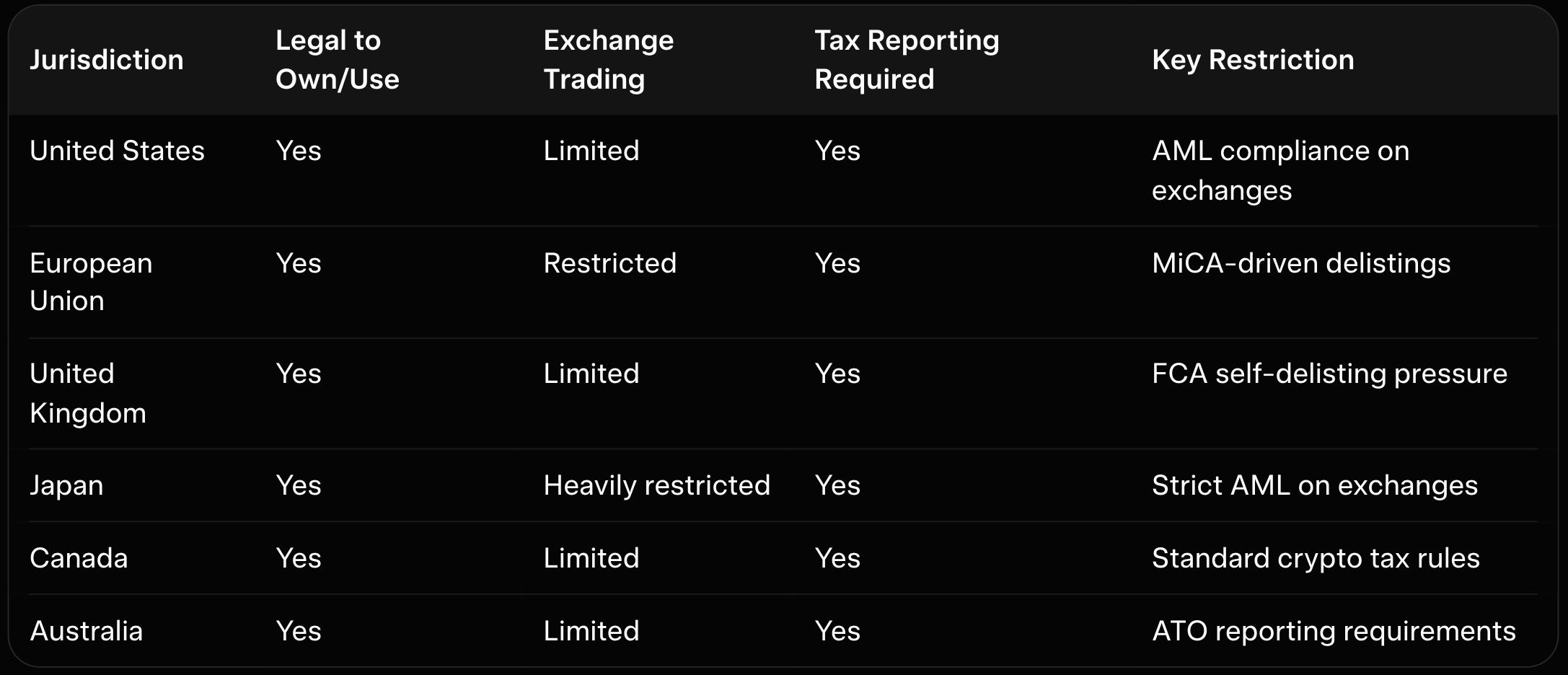
Monero itself is not banned in any major country in 2025. Owning, holding, sending, or receiving XMR remains legal for private individuals in the United States, European Union, United Kingdom, Canada, Australia, Japan, and most other jurisdictions. Regulators focus instead on intermediaries—exchanges and on-ramp services—rather than the coin or its users. The EU’s MiCA regulation has pushed many platforms to delist privacy coins like Monero to simplify compliance, but private use and P2P trading remain unrestricted. In the US, Monero is treated like any other cryptocurrency under existing money transmission and tax laws, with no specific prohibition. As explained in our is-monero-legal-xmr-regulations-mica-compliance, the legal status centers on use rather than possession.
Countries like Japan, South Korea, and parts of India have seen stricter exchange-level restrictions due to AML concerns, but individuals can still hold and use Monero through decentralized means. No jurisdiction has criminalized the software or network itself.
The most visible impact of regulatory pressure in 2025 has been widespread exchange delistings. Major platforms including Binance, Coinbase, Kraken, OKX, and Huobi have removed or restricted Monero trading in various regions to meet AML and KYC requirements. Reports indicate dozens of exchanges took similar action throughout the year. This reduces on-ramp and off-ramp convenience, pushing users toward no-KYC swappers, P2P markets, or decentralized options. Liquidity on remaining platforms has shifted to specialized no-KYC services, where trading volumes remain robust despite the delistings. As explained in our best-no-kyc-monero-xmr-swappers-2026 and top-centralized-exchanges-trade-monero-xmr-2026, delistings have not killed demand—on-chain activity has stayed strong as users adapt to decentralized alternatives.
Users must still comply with local tax laws when using Monero. Gains from buying, selling, or using XMR are taxable in most countries, including the US (as capital gains or ordinary income depending on use) and the EU (under MiCA reporting rules for certain transactions). Privacy does not exempt reporting obligations—users are responsible for accurate records even if transactions are unlinkable on-chain. Businesses accepting Monero may face additional AML compliance burdens in regulated jurisdictions. As explained in our is-monero-legal-xmr-regulations-mica-compliance, privacy coins do not create a tax-free zone; they simply make tracing harder for authorities.
Here is the jurisdiction comparison table:
Here is a compliance and limits context table (2025 averages):
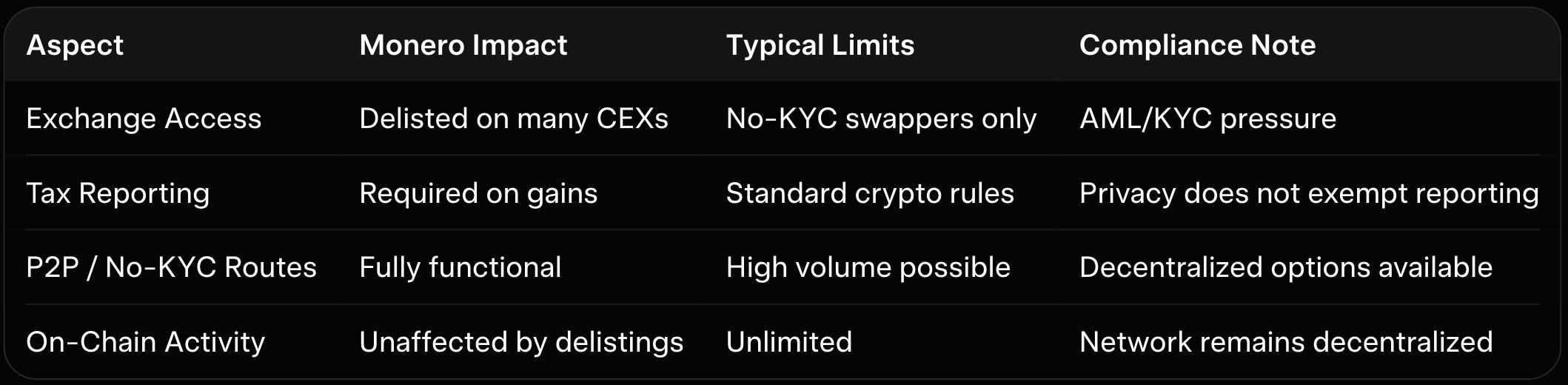
Some jurisdictions have imposed indirect restrictions through exchange rules or banking policies, but no country has banned Monero ownership or private use in 2025. The focus remains on preventing anonymity from being used for illicit activity, leading to delistings rather than outright prohibition. Operational challenges for users include finding reliable no-KYC on-ramps and managing tax records without on-chain traceability. As explained in our is-monero-legal-xmr-regulations-mica-compliance and monero-vs-zcash-vs-dash-privacy-coins-2026, these restrictions have not stopped Monero’s network growth but have shifted activity to decentralized channels.
Exchange delistings have made direct CEX trading harder for Monero users, but baltex.io enables practical XMR swaps and cross-chain liquidity by scanning multiple no-KYC routes and liquidity sources internally. Private Swap mode inserts shielded Monero hops that fully break on-chain links using ring signatures and stealth addresses before delivering clean assets on destination chains. Settlements complete in 8–35 minutes even for cross-chain pairs, fees stay low at ~0.4–0.8%, and there are virtually no limits. Supporting over 10,000 tokens across 200+ networks without manual bridging, baltex.io delivers true one-click optimization for Monero users despite centralized exchange restrictions.
Users swapping XMR to USDT, SOL, or Ethereum L2s benefit enormously—especially when pairing with tools covered in our no-kyc-crypto-swaps-usdt-to-xmr-privately and best-no-kyc-monero-xmr-swappers-2026. Use P2P or atomic swaps for pure privacy and switch to baltex.io when speed and liquidity are needed without KYC.
Monero remains legal to own and use in virtually every major jurisdiction in 2025, with restrictions focused on exchanges rather than individuals. Delistings have reduced centralized access, but the network stays strong through no-KYC swappers, P2P markets, and decentralized tools. Tax obligations apply everywhere, and privacy does not exempt reporting. Understanding these realities helps users navigate the landscape safely. Tools like baltex.io make cross-chain liquidity practical without relying on restricted exchanges.
Always consult local tax advisors and use fresh addresses for privacy. Explore more strategies in our is-monero-legal-xmr-regulations-mica-compliance, best-no-kyc-monero-xmr-swappers-2026, and how-to-buy-monero-xmr-with-fiat-2026-onramps guides to stay compliant and private.

G. Khan
 Ecosystem
G. Khan
Ecosystem
G. Khan
Ecosystem
G. Khan
Ecosystem
G. Khan
Ecosystem
G. Khan
Ecosystem
