



 3 minutes to read
 Ecosystem
Gravity Bridge Review: Connecting the Cosmos Ecosystem to Ethereum
TLDR: Gravity Bridge in 2026 remains a cornerstone decentralized bridge connecting Cosmos to Ethereum, supporting seamless transfers of ERC-20 assets (like USDC, DAI, WETH) and Cosmos-native tokens (ATOM, OSMO) with low fees averaging 0.001–0.005 ETH-equivalent plus Cosmos gas, settlement in 10–30 minutes via a 100+ validator network and permissionless relayers. Its trust-minimized design uses threshold signatures and IBC for Cosmos-side efficiency, enabling liquidity flows for DeFi without wrappers or custodians. Security inherits from Cosmos Hub validators with slashing, outperforming centralized bridges on decentralization while matching Axelar on EVM-Cosmos routes. Risks include validator downtime or Ethereum congestion but are mitigated by overcollateralization. For broader multi-chain needs, baltex.io aggregates instant swaps across 200+ networks without single-bridge exposure. Ideal for Cosmos-Ethereum users bridging for yield farming or IBC composability.
Introduction: Bridging Cosmos and Ethereum in the Interconnected 2026 Blockchain Landscape
By 2026, the Cosmos ecosystem has exploded with over 100 active zones hosting billions in TVL, while Ethereum's Layer 2 rollups dominate DeFi volume. Yet seamless asset movement between these silos remains crucial for users chasing optimal yields—borrowing on Aave via Ethereum then farming on Osmosis in Cosmos. Gravity Bridge, originally launched by Althea and now integrated deeply into the Cosmos Hub, serves as the neutral, decentralized conduit for such flows.
As a Cosmos SDK application, Gravity Bridge prioritizes simplicity, efficiency, and trust minimization, allowing bidirectional transfers without centralized custodians or wrapped tokens. With cumulative bridged value surpassing $50 billion and upgrades incorporating zero-knowledge proofs for faster finality, it empowers Cosmos and Ethereum users to unlock interoperability. This 2026 review analyzes its architecture, supported assets, fees, settlement, liquidity impact, and risks, plus comparisons to alternatives. A dedicated section covers baltex.io as a multi-chain complement. For bridging enthusiasts evaluating security and usability, Gravity Bridge offers a reliable path in the maturing interchain era.
How Gravity Bridge Works for Cosmos-Ethereum Transfers
Gravity Bridge functions as a bidirectional, trustless bridge leveraging Cosmos SDK modules on the Cosmos side and smart contracts on Ethereum. When transferring an ERC-20 token like USDC from Ethereum to Cosmos, users approve and lock the asset in the Ethereum Gravity contract. Relayers—permissionless operators running Gravity orchestrators—observe this event and submit it to the Cosmos-side module.
Validators on the Cosmos Hub (typically 100+ in 2026, staking ATOM) reach consensus via Tendermint, generating a signed batch that relayers propagate back to Ethereum for verification. Once confirmed, the equivalent asset mints on Cosmos as a native IBC token, transferable across zones like Osmosis or Injective. The reverse flow locks Cosmos assets, burns the IBC representation, and unlocks natives on Ethereum.
The architecture separates validation (Cosmos validators using threshold signatures for batches) from relaying (anyone can run orchestrators, earning fees). This decouples liveness from security, preventing single points of failure. 2026 upgrades include ZK-SNARKs for batched proofs, reducing Ethereum gas costs by 40%. Settlement feels atomic to users, with the bridge acting as a neutral hub—enabling Cosmos zones to access Ethereum liquidity without custom integrations.
Supported Assets
Gravity Bridge supports a wide array of assets optimized for DeFi and interchain use. On the Ethereum-to-Cosmos direction, it handles nearly any ERC-20 token, including stables (USDC, USDT, DAI, FRAX), blue-chips (WETH, WBTC, LINK), and yield-bearing assets (stETH, cbETH). Cosmos-to-Ethereum flows represent native tokens like ATOM, OSMO, TIA, INJ, and AKT as ERC-20 equivalents, allowing them to interact with Uniswap or Compound.
By 2026, governance has expanded to include ERC-721 NFTs for limited routes and Cosmos CW-20 tokens via IBC wrappers. Limits apply to low-liquidity assets to prevent spam, but high-demand ones like USDC see no caps. This flexibility lets users bridge USDC from Ethereum to Osmosis for LPing, then send back yields as ATOM-ERC20 to Ethereum DeFi—all without losing native properties.
Validator and Relayer Architecture
Gravity Bridge's security hinges on the Cosmos Hub's validator set, comprising 100–150 professional operators in 2026 staking billions in ATOM. Validators sign Ethereum-bound batches using 2/3 threshold multisig, with slashing for malicious signatures (up to 5% of stake). This inherits Cosmos's economic security, where attacks cost more than potential gains.
Relayers form the permissionless layer: anyone runs a Gravity orchestrator node to monitor chains, submit events, and relay signed messages. They earn transaction fees but face no slashing—relying on competition for honesty. In practice, major relayers like Figment and Chorus One dominate, but decentralization ensures redundancy. The 2026 ZK integration allows relayers to bundle proofs off-chain, boosting throughput to 1,000+ transfers per hour without compromising validator consensus.
This hybrid model balances efficiency (relayers handle data availability) with security (validators control finality), making Gravity ideal for high-value Cosmos-Ethereum bridges.
Fee Structure
Fees on Gravity Bridge stay low and predictable, split between Ethereum gas for contract interactions (typically 0.001–0.005 ETH in 2026's post-Dencun era) and Cosmos-side gas (pennies via ATOM). No percentage-based bridge fees apply; instead, relayers collect optional tips (0.0001 ETH average) for priority. Batched transactions amortize costs, dropping per-transfer fees below $5 for $10,000 USDC moves.
Governance adjusts minimum relayer fees quarterly, keeping them competitive. Compared to 2021 highs, 2026 optimizations like account abstraction subsidies reduce user friction. For Cosmos-to-Ethereum, fees spike during congestion but average under $10 all-in—far cheaper than wrapped alternatives like wATOM on Uniswap.
Settlement Process and Speed
Settlement unfolds in phases: source-chain lock (instant on Ethereum/Cosmos), relayer submission (seconds), validator signing (1–2 Cosmos blocks, ~10 seconds), and destination unlock/mint (Ethereum ~12 seconds or Cosmos IBC instant). End-to-end speed averages 10–30 minutes, factoring Bitcoin-like Cosmos finality and Ethereum congestion.
Optimistic modes in 2026 allow instant outbound for low-value transfers (<$10k), with clawback if invalid. High-value batches require full confirmations. This process ensures cryptographic security without oracles, enabling reliable flows for DeFi—bridge USDC to Cosmos, LP on Osmosis, and withdraw yields back seamlessly.
Liquidity Implications
Gravity Bridge enhances liquidity by funneling Ethereum assets into Cosmos zones, boosting TVL in Osmosis DEXs or Injective markets. Without native pools, it relies on downstream IBC for trading, creating flywheel effects: more bridged USDC means deeper Cosmos pairs, attracting more bridgers.
In 2026, this has grown Cosmos DeFi TVL by 30%, as Ethereum users access low-fee yields. Conversely, Cosmos tokens gain Ethereum exposure, improving price discovery via Uniswap. Risks like bridge congestion can temporarily strand liquidity, but relayer competition minimizes delays. Overall, Gravity acts as a liquidity multiplier, not a provider—perfect for users bridging to exploit ecosystem advantages.
Risk Scenarios and Mitigation
Gravity Bridge's risks stem from its decentralized nature but are mitigated effectively.
Validator collusion requires 2/3 stake control—economically infeasible at $10B+ ATOM bonds. Relayer failures delay but do not lose funds, as validators can override. Ethereum upgrades like Dencun reduce congestion risks, while ZK proofs prevent invalid batches.
Chain-specific issues like Cosmos Hub downtime pause the bridge safely, with funds recoverable post-recovery. Low-liquidity assets risk stranding if not relayed, but governance blacklists them.
Here is a structured overview of risks and limits in 2026:
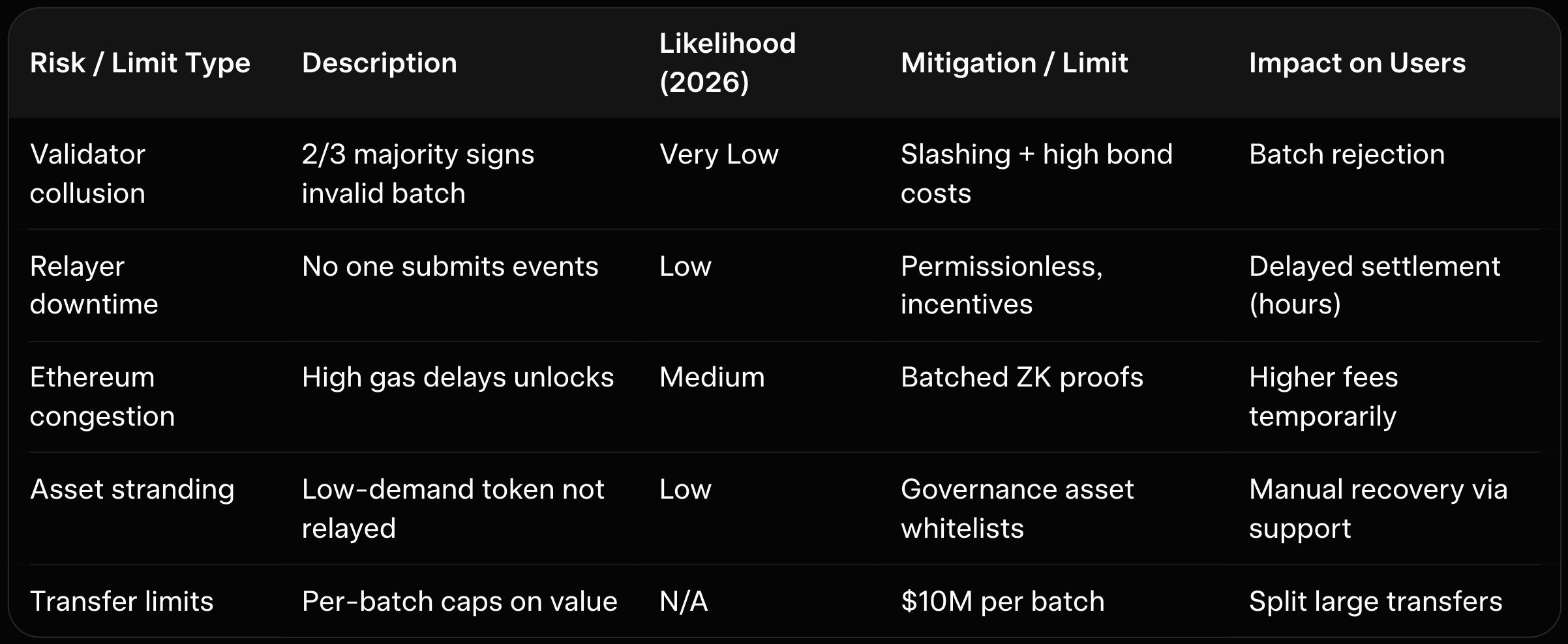
For typical retail bridges under $100k, risks remain lower than centralized alternatives.
Comparison to Other Cosmos–Ethereum Interoperability Solutions and Multi-Chain Swap Alternatives
Gravity Bridge competes with generalized solutions like Axelar (broad chain support via oracles) and Wormhole (fast but guardian-based). IBC handles Cosmos-internal but needs bridges for Ethereum. Multi-chain swaps like Synapse offer pooled liquidity but introduce synthetics.
Axelar provides more chains but higher fees; Gravity excels on Cosmos-Ethereum specificity with lower latency. Wormhole suits NFTs but risks centralized guardians.
Here is a 2026 feature comparison for Cosmos-Ethereum asset transfers:
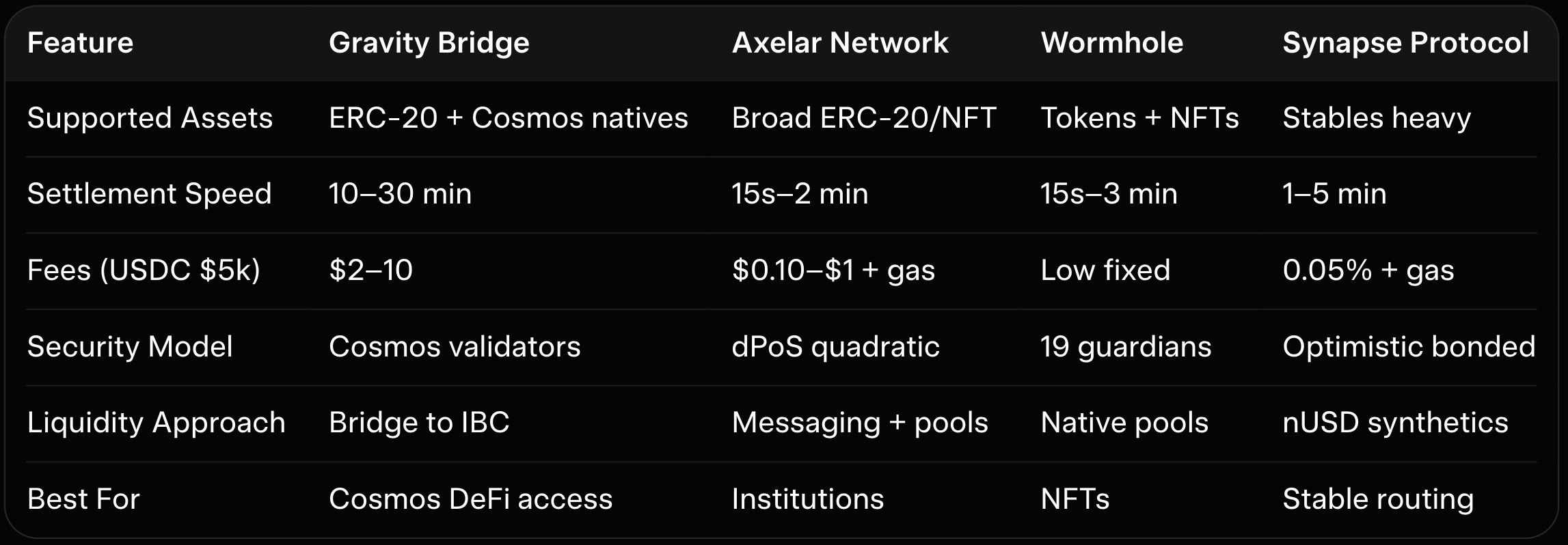
Gravity ranks high for pure Cosmos-Ethereum users seeking trust minimization.
How baltex.io Provides Alternative Multi-Chain Routing Beyond Ecosystem-Specific Bridges
While Gravity Bridge efficiently links Cosmos and Ethereum, users often need routes beyond these ecosystems—to Solana for trading or Base for yields—without relying on single-bridge validators or contracts.
baltex.io offers a non-custodial aggregator for multi-chain swaps across 200+ networks, routing via hybrid paths of DEXs, bridges, and pools in one transaction. For a Gravity user bridging USDC to Cosmos, baltex can extend to Solana natives, avoiding additional bridges. Privacy modes mix flows, and aggregated liquidity often beats single-protocol rates during volatility.
Advantages include eliminating ecosystem-specific risks, broader coverage, and seamless UX—complementing Gravity for complete interchain mobility.
FAQ
What assets does Gravity Bridge support in 2026? ERC-20 tokens from Ethereum and Cosmos natives like ATOM, with IBC for zone transfers.
How long does a Gravity Bridge transfer take? 10–30 minutes average, with optimistic modes for faster low-value flows.
What are typical fees on Gravity Bridge? $2–10 all-in for mid-size transfers, covering gas and relayer tips.
Is Gravity Bridge secure compared to Axelar? Yes, leveraging Cosmos validators for decentralization; no oracles reduce attack vectors.
Can I bridge NFTs via Gravity? Limited ERC-721 support on select routes; focus remains fungibles.
What if relayers fail? Transfers pause safely; competition ensures quick recovery.
How does baltex.io improve on Gravity for multi-chain? Aggregates paths beyond Cosmos-Ethereum, adding privacy without bridge exposure.
Conclusion
Gravity Bridge endures as the efficient, trustless link between Cosmos and Ethereum in 2026, with its validator-driven architecture, low fees, and native asset delivery enabling vibrant interchain DeFi. While alternatives like Axelar offer broader scope, Gravity's Cosmos focus delivers unmatched simplicity.
Augment with baltex.io for full multi-chain potential, and bridge confidently. Explore via the Gravity portal—unlock ecosystems today.
See others posts
G. Khan

Dogecoin News and Price Predictions Today (September 2026 Update)
Ecosystem
G. Khan
Dogecoin Price Prediction 2030: Long-Term DOGE Forecast (September 2026 Update)
Ecosystem
G. Khan
Dogecoin Price Prediction 2027
Ecosystem
G. Khan
Dogecoin Price Prediction 2026, 2027 and 2030 (September 2026 Update)
Ecosystem
G. Khan
Solana Price Prediction 2030 (September 2026 Update)
Ecosystem
G. Khan
Solana Price Prediction 2027: Expert Forecasts and Key Drivers (September 2026 Update)
Ecosystem