



 2 minutes to read
 Ecosystem
P2P Monero Trading: How to Buy XMR Without an Exchange in 2026
TLDR P2P Monero trading in 2026 lets you buy XMR directly from other users using escrow-protected platforms, cash-in-person meets, or privacy-preserving online payments, bypassing centralized exchanges entirely. Methods include Bisq-style decentralized apps, Telegram/Discord groups with escrow, and no-KYC P2P marketplaces. Fees are near-zero or 0.5–1% (much lower than CEX spreads), speed ranges from minutes to hours, limits are flexible (often unlimited for trusted traders), and risks center on counterparty reliability (mitigated by escrow). Privacy is maximized because no KYC ties your identity to holdings. For faster non-custodial XMR swaps without relying on P2P counterparties, baltex.io enables shielded routing—see our best no-KYC Monero swappers in 2026 and private USDT to XMR exchange guides. Overall, P2P remains the most private and flexible way to acquire XMR in 2026 when exchanges are restricted.
Monero (XMR) is prized in 2026 for its mandatory privacy features—ring signatures, stealth addresses, and RingCT—that make every transaction unlinkable and untraceable. Yet centralized exchanges have largely delisted it due to AML and regulatory pressure, pushing privacy-focused users toward peer-to-peer (P2P) trading. P2P lets you buy XMR directly from other individuals using escrow protection, cash, or privacy-preserving payment methods, with no KYC or identity linkage. This guide explains how P2P Monero trading works in 2026, compares the main methods by fees, speed, limits, and risks, and shows how to execute safe trades while preserving Monero’s core anonymity.
How P2P Monero Trading Works
P2P trading connects buyers and sellers directly, with an escrow service holding the XMR until payment is confirmed. In 2026, decentralized protocols and privacy-focused communities handle most volume. The buyer selects a seller, agrees on price and payment method, deposits fiat or crypto into escrow (or meets in person for cash), and the seller releases XMR once payment clears. Escrow protects both parties: the buyer gets XMR or a refund, and the seller gets paid or keeps the coins. Pricing often includes a 1–5% premium over spot due to privacy and convenience.
Popular P2P Methods and Platforms
Decentralized apps like Bisq allow fully non-custodial trades using multisig escrow and onion routing for anonymity. Users trade fiat for XMR via bank transfer, cash-by-mail, or gift cards, with no central authority holding funds. Telegram and Discord groups with trusted escrow bots handle high volume for cash-in-person or online transfers. Some specialized no-KYC marketplaces focus exclusively on privacy coins. As explained in our top P2P Monero exchanges for 2026 and guide to buying XMR with fiat on-ramps, these methods require more user effort but deliver maximum privacy and flexible limits. Also, check our P2P crypto trading platforms comparison for a broader view of the market.
Payment Methods and Verification Risks
P2P buyers use cash in person, bank transfers, gift cards, or privacy coins like USDT on privacy-focused networks. Cash meets offer the highest privacy but require safety precautions. Online payments via privacy-preserving apps or mixers reduce traceability. Verification risks are low when using escrow and avoiding platforms that demand ID. As explained in our Monero legal status and MiCA compliance overview, P2P avoids the KYC that defeats Monero’s purpose.
Here is the P2P platform comparison table:
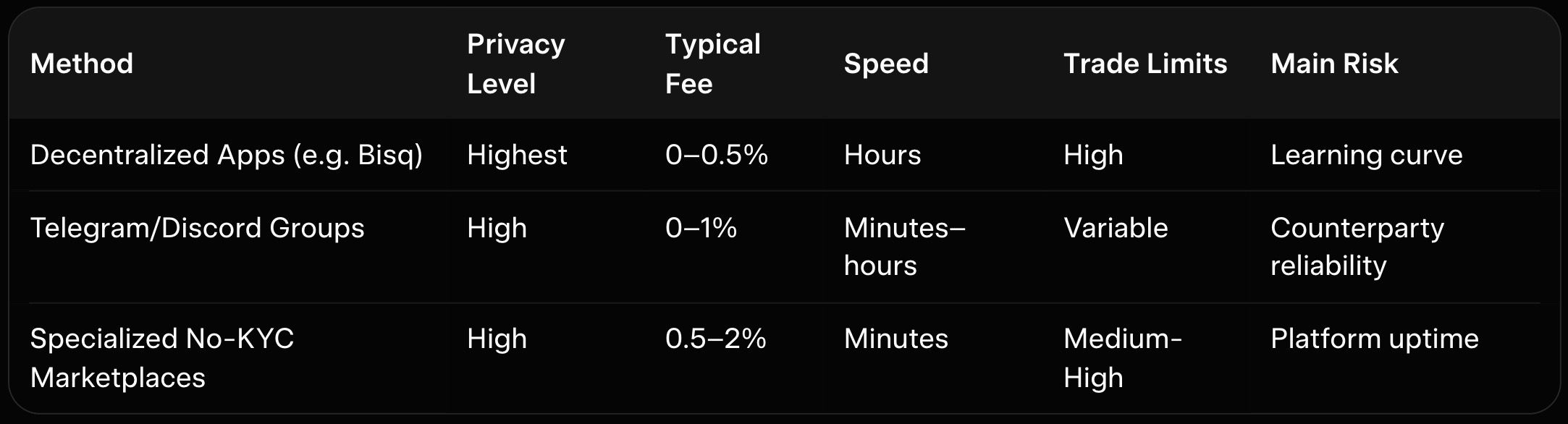
Here is a fees and limits context table (2026 averages for 1 BTC equivalent to XMR):

Operational Security and Best Practices
Successful P2P trading requires strong security habits. Use hardware wallets, fresh Monero subaddresses for every trade, and Tor or VPN for communication. Verify escrow rules before trading, start with small test amounts, and meet in public for cash deals. As explained in our Monero swapper privacy best practices, these practices minimize risks while preserving privacy.
How baltex.io Enables Faster Non-Custodial XMR Swaps
P2P trading offers unmatched privacy but can be slow and require finding counterparties. baltex.io enables faster non-custodial XMR swaps by scanning multiple no-KYC routes and liquidity sources internally and executing the optimal path in one seamless wallet-to-wallet transaction. Private Swap mode inserts shielded Monero hops that fully break on-chain links using ring signatures and stealth addresses before delivering clean assets on destination chains. Settlements complete in 8–35 minutes even for cross-chain pairs, fees stay low at ~0.4–0.8%, and there are virtually no limits. Supporting over 10,000 tokens across 200+ networks without manual bridging, baltex.io delivers true one-click optimization while remaining fully non-custodial.
Use P2P for cash deals and switch to baltex.io when speed and liquidity are needed without counterparties.
Conclusion
P2P Monero trading in 2026 is the most private and flexible way to buy XMR without centralized exchanges. Escrow mechanics, diverse payment methods, and no-KYC platforms make it accessible despite regulatory pressure. While fees are low and limits flexible, operational security is essential. Tools like baltex.io complement P2P by providing faster non-custodial swaps when you need speed.
Always use escrow, start small, and verify counterparties.
Is P2P trading safe for buying Monero? 
What payment methods work for P2P Monero trades?
How do P2P fees compare to exchanges?
Is baltex.io a good alternative to P2P?
See others posts
G. Khan

Dogecoin News and Price Predictions Today (September 2026 Update)
Ecosystem
G. Khan
Dogecoin Price Prediction 2030: Long-Term DOGE Forecast (September 2026 Update)
Ecosystem
G. Khan
Dogecoin Price Prediction 2027
Ecosystem
G. Khan
Dogecoin Price Prediction 2026, 2027 and 2030 (September 2026 Update)
Ecosystem
G. Khan
Solana Price Prediction 2030 (September 2026 Update)
Ecosystem
G. Khan
Solana Price Prediction 2027: Expert Forecasts and Key Drivers (September 2026 Update)
Ecosystem