



 2 minutes to read
 Ecosystem
Stargate Finance Review: How to Swap Native Assets Across Chains
TLDR Stargate Finance powers native asset swaps across 80+ chains in 2026 through unified liquidity pools and the LayerZero messaging layer. Users send USDC, USDT, ETH, BTC or OFTs on the source chain and receive the exact native equivalent on the destination in seconds with instant finality, no wrapping, and fees around 0.06 % plus gas. Deep pooled liquidity keeps slippage minimal on stablecoin and blue-chip routes while the Delta Algorithm automatically balances capital. Compared with intent-based rivals like deBridge or Across, Stargate excels in chain coverage and predictable execution for everyday DeFi flows. When paired with aggregators such as baltex.io, users gain even broader routing options and privacy features. With $128 M+ TVL, $300 M+ daily volume, and a clean security record, Stargate remains a cornerstone infrastructure for cross-chain native asset movement.
Why Stargate Finance Matters for Native Asset Swaps in 2026
By February 2026 the DeFi landscape has fully embraced multi-chain strategies. Yield farmers chase the best APYs on Base one day and move treasury USDT to Solana the next. Traditional bridges that mint wrapped tokens or force users through fragmented pools create friction, depeg risk, and hidden slippage. Stargate Finance solves this by letting anyone swap native assets in a single transaction while tapping into a shared liquidity layer that spans dozens of ecosystems. The protocol’s focus on true native delivery—no synthetic versions, no extra approval steps—makes it the go-to choice for traders who value capital efficiency and simplicity. Whether rebalancing a $50 k stablecoin position or moving ETH between L2s, Stargate delivers the speed and reliability that power users demand in a mature cross-chain world.
How Stargate Finance Works
Stargate operates as a composable liquidity transport protocol built directly on LayerZero. When you initiate a swap—say 10 000 USDC from Ethereum to Arbitrum—the protocol deposits your input into the USDC liquidity pool on the source chain. A LayerZero message instantly notifies the destination chain, where the equivalent amount is released from the local USDC pool as native USDC. The entire process feels like a same-chain DEX trade but across networks.
The magic lies in the unified liquidity model. Instead of isolated per-chain pools that fragment capital, Stargate maintains one logical pool per asset distributed across all supported networks. Liquidity providers deposit into any chain’s pool and earn fees from transfers that touch that asset globally. This design eliminates the need for users to hunt for sufficient liquidity on both sides of a route. The Delta Algorithm continuously monitors pool balances and dynamically adjusts incentives—boosting yields on under-supplied chains or applying equilibrium fees on imbalanced routes—to keep liquidity evenly distributed without manual intervention.
Because LayerZero provides instant guaranteed finality, the destination assets arrive the moment the source transaction confirms on most routes. No waiting for multi-signature thresholds or challenge periods. The result is a seamless experience where native assets move as freely as they do within a single ecosystem.
Supported Networks in 2026
Stargate connects more than 80 blockchains, giving it one of the broadest coverages among native-asset bridges. Core EVM networks include Ethereum, Arbitrum, Optimism, Base, Polygon, BNB Chain, Avalanche, Scroll, Linea, Mantle, and many newer L2s. Non-EVM support extends to Solana and select high-performance chains through LayerZero’s omnichain capabilities. OFT (Omnichain Fungible Token) standards allow projects to launch tokens that are natively transferable across all these networks without custom bridging logic. This extensive mesh means users can move USDT from Tron-adjacent ecosystems to Base or send BTC representations between Ethereum and Solana in one click, all while receiving the canonical native form on arrival.
Liquidity Pools and Capital Efficiency
Stargate’s unified pools currently hold over $128 million in TVL, with individual blue-chip pools such as USDC on Ethereum exceeding $11 million and ETH pools seeing strong depth across L2s. Daily transfer volume routinely surpasses $300 million, proving the model scales under real demand. Because liquidity is shared, a large swap on one chain benefits from reserves deposited on others. The Delta Algorithm prevents common pool-drain issues by incentivizing LPs to rebalance organically. For stablecoin swaps this translates into consistently tight spreads even on six-figure moves—far better than fragmented alternatives. Liquidity providers earn a share of the 0.06 % base fee plus any equilibrium adjustments, creating sustainable yield without relying on inflationary token rewards.
Fees Breakdown
Stargate keeps fees transparent and competitive. The protocol charges a base fee of approximately 0.06 % on the transferred amount, collected automatically from the input. On top of this, LayerZero network fees (paid in source-chain gas) and occasional equilibrium fees (small dynamic adjustments when a pool is temporarily imbalanced) may apply. For a typical $10 000 USDC transfer between major L2s the all-in cost often lands between $6 and $15, including gas on cheap networks. During normal conditions users see the exact total fee before confirming—no surprise slippage hidden in the quote. On high-liquidity corridors like Base to Arbitrum the effective rate can dip even lower thanks to deep pooled reserves.
Slippage and Execution Quality
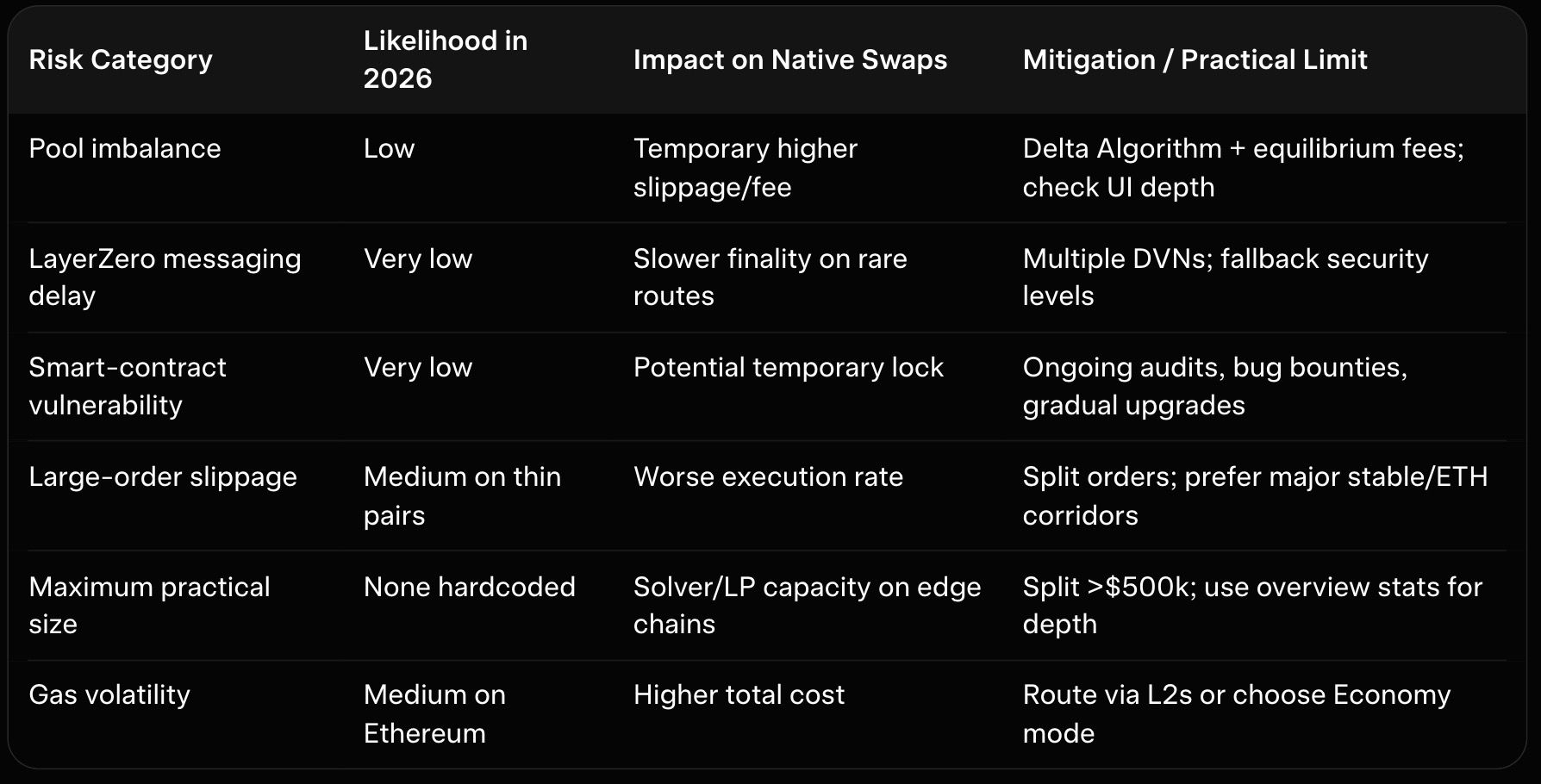
Because of the unified liquidity layer, slippage remains minimal for stablecoins and major assets. Most USDC ↔ USDT or ETH transfers execute at the quoted rate with zero or sub-5 bps deviation even at $100 k size. The Delta Algorithm proactively prevents severe imbalances, and the UI displays real-time pool depth so users can avoid rare edge cases. For exotic OFT pairs or during extreme market events, slippage may appear but is still lower than on single-chain AMMs with thinner liquidity. Advanced users can split large orders or choose “Economy” mode for even tighter economics when speed is not critical.
Settlement Speed and User Experience
Settlement is effectively instant on the vast majority of routes. Once the source transaction lands, LayerZero’s messaging delivers finality within seconds, and the destination pool releases native assets immediately. Real-world tests in early 2026 show Ethereum to Base USDC swaps completing in under 15 seconds, while Solana to Arbitrum routes often finish in under 30 seconds. The bridge interface at stargate.finance offers Simple Transfer (one-click) and Advanced Transfer (custom slippage, recipient address) modes, plus wallet connect for MetaMask, WalletConnect, and hardware options. No extra approvals beyond the initial transfer are required, making the flow feel native to any DeFi dashboard.
Security Architecture
Stargate inherits LayerZero’s battle-tested security stack. Decentralized Verifier Networks (DVNs) and oracles independently verify each cross-chain message, with configurable security levels that applications and users can tune. The protocol has processed billions in volume since 2022 with zero material exploits on the core bridging logic. Smart contracts undergo continuous audits, and the unified pool model avoids the single-point-of-failure risks seen in lock-and-mint designs. Liquidity itself sits in audited pool contracts on each chain, and LPs can withdraw at any time. While no bridge is risk-free, Stargate’s transparent on-chain mechanics and economic alignment between LPs, relayers, and verifiers place it among the most secure options for native asset movement.
Risk Scenarios and Mitigation
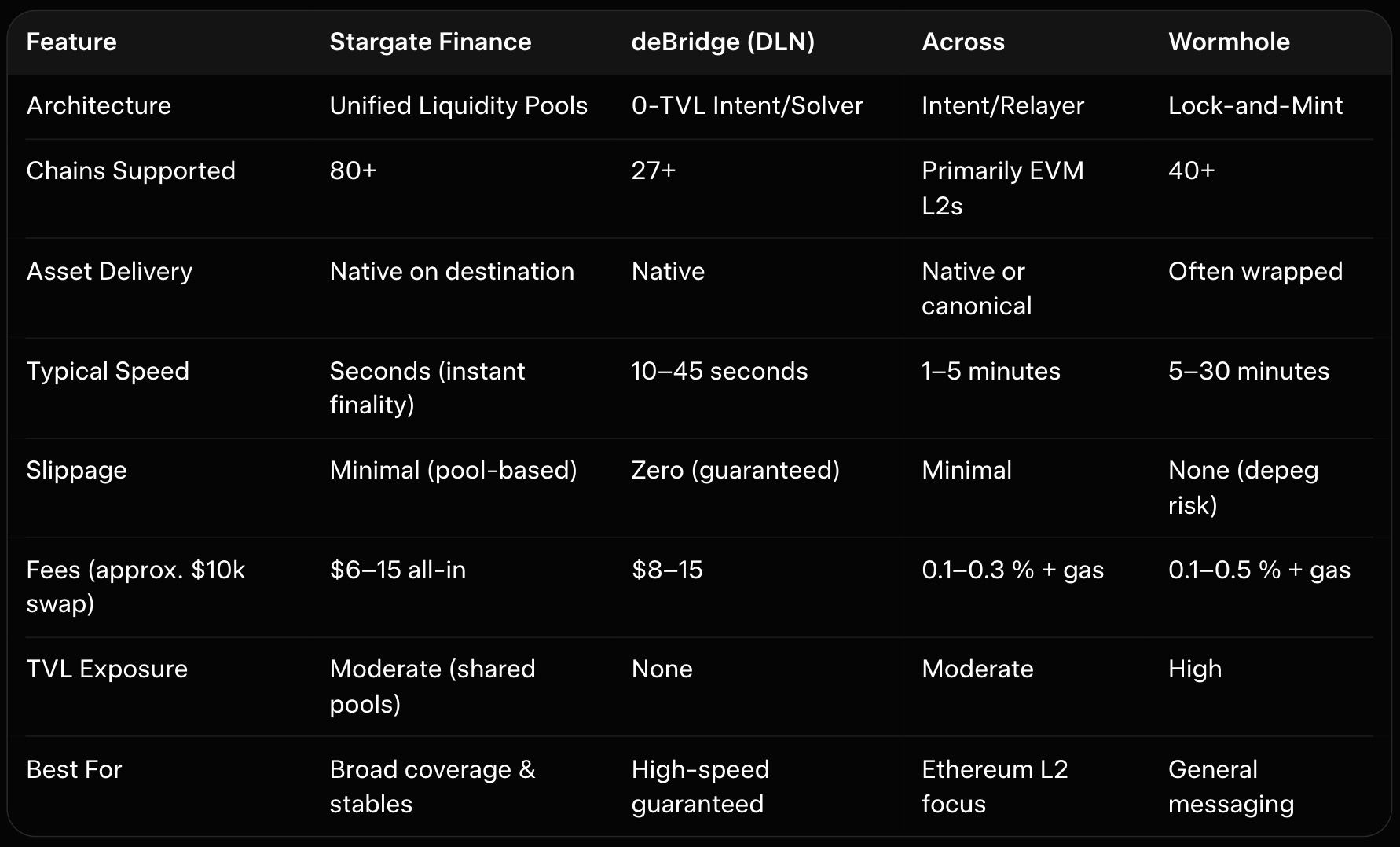
Feature Comparison Table
Risks and Limits Table
How baltex.io Differs from Bridge-Based Swaps and Offers Multi-Chain Routing Alternatives
While Stargate provides the reliable underlying rails for native same-asset transfers, baltex.io functions as a non-custodial aggregator and intelligent router that sits above multiple bridges and DEXes. For users who need more than pure bridge functionality, baltex.io scans Stargate alongside Symbiosis, 1inch cross-chain paths, Curve pools, and other venues to assemble the optimal route for any token pair across 200+ networks.
Key differences versus using Stargate directly:
- Token flexibility — Stargate excels at native USDC to native USDC but does not natively swap USDC for SOL in one transaction; baltex.io handles any-to-any swaps by stitching routes intelligently.
- Privacy and limits — baltex.io emphasizes transaction privacy tools and advertises no artificial caps, whereas pure bridges may surface pool-depth warnings on very large moves.
- Abstraction — One-click interface hides the underlying bridge choice; users simply select input/output and let the engine pick Stargate when it offers the best rate or combine it with another path for superior execution.
- Coverage — baltex.io reaches smaller chains and exotic tokens by combining multiple bridges, extending beyond Stargate’s 80+ mesh when needed.
Many power users therefore treat Stargate as the high-performance engine for core stable and ETH flows while routing through baltex.io for everything else. The two services complement each other perfectly: Stargate supplies deep, native liquidity with instant finality; baltex.io supplies the smart orchestration and privacy layer that makes cross-chain trading effortless at scale.
FAQ
Is Stargate Finance the best bridge for native asset swaps in 2026? For users who prioritize broad chain coverage, native delivery, and instant finality on stablecoins and ETH, yes. Intent-based alternatives may edge it on raw speed for certain pairs, but Stargate wins on reliability and ecosystem integration.
How fast are Stargate transfers? Most complete in seconds with instant finality. Ethereum L2 to L2 routes often finish under 15 seconds; even cross-L1 moves rarely exceed one minute.
Are fees competitive? A $10 000 stablecoin swap typically costs $6–15 total. The 0.06 % base fee plus low gas on L2s makes it cheaper than many alternatives once slippage is factored in.
Is Stargate safe for large transfers? With $128 M+ TVL, years of operation, and LayerZero’s decentralized verification, it is one of the safest pool-based bridges. Standard practice: test small, split large orders, and monitor pool depths via the overview dashboard.
Does baltex.io replace Stargate? No—it enhances it. baltex.io frequently selects Stargate routes internally when they deliver the best outcome and adds multi-path optimization and privacy on top.
Can I integrate Stargate into my dApp? Yes. The protocol offers full composability through LayerZero libraries and widgets, allowing any DeFi application to offer native cross-chain swaps with minimal code.
Conclusion
In 2026, moving native assets across chains is no longer a novelty—it is table stakes for serious DeFi participation. Stargate Finance has solidified its position as the liquidity backbone that makes this possible at scale. Its unified pools, Delta balancing, instant finality, and native-asset guarantee deliver an experience that feels like on-chain trading rather than bridging. With 80+ chains, deep stablecoin liquidity, and a proven security model, the protocol handles hundreds of millions in daily volume while keeping fees low and execution predictable.
When combined with user-friendly aggregators such as baltex.io, the workflow becomes truly seamless: route major stable and ETH positions directly through Stargate for optimal depth, then let baltex.io handle everything else with privacy and any-to-any flexibility. Whether you are a retail yield optimizer, a treasury manager rebalancing reserves, or a developer building the next omnichain application, Stargate belongs in your core toolkit.
Start at stargate.finance, connect your wallet, and experience native cross-chain swaps the way they were meant to be—fast, cheap, and delightfully simple. In a multi-chain future, Stargate is the bridge that just works.
See others posts
G. Khan

Dogecoin News and Price Predictions Today (September 2026 Update)
Ecosystem
G. Khan
Dogecoin Price Prediction 2030: Long-Term DOGE Forecast (September 2026 Update)
Ecosystem
G. Khan
Dogecoin Price Prediction 2027
Ecosystem
G. Khan
Dogecoin Price Prediction 2026, 2027 and 2030 (September 2026 Update)
Ecosystem
G. Khan
Solana Price Prediction 2030 (September 2026 Update)
Ecosystem
G. Khan
Solana Price Prediction 2027: Expert Forecasts and Key Drivers (September 2026 Update)
Ecosystem