



 2 minutes to read
 Ecosystem
Synapse Protocol Review: A Deep Dive into Cross-Chain Liquidity
TLDR:
Synapse Protocol in 2026 powers near-instant (1–5 minute) cross-chain transfers across 20+ EVM and non-EVM networks including Ethereum, Arbitrum, Optimism, Base, Solana, Avalanche, and Polygon, primarily through deep nUSD/nETH liquidity pools that deliver native assets with minimal slippage and fees averaging 0.05% (often 80% cheaper than rivals). Its optimistic validator model with bonded Notaries, Guards, and Executors provides strong economic security while inheriting Ethereum-level finality. Settlement feels like a DEX swap thanks to pooled liquidity, making it ideal for stablecoin-heavy DeFi flows. Compared to Hop’s L2 focus or Across’s intent model, Synapse shines on broader chain coverage and stablecoin routing depth. Risks stay low but include pool imbalance or validator challenges during extreme events. For users routing beyond traditional bridges to 200+ chains with privacy options, baltex.io aggregates instant native swaps without dedicated pool or messaging contracts. Perfect for cross-chain traders chasing yields or arbitraging across ecosystems.
Introduction: The Cross-Chain Liquidity Imperative in 2026 DeFi
By 2026, decentralized finance spans dozens of high-performance chains, each offering unique opportunities—high-throughput trading on Solana, low-cost lending on Base, or specialized yield on Berachain. Yet fragmentation remains the biggest friction point. Moving capital from Ethereum mainnet to Arbitrum for better farming rates, or from Polygon to Avalanche during a token launch, still forces users into slow official bridges, expensive CEX routes, or risky new protocols.
Synapse Protocol has emerged as the leading liquidity-first solution precisely because it treats cross-chain movement as a seamless swap rather than a cumbersome bridge. Built around unified liquidity pools and synthetic nexus assets, it enables users to send native tokens on the destination chain in minutes, not hours or days. With over $50 billion in cumulative volume processed and millions of users, Synapse powers everything from retail rebalancing to institutional treasury flows.
This in-depth 2026 review examines exactly how Synapse delivers its speed, cost efficiency, and security. We cover supported networks, pool mechanics, fee transparency, settlement flow, the optimistic validator system, realistic risks, and head-to-head comparisons with leading alternatives. A dedicated section highlights why baltex.io serves as the natural next step for truly multi-chain routing. Whether you arbitrage stable yields across L2s or move capital to Solana for memecoin launches, understanding Synapse will help you navigate the interconnected DeFi landscape with confidence.
How Synapse Protocol Works for Cross-Chain Transfers
Synapse combines two complementary bridging methods—liquidity-pool routing and canonical token bridging—under a single intuitive interface, with CCTP (Circle Cross-Chain Transfer Protocol) native routing for USDC adding even more efficiency.
The flagship experience uses liquidity pools. Suppose you want to move 50,000 USDC from Ethereum to Arbitrum. Your wallet sends canonical USDC to the Synapse bridge contract on Ethereum. The protocol instantly swaps it for an equivalent amount of nUSD (nexus USD) within the local pool. This nUSD then travels across the Synapse messaging layer to Arbitrum, where the destination pool swaps it back into native USDC and sends it directly to your address. The entire user-facing process completes in 1–5 minutes with no wrapped tokens left behind.
nUSD and its counterpart nETH serve as the unifying interchain stablecoins. Fully backed 1:1 by collateral held in Ethereum mainnet pools (a basket of USDC, USDT, DAI for nUSD; staked and native ETH for nETH), these synthetics allow deep, shared liquidity across all connected chains. Liquidity providers deposit into these pools on every supported chain and earn fees from both local swaps and cross-chain rebalancing activity.
When liquidity becomes imbalanced—say, more capital flowing out of Optimism than into it—the AMM pricing adjusts automatically, incentivizing arbitrageurs and Bonders (professional liquidity operators) to restore equilibrium. This flywheel keeps pools healthy and slippage negligible even on six-figure transfers.
For assets not covered by nUSD/nETH pools, Synapse falls back to canonical bridging: lock the native token on the source, mint a wrapped xAsset representation on the destination, and let users unwrap or swap via integrated DEXs. CCTP routes deliver true native USDC without any synthetic layer for maximum compatibility with protocols that require Circle-issued tokens.
The messaging layer underneath uses an optimistic verification design, ensuring fast execution while maintaining strong security guarantees. Developers can also tap the Synapse SDK for custom cross-chain smart-contract calls, enabling truly native multi-chain applications such as unified lending positions or cross-chain perpetuals.
Supported Networks and Liquidity Depth
Synapse connects more than 20 chains in 2026, spanning major EVM ecosystems and select non-EVM destinations. Core networks include Ethereum mainnet, all major Layer 2s (Arbitrum, Optimism, Base, Blast, Scroll, Linea), Polygon, Avalanche, BNB Chain, Fantom, Metis, and newer high-performance chains like Berachain, World Chain, and HyperEVM. Dedicated Solana integration stands out, allowing seamless EVM-to-Solana and back transfers that many competitors still struggle with.
Supported assets focus heavily on high-liquidity stables and blue-chips: USDC (native via CCTP), USDT, DAI, ETH/WETH, and nUSD/nETH themselves, plus popular tokens such as FRAX, agEUR, LINK, WBTC, and chain-specific gems. New assets are added rapidly through governance and liquidity incentives.
Liquidity depth ranks among the strongest in the industry for stablecoin routes. Individual pools routinely hold tens of millions in TVL per chain, with aggregate stable liquidity exceeding $100 million across the network. This depth translates to sub-0.1% slippage on $100,000+ USDC transfers under normal conditions—far better than thinner messaging-only bridges. During peak volatility, dynamic fees and LP incentives keep pools resilient, while professional liquidity managers rebalance capital efficiently.
Fee Structure and Cost Efficiency
Synapse built its reputation on ultra-competitive pricing. The protocol charges a transparent bridge fee—typically 0.05% for most stablecoin routes, occasionally ranging 0.04–0.15% depending on asset volatility, current pool balance, and destination congestion. Gas costs on source and destination remain standard L2 or L1 fees (pennies on Optimism/Arbitrum), with the protocol often subsidizing or optimizing destination execution.
No hidden destination fees apply, and slippage stays minimal thanks to deep pools. Users can preview exact quotes including slippage tolerance before confirming. Compared to routing through centralized exchanges or slower canonical bridges, Synapse routinely saves users 50–80% on total costs.
Here is a representative overview of fees and limits for popular 2026 routes (live quotes always recommended as conditions fluctuate):
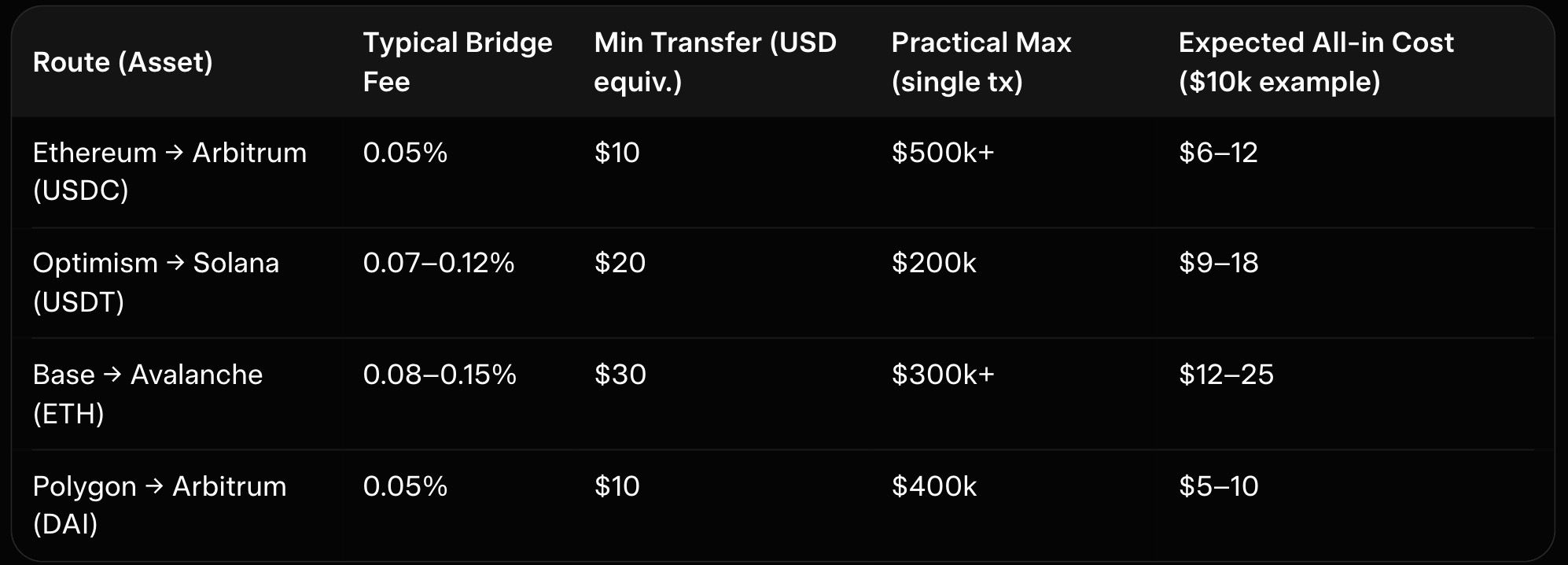
These figures position Synapse among the cheapest options for high-frequency or large-volume cross-chain moves, especially stables.
Settlement Mechanics and Speed
Settlement speed defines Synapse’s user experience. Liquidity-pool routes deliver funds in 1–5 minutes on average, with 95% of transactions completing under 10 minutes even during moderate congestion. The process feels instantaneous because the destination pool fronts the liquidity immediately upon receiving the verified nUSD message.
Underlying message finality follows the optimistic model: messages are assumed valid unless challenged during a short dispute window, after which they become cryptographically settled. Users never wait for this window—liquidity providers absorb the timing risk in exchange for fees. Canonical and CCTP routes may take slightly longer (5–15 minutes) but still far outperform official rollup withdrawals.
This speed enables real-time strategies such as moving capital to the highest-yielding money market or arbitraging price discrepancies the moment they appear across chains.
Validator Model and Security Architecture
Synapse employs a robust optimistic security model powered by a decentralized network of bonded actors: Notaries propose message states, Guards monitor for fraud and submit challenges, and Executors finalize valid messages. These actors stake significant collateral (including SYN tokens) and face slashing for malicious behavior, aligning incentives perfectly with honest operation.
The system requires only 2/3 honest participation for liveness, while economic security ensures that challenging fraudulent messages remains profitable. All critical contracts undergo multiple independent audits, with ongoing bug bounties and gradual rollout of upgrades via the Synapse DAO.
Security ultimately rests on Ethereum mainnet for nUSD/nETH collateral and the underlying chains’ finality. Even in a theoretical total validator outage, funds remain safe in source contracts and can exit through slower canonical paths. The protocol’s $50B+ settled volume with zero major exploits since early incidents demonstrates the model’s resilience in production.
Risk Scenarios and Mitigation Strategies
Every cross-chain protocol carries residual risks that informed users should understand. Pool imbalance during extreme market events could temporarily increase slippage; however, deep TVL and automated incentives have historically resolved such episodes within hours. Validator collusion remains theoretically possible but economically prohibitive given bonded capital far exceeding typical message values.
Smart-contract vulnerabilities present the standard DeFi risk, mitigated through layered audits, formal verification on core components, and the optimistic challenge mechanism that provides an extra safety net. Non-EVM routes like Solana introduce additional bridge complexity, yet Synapse’s dedicated integration has proven reliable.
Liquidity providers face impermanent loss typical of stable-swap AMMs, but yields from bridging fees often more than compensate. For retail users moving under $100k, overall risk remains materially lower than using centralized custodians or unproven bridges. Large holders can split transfers or monitor pool health via the dashboard.
Comparison to Alternative Bridge and Routing Solutions
Synapse competes in a crowded field but consistently differentiates through stable-focused liquidity depth and broad chain support.
Hop Protocol excels at pure Ethereum L2-to-L2 moves with its bonder model but offers narrower coverage and slightly higher fees on non-stable routes. Across Protocol delivers excellent intent-based pricing and often the absolute lowest costs for certain L2 pairs, yet its relayer network can show variability during spikes. Stargate (LayerZero) provides massive native-asset liquidity across 50+ chains but charges marginally higher fees and lacks Synapse’s nUSD efficiency for stables. Wormhole and Axelar shine for generalized messaging and NFT support but sacrifice the instant pooled liquidity experience.
Here is a direct feature comparison for typical stablecoin transfers in 2026:
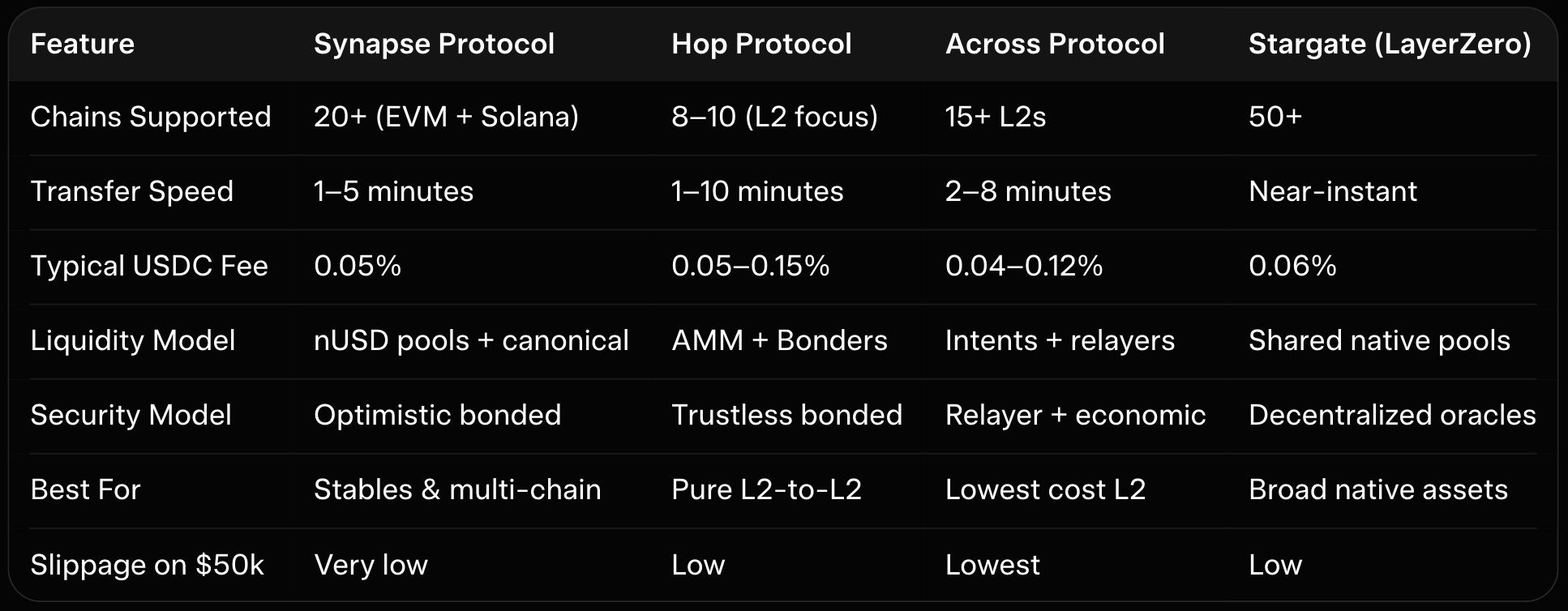
Synapse frequently wins for users whose workflows span beyond Ethereum L2s or who prioritize stablecoin efficiency and Solana connectivity.
How baltex.io Offers Multi-Chain Routing Alternatives Beyond Traditional Liquidity Bridges
While Synapse and similar protocols excel within their pooled or messaging frameworks, many DeFi participants eventually need to move assets to chains or in patterns that traditional bridges cannot optimize—high-frequency Solana trading pairs, privacy-focused routes, or hybrid CEX/DEX liquidity during volatility.
baltex.io addresses exactly these gaps as a non-custodial cross-chain swap aggregator supporting over 10,000 tokens across 200+ networks. Rather than forcing every transfer through dedicated bridge contracts and liquidity pools, baltex scans dozens of paths in real time: on-chain DEX liquidity, native messaging protocols, and even aggregated off-chain liquidity where compliant and secure.
A user bridging USDC from Arbitrum to a Solana memecoin launchpad can complete the entire journey in one wallet transaction with native assets delivered—no intermediate wrapped tokens or pool exposure. The platform’s routing engine often combines multiple under-the-hood hops for superior rates, and built-in privacy modes split and mix portions through privacy-preserving chains.
Key advantages include vastly broader coverage (including chains Synapse does not yet support), elimination of single-bridge smart-contract risk, and hybrid liquidity that frequently beats pure on-chain solutions during stressed markets. DeFi power users commonly combine Synapse for core stable flows with baltex.io for final-mile or exotic destinations, creating a complete sovereign routing stack that keeps users in full control of keys while maximizing speed and minimizing costs.
FAQ
How fast are Synapse transfers compared to official bridges? Liquidity-pool routes complete in 1–5 minutes versus hours or the full 7-day challenge periods of canonical L1/L2 bridges.
What makes nUSD different from other synthetic stables? nUSD is fully collateralized on Ethereum and swapped locally on every chain, ensuring native delivery and deep shared liquidity without fragmentation.
Are fees higher during network congestion? Slightly—dynamic components may rise to 0.15%, but Synapse still typically undercuts alternatives. Always preview the exact quote.
Is Synapse safe for large transfers? Yes. Pools handle six- and seven-figure moves daily. For ultra-large amounts, users can split transactions or coordinate with liquidity managers.
What happens if validators are challenged? The optimistic model allows honest messages to proceed quickly while fraudulent ones are slashed and reverted, protecting user funds.
Does Synapse support NFT or contract calls? Yes via the generalized messaging SDK, though the primary bridge UI focuses on fungible tokens.
How does baltex.io compare in total cost for complex routes? baltex.io often matches or beats Synapse on total all-in cost for non-standard paths while adding privacy and eliminating bridge-specific risks.
Conclusion
Synapse Protocol has matured into the definitive cross-chain liquidity hub of 2026, delivering the speed, cost efficiency, and native-asset experience that modern DeFi demands. Its nUSD-centric liquidity pools, optimistic yet economically secured validator model, and expansive 20+ chain support make it the default choice for anyone moving stables or blue-chips across ecosystems.
While specialized alternatives like Hop or Across may edge out on specific L2 corridors, and generalized bridges like Stargate offer broader native coverage, Synapse strikes the optimal balance for most cross-chain traders. Pair it with baltex.io when your needs extend to exotic chains or privacy-first routing, and you unlock truly frictionless capital mobility.
Start with small test transfers, compare live quotes, and experience the difference at the Synapse Bridge. In a multi-chain world where opportunities appear and disappear in minutes, Synapse gives you the liquidity superhighway to seize them—securely, cheaply, and at the speed of DeFi.
See others posts
G. Khan

Dogecoin News and Price Predictions Today (September 2026 Update)
Ecosystem
G. Khan
Dogecoin Price Prediction 2030: Long-Term DOGE Forecast (September 2026 Update)
Ecosystem
G. Khan
Dogecoin Price Prediction 2027
Ecosystem
G. Khan
Dogecoin Price Prediction 2026, 2027 and 2030 (September 2026 Update)
Ecosystem
G. Khan
Solana Price Prediction 2030 (September 2026 Update)
Ecosystem
G. Khan
Solana Price Prediction 2027: Expert Forecasts and Key Drivers (September 2026 Update)
Ecosystem