



 3 minutes to read
 Ecosystem
How to Transfer XMR to External Wallets and Other Exchanges
TLDR: In 2026, transfer XMR safely to external wallets or exchanges by generating a fresh subaddress (starting with 8), using the official Monero GUI/CLI or hardware wallet, paying dynamic low fees (~0.00001–0.0001 XMR), and waiting for the standard 10 confirmations (about 20 minutes). Self-custody transfers offer maximum privacy and zero custody risk, while direct exchange deposits introduce KYC linkage and platform exposure. For added privacy before CEX deposits, route via Baltex.io: send XMR to Baltex, enable Private Swap mode to convert anonymously through Monero rails to BTC/USDT/etc., then forward the output to the exchange—breaking all on-chain links with minimal extra cost and time. Always double-check addresses, start with test amounts under $100, and avoid reusing addresses or ignoring confirmation requirements. This approach minimizes errors, delays, privacy leakage, and risks across all scenarios.
Transferring Monero remains one of the most privacy-preserving actions in cryptocurrency, yet it demands precision because of the coin’s unique address system and confirmation rules. In 2026, with heightened regulatory scrutiny on privacy assets and more exchanges delisting or restricting direct XMR deposits in certain jurisdictions, users must master both direct wallet-to-wallet moves and strategic routing layers to keep funds secure and untraceable. Whether you are moving XMR from a hot wallet to cold storage after a trade, sending to a family member’s self-custody setup, or preparing funds for a centralized exchange withdrawal or deposit, the process follows the same core principles: generate the correct address type, verify every character, understand confirmation timing, and choose the route that best matches your privacy and speed needs. This comprehensive guide explains every technical detail, compares self-custody versus exchange destinations, delivers clear step-by-step flows, highlights common pitfalls, and shows exactly how Baltex.io functions as a powerful intermediary routing layer to enhance privacy before any exchange interaction.
XMR Address Formats and Why They Matter in 2026
Monero addresses come in three practical forms that every user must distinguish. The primary (main) address starts with the number 4 and represents the wallet’s root public key; it is safe to share publicly but should be used sparingly because repeated use on transparent chains or services can create linkage patterns over time. Subaddresses, which begin with 8, are the recommended choice for almost every transfer in 2026. They are one-time or purpose-specific derivations from the same seed that appear completely unrelated on the blockchain to outside observers, preserving Monero’s signature unlinkability. Integrated addresses combine a subaddress with an embedded short payment ID for services that still require one, though most modern platforms and wallets have phased out the need for separate 64-character payment IDs in favor of integrated formats or subaddresses alone.
When receiving XMR, always generate a fresh subaddress rather than reusing an old one. Hardware wallets such as Ledger or Trezor with Monero apps, as well as software options like the official GUI, Cake Wallet, or Feather Wallet, make this effortless with a single click labeled “Generate new subaddress” or “Receive.” For sending to an exchange, the platform will usually provide either a dedicated subaddress or an integrated address specific to your account—never send to a generic address without confirming it belongs to your verified deposit page.
Confirmations, Fees, Timing, and Network Behavior
Monero’s proof-of-work chain produces blocks roughly every two minutes. The network and all major services require a minimum of 10 confirmations before considering a transaction final and creditable. This translates to approximately 20 minutes under normal conditions, though occasional congestion or deliberate delays by the sender’s node can extend it to 30–45 minutes. Once 10 blocks are mined on top of your transaction, the funds become spendable and irreversible.
Transaction fees are dynamic and extremely low compared with most blockchains—typically between 0.00001 XMR and 0.0001 XMR (a few cents at current prices) depending on network load and the priority you select in your wallet. The official GUI and CLI automatically calculate the optimal fee for “normal” or “fast” priority; choosing “fast” adds only a tiny premium but can shave several minutes off inclusion time during busy periods. Timing matters: Monero’s privacy features mean there is no public mempool visible to outsiders, so you cannot track pending transactions on generic explorers until they are mined. Use the built-in wallet history or trusted explorers like exploremonero.com or xmrchain.net (accessed via privacy-preserving browser) to monitor your outgoing transaction hash.
Step-by-Step: Transferring XMR to External Self-Custody Wallets
- Open your source Monero wallet (GUI, CLI, Cake, or hardware-integrated).
- Navigate to the “Receive” or “Addresses” tab and click to generate a new subaddress.
- Copy the full subaddress (it will start with 8) and paste it into a secure note or directly into the sending wallet.
- In your sending wallet, go to “Send,” paste the destination subaddress, enter the exact XMR amount (leave a small buffer for fees if needed), and select normal or fast priority.
- Double-check every character of the address, the amount, and the fee estimate.
- Confirm the transaction and record the transaction hash shown.
- Monitor progress in the source wallet until it shows 10+ confirmations.
- Verify receipt in the destination wallet’s balance and transaction list.
This flow keeps full self-custody throughout and exposes zero additional metadata.
Step-by-Step: Transferring XMR Directly to Centralized Exchanges
- Log into your target exchange account and navigate to the deposit section for XMR.
- Generate or copy the unique deposit address provided (usually a subaddress or integrated address tied to your account).
- Paste this address into your sending Monero wallet’s “Send” field.
- Enter the precise amount you wish to deposit (check the exchange minimum and any displayed memo or payment ID requirement).
- Select appropriate fee priority and confirm the details twice.
- Send the transaction and immediately save the TX hash.
- Return to the exchange deposit page and refresh until it shows the incoming transaction.
- Wait for the exchange to credit the funds after their required confirmations (almost always 10).
Some exchanges in 2026 still display a separate short payment ID or memo field—fill it exactly if present, or use the integrated address that already embeds it.
Common Mistakes That Lead to Lost Funds or Privacy Leaks
Reusing the same address multiple times is the most frequent error; it gradually reduces Monero’s privacy guarantees by allowing statistical linkage. Sending to an incorrect address format—such as pasting a Bitcoin address by mistake—results in permanent loss because Monero transactions are non-recoverable across chains. Ignoring the 10-confirmation rule and spending or trading funds too early on an exchange can cause failed withdrawals or disputes. Underestimating fees during high-priority needs leads to delayed inclusion and frustration. Failing to test with a tiny amount (under $50 equivalent) before a large transfer has stranded significant sums when users discover an exchange’s deposit rules changed or a wallet software glitch occurred. Finally, performing transfers while connected to public Wi-Fi or without a VPN unnecessarily increases metadata leakage that could later be correlated with your IP.
Comparing Transfers to Self-Custody Wallets Versus Exchanges
Sending XMR to a self-custody wallet—whether software on an air-gapped machine or hardware device—delivers the lowest possible risk profile. You retain complete control of private keys, no third party ever sees your balance or transaction history beyond what the blockchain reveals (which is minimal thanks to ring signatures and stealth addresses), and there are no account freezes, KYC requirements, or withdrawal queues. Operational impact is light: the only delay is the 20-minute confirmation window, and fees stay negligible. The downside is that you bear full responsibility for seed backup and device security; losing access means losing funds permanently.
Direct transfers to centralized exchanges shift some operational convenience to the platform (instant crediting after confirmations, easy trading or fiat off-ramps) but introduce substantial new risks. The exchange knows your deposit address is linked to your verified identity, creating a permanent on-chain record that regulators or chain analysts can query. Platform hacks, account locks due to compliance flags, or unexpected delistings have affected users in the past. Custody risk exists for the brief period after crediting until you withdraw again, and operational impact includes potential withdrawal delays, higher minimums, and the need to navigate support tickets if anything goes wrong. In 2026, with many jurisdictions tightening Travel Rule compliance, direct XMR deposits are increasingly scrutinized or limited, making self-custody the clear preference for privacy-conscious holders and routed methods the smarter path when exchange access is required.
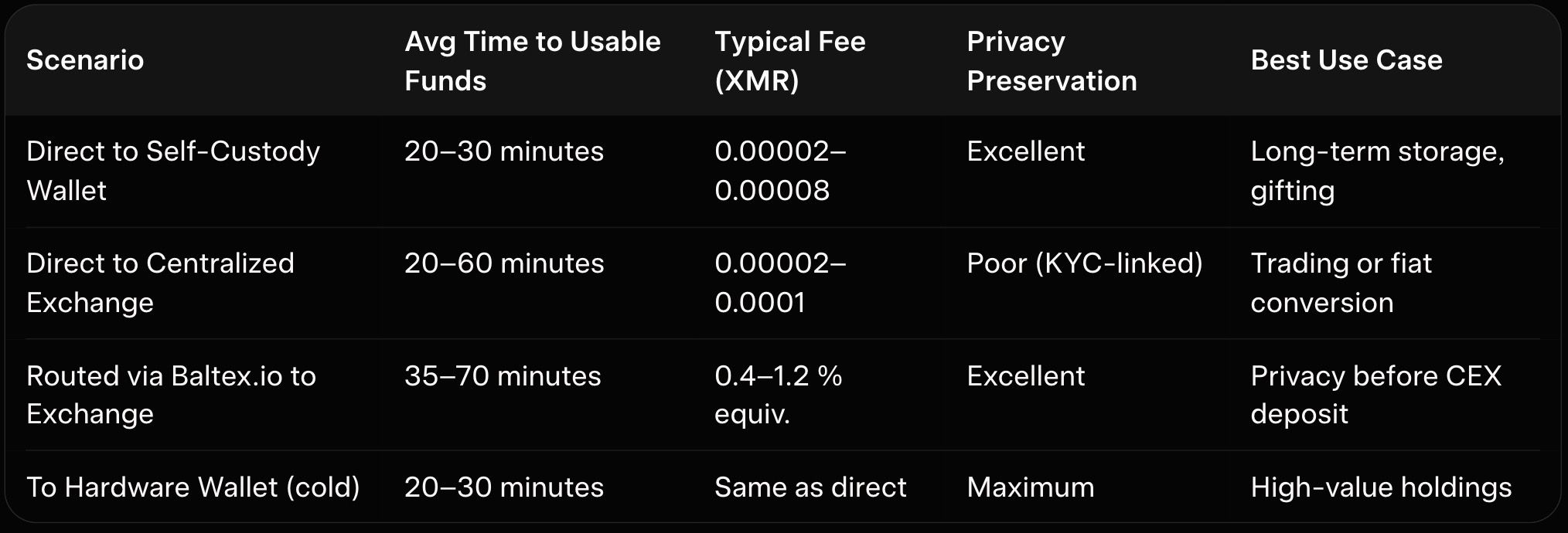
Transfer Scenarios Table (Typical February 2026 Conditions)
Risks and Limits Table
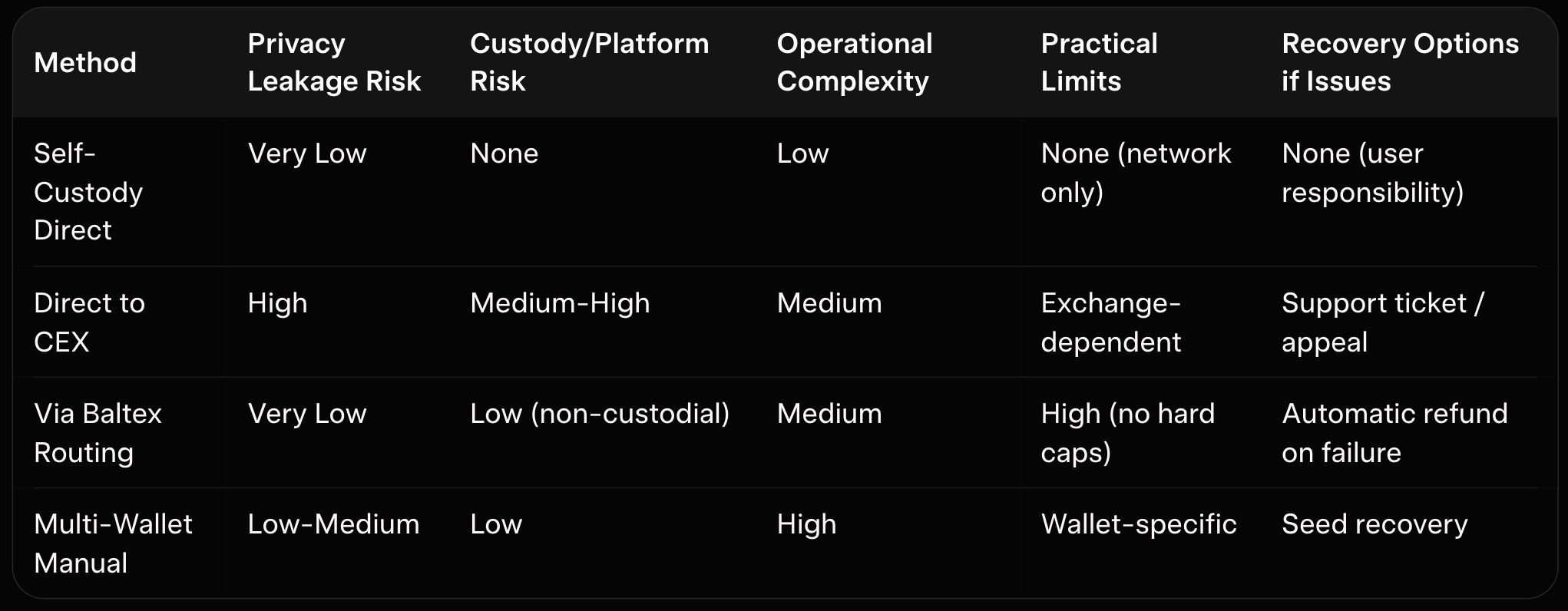
These tables demonstrate why most experienced Monero users in 2026 prefer self-custody for pure transfers and use privacy-preserving intermediaries when interaction with regulated platforms becomes necessary.
How Baltex.io Serves as an Intermediary Routing Layer Before Exchange Deposits
Baltex.io has become the preferred privacy layer for Monero users who need to move funds toward centralized exchanges without creating direct on-chain evidence linking their personal XMR wallet to a KYC-verified account. The process is elegantly simple yet extremely effective. You begin by initiating a swap on Baltex.io, selecting XMR as the send asset and your desired intermediate (usually BTC or USDT on a fast network) as the receive asset. The platform generates a one-time deposit address for your XMR. When you send your Monero to that address, Baltex’s Private Swap mode automatically routes the incoming funds through Monero’s own privacy protocol—leveraging ring signatures and stealth addresses internally—to completely break any traceable link between your original sending address and the final output.
After the short routing window (typically 10–40 minutes total), Baltex delivers the chosen asset (BTC or USDT) directly to the wallet address you specify. You then take that freshly received BTC or USDT and deposit it into your target exchange using the exchange’s standard deposit flow for that asset. Because the exchange never sees an XMR transaction originating from your wallet, chain analysis becomes far more difficult, and you avoid any direct XMR deposit flags that some platforms apply in 2026. The entire intermediary step adds only a modest 0.5–1.2 % all-in cost (clearly displayed upfront) while delivering non-custodial execution—your funds never sit on Baltex longer than the atomic routing requires.
Baltex supports high limits with no practical upper bound for most users, offers live transaction tracking, and maintains 24/7 support without requiring any account or personal data. For users who frequently bridge between private Monero holdings and exchange liquidity, this routed approach has become standard practice: it combines the speed of instant swaps with the privacy guarantees Monero users expect. Many combine it with hardware wallets on both ends, further isolating the flow.
Safety Checks and Best Practices for Every Transfer
Before sending any amount, confirm you are on the official wallet or platform domain and that your connection is encrypted. Always generate fresh subaddresses and never reuse them across different counterparties. Perform a test transfer of a small amount (equivalent to $20–100) and wait for full confirmation and crediting before moving larger sums. Copy and paste addresses rather than typing them, then visually compare the first six and last six characters plus total length. Enable transaction notifications in your wallet and set up alerts on the receiving side. During periods of elevated network activity, choose “fast” fee priority. Keep detailed but secure records of transaction hashes only—never store full addresses or seeds in the same location as your devices. Finally, maintain separate wallets or subaddress sets for different purposes (trading, savings, gifting) so that any potential future linkage affects only a small portion of your holdings.
Frequently Asked Questions
How long should I wait before the funds are usable on the receiving end? Ten confirmations on the Monero blockchain—approximately 20 minutes under normal conditions—is the universal standard in 2026.
Do I still need a payment ID when sending to exchanges? Most exchanges now provide integrated addresses that embed the necessary identifier; if a separate payment ID field appears, fill it exactly as shown.
Is it safe to send XMR directly from a hardware wallet? Yes—hardware wallets offer the highest security for signing; just ensure the firmware and Monero app are updated.
Can Baltex.io routing add too much extra cost or delay? The added cost is typically under 1.2 % and the total time 35–70 minutes, which is often offset by the significant privacy and compliance benefits.
What happens if I send to the wrong address? Monero transactions are irreversible; always triple-check and test small first. There is no recovery mechanism.
Are there any new address formats in 2026 I should know about? Subaddresses starting with 8 remain the standard; the community continues to discourage legacy 64-character payment IDs.
Which wallet is best for frequent transfers? The official Monero GUI for full control and privacy, Cake Wallet for mobile convenience, or Feather Wallet for advanced users.
Should I use a VPN or Tor when transferring XMR? Yes, especially for high-value moves, to prevent metadata correlation with your IP address.
Conclusion
Transferring XMR to external wallets or exchanges in 2026 is straightforward once you internalize address hygiene, confirmation rules, and the strategic value of privacy-preserving routing. Self-custody remains the gold standard for pure preservation of anonymity and control, while direct exchange deposits serve operational needs at the cost of increased visibility and platform risk. By incorporating Baltex.io as an intermediary routing layer—leveraging its Monero-based Private Swap technology—you gain the best of both worlds: seamless access to exchange liquidity without sacrificing the core privacy that makes Monero valuable in the first place.
Follow the step-by-step checklists, consult the comparison tables, and always prioritize small tests and fresh subaddresses. The Monero ecosystem continues to evolve with stronger tools and better user interfaces, but the fundamental principles of caution, verification, and self-sovereignty endure. Whether you are securing life savings in cold storage, rebalancing across personal wallets, or preparing funds for trading, the methods detailed here will help you execute every transfer confidently, efficiently, and with maximum privacy protection throughout 2026 and beyond.
See others posts
G. Khan

Solana Price Prediction 2030 (September 2026 Update)
Ecosystem
G. Khan
Solana Price Prediction 2027: Expert Forecasts and Key Drivers (September 2026 Update)
Ecosystem
G. Khan
Solana Price Prediction for the End of 2026
Ecosystem
G. Khan
Solana (SOL) Price Prediction 2026, 2027 and 2030 (September 2026 Update)
Ecosystem
G. Khan
Ethereum Price Prediction September 2026
Ecosystem
G. Khan
AI Ethereum Price Prediction for 2026 and 2027 (September 2026 Update)
Ecosystem