 2 minutes to read
 Ecosystem
Top Centralized Exchanges to Trade Monero (XMR) in 2026
The year 2026 has been a turning point for the "Privacy Purge." Following the full enforcement of the European Union’s MiCA (Markets in Crypto-Assets) framework and similar strictures in North America, the list of centralized exchanges (CEXs) supporting Monero (XMR) has shrunk significantly.
As of January 2026, over 70 major platforms have delisted XMR to comply with custodial regulations. However, for traders who require high liquidity, fast order execution, and advanced charting tools, CEXs remain a vital—if rare—resource. This guide identifies the top centralized platforms still standing, comparing thei
The State of Monero CEXs in 2026
In 2026, the "CEX Monero" market is divided into two camps: Institutional/Regulated Hubs (strict KYC) and Liquidity Outliers (offshore or tiered KYC). While the price of XMR has found stability above the $600 mark, the primary challenge for traders is no longer price volatility, but withdrawal accessibility.
1. Bitfinex: The Professional’s Choice
Bitfinex remains one of the oldest and most resilient supporters of Monero. In 2026, it serves as the primary "liquidity hub" for institutional and high-volume XMR traders.
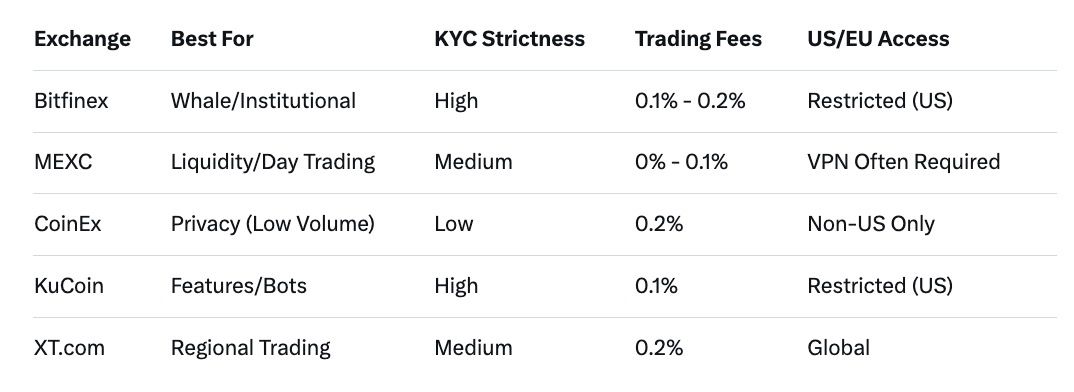
- KYC Requirement: Strict / Mandatory. In 2026, Bitfinex requires full identity verification for all accounts. This includes proof of address and, in some cases, proof of funds for large transactions.
- Fees: Maker fees start at 0.1%, while Taker fees are 0.2%. Significant discounts are available for holders of the LEO token.
- Pros: Deepest liquidity in the XMR/USD and XMR/BTC pairs; advanced margin trading (up to 10x leverage for XMR).
- Cons: Not available to US residents; highly invasive verification process.
2. MEXC: The High-Volume Powerhouse
MEXC has solidified its position in 2026 as the go-to exchange for "fast" Monero trading. It frequently tops the charts for the highest 24-hour trading volume for XMR.
- KYC Requirement: Tiered. MEXC utilizes a tiered system. While basic accounts can sometimes trade with minimal verification (email/phone), full withdrawals and higher limits require "Primary" or "Advanced" KYC.
- Fees: MEXC is known for its aggressive pricing, often offering 0% Maker fees on certain spot pairs and a low 0.1% Taker fee.
- Pros: Massive selection of trading pairs; very fast engine; relatively "light" KYC for non-US users compared to Tier-1 exchanges.
- Cons: Geo-blocks US IP addresses; frequent "maintenance" on XMR withdrawals during high volatility.
3. CoinEx: The Last No-KYC Bastion (Non-US)
For those looking to avoid the "KYC trap" while still using a centralized interface, CoinEx remains a favorite in 2026 for international users.
- KYC Requirement: Optional (for non-US). As of early 2026, CoinEx still allows users to trade and withdraw up to $10,000 per day without submitting a passport, provided they are not accessing the site from restricted regions.
- Fees: Standard fees are 0.2%, but can be reduced by using the CET token for gas.
- Pros: Simple, clean UI; high privacy for low-volume traders; reliable XMR wallet infrastructure.
- Cons: Lower liquidity compared to Bitfinex; strict geo-blocking for US and UK residents.
4. KuCoin: The "People’s Exchange" (With Guardrails)
KuCoin survived the regulatory waves of 2024 and 2025 but at a cost. In 2026, it is no longer the "No-KYC" haven it once was, but it remains a top-5 venue for Monero.
- KYC Requirement: Mandatory. Following legal settlements in late 2024, KuCoin requires all users to complete identity verification.
- Fees: 0.1% Maker/Taker. Fees can be paid in KCS for a 20% discount.
- Pros: Excellent mobile app; reliable security protocols; integrated "Trading Bots" that support XMR pairs.
- Cons: Mandatory KYC; complex fee structures for futures trading.
5. XT.com: The Global Alternative
XT.com has gained traction in 2026 by catering to markets in Asia and Eastern Europe where XMR demand remains high despite Western delistings.
- KYC Requirement: Tiered. Small daily withdrawals are possible with minimal verification, but full access requires ID.
- Fees: 0.2% spot trading fees.
- Pros: Aggressive listing of privacy-adjacent tokens; active XMR/USDT markets.
- Cons: Interface can be cluttered; customer support is primarily geared toward Asian time zones.
2026 CEX Comparison Table: XMR Support
The "CEX Risk" for Monero Holders in 2026
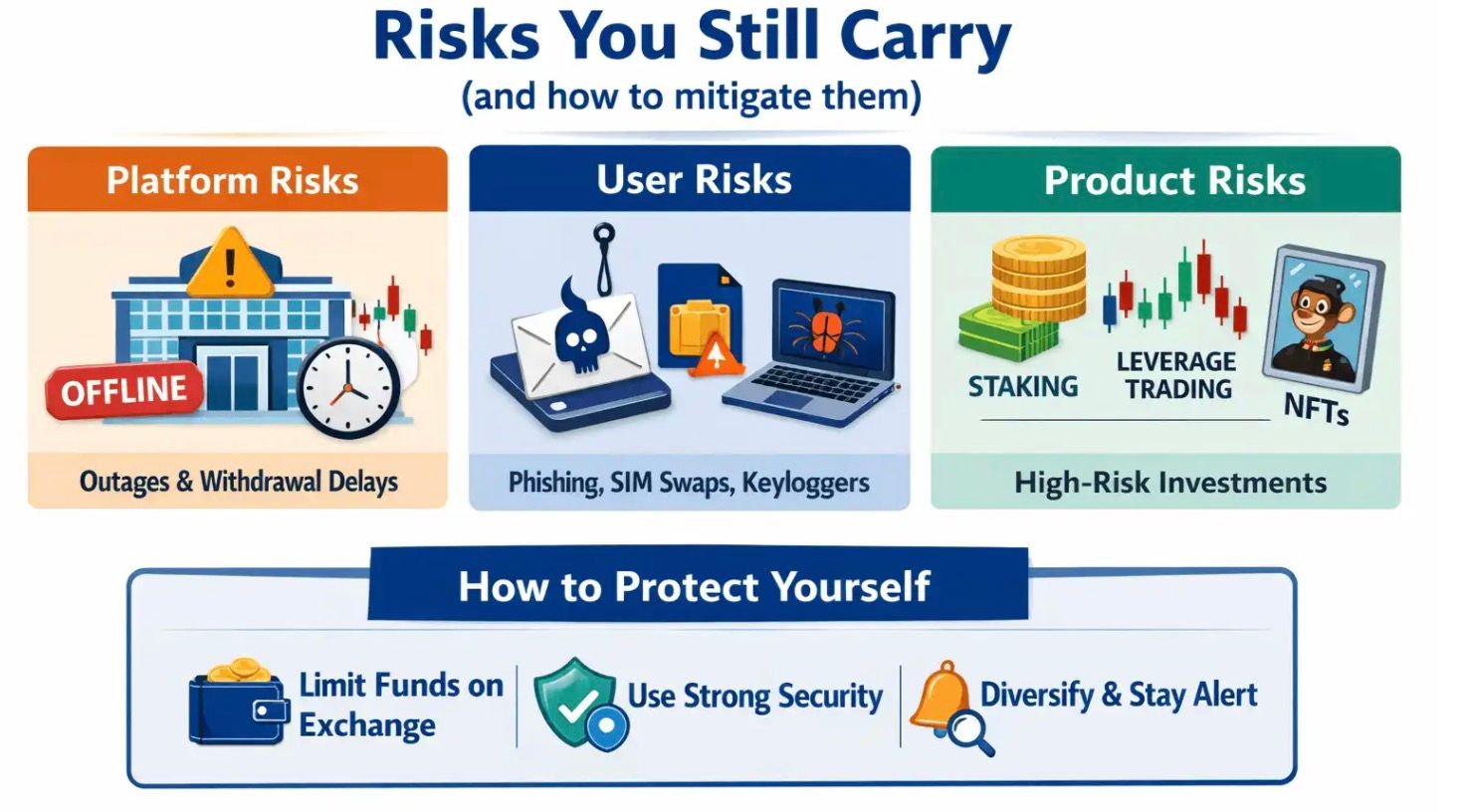
While CEXs provide the best prices and liquidity, they carry a specific risk for XMR holders: Withdrawal Freezes.
In 2026, regulators often pressure exchanges to monitor the "source of funds" for privacy coins. It is not uncommon for a CEX to allow you to buy Monero but then freeze the withdrawal until you provide additional documentation.
Pro-Tip: Always check the "Wallet Status" page on the exchange before depositing funds. If "XMR Withdrawals" are marked as "Under Maintenance," do not trade there.
Conclusion: Which CEX Should You Use?
If you are a Professional Trader with a large portfolio and don't mind identity verification, Bitfinex offers the best execution.
If you are a Privacy-Conscious Trader outside the US, CoinEx remains the most accessible option for 2026.
If you need Maximum Liquidity for scalping, MEXC is the winner, provided you have a reliable way to manage your IP residency.
As the "Privacy Purge" continues, the number of centralized gates will likely decrease further. Always maintain a self-custody wallet (like Cake Wallet or Feather) and move your XMR off the exchange as soon as your trade is complete.
For more on this, see our guide on SimpleSwap Review 2026: Pros, Cons, and Monero Exchange Fees.
For more on this, see our guide on Instant Swap Services: The Go-To for Privacy-Conscious Users.
Related reading: XMR.to Alternatives: How to Pay Bitcoin Invoices with Monero.
We cover this in more detail in Zcash (ZEC) vs Monero (XMR): Which Privacy Coin Wins in 2026.