4 minutes to read
 Ecosystem
StealthEX Review 2026: Is It the Best Instant Exchange for Anonymous XMR?
Updated October 21, 2026. This review is educational, not financial or legal advice. Fees, limits, and policies change, so confirm them on each service before you swap.
TLDR In 2026, StealthEX remains a working, registration-free instant exchange for crypto-to-crypto swaps, with Monero (XMR) support, 2,000+ assets by its own count (third-party reviews cite 1,400 to 2,000), a service fee of about 0.4% built into the quoted rate, fixed and floating rate options, and no stated upper limit on crypto swaps. It marked its eighth anniversary on October 6, 2026. The trade-off is its automated AML screening: StealthEX says flagged transactions may be held for manual verification or KYC regardless of size, and some users on Trustpilot (about 4.0 from roughly 440 reviews) report holds that lasted days or longer. Compared with ChangeNOW or Godex, it stands out for asset variety, while each service has its own KYC triggers. For multi-chain routing with private modes, baltex.io is an alternative worth testing, and Baltex also reserves the right to request KYC when risk checks trigger. StealthEX works well for casual XMR swaps, but test with a small amount first and do not treat any swap service as a guarantee of anonymity.
Privacy-conscious traders in 2026 face rising regulatory pressure, so instant swap services remain a common way to move assets into or out of Monero. Monero's built-in ring signatures, stealth addresses, and confidential transactions already provide strong protocol privacy, yet the entry and exit points remain the main exposure. StealthEX positions itself as a no-account service for these swaps. As detailed in our How to Buy Monero Anonymously in 2026, you pick a pair, send funds to a one-time deposit address, and receive the swapped asset at the wallet address you provide.
What Is StealthEX and How the Instant Exchange Works
StealthEX is an instant exchange, founded in 2018, that connects users to multiple liquidity providers across chains. The process is straightforward: select the sending and receiving assets (for instance, USDT on Tron to XMR), view the live rate and minimum deposit, enter your destination Monero wallet address (ideally a fresh subaddress), and send the exact amount to the generated deposit address. Once the deposit confirms, the swap executes and pays out XMR to your wallet.
StealthEX describes this as non-custodial. As with most instant exchanges, your deposit still passes through the service's own addresses and partners before the payout, so the provider and its liquidity partners see transaction details, and flagged deposits can be paused. The model fits privacy best practices outlined in our Cross-Chain Swaps Guide 2026, but it is not a guarantee of anonymity.
With over 1,400 to 2,000 cryptocurrencies and tokens supported, depending on the count you use, including native XMR pairs with BTC, ETH, USDT (multiple chains), SOL, and more, StealthEX covers most scenarios privacy users encounter. Its recent news is mostly wallet integrations, such as Unstoppable Wallet and Coinomi, and new listings such as tokenized stocks. This breadth can reduce the need for extra hops, as explained in our Best Privacy Coins to Hold in 2026.
Fee Model and Rate Transparency
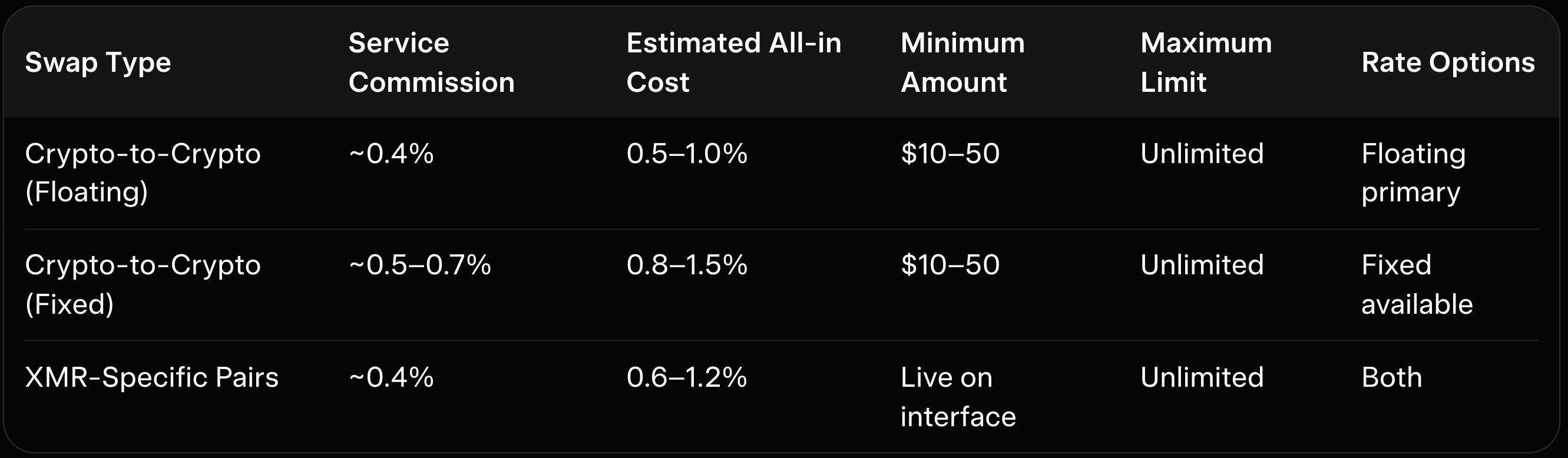
StealthEX builds its service commission into the displayed rate. Its fee averages about 0.4% on popular pairs, and network and liquidity-provider costs are part of the quote, so the amount shown is what you receive. It does not publish one headline fee, so compare the final amount rather than the percentage. Total all-in costs of roughly 0.5% to 1.5% are common on typical pairs, but they vary with the pair, network fees, and market conditions. There are no separate deposit or withdrawal charges beyond blockchain costs.
Users choose floating rates for potentially better pricing or fixed rates to lock in the receive amount and protect against XMR volatility. Fixed rates usually come with a slightly wider spread, and one user reported a 3% to 5% gap versus the quote on a floating swap, which StealthEX said a fixed rate protects against. For deeper cost-optimization strategies, check our Intent-Based Routing Explained article.
Here is an overview of StealthEX fees and limits in 2026:
Settlement Speed and User Experience
Most swaps finish within roughly 5 to 30 minutes from deposit confirmation, with popular XMR pairs often landing in the 10 to 15 minute range under normal conditions. Time also depends on confirmations on the source chain and, once you receive XMR, your wallet needs 10 confirmations (about 20 minutes) before the funds are spendable.
Support is available through live chat and email around the clock, and it handles delayed transactions caused by network congestion. For wallet options, see our Best Monero Wallets for Maximum Privacy review.
Transaction Limits and Privacy Implications
StealthEX states no upper limit on crypto-to-crypto swaps, and minimums are shown live in the quote. For fiat card purchases, orders have been reported as KYC-free below about €700 (some sources cite up to €900), and larger fiat purchases trigger identity verification. Crypto-to-crypto swaps need no registration.
The service stores no accounts or emails for standard swaps, and your source address connects only to a temporary deposit address before Monero's protections apply on your received funds. That reduces data exposure compared with an exchange account, but the swap provider still sees the transaction, and the amounts and addresses on the source chain remain public. As noted in our Privacy Coin Swaps: Risks and Best Practices 2026, everyday XMR swaps usually proceed without verification when users follow sensible operational security (fresh subaddresses, hardware wallets, and no address reuse).
Potential Risk Scenarios
Floating rates can shift during confirmation windows, so consider fixed rates in volatile periods. Blockchain congestion on source chains may delay recognition, and support typically fixes this manually. The larger risk is compliance screening. StealthEX's published KYC/AML policy says suspicious transactions are stopped for manual verification, which can include ID documents and a selfie, and the pending transaction is then completed or refunded. Reviewers on Trustpilot describe both smooth swaps and holds that lasted days, plus a few claims of much longer delays, which are individual accounts and not independently verified. Larger amounts, privacy-coin pairs, or funds linked to flagged addresses are the most likely to be paused. Also verify you are on the real StealthEX domain, because lookalike sites exist. For more, read our Top No-KYC Crypto Exchanges Compared.
How StealthEX Compares to Other Instant Swap Services
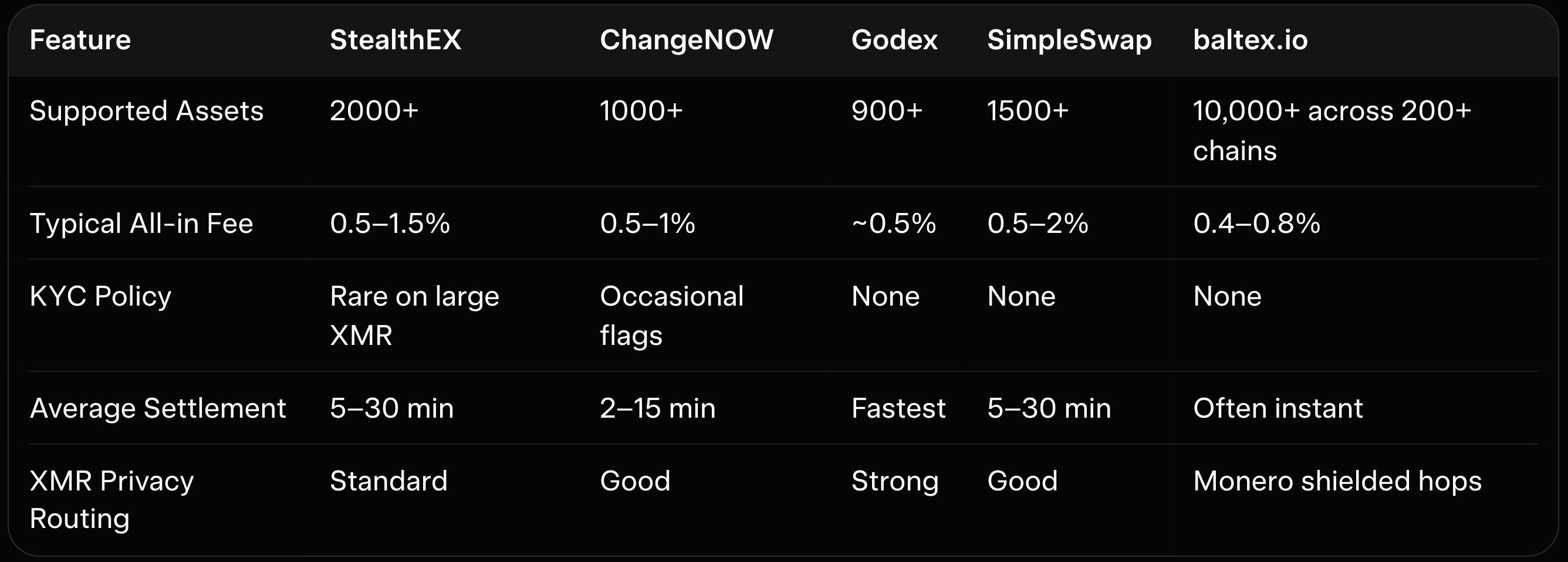
StealthEX competes on asset selection and a simple flow. ChangeNOW applies automated risk checks and has reportedly requested KYC on larger orders and privacy pairs, and it has a much larger review base. Godex advertises that it never asks for KYC, though that is a self-reported claim worth testing yourself, and SimpleSwap offers similar simplicity. DEX aggregators add gas costs and steps. Every service on this list can hold a flagged transaction, so the practical differences are asset coverage, fees, and how each handles reviews.
Baltex.io: A Multi-Chain Routing Alternative for Fast XMR Swaps
For users who want more than a basic instant swap, baltex.io offers multi-chain routing with 10,000+ coins across 200+ networks. It describes itself as a non-custodial routing network that aggregates CEX and DEX liquidity. For privacy, its Private Exchange modes include Efficient Mode, Private Exchange (routing through multiple proxy exchanges), and Private+, which uses Monero as the intermediary currency.
Standard swaps need no account and use a deposit address, like other instant exchanges. Baltex advertises low fees shown before you confirm and no swap limits, with support available for large amounts, and reports an average completion time under 5 minutes on most routes (a few minutes to 30 minutes depending on the coin and network). Its KYC/AML policy says it may request KYC if a transaction fails its risk checks, involves high-risk regions, or shows high-risk patterns, and in that case it usually offers a refund to the depositing address minus network fees, sometimes only after the review ends. Baltex also prohibits use from sanctioned jurisdictions. Pair it with bridges covered in our deBridge Review: High-Speed Stablecoin Bridge 2026. Use StealthEX for quick simple pairs and consider baltex.io when you need cross-chain routing or private modes, comparing live quotes first.
Conclusion
StealthEX remains a functional instant exchange for XMR swaps in 2026, with broad asset support, a transparent fee approach of about 0.4% built into the rate, and a no-registration flow for standard swaps. Its automated AML screening and the reports of holds mean it isn't the best fit for every use case, and no instant exchange should be treated as guaranteed anonymous. By comparing quotes across services, including baltex.io, users can choose based on cost, speed, and how much compliance friction they can accept. Always start with small test swaps, use fresh wallets, double-check addresses, and follow operational security best practices. Explore more strategies in our Best Privacy Coins to Hold in 2026 and Intent-Based Routing Explained guides.
We cover this in more detail in Instant Swap Services: The Go-To for Privacy-Conscious Users.
Related reading: XMR.to Alternatives: How to Pay Bitcoin Invoices with Monero.
Related reading: Zcash (ZEC) vs Monero (XMR): Which Privacy Coin Wins in 2026.