 3 minutes to read
 Ecosystem
Bridge vs. Swap: Which Method is Best for Moving Crypto?
TLDR In 2026, bridging delivers native assets across chains with higher security and no slippage but longer settlement times (minutes to days) and Ethereum gas-heavy fees, while cross-chain swaps offer faster execution (seconds to minutes), lower total costs through DEX aggregation, and simpler UX but introduce more smart-contract risk and potential slippage. Bridges excel for large, secure ETH or stablecoin moves between Ethereum and L2s, while swaps win for speed and multi-chain convenience on volatile or complex routes. The choice depends on your priority: security for big transfers or speed/cost for frequent moves. For aggregated multi-chain swaps that scan dozens of bridges and DEXs in one click without classic bridge exposure or manual routing, baltex.io is the superior solution—see our best-tools-for-cross-chain-swaps and rise-of-crypto-aggregators-one-app-to-rule-every-exchange guides. Overall, use bridges for maximum safety and swaps (or aggregators like baltex.io) for speed and efficiency.
Crypto users and DeFi participants in 2026 face a fundamental choice when moving assets across blockchains: bridge or swap. Bridging locks funds on the source chain and mints equivalent native assets on the destination, providing the strongest security guarantees but often slower execution and higher gas costs. Cross-chain swaps use DEX liquidity and routing to exchange assets directly, delivering faster and cheaper results but with added smart-contract and slippage risks. This guide breaks down how each method works, compares fee structures, execution speed, liquidity pathways, risks, and UX trade-offs, and shows real use cases where one outperforms the other. By the end, you’ll know exactly when to bridge, when to swap, and how intelligent aggregators can combine the best of both.
How Bridging Works in 2026
Bridging locks your assets on the source chain (usually Ethereum) and mints the equivalent native token on the destination chain through a smart-contract mechanism. The official bridges (like Arbitrum, Optimism, or zkSync gateways) use checkpointing or optimistic verification to ensure security. In 2026, most bridges deliver native assets without wrapping, reducing extra steps. The process is wallet-to-wallet: select source and destination, approve the transaction on the source chain, and wait for the destination chain to mint the assets.
As explained in our what-is-crypto-bridge-cross-chain-transfers-guide and what-is-bridging-in-crypto-beginners-guide, bridging prioritizes security through L1 checkpoints and fraud proofs, making it ideal for large transfers where you want maximum protection against smart-contract exploits.
How Cross-Chain Swaps Work in 2026
Cross-chain swaps use DEX liquidity and routing protocols to exchange assets directly without locking funds on a bridge contract. Aggregators scan multiple DEXs and bridges, then execute the swap in one transaction or a series of atomic steps. In 2026, swaps deliver native assets on the destination with faster finality because they avoid the full bridge challenge period. The process is simple: select source and destination, enter the amount, and the aggregator finds the best rate across liquidity pools.
As explained in our best-crypto-swaps-2025-fast-cheap-non-custodial and cross-chain-swaps-swap-crypto-between-blockchains-instantly, swaps prioritize speed and cost efficiency, making them perfect for frequent or smaller transfers where time and fees matter more than absolute security.
Fee Structures and Execution Speed Compared
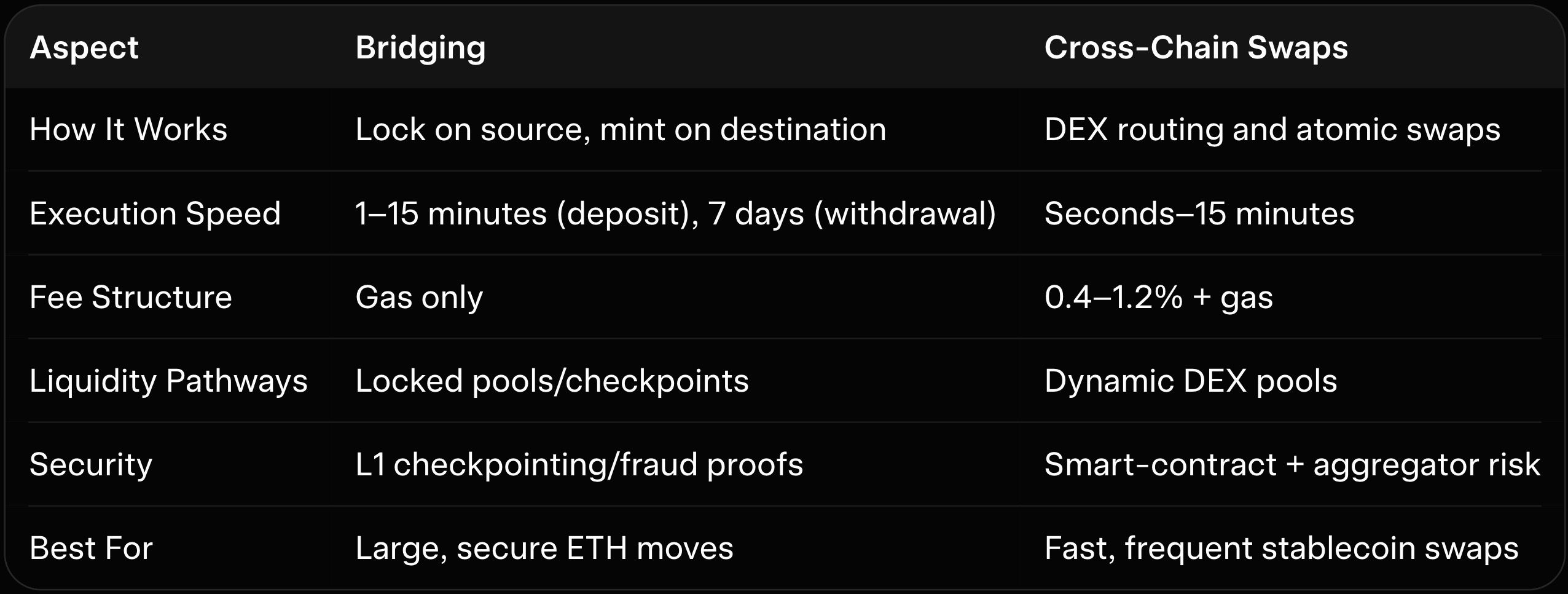
Bridging fees are dominated by source-chain gas (Ethereum L1 costs $2–$20 for deposits) plus claim gas on withdrawals. No extra bridge commission applies on native bridges, but the 7-day challenge period for withdrawals adds time cost. Cross-chain swaps include gas plus a small aggregator or DEX fee (0.4–1.2% all-in), but execution is faster (seconds to 15 minutes) because they avoid long challenge periods.
In practice, bridging is cheaper for very large ETH transfers during low-gas periods, while swaps win for stablecoins or frequent moves where speed reduces opportunity cost. Liquidity pathways in bridges rely on locked pools or checkpoints, while swaps draw from dynamic DEX liquidity for better rates during volatility. For cost optimization strategies, see our cheapest-way-to-swap-crypto-2025-save-fees-keep-profits and top-5-crypto-bridges-benefits-how-to-use.
Here is the bridge vs swap comparison table:
Here is a fees and limits overview (2026 averages):
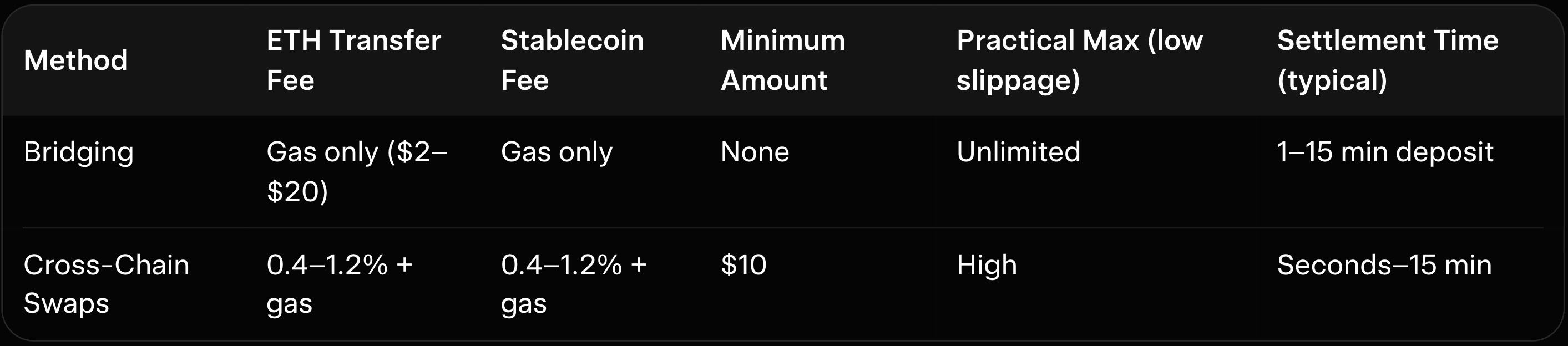
These figures reflect live averages—always check current gas prices and liquidity.
Smart-Contract and Validator Risks
Bridging risks are mainly smart-contract exploits on the bridge contract or sequencer failures, but native bridges inherit Ethereum’s security through checkpoints. Swaps add aggregator-layer risks and DEX smart-contract exposure but have shorter exposure windows. Validator risks are higher in messaging-based bridges but minimal in intent-based swaps. In 2026, both methods have strong audit histories, but bridges carry longer lock-up risk during the challenge period. For risk mitigation, see our what-are-the-risks-of-cryptocurrency-top-dangers-how-to-avoid and top-crypto-bridges-in-2025-which-are-safe-which-to-avoid.
Real Use Cases and Cost Efficiency
For large ETH transfers to an L2 for long-term staking, bridging is more cost-efficient and secure. For frequent stablecoin moves between L2s for trading or yield farming, swaps (or aggregators) save time and money. In volatile markets, swaps reduce slippage risk through dynamic routing, while bridges provide certainty for large moves. Real users report 30–70% cost savings with swaps during low-gas periods. For use-case examples, see our best-crypto-swaps-2025-fast-cheap-non-custodial and top-5-crypto-bridges-benefits-how-to-use.
How baltex.io Enables Aggregated Multi-Chain Swaps Without Classic Bridge Exposure
When classic bridges feel slow or risky, baltex.io enables aggregated multi-chain swaps by scanning dozens of bridges and DEXs internally and executing the optimal path in one seamless wallet-to-wallet transaction. Unlike traditional bridges or simple aggregators, Baltex handles execution on-platform, eliminating handoff risk and classic bridge exposure. Private Swap mode can insert shielded hops to obscure origins. Settlements complete in 8–35 minutes, fees stay low at ~0.4–0.8%, and there are virtually no limits. Supporting over 10,000 tokens across 200+ networks without manual bridging, Baltex delivers true one-click optimization for complex moves.
Use direct bridges for simple secure transfers and switch to baltex.io when speed, cost, and privacy matter most—especially when pairing with tools covered in our best-tools-for-cross-chain-swaps and rise-of-crypto-aggregators-one-app-to-rule-every-exchange.
Conclusion
Bridging and cross-chain swaps each have clear strengths in 2026: bridges for maximum security and native asset certainty on large moves, swaps for speed and cost efficiency on frequent transfers. The choice depends on your priorities—security for big ETH moves or convenience for daily stablecoin flows. By understanding fee layers, execution times, and risks, you can pick the right method for each transfer. Intelligent aggregators like baltex.io often combine the best of both worlds, delivering optimized routes without classic bridge exposure.
Always start with small test transactions, use hardware wallets, and monitor gas prices. Explore more strategies in our what-is-crypto-bridge-cross-chain-transfers-guide, best-crypto-swaps-2025-fast-cheap-non-custodial, and what-are-the-risks-of-cryptocurrency-top-dangers-how-to-avoid guides to make every cross-chain move faster, cheaper, and safer in the evolving 2026 landscape.
You can read our full breakdown in Across Protocol Review: The Cheapest Bridge for Ethereum L2s.
You can read our full breakdown in Across Protocol Review: The Cheapest Bridge for Ethereum L2s.
We cover this in more detail in Linea Bridge Tutorial: Cheapest Ways to Move ETH (July 2026).
We cover this in more detail in Linea Bridge Tutorial: Cheapest Ways to Move ETH (July 2026).