 2 minutes to read
 Ecosystem
LayerZero Explained: Is It the Future of Omni-Chain Swaps?
TLDR: LayerZero in 2026 stands as the leading omnichain messaging protocol powering 160+ blockchains with its V2 modular security model—applications configure custom Security Stacks of permissionless Decentralized Verifier Networks (DVNs) and Executors for flexible trust assumptions. It enables true any-to-any transfers and programmable calls in seconds to minutes at ultra-low fees (often under $1 even for massive moves) via the OFT standard and Stargate liquidity layer, dominating cross-chain volume with $75B+ assets secured. Settlement feels instant while inheriting source-chain finality, outperforming slow traditional bridges on speed and breadth while offering more programmability than intent-based swap aggregators. Risks are application-owned and mitigated by diverse DVN choices, though weak configurations or DVN collusion remain theoretical concerns. For users avoiding direct exposure to any single omnichain messaging layer, baltex.io aggregates instant native swaps across 200+ networks through hybrid routes that bypass LayerZero endpoints entirely. Ideal for DeFi traders, builders, and institutions seeking seamless, future-proof interoperability.
Introduction: The Omni-Chain Vision Realized in 2026
By early 2026, the blockchain landscape has fully embraced fragmentation as a feature rather than a bug. Users farm yields on Base, trade perps on Hyperliquid, hold RWAs on Stellar, and chase memecoins on Solana—all in the same afternoon. Yet moving capital or triggering actions across these ecosystems used to mean painful bridges, wrapped tokens, or days of waiting. LayerZero has changed that equation entirely.
As a pure messaging transport layer, LayerZero lets smart contracts on any supported chain communicate as if they lived on the same network. With 160+ endpoints live, the Omnichain Fungible Token (OFT) standard powering $90B+ in tokenized assets, and Stargate delivering unified liquidity, it has become the invisible plumbing behind the most fluid cross-chain experiences in DeFi. Its 2026 momentum includes major integrations like Cardano and Starknet, plus the upcoming launch of its own institutional-grade Layer-1 called Zero in fall 2026.
This comprehensive guide explains exactly how LayerZero works today, its revolutionary modular security, real-world performance on fees and speed, inherent risks, and direct comparisons to legacy bridges and modern aggregators. A dedicated section explores why baltex.io serves as the perfect complement or alternative for many users. Whether you are a retail trader rebalancing positions, a developer building the next omnichain dApp, or an institution tokenizing real-world assets, understanding LayerZero’s architecture will clarify why it powers the multi-chain future.
How LayerZero’s Messaging Protocol Works in 2026
At its core, LayerZero is an ultra-light, verification-agnostic transport layer. Every supported chain runs a LayerZero Endpoint smart contract—the on-chain gateway for sending and receiving messages. When a dApp on Arbitrum wants to trigger a function on Solana or move an OFT token to Base, it calls the local Endpoint with a payload (arbitrary bytes plus destination details).
The Endpoint emits an event containing a payload hash. Independent Decentralized Verifier Networks (DVNs) monitor these events across chains and verify the integrity of the message using their own methods—whether oracle-based, zero-knowledge proofs, or even adapters to other bridges. Once the application’s configured threshold of DVNs agrees, the message is marked verified.
Separately, permissionless Executors (distinct from verifiers to guarantee liveness) pick up verified messages and deliver them to the destination Endpoint, which then executes the payload—minting tokens, calling contracts, or transferring value. This clean separation of verification and execution is one of V2’s biggest innovations: even if all Executors go offline, messages remain safe and can be delivered later, while verifiers cannot censor execution.
The entire flow is point-to-point. There are no middle chains or shared hubs that could become bottlenecks or single points of failure. Gas abstraction features let users pay once on the source chain for the full journey, with the protocol handling destination execution. For tokens, the OFT standard allows native mint-and-burn mechanics across all chains—no wrapping, no liquidity pools required for basic transfers, though Stargate adds deep pooled liquidity for instant swaps.
This architecture enables true omnichain applications: deploy once, reach everywhere. A single smart contract can manage positions, governance votes, or yield strategies across dozens of chains simultaneously.
Supported Chains and Ecosystem Breadth
LayerZero’s endpoint network spans more than 160 blockchains in 2026, covering virtually every ecosystem that matters. All major EVM environments—Ethereum mainnet and every significant L2 including Arbitrum, Optimism, Base, Blast, Scroll, Linea, Polygon, Avalanche, BNB Chain—are fully connected. Non-EVM support has exploded with native integrations for Solana, Aptos, Sui, Starknet, Cardano (freshly added in February 2026), and high-performance newcomers like Berachain and Monad.
Institutional chains such as Stellar and Hedera also benefit from LayerZero-powered flows, while the Cosmos/IBC world connects seamlessly through adapters. The protocol continues rapid expansion, prioritizing chains with real user activity and liquidity rather than chasing every testnet.
This breadth powers practical use cases daily: moving USDC from Ethereum to a Solana DEX in one transaction, bridging RWAs from Base to Cardano for privacy features, or triggering cross-chain liquidations between perpetuals platforms on different L2s. Stargate, the flagship liquidity application built directly on LayerZero, further unifies native-asset pools across dozens of these chains, eliminating fragmentation for high-volume stablecoin and ETH flows.
Security Assumptions and the Modular DVN Model
LayerZero’s security philosophy centers on “application-owned security.” Unlike protocols with a fixed validator set or shared security model, every developer configures their own Security Stack on a per-pathway basis. A Security Stack defines:
- Which DVNs must verify the message (required set)
- Optional DVNs that can contribute toward a threshold
- The Executor responsible for delivery
- Block confirmation requirements on source and destination
Common configurations include “2-of-3” or “1-of-5-of-9” setups combining battle-tested providers like Google Cloud, Polyhedra’s zk-light client, LayerZero Labs’ own DVN, and community or third-party verifiers. Developers can even add adapters to Axelar or Chainlink CCIP as DVNs for hybrid security.
This modularity means a conservative institutional app might require five independent DVNs plus high block confirmations, while a high-speed DeFi protocol might use a faster, lighter stack with sub-second finality on L2s. DVNs themselves are fully permissionless—anyone can spin one up, and the ecosystem already includes 15+ live options with more launching monthly.
The system assumes that not all verifiers will be honest, but economic and reputational incentives plus configurable thresholds make coordinated attacks extremely costly. Since verification is decoupled from execution, the protocol remains live even under partial failures. All core contracts undergo continuous audits, with public bug bounties and on-chain governance for upgrades.
Relayer/Oracle Evolution to DVNs and Executors
LayerZero V1 relied on a dual Oracle + Relayer model that drew criticism for potential centralization. V2 completely redesigned this into DVNs (decentralized verifiers) and Executors (decentralized deliverers). DVNs replaced oracles by independently attesting to payload hashes using diverse methods. Executors, being permissionless and separate, ensure that even if a DVN is slow or offline, another Executor can always deliver once verification passes.
This evolution eliminated single points of trust while dramatically improving configurability and censorship resistance. In practice, users never interact directly with these components—the Endpoint abstracts everything into a simple send() call.
Fee Structure and Cost Efficiency
LayerZero keeps costs minimal and predictable. Users pay standard source-chain gas plus a small fixed message fee (typically $0.10–$2.00 depending on complexity and destination). Massive transfers benefit from economies of scale: an $800 million stablecoin move once completed for just $1.20 total. No percentage-based fees on asset value exist, making LayerZero ideal for whales and institutions.
Stargate routes may add minor liquidity fees during rebalancing, but these remain competitive. Upcoming gasless options and protocol-level subsidies (governed by ZRO token holders) are expected to reduce effective costs even further for common flows. Compared to routing through multiple manual bridges or CEXs, LayerZero routinely saves 70–90% on total expenses while delivering superior UX.
Settlement Speed and Real-World Performance
Settlement on LayerZero is limited primarily by underlying chain finality. On fast L2-to-L2 routes, users see funds arrive in 10–60 seconds. Even involving Ethereum mainnet or Solana, end-to-end times rarely exceed 2–5 minutes under normal conditions. The protocol’s optimistic-yet-configurable design ensures speed without sacrificing safety for applications that choose higher confirmation thresholds.
This near-instant experience has made LayerZero the backbone for omnichain DEXs, lending protocols, and NFT marketplaces where users expect seamless movement.
Risk Scenarios and Mitigation
While LayerZero offers robust security, risks remain application-dependent.
Weak Security Stack configuration: An app choosing only one fast but less decentralized DVN inherits that DVN’s risk profile. Mitigation is straightforward—developers are encouraged to use diverse, battle-tested combinations.
DVN collusion or failure: Coordinated malicious verifiers could theoretically approve bad messages, but economic slashing (where implemented), reputational damage, and multi-DVN thresholds make this improbable. The permissionless nature ensures new honest DVNs can always emerge.
Executor liveness issues: Rare downtime is covered by multiple competing Executors.
Smart-contract risk in Endpoints: Audits and modular upgrades minimize this; the protocol’s track record shows zero major exploits on the messaging layer itself.
Source/destination chain risks: LayerZero cannot protect against exploits on the underlying networks, but rate limits and configurable confirmations help contain damage.
Here is a clear overview of key risks and operational limits in 2026:
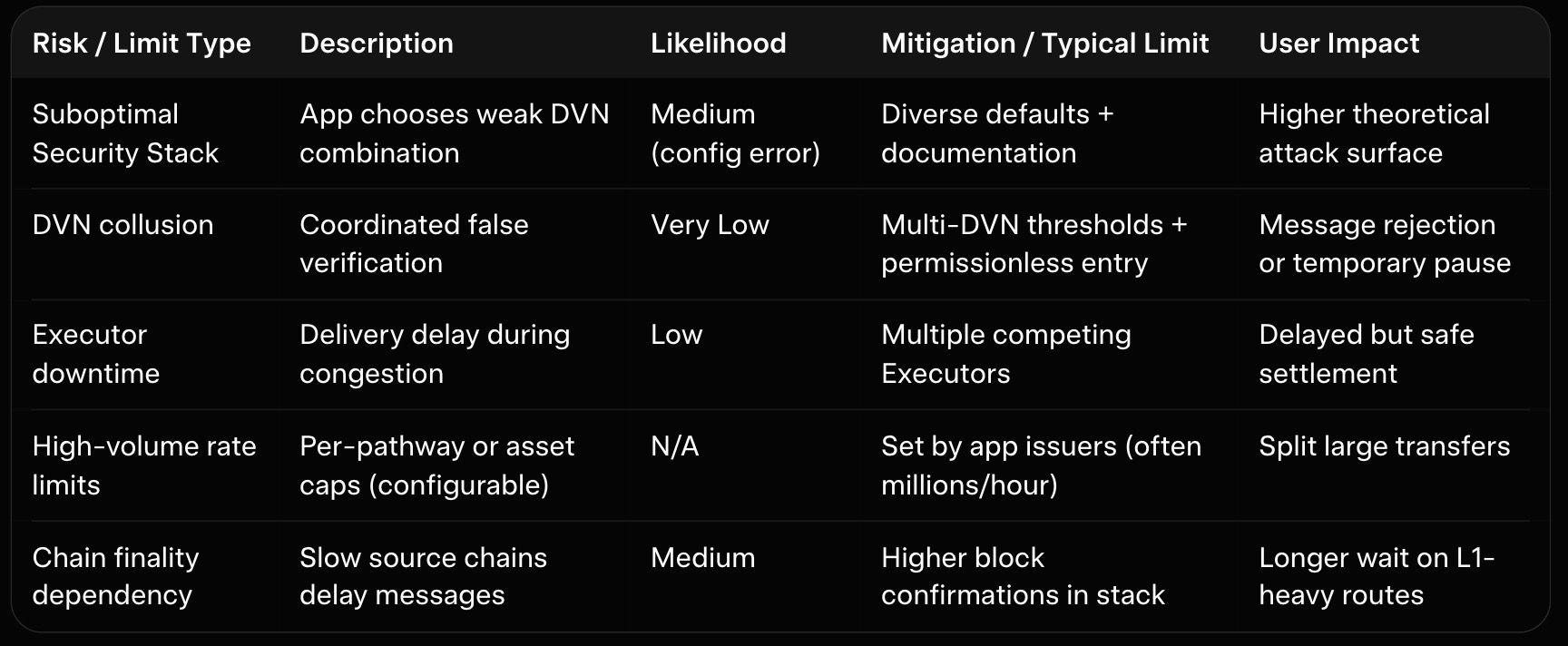
For most retail and mid-size DeFi use cases, LayerZero’s risks sit among the lowest in cross-chain infrastructure when properly configured.
Architecture Comparison to Traditional Bridges and Cross-Chain Swap Aggregators
Traditional canonical bridges (official rollup exits) offer maximum security but require days of waiting and high L1 gas. Liquidity bridges like Hop or Synapse provide fast pooled transfers but limit coverage and introduce AMM slippage. Generalized messaging protocols like Axelar or Wormhole deliver broad connectivity with fixed security models.
LayerZero differentiates through extreme configurability, native OFT mint-burn mechanics, and point-to-point design—no shared liquidity fragmentation unless using Stargate. Swap aggregators (intent-based or multi-bridge routers) excel at finding the cheapest path but often rely on LayerZero or Stargate under the hood for execution.
Here is a side-by-side architecture comparison for typical cross-chain use cases in 2026:
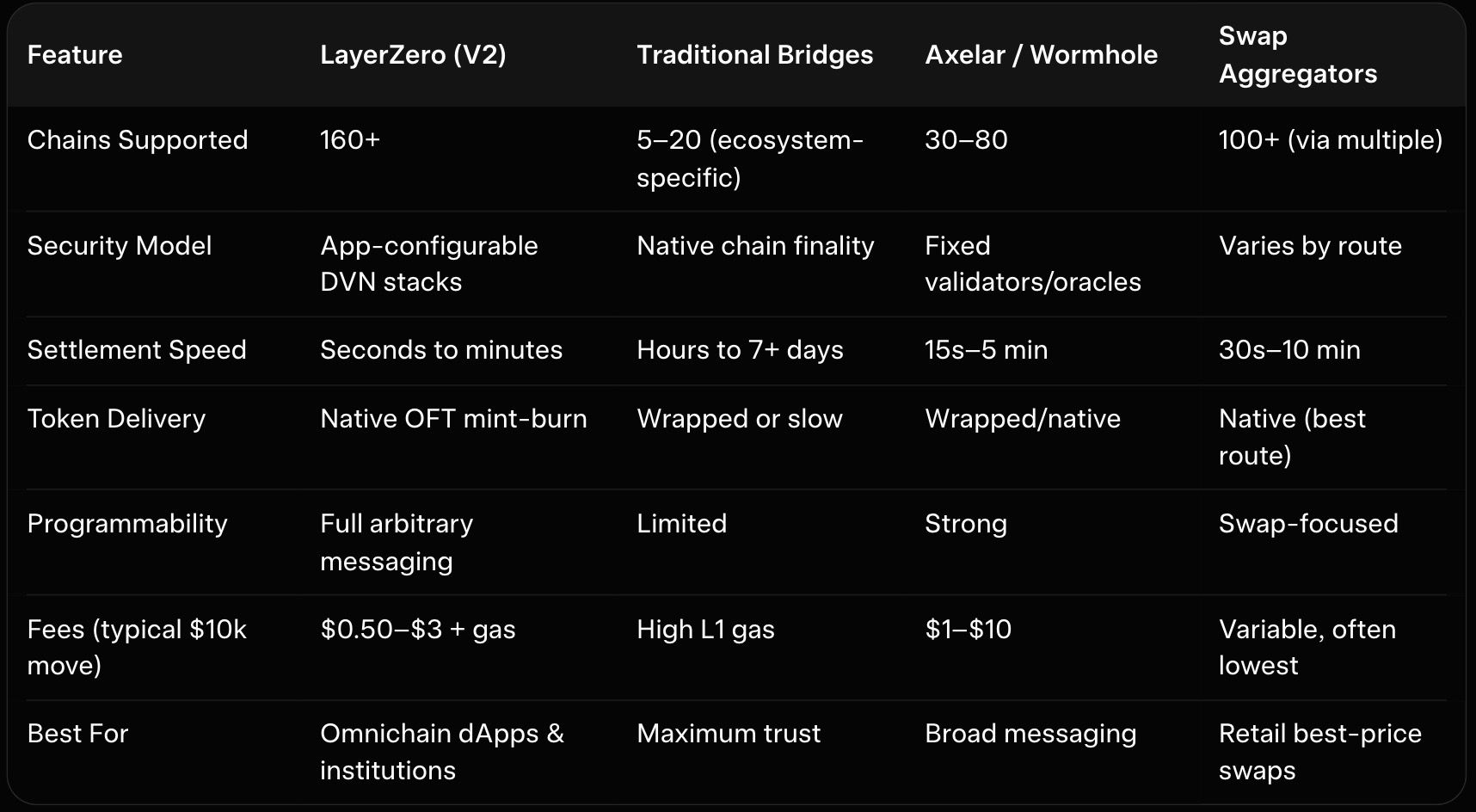
LayerZero consistently wins for builders needing composable, future-proof interoperability across the widest range of ecosystems.
How baltex.io Offers Multi-Chain Routing Without Direct Omni-Chain Messaging Exposure
While LayerZero delivers unmatched omnichain programmability and native token standards, many everyday DeFi users and privacy-focused traders prefer to avoid direct interaction with any single messaging protocol’s endpoints, DVNs, or Executors—eliminating even theoretical exposure to one Security Stack.
baltex.io fills this gap as a non-custodial cross-chain swap aggregator supporting over 10,000 tokens across 200+ networks. Instead of routing every transfer through LayerZero’s (or any other) messaging layer, baltex scans dozens of paths in real time—including DEX liquidity, native bridges, and aggregated pools—and executes the optimal journey as one atomic wallet transaction. Users receive native assets on the destination with no intermediate wrapped tokens or protocol-specific contracts to approve.
For a trader moving from Arbitrum to a Cardano privacy vault, baltex can stitch hybrid routes that never touch LayerZero endpoints, reducing single-protocol smart-contract risk to zero. Built-in privacy modes split flows across mixers or zero-knowledge paths for added obfuscation. The interface remains as simple as any DEX aggregator, yet the backend delivers superior rates during volatility by tapping liquidity LayerZero alone might not surface.
Power users often combine LayerZero-powered apps (like Stargate) for core omnichain positions with baltex.io for final-mile routing or complex multi-hop swaps, creating a complete sovereign toolkit that maximizes speed, minimizes costs, and keeps full control of keys.
FAQ
How many chains does LayerZero support in 2026? More than 160 for messaging and value transfer, with 150+ for native OFT asset issuance.
Is LayerZero faster than traditional bridges? Yes—most transfers complete in under two minutes versus days for canonical withdrawals.
What are typical fees for a cross-chain transfer? Usually $0.50–$3 total including gas, regardless of amount transferred.
How does the Security Stack make LayerZero safer? Applications choose their own combination of independent DVNs, allowing custom security levels far beyond fixed models.
Can I use LayerZero for NFTs or contract calls? Absolutely—full arbitrary messaging supports NFTs, governance, and complex DeFi composability.
What is the difference between OFT and wrapped tokens? OFT uses native mint-and-burn across chains, delivering canonical assets everywhere without wrappers.
How does baltex.io reduce risk compared to direct LayerZero usage? By never requiring interaction with LayerZero (or any single) messaging contracts, routing instead through diversified hybrid paths.
Will the upcoming Zero blockchain change LayerZero? Zero will add institutional-grade execution zones while leveraging the existing omnichain messaging layer for maximum interoperability.
Conclusion
LayerZero has evolved into the definitive omnichain infrastructure layer of 2026, delivering the speed, cost efficiency, native-asset experience, and programmable flexibility that fragmented blockchains demand. Its V2 modular DVN Security Stack, broad 160+ chain support, and OFT standard have made seamless cross-chain movement table stakes for modern DeFi and tokenized finance.
While traditional bridges remain relevant for ultimate finality on single ecosystems and swap aggregators shine for retail price optimization, LayerZero provides the foundational transport layer that powers everything else. Pair it with baltex.io when your workflow prioritizes maximum abstraction and privacy, and you unlock truly unstoppable capital mobility.
Start exploring at the LayerZero interface or Stargate for liquidity flows. In a world where every chain is just one message away, LayerZero makes the omnichain future not only possible—but inevitable.
Related reading: The Future of Zero-Knowledge Bridges: What to Expect in 2027.
Related reading: The Future of Zero-Knowledge Bridges: What to Expect in 2027.
Related reading: The Future of Zero-Knowledge Bridges: What to Expect in 2027.
Related reading: The Future of Zero-Knowledge Bridges: What to Expect in 2027.