 2 minutes to read
 Ecosystem
Monero vs Bitcoin: Transaction Speed & Fees Compared
TL;DR
In 2026 Monero offers consistently low fees of $0.01–$0.10 with 2-minute block times and reliable 10-confirm privacy guarantees while Bitcoin on-chain fees fluctuate from $1 to $15+ during congestion and Lightning delivers sub-cent instant settlement after channel setup. Monero wins for predictable cost and simple private payments without extra infrastructure while Bitcoin Lightning excels at raw speed for small everyday transfers once channels are open. Most users route between the two via Baltex.io to optimize fees and speed for each specific payment.
Monero and Bitcoin both function as peer-to-peer payment systems in 2026 yet their architectures create measurable differences in speed, fees, and real-world efficiency. Bitcoin relies on its 10-minute block time on the base layer and Lightning Network for near-instant small payments. Monero uses 2-minute blocks with built-in privacy that adds slight overhead but keeps every transaction simple and predictable.
The practical gaps appear clearest when you send money to a friend, pay a freelancer, or move funds between wallets. One coin delivers stable low costs with automatic privacy while the other offers faster settlement for small amounts once Layer 2 is configured. This comparison focuses on measurable performance metrics rather than theoretical ideals.
Transaction Speed and Block Times
Monero generates blocks roughly every 2 minutes on average so the first confirmation arrives faster than Bitcoin’s 10-minute average. The shorter interval reduces waiting time for initial visibility and makes zero-confirmation acceptance safer for small private payments. Merchants who accept Monero often treat it as confirmed after one or two blocks because double-spend risk remains extremely low.
Bitcoin on-chain blocks average 10 minutes and most users wait for six confirmations before considering funds settled for larger amounts. Lightning Network bypasses this delay entirely by settling payments instantly once channels are open. The speed advantage shines for frequent small transfers but requires upfront channel management that Monero avoids.
Confirmation Reliability
Monero’s lack of replace-by-fee means once a transaction enters the mempool it stays there until confirmed without risk of being bumped. This predictability reduces merchant uncertainty compared to Bitcoin where RBF can create last-minute changes. Both networks remain highly reliable in 2026 but Monero’s design eliminates certain edge-case headaches during congestion.
Bitcoin Lightning provides true instant finality for opened channels yet requires users to monitor liquidity and channel health continuously. On-chain Bitcoin still faces occasional congestion that delays confirmations for hours. Monero’s dynamic blocks absorb demand spikes without the same volatility.
Fees and Mempool Behavior
Monero maintains stable fees through dynamic block sizing that automatically expands to meet demand without bidding wars. Even during high activity the cost rarely exceeds ten cents for a typical private transaction. The mempool clears quickly because blocks adjust size in real time.
Bitcoin on-chain fees spike sharply when the mempool fills because users compete for limited block space. Lightning fees stay under a cent for most payments but channel opening and closing still require on-chain fees that can reach double digits during peaks. Our best no-KYC Monero swappers overview highlights how Monero’s predictable fees make routing to and from Bitcoin more practical for cost-conscious users.
Real-World Payment Efficiency
Monero’s combination of low stable fees and short block times makes it ideal for frequent private remittances or micro-payments without extra setup. Users simply send to a subaddress and the wallet handles everything automatically. This simplicity reduces friction for everyday peer-to-peer transfers.
Bitcoin Lightning delivers the fastest small-value payments once channels exist yet the initial setup and liquidity management add overhead that many casual users skip. On-chain Bitcoin remains efficient for infrequent larger transfers when fees are low but becomes costly during busy periods. Our Cake Wallet review shows how mobile users experience these differences in practice.
Speed Comparison
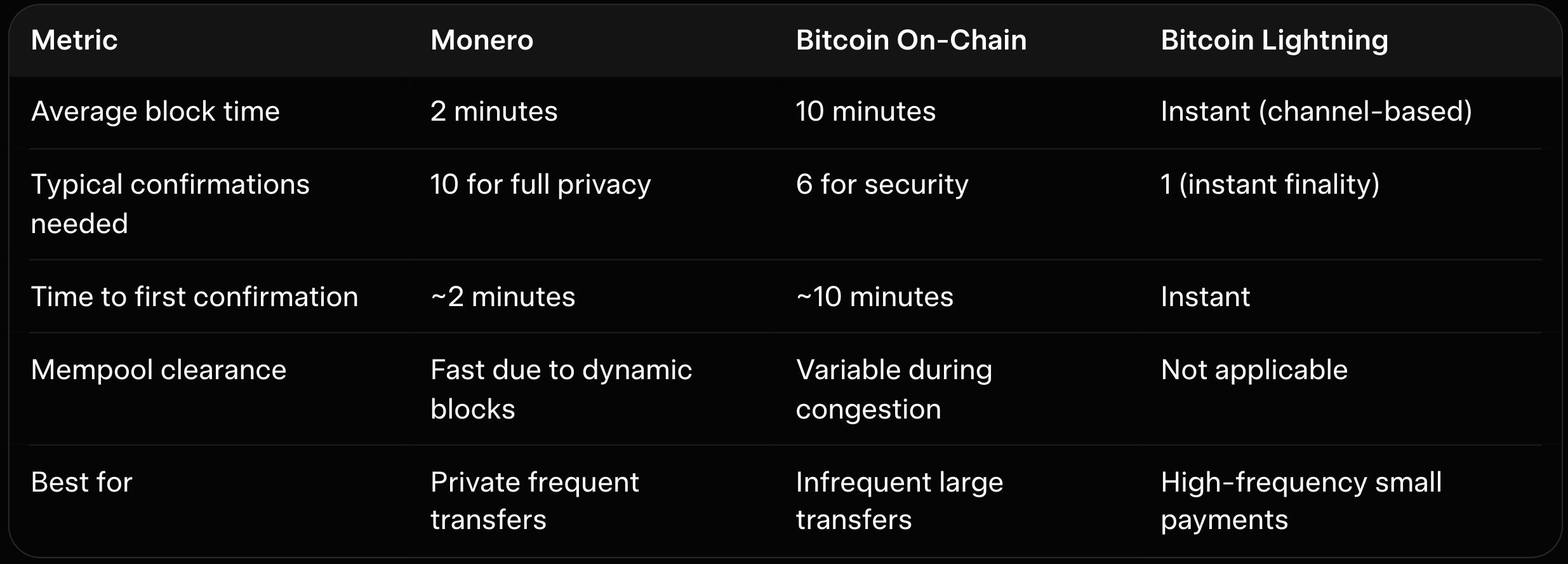
The table illustrates why Monero feels more responsive for private daily use while Lightning dominates instant small payments after setup.
Fee Scenarios
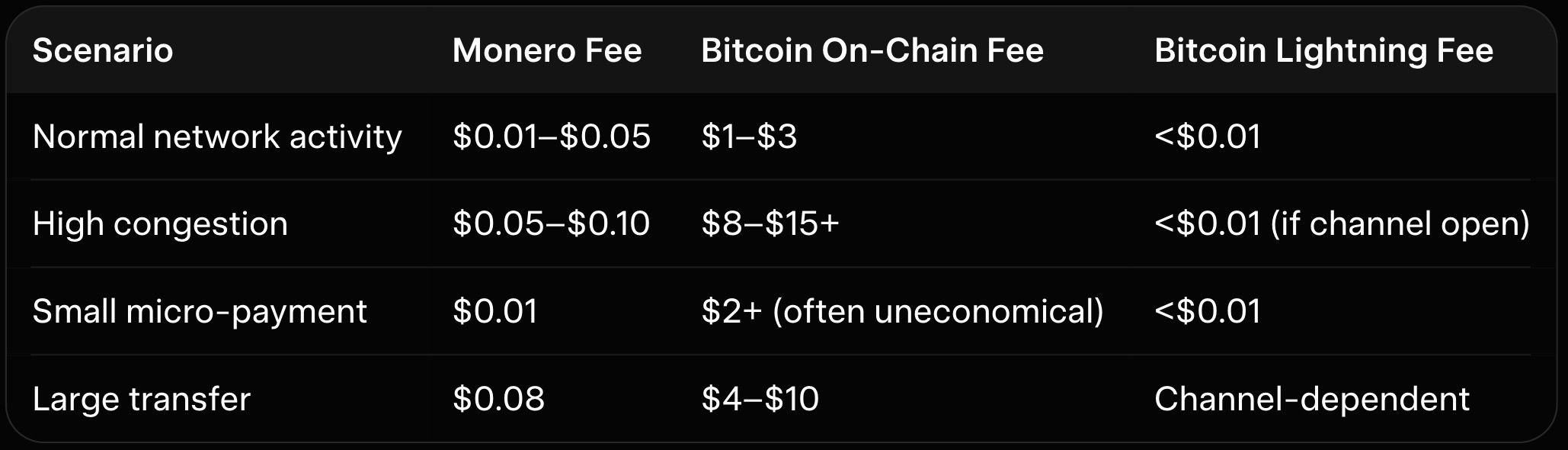
This table shows measurable cost differences across common payment situations. Monero remains economical in every scenario while Bitcoin on-chain becomes expensive during peaks.
Mempool Behavior in Practice
Monero’s mempool clears efficiently because blocks expand dynamically to include all pending transactions without fee competition. Users rarely see transactions stuck for long periods. The system self-regulates without forcing users to overpay.
Bitcoin’s mempool fills quickly during demand spikes and creates a fee auction that delays low-fee transactions for hours or days. Lightning bypasses the mempool entirely for channel-based payments but still depends on occasional on-chain settlements. Our Monero GUI vs CLI wallet comparison explains how Monero users monitor mempool status more predictably than Bitcoin users.
Payment Efficiency for Merchants and Users
Merchants who accept Monero benefit from predictable low fees and simple QR code invoices with fresh subaddresses. No extra compliance steps are needed for tainted-coin risks because fungibility is perfect. Our best Monero desktop wallets guide helps merchants set up efficient receipt workflows.
Bitcoin merchants prefer Lightning for its instant settlement and low cost on small transactions but must manage channel liquidity and occasional on-chain fees. On-chain Bitcoin works for larger one-off payments when fees are reasonable. The choice often depends on transaction size and frequency.
How Baltex.io Enables Efficient Routing Between BTC and XMR for Cost Optimization
When Bitcoin on-chain fees spike or Lightning channels are inconvenient many users switch to Monero for its stable low costs. Baltex.io integrates directly by accepting BTC deposits and delivering clean XMR outputs in one non-custodial transaction. You send from your Bitcoin wallet to a Baltex deposit address and the platform routes privately without ever seeing your keys.
The reverse flow works equally well so you can move Monero back to Bitcoin Lightning when instant settlement matters more. Enable Private Swap mode for extra shielded hops that maintain unlinkability during the transition. For readers of our Trocador review and StealthEX review, Baltex.io provides the cleanest bridge when optimizing fees and speed across networks.
Traders convert Bitcoin holdings into Monero during high-fee periods and back again when Lightning liquidity is abundant. The workflow completes in minutes and works with any wallet. Our best P2P Monero exchanges guide shows additional options that pair naturally with this cost-optimization routing.
Businesses accepting mixed payments route Bitcoin inflows through Baltex.io into Monero for predictable low-cost accounting while keeping receive addresses isolated. The non-custodial design ensures full key control throughout. Our hardware wallet for Monero guide and Monero wallet security best practices help users layer extra protection on top of these routed transactions.
Advanced Cost-Optimization Tips
Monitor Bitcoin mempool congestion before deciding which coin to use for each payment. Route small frequent transfers through Monero and larger one-off payments through Bitcoin Lightning when fees are low. Test small amounts first when setting up new routing habits.
Our best Monero mobile wallets guide and Cake Wallet review show how mobile users execute these routes effortlessly. Our Monero GUI vs CLI wallet comparison helps advanced users monitor both networks in real time.
FAQ Which coin is faster for small payments in 2026? Bitcoin Lightning delivers instant settlement once channels are open while Monero offers reliable 2-minute blocks with no setup required.
Are Monero fees really lower than Bitcoin? Monero fees stay consistently low and predictable while Bitcoin on-chain fees fluctuate sharply during congestion.
Does Lightning make Bitcoin more efficient than Monero? Lightning excels at high-frequency small payments but requires channel management that Monero avoids entirely.
How do confirmation times compare for merchants? Monero merchants often accept after one or two blocks while Bitcoin Lightning settles instantly and on-chain Bitcoin needs multiple confirmations.
Can I use both coins for payments? Yes. Route between them via Baltex.io to optimize fees and speed for each specific transaction.
Is mempool congestion worse on Bitcoin? Yes. Bitcoin’s fixed block size creates fee auctions while Monero’s dynamic blocks clear the mempool more reliably.
How does Baltex.io help with cost optimization? It converts BTC to XMR or XMR to BTC non-custodially so users can switch networks instantly when fees or speed favor one coin over the other.
Conclusion
Monero and Bitcoin deliver different strengths for payments in 2026. Monero provides stable low fees, predictable confirmations, and built-in privacy that make it ideal for frequent private transfers. Bitcoin with Lightning offers unmatched speed for small payments once infrastructure is in place while on-chain Bitcoin remains efficient for larger infrequent transfers when fees are reasonable.
The smartest payment strategy is to use both coins and route between them as each situation demands. Monero handles the predictable private layer while Bitcoin Lightning powers the instant small-value layer. When the time comes to optimize costs across networks, our best no-KYC Monero swappers overview shows exactly why Baltex.io belongs in every payment-focused workflow.
For deeper wallet and efficiency strategies explore our best Monero mobile wallets guide, the Cake Wallet review, or the hardware wallet for Monero guide. Payments work best when you match the right coin to the right transaction and route intelligently between them. Your costs and your speed will both stay optimized.
You can read our full breakdown in SimpleSwap Review 2026: Pros, Cons, and Monero Exchange Fees.
For more on this, see our guide on Instant Swap Services: The Go-To for Privacy-Conscious Users.
We cover this in more detail in XMR.to Alternatives: How to Pay Bitcoin Invoices with Monero.
Related reading: Zcash (ZEC) vs Monero (XMR): Which Privacy Coin Wins in 2026.