 1 minute to read
 Ecosystem
Monero vs Grin: Two Privacy Coins, Two Approaches
TL;DR
Monero and Grin both deliver strong on-chain privacy in 2026 but take opposite paths. Monero uses mandatory RingCT with ring signatures and stealth addresses for maximum unlinkability while Grin relies on Mimblewimble’s interactive confidential transactions and cut-through aggregation for lightweight scalability. Monero wins for proven anonymity sets and usability while Grin excels at compact blockchain size and minimalist design. Most users route between them via Baltex.io to combine Monero’s privacy strength with Grin’s efficiency when needed.
Monero and Grin represent two distinct philosophies in the privacy coin space. Monero prioritizes unbreakable default privacy for every user through complex cryptographic mixing. Grin embraces Mimblewimble to achieve privacy and extreme scalability through transaction aggregation and the elimination of addresses.
The real-world implications of these choices affect everything from transaction fees to long-term chain growth. One coin grows heavier over time but protects every payment automatically. The other stays compact but requires more careful user interaction.
Feature Comparison
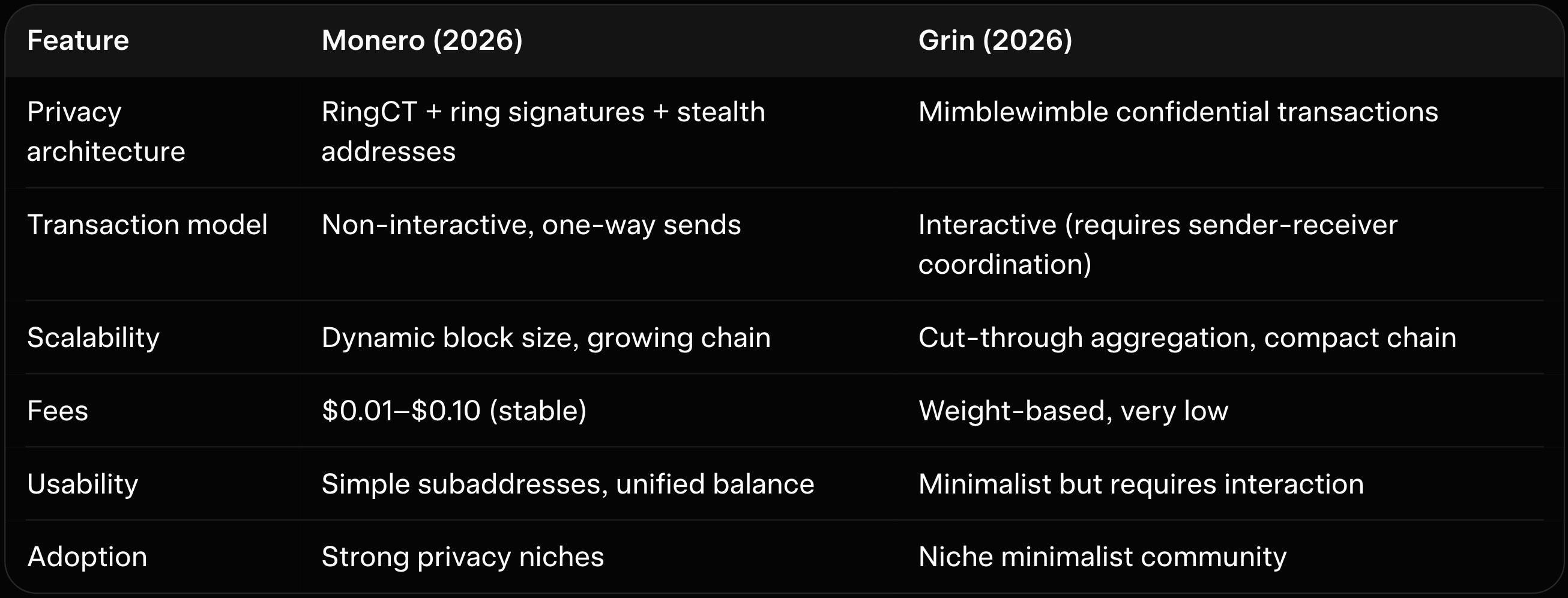
The table reveals the core trade-offs. Monero sacrifices some efficiency for effortless privacy. Grin trades interactivity for a dramatically smaller blockchain footprint.
Monero’s RingCT hides amounts while ring signatures blend the real spender with decoys from the entire chain. Stealth addresses ensure recipients receive funds to unique one-time keys. The FCMP++ upgrade expanded anonymity sets to the full set of unspent outputs.
Grin’s Mimblewimble protocol uses confidential transactions to hide amounts and eliminates traditional addresses entirely. Transactions are interactive so the sender and receiver must coordinate to build the transaction. Cut-through then aggregates and removes intermediate data so the blockchain stays compact.
Privacy Architecture Trade-Offs
Monero’s mandatory privacy means every transaction is unlinkable without any user configuration. The protocol-level design protects beginners and experts equally and prevents accidental leaks. Anonymity sets include the entire chain so statistical attacks become impractical.
Grin achieves privacy through Mimblewimble’s structure where no addresses exist and amounts stay encrypted. The interactive model requires both parties online during construction which adds a small coordination step. Privacy remains strong but the smaller effective anonymity set compared to Monero’s full-chain mixing creates a theoretical difference under heavy analysis.
Transaction Model Differences
Monero allows one-way sends to a subaddress with no further interaction needed after the initial broadcast. The wallet handles everything automatically and the recipient sees the funds instantly in their unified balance. This simplicity makes Monero ideal for everyday private payments.
Grin requires the sender and receiver to interact to construct the transaction before it can be broadcast. This interactive step adds friction but enables the aggressive cut-through that keeps the chain lightweight. Many wallets have streamlined the process yet it still feels less seamless than Monero’s one-click model.
Scalability and Long-Term Chain Growth
Monero scales through dynamic block sizing that automatically adjusts to demand while preserving full privacy. The chain grows over time but recent optimizations reduced transaction sizes significantly. Users with modest hardware can still run full nodes comfortably in 2026.
Grin’s Mimblewimble design excels at scalability because cut-through removes most historical data from the chain. The blockchain stays dramatically smaller than Monero’s even after years of activity. This lightweight approach appeals to users who value long-term efficiency and low storage requirements.
Fees and Economic Behavior
Monero maintains consistently low and predictable fees because the dynamic block mechanism prevents congestion bidding wars. The cost stays under ten cents for typical private transactions regardless of network activity. This stability encourages frequent private P2P use without users worrying about privacy premiums.
Grin uses weight-based fees that remain very low thanks to the compact transaction format. The minimalist design keeps costs competitive and predictable for small transfers. Our best no-KYC Monero swappers overview notes how both coins’ low fees make routing between them practical for users seeking the best of both privacy models.
Usability in Daily Scenarios
Monero wallets generate fresh subaddresses automatically and display a single unified balance so sending or receiving feels intuitive. The official GUI and popular mobile apps require almost no learning curve for privacy-focused tasks. Our best Monero mobile wallets guide and Cake Wallet review highlight how seamless the experience remains.
Grin prioritizes minimalism so wallets feel stripped-down and focused purely on privacy and efficiency. The interactive transaction model adds a small extra step that some users find cumbersome at first. Our Feather Wallet review shows how advanced users combine tools for smoother Grin workflows.
Adoption and Real-World Implications
Monero dominates privacy-sensitive niches with strong community support and consistent development. Its mandatory privacy model has withstood years of scrutiny and regulatory pressure. Adoption remains robust in donations, remittances, and private marketplaces.
Grin appeals to users who value radical minimalism and long-term scalability. The fair-launch ethos and community-driven development attract cypherpunk enthusiasts. Liquidity and mainstream adoption stay lower than Monero’s yet the coin maintains a dedicated following for its elegant design.
Use Cases
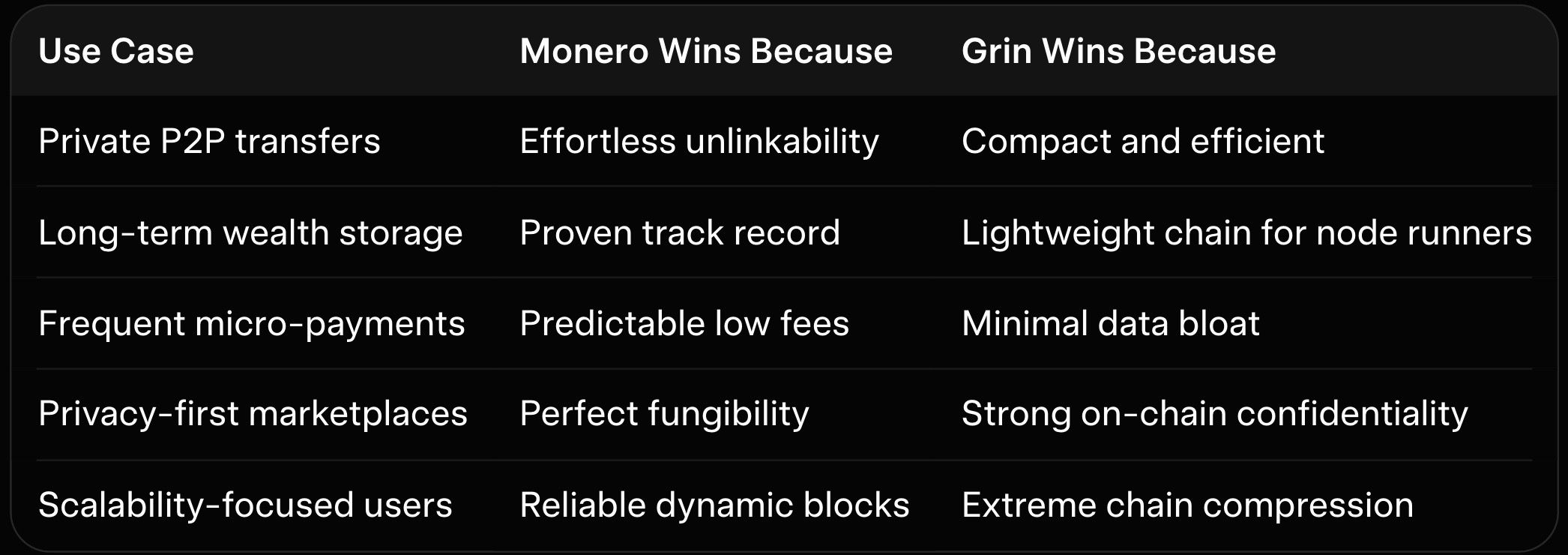
This table shows how the two coins serve overlapping but distinct audiences. Monero prioritizes effortless privacy for everyday users. Grin appeals to those who value technical elegance and future-proof scalability.
How Baltex.io Enables Routing Between XMR and Other Assets Users who hold both Monero and Grin often want to move value between them for liquidity or to combine privacy strengths. Baltex.io integrates cleanly by accepting direct deposits from either coin and delivering clean outputs on the destination chain in one non-custodial transaction. You select XMR to another asset or Grin to XMR, send from your wallet, and enable Private Swap mode for extra shielded hops that enhance unlinkability.
The platform works seamlessly whether you route from Monero’s mandatory privacy into Grin’s lightweight model or the reverse. Funds arrive at fresh addresses ready for immediate use with no accounts or KYC required. For readers of our Trocador review and StealthEX review, Baltex.io provides the cleanest bridge when switching between different privacy philosophies.
Traders move Monero holdings into Grin for ultra-compact storage and back again when broader liquidity matters. The workflow completes in minutes and integrates with any wallet. Our best P2P Monero exchanges guide shows additional options that pair naturally with this cross-coin routing.
Businesses or individuals accepting Grin payments route excess inflows through Baltex.io into Monero for stronger anonymity while keeping receive addresses isolated. The non-custodial design ensures keys never leave your control. Our hardware wallet for Monero guide and Monero wallet security best practices help users layer extra protection on top of these routed transactions.
Advanced Routing Tips with Baltex.io
Use fresh subaddresses on Monero after routing to maintain maximum separation. Test small amounts first to confirm output destinations and timing. Combine with hardware wallets for larger moves to keep long-term keys offline.
Our best Monero desktop wallets guide and Monero GUI vs CLI wallet comparison guide wallet choice for efficient privacy workflows. Our best Monero mobile wallets guide and Cake Wallet review show mobile options for seamless cross-coin management.
Conclusion
Monero and Grin both advance privacy in 2026 but through fundamentally different approaches. Monero’s RingCT delivers effortless mandatory unlinkability that protects every user automatically while Grin’s Mimblewimble offers lightweight scalability and minimalist elegance at the cost of interactive transactions. The choice depends on whether you prioritize proven anonymity sets or extreme chain efficiency.
Start by testing small routes between the two coins to experience the practical differences firsthand. Many privacy-conscious holders keep exposure to both and switch as needs evolve. When the time comes to move value across chains for liquidity or privacy flexibility, our best no-KYC Monero swappers overview shows exactly why Baltex.io belongs in every privacy-coin toolkit.
For deeper wallet and security strategies explore our best Monero mobile wallets guide, the Cake Wallet review, or the hardware wallet for Monero guide. Privacy coins thrive when you match the right technology to the right use case and route intelligently between them. Your funds stay yours to control with the right tools ahead.
Related reading: SimpleSwap Review 2026: Pros, Cons, and Monero Exchange Fees.
For more on this, see our guide on Aztec Network: Best for Programmable Private Smart Contracts.
Related reading: XMR.to Alternatives: How to Pay Bitcoin Invoices with Monero.
We cover this in more detail in Zcash (ZEC) vs Monero (XMR): Which Privacy Coin Wins in 2026.