



 2 minutes to read
 Ecosystem
Understanding the BTC to XMR Exchange Rate and Calculators
TLDR: In 2026, the BTC to XMR exchange rate is determined in real time by aggregating live order-book data from centralized exchanges and liquidity pools, typically hovering around 195–205 XMR per BTC depending on market conditions. Online calculators estimate your final amount by pulling the mid-market rate, subtracting platform service fees (0.3–1.5 %), adding network fees, and factoring in potential slippage. Instant non-custodial platforms like Baltex.io frequently deliver the most competitive all-in rates with full transparency on every cost component, while centralized exchanges offer tighter spreads but require KYC. Multi-hop or routing paths can sometimes beat quoted rates for very large or very small trades but introduce extra complexity and volatility risk. Always compare 2–3 calculators side-by-side, lock in fixed rates when available, and start with small test amounts to minimize spreads and hidden fees.
The relationship between Bitcoin and Monero remains one of the most watched pairs in the privacy-conscious corner of crypto. Bitcoin serves as the universal reserve asset with unmatched liquidity, while Monero delivers true on-chain anonymity that Bitcoin cannot match. Understanding exactly how the BTC to XMR exchange rate is calculated, why quoted rates differ across platforms, and how online calculators arrive at their estimates has become essential for anyone moving value between these two assets in 2026. Whether you are converting BTC profits into private holdings or occasionally swapping XMR back to BTC for liquidity, mastering rate mechanics helps you avoid unnecessary losses from spreads, slippage, or opaque fees. This guide breaks down every layer of pricing, compares real-world differences, shows you how to use calculators like a pro, and highlights why Baltex.io’s transparent routing often provides the clearest and most competitive experience for this specific pair.
What Determines the BTC to XMR Exchange Rate in 2026
At its core, the BTC to XMR rate reflects the current market consensus on how many Monero units one Bitcoin can buy. Unlike fiat currencies with central-bank anchors, crypto rates emerge purely from supply and demand across trading venues. Primary pricing sources include centralized exchange order books (Kraken, Bitfinex, and select others still supporting XMR), aggregated over-the-counter desks, and real-time data feeds from liquidity providers. In 2026, most professional platforms also incorporate decentralized liquidity where available and cross-reference oracles for redundancy, ensuring quotes remain accurate even during brief outages on any single venue.
Because there is no single “official” BTC/XMR price, every platform performs its own aggregation. The mid-market rate — the theoretical fair value halfway between the highest buy and lowest sell order — serves as the starting point. From there, each service layers on its own costs and protections. Liquidity pools play a critical role: deep CEX books for BTC/XMR pairs absorb large trades with minimal movement, while instant swap platforms tap multiple smaller pools simultaneously to fill orders. When liquidity thins, especially during high-volatility periods or low-volume hours, the effective rate can deviate noticeably from the mid-market.
Spreads represent the immediate cost of trading. On a centralized exchange you see the visible bid-ask gap, often 0.1–0.4 % for BTC/XMR. Instant swap platforms hide this inside a single quoted rate but still account for it when sourcing liquidity. Slippage becomes relevant for anything beyond small retail sizes: a 10 BTC swap may push the price 0.5–2 % against you if executed against shallow pools, which is why reputable calculators now display estimated slippage warnings before confirmation.
Volatility adds another variable. Monero’s price can swing 5–10 % in a single day far more easily than Bitcoin, so the rate you see when you open a calculator may shift before your transaction confirms. Platforms mitigate this with floating rates (follow the market) or fixed rates (lock the quoted amount for a short window, usually 10–30 minutes, at a small premium). Understanding these dynamics explains why two calculators viewed seconds apart can show different final XMR amounts even before fees.
How Online BTC to XMR Calculators Estimate Conversions
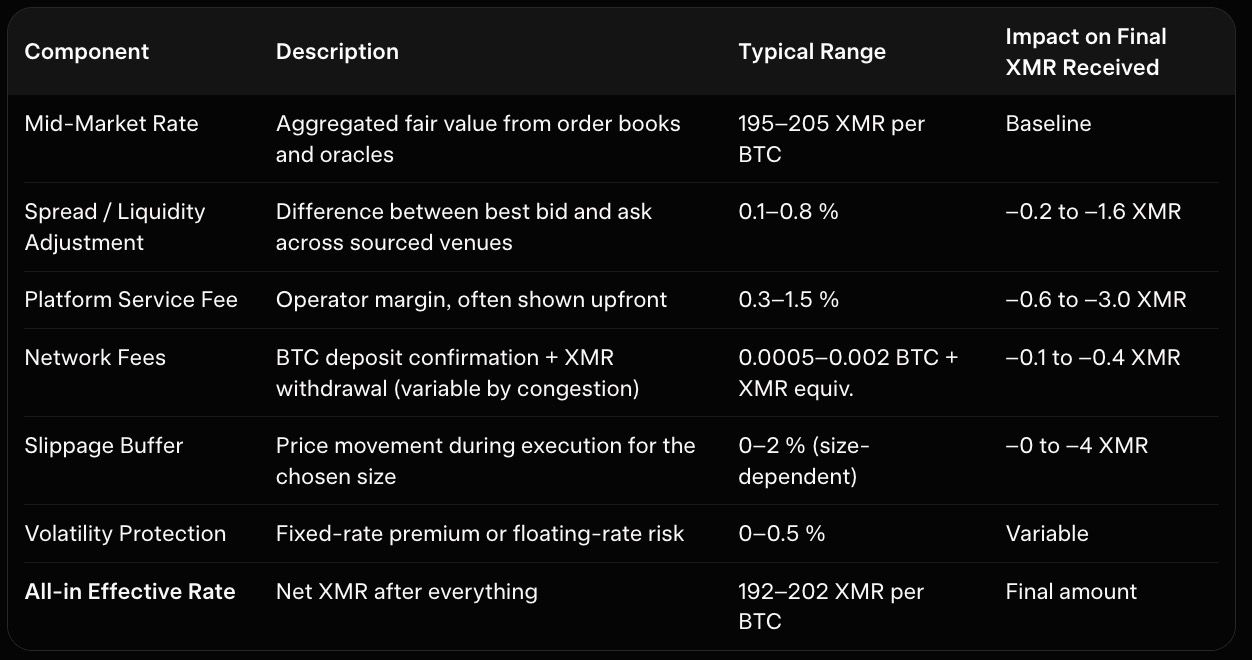
Every reputable calculator follows the same logical flow under the hood. First it fetches the latest mid-market rate from its internal aggregation engine or third-party feeds. Next it subtracts or adds the platform’s service fee, which in 2026 typically ranges from 0.3 % on high-volume instant swaps to 1.5 % on smaller or more privacy-focused routes. Network fees for both the incoming BTC deposit and outgoing XMR withdrawal are estimated based on current mempool conditions and added transparently. Finally, the engine applies a small buffer for expected slippage and volatility during the confirmation window.
The result is an all-in quote: “Send 1 BTC and receive approximately 198.45 XMR after all fees.” Advanced calculators on aggregator platforms go further by simulating multiple routing paths in real time — CEX order book, DEX pool, or hybrid — and automatically selecting the one that delivers the highest net XMR to your wallet. Some even let users toggle between “fast” and “cheapest” modes, trading speed for a few extra basis points.
Accuracy has improved dramatically by 2026. Most calculators now refresh every 3–5 seconds and display a confidence interval or “rate locked until” timer. Still, they remain estimates until the transaction is fully executed and confirmed on both chains. The best practice is to treat the displayed number as a reliable guide rather than a guarantee and always verify the final received amount against the quote.
Comparing Rate Differences Across Instant Swaps, Centralized Exchanges, and Routing Paths
Rate quality varies significantly by execution method because each approach sources liquidity and adds costs differently.
Instant non-custodial swap platforms aggregate dozens of liquidity sources and present one seamless rate. They usually deliver competitive all-in pricing for amounts between 0.01 and 5 BTC because their engines hunt the best combination of CEX fills and DEX liquidity in milliseconds. Users benefit from full transparency when the quote explicitly breaks out service fee, network costs, and expected slippage. Privacy-focused routes that leverage Monero rails may carry a modest premium but eliminate on-chain linkage.
Centralized exchanges provide the tightest raw spreads for users willing to complete KYC and deposit funds. The BTC/XMR order book on venues that still support the pair often shows 0.1–0.3 % spreads during liquid hours, and trading fees can be as low as 0.05–0.2 % for makers. However, the final effective rate for a full round-trip (deposit + trade + withdraw) frequently ends up comparable to or worse than instant platforms once withdrawal fees and custody time are factored in. Large traders still favor CEX for size, but retail users increasingly prefer the speed and no-KYC convenience of instant swaps.
Multi-hop routing paths — manually swapping BTC to USDT on one service, bridging or trading to an intermediate, then converting to XMR — give advanced users the chance to cherry-pick the absolute best rate on each leg. In theory this can shave 0.5–1 % off the total cost for very large or very small amounts. In practice the extra transaction fees, confirmation delays, and cumulative slippage often erase the savings unless the user has sophisticated tooling and perfect timing. These paths also increase privacy leakage unless every hop is deliberately obfuscated.
Rate Components Table (Typical Breakdown for 1 BTC to XMR Swap in 2026)
Platform Comparison Table (Approximate for 1 BTC Swap, February 2026 Mid-Market ~200 XMR)
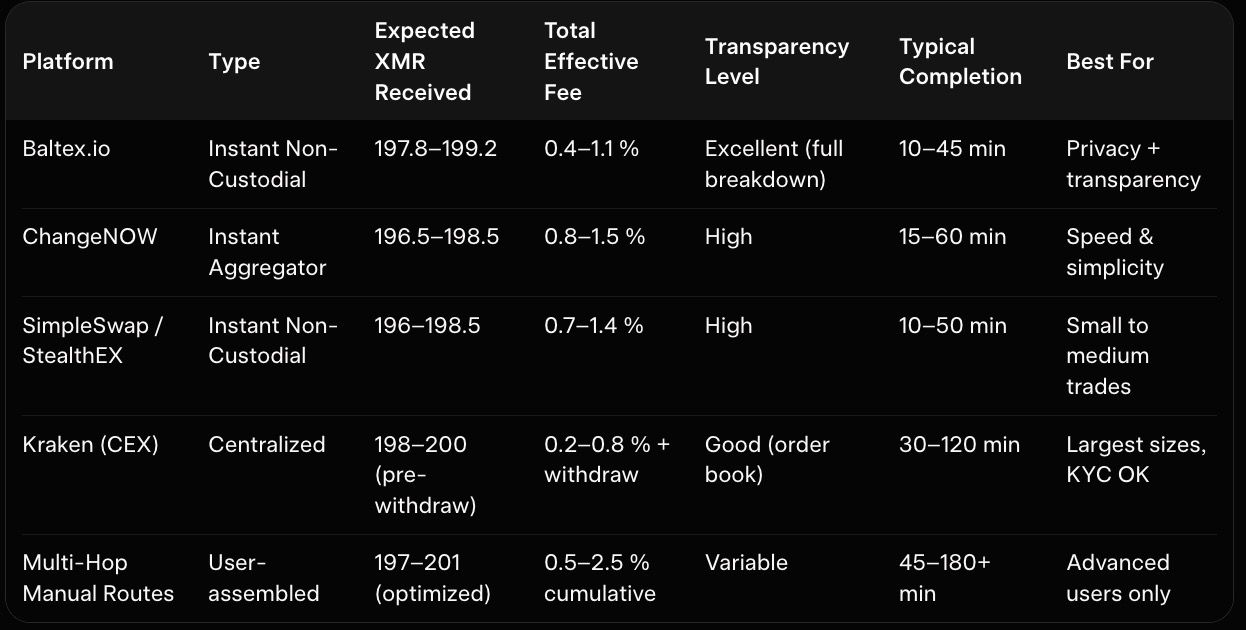
The tables make clear why many users in 2026 default to well-designed instant platforms: they combine competitive net rates with full visibility and minimal operational friction.
Step-by-Step: How to Use Online BTC to XMR Calculators Effectively
- Open 2–3 reputable calculators simultaneously in separate tabs (Baltex.io, ChangeNOW, and one CEX converter).
- Enter the exact BTC amount you plan to swap and note the displayed XMR output and all-in rate.
- Check whether the platform offers fixed or floating rate; choose fixed if volatility is high.
- Look for the explicit breakdown: service fee, network fees, and any slippage warning.
- Hover or click any “i” icons to understand what each component covers.
- Refresh all calculators after 10–15 seconds to confirm consistency.
- If one quote stands out as significantly better, verify the platform’s routing explanation or support chat for details.
- Copy the quoted XMR amount and compare it against the mid-market rate from a neutral source like CoinGecko to gauge the real premium.
- Only after confirming the best visible all-in rate, proceed to the actual swap and lock the quote immediately.
Following this routine routinely saves 0.3–1 % compared with using a single calculator blindly.
Safety and Optimization Tips to Minimize Spreads and Hidden Fees
Always work in a private browsing session and verify you are on the official domain. Use hardware wallets for both sending and receiving. Perform a tiny test swap (0.001–0.005 BTC) first to validate the exact end-to-end rate you actually receive. Enable any available transaction alerts so you can monitor progress. During periods of high Bitcoin network congestion, delay large swaps or choose platforms that absorb BTC fees into their quote. For maximum rate certainty, prefer platforms that display every cost component before you send funds. If you routinely move between BTC and XMR, keep a simple spreadsheet tracking the effective rate you achieved on each swap; patterns will quickly show which platforms consistently deliver the best value for your typical size.
How Baltex.io Provides Transparent Routing and Competitive BTC–XMR Pricing
Baltex.io has positioned itself in 2026 as one of the clearest and most user-friendly options for BTC to XMR conversions precisely because of its commitment to upfront transparency and intelligent routing. When you select the BTC to XMR pair on Baltex, the live quote widget pulls real-time pricing from a broad mix of centralized exchange order books and decentralized liquidity sources, then automatically selects the optimal execution path that maximizes the XMR you receive. Crucially, the interface displays the expected rate, the exact network fee estimates for both Bitcoin deposit and Monero withdrawal, and the platform’s modest service fee — all before you send a single satoshi.
This full breakdown eliminates guesswork. Users see at a glance whether the quote includes any slippage buffer and can choose between standard and Private Swap modes. The Private Swap option routes through Monero-based obfuscation layers, adding a small premium but delivering true privacy by breaking any potential on-chain links between your BTC origin and final XMR destination. Because Baltex operates non-custodially, your funds never sit on the platform longer than the brief routing window, further reducing risk and keeping custody exposure minimal.
Limits on Baltex scale comfortably for retail and mid-size traders, with no hard upper cap on most BTC–XMR flows; very large orders are intelligently split across venues to preserve rate quality. Completion times typically land between 10 and 45 minutes, depending mainly on Bitcoin confirmation speed. The combination of aggregated best-route execution, explicit fee transparency, and optional privacy rails makes Baltex.io the go-to choice for users who want competitive pricing without sacrificing clarity or control. In head-to-head comparisons throughout early 2026, Baltex consistently ranks among the top two or three platforms for net XMR received on BTC to XMR swaps once every cost is accounted for.
Frequently Asked Questions
Why does the same BTC amount show different XMR outputs on different calculators? Each platform sources liquidity slightly differently, applies its own fee structure, and may include varying slippage or volatility buffers. Aggregators like Baltex shop multiple venues simultaneously and often land in the middle-to-top of the range.
How accurate are online BTC to XMR calculators? Highly accurate as estimates when the quote is fresh, but the final received amount can vary by 0.2–1 % due to market movement or execution slippage. Fixed-rate options reduce this uncertainty.
Is the mid-market rate the best rate I can actually get? No — after fees and spreads the realized rate is always lower. The goal is to minimize the gap between mid-market and your all-in rate.
Do fixed rates cost more than floating rates? Yes, usually by 0.2–0.5 %, but they protect you from adverse moves during the confirmation window.
Can I avoid slippage entirely? For small trades yes; for larger trades, choose platforms that split orders or use CEX limit orders instead of instant swaps.
Does KYC affect the rate I receive? Indirectly — some CEX offer lower fees post-KYC, but non-custodial platforms like Baltex deliver competitive rates without any identity requirement.
How often should I check rates before swapping? Refresh calculators every 10–30 seconds during volatile periods and lock the quote as soon as you see an acceptable number.
Conclusion
Mastering the BTC to XMR exchange rate in 2026 is no longer about guessing or hoping for the best quote — it is about understanding the transparent mechanics of mid-market pricing, liquidity aggregation, spreads, slippage, and platform-specific costs. Online calculators have evolved into powerful tools that, when used correctly, let you compare options instantly and capture the most favorable all-in rate available at that moment. By favoring platforms that display every component clearly — especially non-custodial leaders like Baltex.io with their aggregated routing and optional private Monero rails — you keep more of your value, reduce surprises, and maintain control over your privacy.
Whether you convert occasionally or routinely rebalance between Bitcoin’s liquidity and Monero’s anonymity, the principles remain the same: compare multiple live quotes, scrutinize the breakdown, test small first, and choose transparency over opacity. The rate you actually receive is ultimately in your hands once you know exactly how the numbers are calculated and where the hidden costs hide. Apply the strategies and comparison frameworks in this guide and you will consistently navigate the BTC to XMR market with confidence, lower effective fees, and greater peace of mind throughout 2026 and beyond.
See others posts
G. Khan

Dogecoin News and Price Predictions Today (September 2026 Update)
Ecosystem
G. Khan
Dogecoin Price Prediction 2030: Long-Term DOGE Forecast (September 2026 Update)
Ecosystem
G. Khan
Dogecoin Price Prediction 2027
Ecosystem
G. Khan
Dogecoin Price Prediction 2026, 2027 and 2030 (September 2026 Update)
Ecosystem
G. Khan
Solana Price Prediction 2030 (September 2026 Update)
Ecosystem
G. Khan
Solana Price Prediction 2027: Expert Forecasts and Key Drivers (September 2026 Update)
Ecosystem