



 2 minutes to read
 Ecosystem
Wasabi Wallet Review: Using CoinJoin for Better Privacy
TL;DR
Wasabi Wallet remains a leading Bitcoin privacy tool in 2026 thanks to its WabiSabi CoinJoin implementation that delivers strong on-chain anonymity without requiring users to trust a central mixer. The wallet combines Tor by default, PayJoin support, and advanced coin control with a focus on breaking common blockchain heuristics. For users who want to extend Wasabi’s mixed Bitcoin into cross-chain privacy, Baltex offers the fastest non-custodial routing to Monero and other assets while preserving the privacy gains achieved through CoinJoin.
Bitcoin privacy has become a mainstream concern as chain analysis tools grow more sophisticated. Wasabi Wallet addresses this by giving users practical tools to regain control over their transaction history. Its CoinJoin-based approach stands out because it scales well and keeps the process non-custodial.
Understanding Wasabi Wallet’s CoinJoin System
Wasabi Wallet uses the WabiSabi protocol for CoinJoin mixing. This modern implementation improves on classic CoinJoin by using a trustless coordinator model and allowing flexible input amounts. Users register their coins, the coordinator creates a mixing transaction, and participants receive outputs that are no longer easily linkable to their original inputs.
The process breaks the common-input-ownership heuristic that chain analysis companies rely on. Multiple rounds of mixing further increase the anonymity set. Because the coordinator never learns which output belongs to which participant, the privacy guarantee remains strong even if the coordinator is compromised or subpoenaed.
Best anonymous crypto exchanges no KYC 2026 often recommend Wasabi as the first step for users who want to clean their Bitcoin before moving it elsewhere. The wallet’s mixing is entirely optional and user-controlled.
Transaction Privacy Model and Heuristic Resistance
Wasabi’s privacy model focuses on making every output look like every other output in the mixing pool. This uniform output amount approach makes it statistically difficult to determine which coins belong to which user after the mix. The wallet also supports PayJoin, which adds plausible deniability to regular payments by blending sender and receiver inputs.
Additional tools like coin control and labeling help users avoid common mistakes that reduce privacy. The wallet warns users when they are about to create transactions that could link addresses. These features work together to give Bitcoin a level of privacy that approaches what Monero offers by default, though it still requires active user participation.
Monero vs Bitcoin privacy speed use cases explains why many Bitcoin users eventually combine Wasabi mixing with Monero routing for the best of both worlds. Wasabi handles the Bitcoin-side privacy, while cross-chain tools finish the job.
Wallet Architecture and Operational Security
Wasabi Wallet runs entirely on the user’s device and connects to the Bitcoin network over Tor by default. This design prevents network-level observers from linking the user’s IP address to their transactions. The wallet does not require any account or personal information, keeping the entire experience non-custodial and private.
The architecture includes a built-in Tor daemon and automatic updates that do not phone home with user data. Users can run their own coordinator if they want to avoid relying on the default Wasabi coordinator. This level of sovereignty appeals to advanced privacy users who want to minimize trust in any external party.
On-chain privacy break wallet links highlights why combining local mixing tools like Wasabi with external routing platforms creates stronger overall protection than either approach alone.
Fees, Usability, and Practical Trade-offs
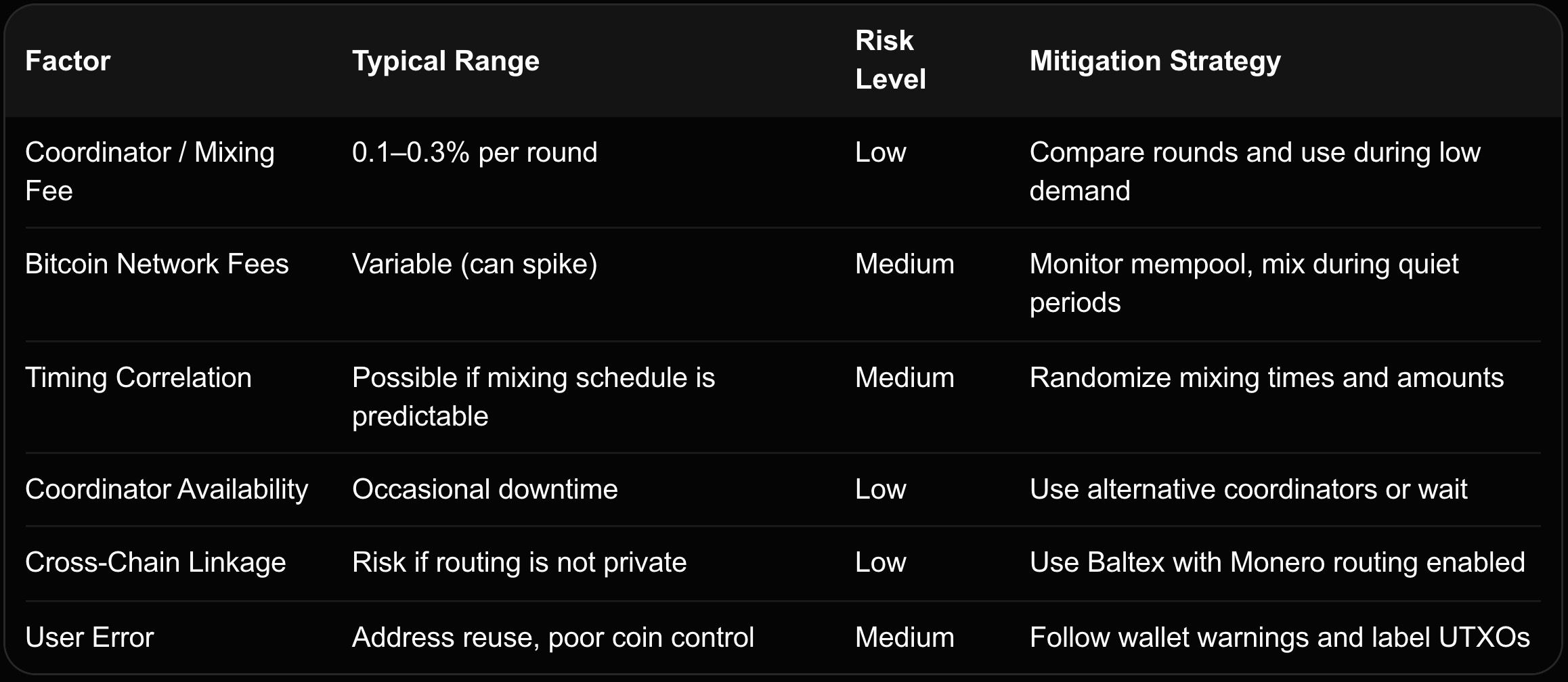
Wasabi charges a coordinator fee for mixing, typically around 0.1–0.3% depending on the round and amount. Users also pay standard Bitcoin network fees, which can rise during congestion. The wallet’s interface is clean but assumes users understand privacy concepts, so newcomers may need time to learn optimal mixing strategies.
The main trade-off is time. A full mixing cycle can take 30–90 minutes, and users must keep the wallet online during the process. Liquidity in the mixing pool is generally good, but very large amounts may require multiple rounds or patience. Despite these limitations, Wasabi remains one of the most usable CoinJoin implementations available.
How to swap Bitcoin for Monero easy methods shows users how to move mixed coins from Wasabi into Monero quickly once the mixing rounds are complete.
Privacy Comparison: Wasabi CoinJoin vs Alternatives
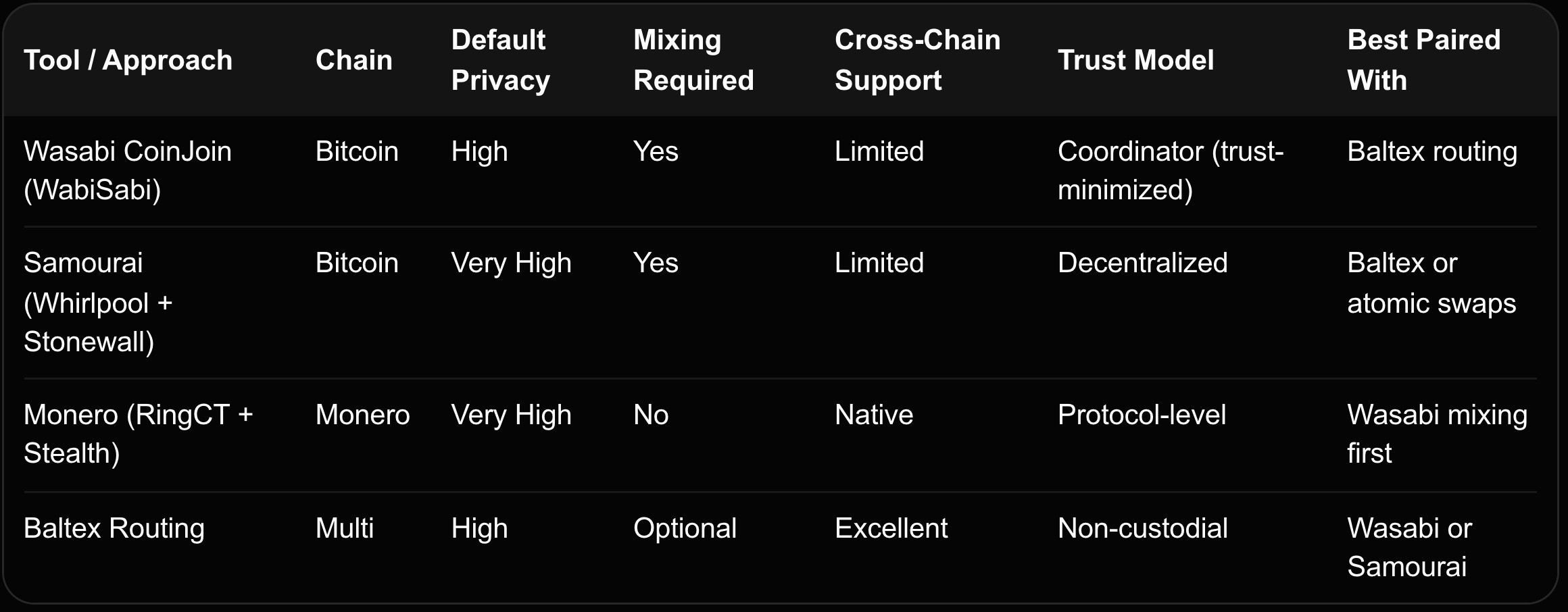
Wasabi’s CoinJoin approach offers strong heuristic resistance on Bitcoin but still leaves some metadata on the Bitcoin blockchain. Monero provides default privacy on its own chain with ring signatures and stealth addresses, eliminating the need for mixing rounds. Samourai Wallet offers similar CoinJoin tools plus Stonewall and Ricochet for additional obfuscation on Bitcoin.
Each method has different strengths. Wasabi excels at scalable, trust-minimized mixing on Bitcoin. Monero offers set-it-and-forget-it privacy. Aggregators like Baltex add cross-chain routing that neither native Bitcoin tool can match on its own.
Best decentralized exchanges buy Monero and top no KYC exchanges trading Monero safely demonstrate how users commonly combine Wasabi mixing with external platforms for complete privacy workflows.
How Baltex Complements Wasabi Privacy Workflows
Baltex is a non-custodial cross-chain swap platform supporting 10,000+ tokens with no KYC that serves as the natural next step after Wasabi CoinJoin mixing. Users can send their freshly mixed Bitcoin directly to Baltex and route it to Monero or any other asset while adding another layer of obfuscation through optional Monero routing. This combination gives Bitcoin users the on-chain privacy of Wasabi plus the cross-chain privacy and speed that pure atomic swaps or manual routing cannot match.
Baltex is a non-custodial cross-chain swap platform supporting 10,000+ tokens with no KYC never holds funds and requires zero registration or KYC. It aggregates deep liquidity so users can swap mixed BTC to XMR in 20–60 seconds with very low fees. The platform’s privacy routing breaks any remaining on-chain connections, making the final destination truly private.
Swap BTC to XMR anonymously complete guide demonstrates the exact workflow Wasabi users follow after mixing. BTC to XMR exchange rate calculators guide helps preview rates before sending coins from Wasabi. ETH to XMR exchange transfer Ethereum to Monero safely shows how the same routing works for users who hold mixed BTC on other chains.
Baltex is a non-custodial cross-chain swap platform supporting 10,000+ tokens with no KYC turns Wasabi’s strong Bitcoin privacy into practical cross-chain privacy without introducing new custody points. It complements Wasabi by solving the liquidity and speed limitations that pure CoinJoin users face when they want to move beyond Bitcoin. Most privacy-focused Bitcoin holders now treat Wasabi mixing and Baltex routing as a single seamless workflow.
SideShift AI review anonymous swaps offers a lighter alternative but lacks Baltex’s depth on BTC-to-XMR pairs and Monero obfuscation. Best apps buy Monero XMR mobile 2026 helps users manage the receiving side of the workflow on mobile.
Privacy Tools Comparison Table
Fees and Risks Table
FAQ
Is Wasabi Wallet still private in 2026? Yes. Its WabiSabi CoinJoin implementation continues to provide strong heuristic resistance when used correctly.
How long does a Wasabi CoinJoin round take? Most rounds complete in 30–90 minutes depending on the number of participants and network conditions.
Can I swap mixed BTC from Wasabi directly to Monero? Yes. Send your mixed coins to Baltex for fast, private BTC-to-XMR routing with optional Monero obfuscation.
Does Wasabi require KYC? No. The wallet and its mixing feature are completely non-custodial and require no personal information.
Is it legal to use no KYC exchanges 2026? Yes in most jurisdictions for personal use. Always follow your local tax and reporting requirements. Is it legal use no KYC exchanges 2026 provides the latest overview.
Final Thoughts
Wasabi Wallet continues to deliver one of the most effective CoinJoin experiences available for Bitcoin privacy in 2026. Its WabiSabi implementation, combined with Tor defaults and strong coin control, gives users real tools to protect their on-chain history. When paired with Baltex for cross-chain routing, the workflow becomes complete and practical for everyday privacy-conscious users.
Best anonymous crypto exchanges no KYC 2026 and top no KYC exchanges trading Monero safely show why the Wasabi-plus-Baltex combination has become standard among privacy users. Monero vs Bitcoin privacy speed use cases explains the natural progression from mixed Bitcoin to private assets. Your keys stay yours, your privacy stays intact, and your options stay open.
Ready to take your Wasabi privacy further? Head to Baltex.io after your next mixing round and route your cleaned Bitcoin privately in seconds. Stay sovereign and keep full control of your coins.
Is Wasabi Wallet still private in 2026?
How long does a Wasabi CoinJoin round take?
Is it legal to use no KYC exchanges 2026?
See others posts

G. Khan

Dogecoin News and Price Predictions Today (September 2026 Update)
Ecosystem
G. Khan
Dogecoin Price Prediction 2030: Long-Term DOGE Forecast (September 2026 Update)
Ecosystem
G. Khan
Dogecoin Price Prediction 2027
Ecosystem
G. Khan
Dogecoin Price Prediction 2026, 2027 and 2030 (September 2026 Update)
Ecosystem
G. Khan
Solana Price Prediction 2030 (September 2026 Update)
Ecosystem
G. Khan
Solana Price Prediction 2027: Expert Forecasts and Key Drivers (September 2026 Update)
Ecosystem