 3 minutes to read
 Ecosystem
deBridge Review 2026: Best High-Speed Bridge for Stablecoin Swaps?
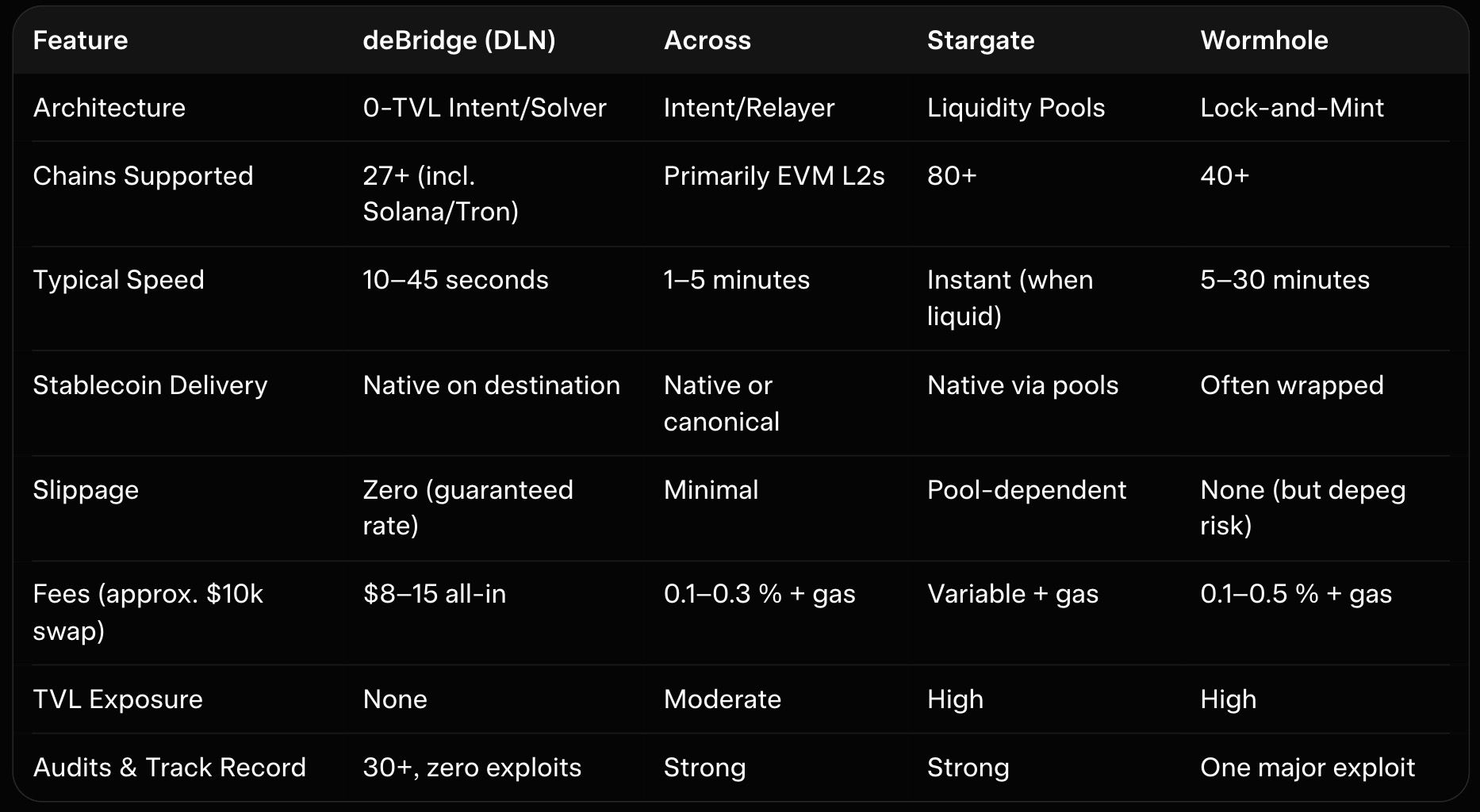
TLDR In 2026, deBridge delivers one of the fastest, most capital-efficient bridges for stablecoin swaps thanks to its 0-TVL intent-based DLN model. Users receive native USDT or USDC on the destination chain in seconds with guaranteed rates, zero slippage, and no wrapped-token or pool risks. Fees average a tiny flat gas token charge plus 4 bps on input, often lower than pool-based rivals on high-liquidity routes like Tron USDT. With 27+ chains including Ethereum, Solana, Tron, Base, and Arbitrum, it powers seamless cross-chain stablecoin movement for DeFi traders and institutions. When paired with user-friendly aggregators such as baltex.io, the experience becomes even smoother. Risks remain low due to 30+ audits, unclaimed $200k bug bounty, and zero exploits since 2022.
Why deBridge Matters for Stablecoin Swaps in 2026
Stablecoins dominate cross-chain volume because traders and institutions constantly move USDT, USDC, and equivalents between ecosystems to chase yields, arbitrage, or simply manage treasury. Traditional bridges often force users into wrapped versions, liquidity-pool slippage, or multi-hour waits. deBridge changes the game by treating every swap as an executable intent fulfilled by competitive solvers who source real liquidity externally. The result feels like an instant on-chain trade rather than a traditional bridge. In a year when multi-chain DeFi has matured, deBridge’s combination of speed, native assets, and security positions it as a top choice for anyone swapping five-figure or larger stablecoin positions daily.
How deBridge Works
At its core, deBridge operates through the Decentralized Liquidity Network (DLN), an intent-based execution layer. When you want to swap 10,000 USDT on Ethereum for native USDC on Solana, you broadcast an order specifying the exact output amount you will accept. Competing solvers—professional liquidity providers running automated takers—scan the order, check external DEX liquidity across supported chains, and fulfill it by executing the destination-side trade first. Once fulfilled, decentralized validators verify the proof and release your input funds on the source chain only after confirmation.
This “fulfill-first, settle-later” flow is what enables sub-minute execution and guaranteed rates. Because no liquidity ever sits locked inside deBridge smart contracts, the protocol maintains true 0-TVL. Users receive the exact native token they asked for—no bridged wrappers that could depeg, no pool imbalance that causes 50 bps of hidden slippage on a $100k move. The entire process happens with full on-chain transparency: every order, fulfillment, and validation is verifiable.
For stablecoin users this architecture shines brightest. High-liquidity corridors such as Ethereum → Tron or Base → Solana frequently route through Tron’s massive native USDT reserves (which accounted for roughly 40 % of deBridge’s November 2025 monthly volume). Solvers can therefore quote extremely tight spreads even for seven-figure sizes.
Supported Chains in 2026
deBridge connects 27+ blockchains, giving stablecoin traders genuine any-to-any flexibility without leaving the app.debridge.com interface. Major networks include Ethereum, Solana, Tron, BNB Chain, Base, Arbitrum, Polygon, Avalanche, Optimism, Linea, Gnosis, Neon, Injective, Sei, Mantle, Berachain, Monad, MegaETH, Abstract, Sonic, Story, Plasma, Cronos, BOB, HyperEVM, Flow, Sophon, and more. Newer L2s and high-performance chains such as Monad and MegaETH were added rapidly in late 2025, reflecting deBridge’s focus on future-proof coverage. Because the protocol uses a unified messaging layer rather than per-pair liquidity pools, adding a new chain costs far less capital and time than pool-based competitors.
Liquidity Routing for Stablecoins
Unlike bridges that rely on their own locked pools, deBridge solvers pull liquidity from wherever it is deepest at the moment of execution—Curve on Ethereum, Jupiter on Solana, or massive USDT reserves on Tron. This external sourcing delivers virtually unlimited depth for stablecoins. A $500k USDC → USDT swap that might move the price 20–30 bps on a smaller pool-based bridge usually executes at the quoted rate on deBridge because the solver can split across multiple external venues or front the trade from their own inventory and hedge instantly.
The routing engine also supports same-chain meta-aggregation. You can swap USDT to USDC on Arbitrum natively through deBridge’s widget even if you never leave the Arbitrum ecosystem, benefiting from the same solver competition.
Fees Breakdown for Stablecoin Swaps
deBridge keeps fees transparent and competitive. When you create an order you pay two components on the source chain only:
- A flat fee in the source chain’s native gas token (examples: 0.001 ETH on Ethereum/Base/Arbitrum/Optimism, 0.015 SOL on Solana, 4 TRX on Tron, 0.5 MATIC on Polygon).
- A 4 bps (0.04 %) variable fee taken in the input token.
The flat fee is fully refunded if you cancel before fulfillment. Gas costs remain the only other expense, and on L2s these are often under $0.10. For a typical $10,000 USDT swap from Ethereum to Solana the total protocol cost usually lands between $8 and $15 all-in—noticeably cheaper than many pool-based bridges once you factor in their implicit slippage and destination gas. On ultra-low-fee corridors like Tron → Base the effective cost can drop below 0.05 % total.
Speed That Feels Instant
Most stablecoin swaps via deBridge complete in 10–45 seconds from order submission to receiving native assets on the destination. On high-throughput pairs such as Tron ↔ Solana or Base ↔ Arbitrum, users routinely see sub-20-second execution. Because solvers can front liquidity before source-chain finality in many cases, the UX feels closer to a same-chain DEX swap than a traditional bridge. Even during network congestion on Ethereum, the intent model routes around delays by leveraging faster chains as intermediaries when beneficial.
Security Architecture
deBridge’s security rests on three pillars that have delivered zero exploits and zero downtime since mainnet in 2022:
- 0-TVL design — No pools or locked assets inside the protocol means no single contract holds user funds long-term.
- Decentralized validator network — Validators stake the native DBR token and face slashing for incorrect or malicious attestations. With 26+ independent validators and economic incentives aligned, collusion risk stays minimal.
- Battle-tested code — More than 30 audits by firms including Halborn and Zokyo, plus an active $200,000 bug bounty that has never been claimed.
Validators only sign after solvers have already delivered the destination assets, creating a strong economic guarantee. The protocol also stores all historical data permanently on Arweave for auditability.
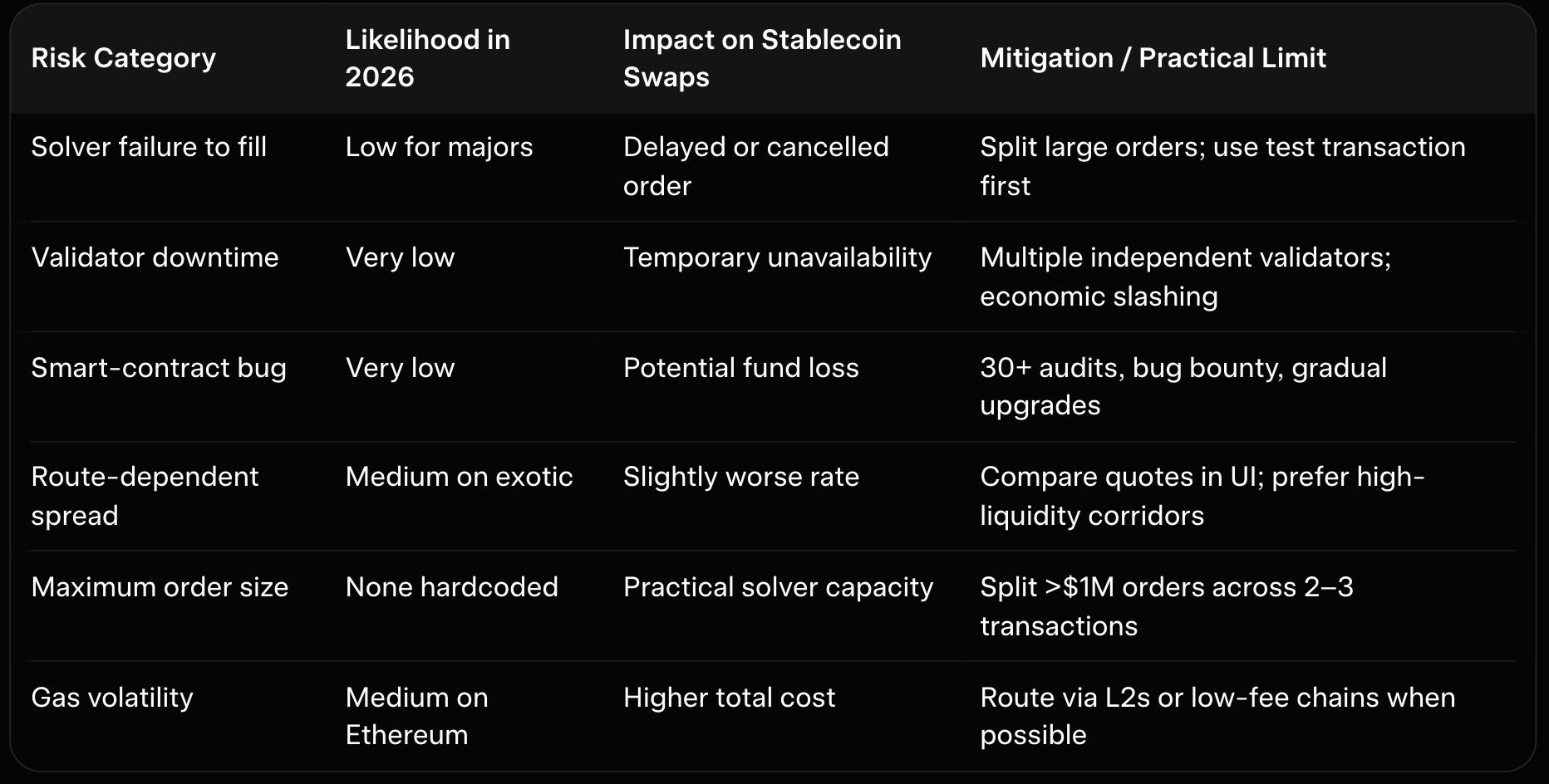
Risk Scenarios and Mitigation
Even the strongest bridge carries residual risks. For deBridge the primary scenarios are:
- Solver liquidity shortfall on exotic pairs — Extremely rare for major stablecoins but possible on low-volume routes during extreme volatility. Mitigation: the UI shows real-time quoted rates; large users split orders.
- Validator liveness or collusion — Theoretical. Mitigated by staking/slashing economics and growing validator set.
- Smart-contract vulnerability — Standard DeFi risk, but mitigated by extensive audits and gradual rollout of new features.
- Destination-chain congestion — Can delay final settlement even if intent is fulfilled. Users see this in real time and can cancel/refund the flat fee.
Overall risk profile sits materially lower than pool-based or lock-and-mint bridges because there is simply less capital at rest inside the system.
Risks and Limits Table
How baltex.io Complements or Differs from Bridge-Based Routing
While deBridge provides the secure, high-speed underlying execution layer, baltex.io functions as a non-custodial aggregator and front-end optimizer that sits on top of multiple bridges and DEXes—including deBridge routes when they offer the best rate. For stablecoin users this creates a powerful one-two punch.
baltex.io supports over 200 networks and 10,000+ tokens, far beyond any single bridge. Its routing engine automatically scans deBridge, Symbiosis, 1inch cross-chain, Curve pools, and others to find the combination that delivers the lowest total cost and slippage for USDT ↔ USDC moves. The interface is deliberately simple: connect wallet, pick input/output stable and chains, see preview with slippage protection, and confirm. No KYC, no account creation, and built-in privacy features that can obscure transaction trails when swapping into privacy coins afterward.
Key differences versus using deBridge directly:
- Abstraction level — deBridge requires understanding intents and sometimes manual chain selection; baltex.io abstracts everything into one “swap” button.
- Coverage — baltex.io reaches smaller chains or exotic pairs by stitching multiple bridges together, whereas pure deBridge stays within its 27-chain mesh.
- Optimization focus — baltex.io specializes in stablecoin efficiency, often achieving sub-0.2 % total effective cost by blending routes.
- Privacy and limits — baltex.io emphasizes hiding trades from on-chain observers and supports higher privacy flows; it also advertises no artificial volume limits.
In practice many power users route large stablecoin swaps through baltex.io precisely because it can intelligently choose deBridge for the fast, native leg while using other paths for the remainder. The two services are synergistic rather than competitive: deBridge supplies the reliable high-speed rails, baltex.io supplies the smart routing and beautiful UX that makes those rails accessible to everyday DeFi participants.
FAQ
Is deBridge the best high-speed bridge for stablecoin swaps in 2026? For users prioritizing native assets, zero slippage, and sub-minute execution on major corridors, yes. Pool-based alternatives still win on sheer chain count, but deBridge leads on security and capital efficiency.
How long do stablecoin swaps actually take? Between 10 and 45 seconds in most tested pairs, with Tron and Solana routes frequently under 20 seconds.
Are deBridge fees competitive? Yes. A $50,000 USDT swap typically costs $15–25 total (flat + 4 bps + negligible gas on L2s), often beating competitors once slippage is included.
Is deBridge safe for large transfers? Its track record (zero exploits, $2.35 B+ processed) and 0-TVL design make it one of the safest options. For seven-figure moves, split into 2–3 tranches and test with $1,000 first—standard best practice across all bridges.
Does baltex.io replace deBridge? No. It enhances it. baltex.io frequently selects deBridge routes internally when they provide the best outcome.
Can I use deBridge inside my favorite dApp? Yes. The embeddable widget and API allow any DeFi protocol to offer native cross-chain stablecoin swaps with one-click integration.
Conclusion
As we move deeper into 2026, cross-chain stablecoin liquidity has become table stakes for serious DeFi participation. deBridge has emerged as the high-performance engine powering that liquidity—delivering speed that rivals centralized exchanges, security that institutions trust, and an architecture that scales without the systemic risks that plagued earlier bridges. Its 0-TVL model, native asset delivery, and solver-driven execution set a new standard that competitors are still racing to match.
When combined with intuitive aggregators such as baltex.io, the end-user experience crosses from “good enough” to genuinely delightful. Whether you are a yield farmer moving six figures between Base and Solana, a treasury manager rebalancing USDT reserves, or an AI agent executing programmatic trades via deBridge’s new MCP server, the protocol stands ready.
For anyone serious about efficient, low-risk stablecoin movement across chains in 2026, deBridge deserves a permanent place in the rotation. Start with a small test swap on app.debridge.com or let baltex.io handle the routing automatically—you will quickly see why so many power users have made the switch.
We cover this in more detail in Across Protocol Review: The Cheapest Bridge for Ethereum L2s.
We cover this in more detail in Across Protocol Review: The Cheapest Bridge for Ethereum L2s.
For more on this, see our guide on Linea Bridge Tutorial: Cheapest Ways to Move ETH (July 2026).
For more on this, see our guide on Linea Bridge Tutorial: Cheapest Ways to Move ETH (July 2026).