 3 minutes to read
 Ecosystem
Hop Protocol Review: How to Move Funds Fast Between Arbitrum and Optimism
TLDR: In 2026, Hop Protocol delivers near-instant (minutes) transfers between Arbitrum and Optimism for major assets like USDC, ETH, USDT, and DAI using bonded liquidity and hTokens, with competitive fees of 0.05–0.30% plus gas and deep pools that minimize slippage. Its trustless security model settles eventually on Ethereum L1 without central authorities, outperforming slow official rollup bridges while matching or beating Across and Synapse on L2-specific speed and cost. Risks remain low but include temporary bonder delays or smart-contract edge cases. For users needing broader multi-chain moves beyond Ethereum rollups, baltex.io aggregates instant native swaps across 200+ networks with privacy routing—no bridges required. Ideal for DeFi traders chasing yield or rebalancing fast.
Introduction: Why Fast L2-to-L2 Transfers Matter in 2026 DeFi
Ethereum Layer 2 ecosystems have matured dramatically by 2026. Arbitrum and Optimism each host tens of billions in TVL, powering everything from perpetuals trading and lending protocols to NFT marketplaces and yield farms. Yet moving capital between them still frustrates users who want to chase the best opportunities without paying Ethereum mainnet gas or waiting days for withdrawals.
Traditional official bridges force users through the full optimistic rollup challenge period—typically seven days for withdrawals—rendering capital inefficient. Centralized exchanges add KYC friction and custody risk. This is where specialized L2 bridges shine, and Hop Protocol has established itself as the go-to solution for seamless, low-friction movement specifically between Optimistic rollups like Arbitrum and Optimism.
This comprehensive review breaks down exactly how Hop works in practice today, its strengths for speed, fees, liquidity, and security, realistic risk scenarios, and direct comparisons to alternatives. A dedicated section also explores how platforms like baltex.io extend routing options far beyond rollup-centric designs. Whether you are a daily DeFi participant arbitraging rates between Aave on Arbitrum and Compound on Optimism or simply consolidating positions, understanding Hop’s mechanics will help you move funds faster and cheaper while staying in control of your keys.
How Hop Protocol Works for Transfers Between Arbitrum and Optimism
Hop Protocol solves the L2 fragmentation problem with a clever two-layer architecture that combines synthetic “hTokens” on each chain, automated market makers (AMMs) for local swaps, and professional liquidity providers called Bonders who front capital for instant settlement.
When you want to move, say, 10,000 USDC from Arbitrum to Optimism, the process unfolds in seconds from your perspective:
First, your wallet interacts with Hop’s bridge contract on Arbitrum. You send canonical USDC, which gets locked. In return, you receive an equivalent amount of hUSDC (Hop’s synthetic version) minus fees. This hUSDC can then be swapped locally on Arbitrum’s Hop AMM for the canonical USDC if needed, but most users let the protocol handle the full flow.
Next, a Bonder—operating under economic incentives and collateral requirements—detects your transfer on-chain and immediately sends the equivalent canonical USDC from their liquidity pool on Optimism to your destination address. You receive funds in minutes, often under five, without waiting for any challenge period.
Behind the scenes, the Bonder has effectively “bonded” your transfer by putting up collateral. Once the canonical bridge message from Arbitrum eventually settles on Ethereum mainnet (which can take hours to days depending on the rollup’s finality), the Bonder gets reimbursed from the locked funds plus their fee. This reimbursement mechanism keeps everything trust-minimized and aligned with Ethereum’s security.
The hToken layer is crucial. Each supported chain has its own Hop AMM pairing canonical tokens (e.g., native USDC) with hTokens (hUSDC). Liquidity providers deposit into these pools and earn fees from swaps and rebalancing. When liquidity gets imbalanced—say, more people bridging out of Arbitrum than into it—the AMM prices adjust naturally, and Bonders arbitrage by moving capital across chains to restore balance.
This design avoids the need for every transfer to hit Ethereum mainnet immediately, slashing costs and latency. For Arbitrum-to-Optimism routes specifically, both being optimistic rollups with similar finality mechanics, the system operates at peak efficiency. The entire user experience feels like a fast DEX swap rather than a traditional bridge.
Supported Assets and Liquidity Pools
Hop focuses on the most liquid, high-demand assets that DeFi users actually move between L2s. As of 2026, core supported tokens between Arbitrum and Optimism include:
Additional assets like MAGIC, SNX, and sUSD appear on select routes, with more being added via governance as TVL grows. The protocol prioritizes stables and blue-chip ETH derivatives because these see the highest cross-L2 volume.
Liquidity pools sit at the heart of Hop’s efficiency. On each chain, separate AMM pools exist for every asset pair (canonical vs. hToken). Bonders maintain separate bonded liquidity that powers the instant payouts. Total liquidity across major routes routinely exceeds tens of millions per asset pair, keeping slippage negligible even for six-figure transfers.
Deep pools mean users rarely experience the painful price impact common on thinner bridges. When volume spikes—during a major airdrop or yield opportunity—Bonders and LPs quickly rebalance, often earning attractive yields themselves from fees. This flywheel keeps Hop self-sustaining and attractive for both users and capital providers.
Fee Structure
Hop’s fees stay transparent and competitive, designed to cover Bonder risk and operational costs without gouging users.
The primary variable component is the Bonder fee, typically ranging from 0.05% to 0.30% depending on the asset, route, and current liquidity conditions. High-volume stables like USDC on popular Arbitrum–Optimism routes often sit at the lower end. ETH transfers may command slightly higher percentages due to volatility.
You also pay standard L2 gas fees on the source chain for the initial transaction—usually pennies on Arbitrum or Optimism. Destination gas is covered by the Bonder. Minor AMM slippage can add a fraction of a percent on very large swaps, but deep pools keep this minimal.
No hidden withdrawal fees or percentage-based destination charges apply. The total cost for a typical $5,000 USDC transfer often lands under $15–25 all-in, making Hop dramatically cheaper than routing through Ethereum mainnet.
Here is a clear overview of typical fees and limits for Arbitrum to Optimism transfers (values fluctuate slightly with market conditions; always check the app for live quotes):
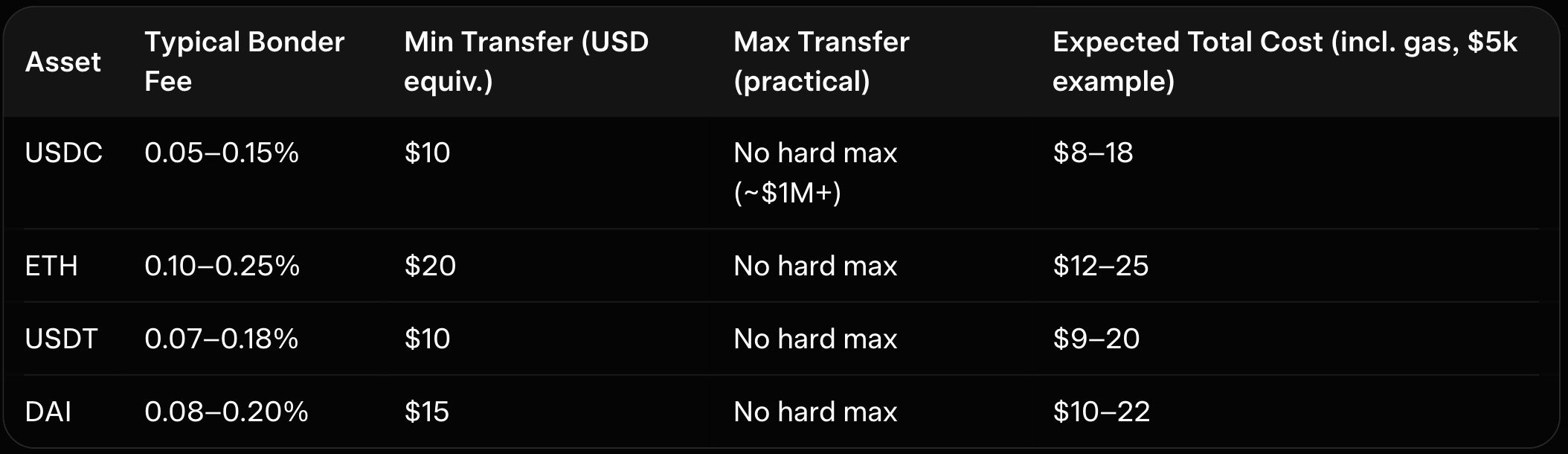
Limits remain high enough for most DeFi participants, and the protocol handles whale-sized moves without issue thanks to professional Bonders.
Settlement Speed
Settlement speed represents Hop’s biggest advantage. Users receive funds on the destination chain in 1–10 minutes on average for Arbitrum–Optimism routes. Compare that to the official Arbitrum or Optimism bridge, where moving the other direction can require waiting the full 7-day challenge window plus additional finality buffers.
The instant experience comes entirely from Bonder liquidity. Once the Bonder bonds the transfer on-chain, the protocol treats it as settled for the user. Full cryptographic finality still propagates through the underlying rollups and Ethereum, but you do not need to wait for it to spend or farm with the received funds.
In practice, this speed enables real-time strategies: spotting a better farming APY on the other chain and moving capital before the opportunity disappears.
Security Model
Hop operates in a fully trustless manner at the protocol level. No single entity controls funds or can censor transfers. Smart contracts on each chain handle locking, minting hTokens, and reimbursement logic. Bonders must post collateral that exceeds the value of transfers they bond, creating strong economic disincentives for misbehavior.
Governance through the HOP token DAO allows the community to upgrade parameters, add assets, or adjust incentives over time. All changes follow transparent on-chain processes.
Security ultimately inherits from the underlying Ethereum L1 and the rollups themselves. Even if every Bonder disappeared simultaneously—an extremely unlikely event—your funds would simply take the normal L2 exit path and arrive after the standard challenge period. No funds are ever at risk of permanent loss from protocol failure alone.
Multiple independent audits, bug bounties, and years of battle-tested operation since 2021 reinforce confidence. The $6B+ cumulative volume processed with zero major exploits speaks volumes.
Risk Scenarios and Mitigation
While Hop is among the safest L2 bridges, users should understand residual risks.
Bonder downtime or collusion: If all Bonders for a route go offline, transfers fall back to slow canonical settlement. In practice, multiple professional Bonders compete, and incentives keep them online. Users can monitor bonder status via the explorer.
Smart-contract vulnerabilities: Any bridge carries this risk. Hop mitigates through audits, formal verification on key contracts, and gradual upgrades. The modular design means a bug on one chain does not necessarily affect others.
Liquidity and slippage risk: Extremely large transfers during thin markets could incur higher slippage. Check live quotes and split large moves if needed.
Rollup-specific risks: Since Hop relies on Arbitrum and Optimism finality, any sequencer outage or forced transaction issues on those chains could delay the underlying messages. These events remain rare and usually resolved within hours.
Impermanent loss for LPs: Liquidity providers face classic AMM risks, but Hop’s pools are relatively stable because they primarily facilitate rebalancing rather than speculative trading.
Overall, for amounts typical in retail or even mid-size DeFi (under $100k), risks sit far lower than using centralized exchanges or unproven new bridges.
Comparison to Alternative L2 Bridge and Routing Solutions
Several strong contenders exist in the L2 bridging space, each with different trade-offs.
Across Protocol excels at ultra-low fees and fast L2-to-L2 moves using a relayer network and intent-based architecture. It often undercuts Hop slightly on cost for stablecoins but may show marginally slower times during peak congestion.
Synapse Protocol focuses heavily on stablecoin routing with its own nUSD synthetic, offering excellent liquidity across more chains including some non-EVM. Its fees can be competitive, but the synthetic asset model sometimes introduces minor conversion friction.
Official Arbitrum and Optimism bridges provide the highest security guarantees but remain painfully slow for outbound moves. They suit users who prioritize maximum trust minimization over speed and can afford to lock capital for a week.
Stargate (LayerZero-based) and other generalized bridges offer broader chain support but sacrifice the deep L2-specific liquidity and optimized fees Hop provides for Arbitrum–Optimism.
Here is a side-by-side feature comparison for Arbitrum-to-Optimism transfers in 2026:
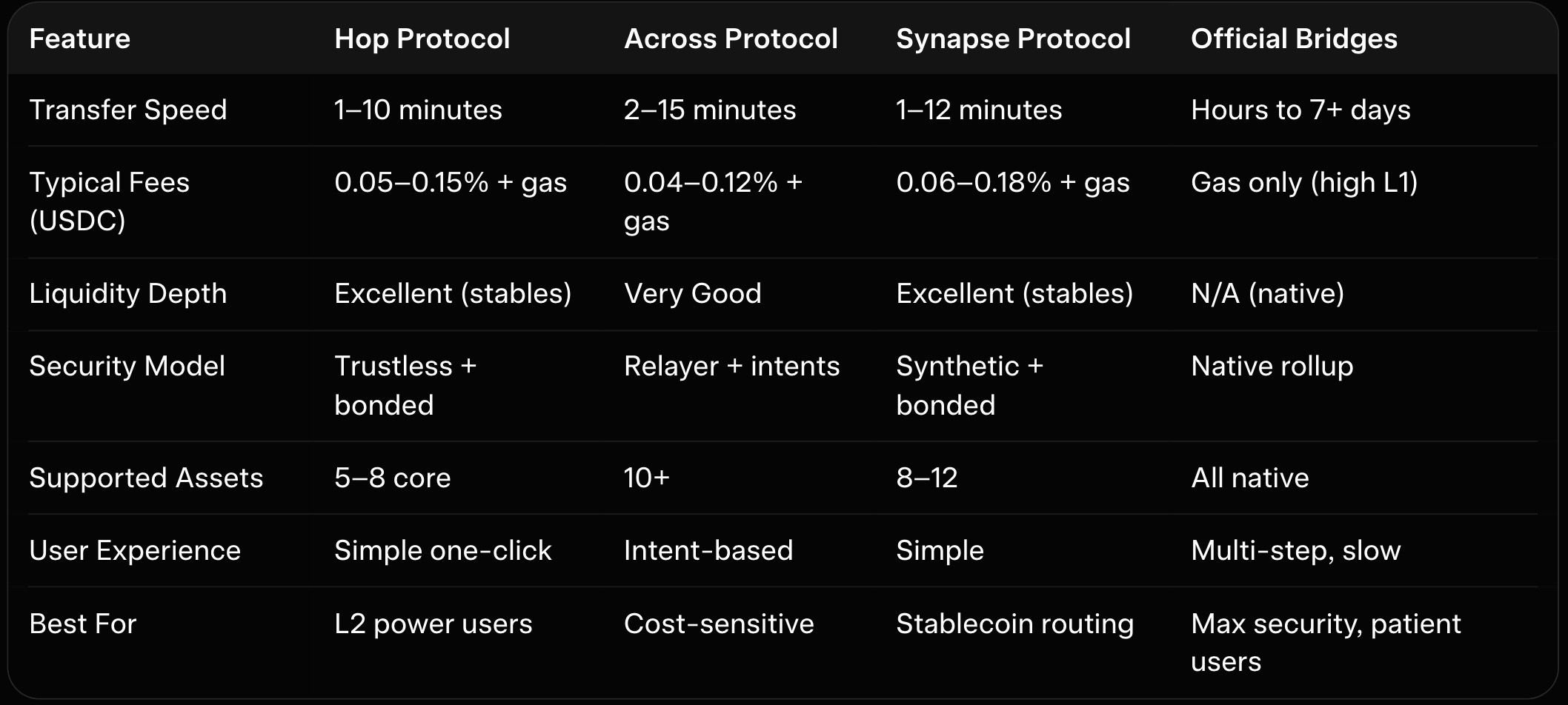
Hop consistently ranks at or near the top for pure Arbitrum–Optimism use cases where speed and native asset delivery matter most.
How baltex.io Offers Multi-Chain Routing Alternatives Beyond Rollup-Specific Bridges
While Hop excels within the Ethereum L2 ecosystem, many DeFi participants need to move funds beyond Arbitrum and Optimism—to Solana for high-frequency trading, Base for new yield opportunities, or even non-EVM chains. This is where baltex.io shines as a powerful complement or alternative.
baltex.io functions as a non-custodial cross-chain swap aggregator supporting over 10,000 tokens across more than 200 networks. Instead of relying on dedicated bridge contracts and hTokens, it routes swaps through optimized combinations of DEX liquidity, CEX liquidity pools (where appropriate), and native cross-chain messaging protocols—all executed in a single wallet-to-wallet transaction.
For an Arbitrum user wanting USDC on Optimism, baltex can deliver the swap instantly without ever touching a traditional bridge interface. The platform’s routing engine scans dozens of paths in real time, often stitching together multiple hops under the hood to achieve better rates or privacy. Users simply select source asset and chain, destination asset and chain, and confirm—funds arrive directly in native form with no wrapped tokens to unwrap later.
Key advantages over rollup-specific solutions like Hop include:
- Vastly broader coverage: Ethereum L2s plus Solana, TON, Tron, Avalanche, and dozens more in one click.
- Built-in privacy modes that route portions through Monero or other mixers to obscure transaction history.
- No bridge smart-contract risk on the user side—the platform handles routing so you avoid direct exposure to any single protocol’s vulnerabilities.
- Hybrid liquidity that often beats pure on-chain bridges during volatility by tapping deeper off-chain or aggregated pools.
DeFi participants frequently use baltex.io after a Hop transfer to move onward to non-EVM ecosystems, or as a primary tool when the destination lies outside Ethereum rollups entirely. The interface feels familiar to anyone who has used a DEX aggregator, yet the backend complexity delivers true multi-chain freedom without compromising self-custody.
FAQ
How long does an Arbitrum to Optimism transfer take with Hop? Most complete in under 5 minutes. Rare congestion may extend to 10–15 minutes, but never days.
What is the cheapest way to move USDC between Arbitrum and Optimism? Hop or Across usually win on cost. Always compare live quotes on both apps, but expect under 0.20% total for typical sizes.
Can I send large amounts ($100k+) without issues? Yes. Bonders handle significant volume daily. For seven-figure moves, splitting into a few transactions or contacting support for bonder coordination minimizes any temporary liquidity impact.
Is Hop safer than using a centralized exchange? Absolutely. You never lose custody, and security rests on audited smart contracts plus Ethereum rather than a company’s hot wallets.
What happens if a Bonder fails to deliver? Your funds remain locked on the source chain and will settle via the canonical bridge after the normal period. Bonders stake collateral far exceeding typical transfer sizes, so economic incentives prevent failure.
Does Hop support NFT bridging? No, Hop focuses exclusively on fungible ERC-20 tokens. Use specialized NFT bridges for those assets.
How does baltex.io compare in fees to Hop for L2-to-L2 moves? baltex.io often matches or slightly undercuts on total cost thanks to aggregated liquidity, plus it adds privacy and multi-chain flexibility in the same transaction.
Conclusion
Hop Protocol has solidified its position in 2026 as the premier fast bridge for Ethereum Layer 2 users who need to shuttle funds between Arbitrum and Optimism without friction. Its combination of near-instant settlement, competitive fees, robust liquidity, and trustless security makes it the default choice for active DeFi participants.
While alternatives like Across and Synapse offer strong competition, and official bridges provide ultimate security at the expense of speed, Hop strikes the best balance for most real-world use cases. Pair it with baltex.io when your journey extends beyond the Ethereum rollup universe, and you gain a complete toolkit for navigating the multi-chain future.
Start small, verify live quotes, and experience the difference yourself at the Hop Exchange. In a world where every basis point and every minute counts, Hop delivers the speed and reliability that power modern DeFi strategies. Move fast, stay secure, and keep hopping.
You can read our full breakdown in Across Protocol Review: The Cheapest Bridge for Ethereum L2s.
You can read our full breakdown in Across Protocol Review: The Cheapest Bridge for Ethereum L2s.
You can read our full breakdown in Linea Bridge Tutorial: Cheapest Ways to Move ETH (July 2026).
You can read our full breakdown in Linea Bridge Tutorial: Cheapest Ways to Move ETH (July 2026).