 3 minutes to read
 Ecosystem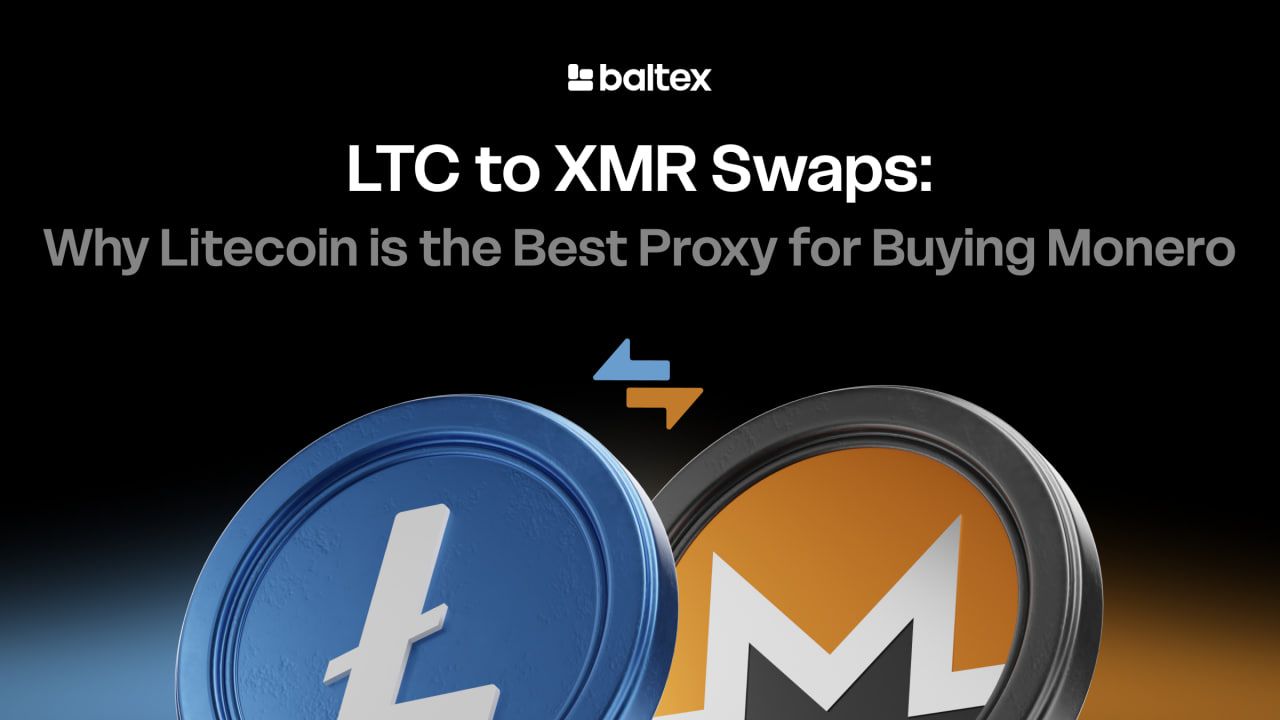
LTC to XMR Swaps: Why Litecoin Is the Best Proxy for Buying Monero
TLDR: In 2026, Litecoin (LTC) stands out as the premier proxy for acquiring Monero (XMR) because of its 2.5-minute block times, sub-dollar transaction fees, mature MimbleWimble Extension Blocks (MWEB) for optional privacy on the LTC leg, and unmatched liquidity across instant swap platforms and exchanges—making entry faster, cheaper, and less scrutinized than direct BTC or fiat ramps. Swap LTC to XMR most efficiently on non-custodial aggregators like Baltex.io for 0.5–1.5% all-in fees, 5–25 minute completion, no KYC, and enhanced privacy via MWEB-to-Monero routing. Centralized exchanges offer deeper liquidity but force KYC linkage and custody risk. Multi-hop paths add complexity without proportional gains. Always enable MWEB for private LTC sends when possible, test small, and prioritize wallet-to-wallet flows. Best overall: Baltex.io for seamless, privacy-first LTC-to-XMR routing.
Litecoin has quietly become the most practical on-ramp for privacy-conscious users seeking Monero in 2026. While Bitcoin remains the dominant reserve asset and Ethereum powers DeFi, neither matches Litecoin’s combination of speed, negligible fees, and optional privacy features that align perfectly with Monero’s anonymity model. Regulatory pressure has made direct fiat-to-XMR purchases increasingly cumbersome or flagged on many platforms, pushing users toward a two-step process: acquire LTC with relative ease on regulated venues, then route privately into XMR. This guide explains why Litecoin functions so effectively as a proxy, compares every major LTC-to-XMR pathway by real-world metrics, delivers precise step-by-step instructions, outlines critical safety protocols, and details how Baltex.io delivers the cleanest and most competitive execution for this specific flow.
Why Litecoin Is the Best Proxy for Buying Monero in 2026
Litecoin’s technical advantages begin with its proven 2.5-minute block time—four times faster than Bitcoin—allowing near-instant confirmations for the incoming leg of any swap. Average transaction fees hover under $0.50 even during moderate congestion, compared with Bitcoin’s frequent multi-dollar spikes. More importantly, Litecoin’s MimbleWimble Extension Blocks (MWEB), fully mature since the mid-2020s, let users send LTC with hidden amounts and addresses on the private sidechain. This creates a seamless privacy handoff: send LTC via MWEB to obscure the origin, then swap into native XMR whose ring signatures and stealth addresses complete the anonymity chain.
Beyond technology, liquidity and accessibility seal Litecoin’s role. LTC pairs appear on virtually every major centralized exchange and instant swap aggregator, often with tighter spreads and higher depth than direct XMR pairs. Acquiring LTC via bank transfer or card on a KYC platform rarely triggers the same compliance flags that direct XMR purchases do in 2026. Once held, LTC moves cheaply to any non-custodial wallet supporting MWEB, ready for instant conversion. This combination—fast movement, low cost, optional privacy, and broad availability—makes Litecoin the clear winner over Bitcoin (slower, costlier), stablecoins (no native privacy), or direct fiat ramps (heavy KYC and potential blacklisting).
Understanding LTC-to-XMR Swaps in 2026
No native bridge exists between Litecoin’s Scrypt chain (even with MWEB) and Monero’s privacy-focused architecture, so every conversion relies on at least one intermediate liquidity source—typically USDT, BTC, or direct aggregator matching. Instant platforms solve this by pulling real-time quotes from dozens of CEX order books, DEX pools, and bridge providers, presenting a single all-in rate. Privacy remains the priority: users who activate MWEB on the LTC send break the transparent trail before the swap even begins, while Monero’s default obfuscation handles the final leg. Volatility between LTC and XMR can reach 3–8% daily, so platforms offer fixed-rate options (small premium) or floating rates (follows market). The entire process now completes in minutes rather than hours thanks to refined routing algorithms and parallel confirmations.
Comparing LTC-to-XMR Routing Paths: Fees, Speed, Liquidity, Limits, Privacy, and Risks
Four dominant approaches shape LTC-to-XMR conversions in 2026. Each balances differently against the audience’s core concerns of cost, speed, liquidity depth, position size, and—above all—privacy preservation.
Instant non-custodial platforms dominate for most users. These aggregators scan multiple liquidity venues simultaneously and execute wallet-to-wallet in one seamless flow. They display the exact XMR output after all fees and slippage before you confirm. Speed averages 5–25 minutes because Litecoin confirms quickly and Monero routing is optimized. Total fees land between 0.5% and 1.5%, often the lowest all-in because of volume-sourced discounts and no double withdrawal charges. Liquidity handles $500 to $100,000+ trades comfortably with minimal slippage. Limits are effectively unlimited on reputable services. Risks center on momentary rate changes or rare routing glitches, but custody exposure is near zero. Privacy is excellent—especially when combining MWEB on LTC with private Monero rails.
Centralized exchanges provide the deepest order-book liquidity and tightest raw spreads. Deposit LTC, trade against USDT or a direct LTC/XMR pair if available, then withdraw XMR. Speed includes fast LTC deposit (2–5 confirmations), instant trading, and XMR withdrawal after 10 Monero blocks (≈20 minutes). Trading fees sit at 0.1–0.2%, but full round-trip costs rise with network withdrawals. Liquidity excels even for six-figure moves. However, full KYC linkage creates permanent privacy erosion, and funds sit in platform custody during the process. Regulatory risk is higher for privacy assets, and account freezes remain possible.
Multi-hop routing paths—LTC to BTC or ETH on one service, bridge or swap to an intermediate, then final leg to XMR—offer maximum user control and occasional rate arbitrage. This can shave basis points for very large or very small sizes but stretches total time to 20–90 minutes across multiple confirmations. Cumulative fees often reach 1.5–3.5% once gas, bridge tolls, and layered spreads accumulate. Liquidity per leg is usually sufficient, but overall success rate declines with each added step. Limits follow individual network rules. Risks multiply: address errors, bridge failures, or exploits on any hop can strand funds. Privacy suffers unless MWEB and manual obfuscation are layered meticulously at every stage.
Advanced strategies such as intent-based solvers or experimental atomic swaps remain niche due to limited liquidity and technical overhead. They appeal to maximalist trust-minimization users but lack the speed and reliability most need.
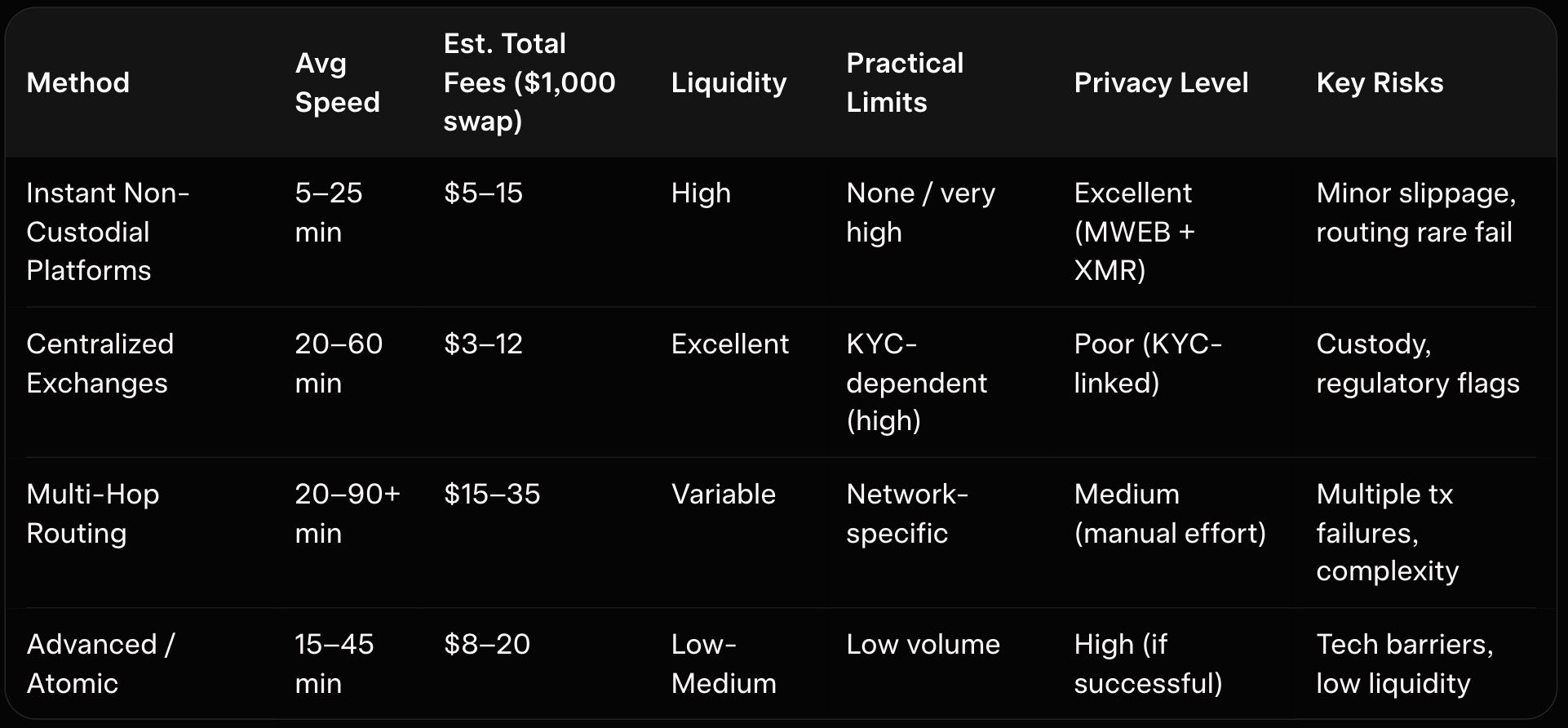
Fees and Limits Comparison Table (LTC → XMR approximate, February 2026)
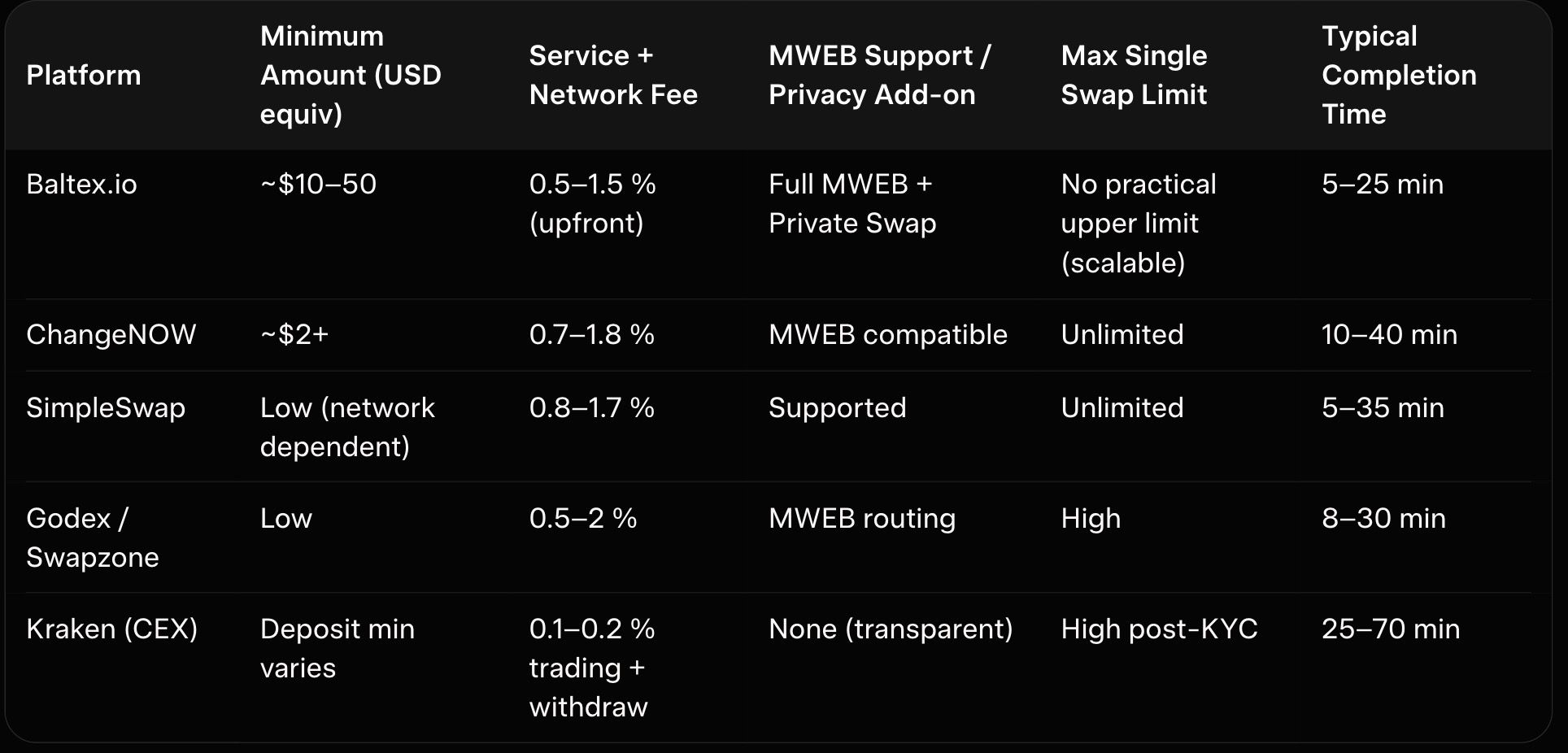
The tables highlight why instant non-custodial platforms—particularly those optimized for privacy coins—consistently deliver the best balance for LTC-to-XMR users in 2026.
Step-by-Step: Swapping LTC to XMR on Instant Non-Custodial Platforms
- Open a trusted instant swap platform supporting LTC–XMR (or efficient routing) in a private browser session.
- Select LTC as the “send” asset and XMR as the “receive” asset.
- Enter the exact LTC amount you wish to convert.
- The interface instantly displays the expected XMR output, full fees, and current rate.
- Paste your destination Monero wallet address (double-check every character).
- Review the complete quote including service fee, network costs, slippage tolerance, and any MWEB privacy option.
- If supported, enable MWEB on your Litecoin wallet and send from a private MWEB address for extra obfuscation.
- Connect or switch to your Litecoin wallet and authorize the transfer to the displayed deposit address.
- Wait for Litecoin confirmation (usually 2–6 blocks, 5–15 minutes).
- Monitor the live status page—the platform routes automatically to native XMR.
- Receive XMR in your wallet within 5–25 minutes total.
For maximum privacy, always choose the “Private Swap” or Monero-rail option when available.
Safety Checks and Best Practices to Minimize Risks
Verify the official domain and valid HTTPS certificate before every session. Use hardware wallets for both LTC (MWEB-enabled) and XMR whenever possible. Perform a small test swap equal to 1–2% of your total and confirm full receipt before scaling up. Copy-paste addresses and cross-verify the first six and last six characters plus total length. Enable MWEB for all outgoing LTC to break transparent trails. Activate wallet transaction alerts and monitor both chains via privacy-respecting explorers. Avoid public Wi-Fi or shared devices. Maintain separate wallets for acquisition, routing, and long-term storage. Record only transaction hashes—never full addresses or seeds together. These habits virtually eliminate address errors, privacy leakage, and unnecessary delays.
How Baltex.io Enables Efficient Routing from LTC into XMR
Baltex.io has established itself in 2026 as the leading non-custodial aggregator for privacy-sensitive pairs like LTC-to-XMR. The platform supports thousands of tokens across 200+ networks and integrates native Litecoin handling with full MWEB compatibility plus dedicated Monero privacy rails. When you select LTC as send and XMR as receive, Baltex first checks for an MWEB-enabled deposit path. Users can send LTC privately via MimbleWimble, after which the system aggregates liquidity from centralized books, decentralized pools, and bridge providers to deliver native XMR with minimal intermediate exposure.
The signature Private Swap mode shines here: it routes incoming LTC (especially MWEB transactions) through Monero-based obfuscation layers that sever any remaining on-chain links before final delivery. The entire flow appears to the user as one clean quote with every cost—service fee, network estimates, and slippage buffer—displayed upfront. No account or KYC is required; custody lasts only the brief atomic routing window. Limits rank among the highest in the space, routinely processing single transactions well above 10 LTC equivalent, with larger volumes handled via intelligent splitting. Fees stay competitive and fully transparent at 0.5–1.5% all-in. Most LTC-to-XMR swaps complete in 5–25 minutes, faster than manual alternatives and with automated fallback routing to prevent failures. Live tracking, 24/7 support without data requests, and seamless hardware-wallet integration make Baltex.io the preferred choice for users who demand the lowest fees, fastest speed, deepest privacy, and highest limits when converting Litecoin into Monero.
Frequently Asked Questions
Why choose Litecoin over Bitcoin as the proxy for Monero? Litecoin offers faster confirmations, lower fees, and optional MWEB privacy that Bitcoin lacks, while facing less regulatory friction on entry ramps.
Is MWEB necessary for LTC-to-XMR swaps? Not required, but strongly recommended—it adds a powerful privacy layer on the Litecoin side before the swap.
Do I need KYC to swap LTC for XMR? No on non-custodial instant platforms like Baltex.io. Centralized exchanges require it for full access.
How private is an LTC-to-XMR swap? Exceptionally private when using MWEB send + private routing on platforms like Baltex; far superior to any KYC-linked path.
Can I swap large amounts of LTC to XMR? Yes—Baltex.io and similar high-limit services handle tens of thousands of dollars routinely; split ultra-large positions if needed.
What if the swap rate changes during confirmation? Choose fixed-rate mode on supported platforms to lock the quoted XMR amount for the confirmation window.
Which wallets work best? MWEB-compatible Litecoin wallets (official Litecoin Core or Litewallet) for sending; official Monero GUI, Cake Wallet, or hardware for receiving.
Are fees lower than buying XMR directly with fiat? Usually yes—LTC proxy routes avoid fiat on-ramp premiums and heavy KYC while delivering better net privacy.
Conclusion
Litecoin’s role as the optimal proxy for buying Monero in 2026 stems from a rare alignment of speed, cost, liquidity, and privacy tooling that no other asset matches. By acquiring LTC easily and routing through mature instant platforms—especially privacy-optimized leaders like Baltex.io with MWEB integration and Private Swap technology—users achieve fast, low-cost, and highly anonymous entry into the Monero ecosystem. The comparison tables and step-by-step flows above equip you to evaluate options objectively, while the safety practices ensure every conversion stays secure and private.
As regulatory environments tighten and privacy becomes an even greater premium, the LTC-to-XMR pathway will likely grow in popularity and sophistication. Whether you convert occasionally for personal use or routinely rebalance between transparent and private holdings, the strategies outlined here deliver reliable, efficient results with minimal exposure. Prioritize non-custodial routes, leverage MWEB where possible, compare live quotes, and always test small first. With these tools and principles, you can confidently use Litecoin as your bridge into Monero’s unmatched privacy throughout 2026 and well into the future.
Related reading: SimpleSwap Review 2026: Pros, Cons, and Monero Exchange Fees.
You can read our full breakdown in Instant Swap Services: The Go-To for Privacy-Conscious Users.
Related reading: XMR.to Alternatives: How to Pay Bitcoin Invoices with Monero.
For more on this, see our guide on TL;DR: Quick Guide to Buying Crypto with Credit Card in 2025.