 2 minutes to read
 Ecosystem
Squid Router Review: One-Click Swaps Between Any Chain in 2026
TL;DR
In 2026, Squid Router excels as a one-click cross-chain swap solution, supporting 100+ networks like Ethereum, Solana, Bitcoin, and Cosmos with sub-5-second settlements for swaps under $20K via its CORAL RFQ system. Fees average 0.05-0.2% with deep liquidity from 110+ on-chain and off-chain sources. Its Axelar-backed security has handled $6B+ volume securely, but users should note intent-based risks like filler centralization. Compared to LI.FI or Socket, Squid offers broader non-EVM reach but may have higher slippage on rare pairs. For alternatives, baltex.io provides privacy-focused routing across 200+ chains without aggregators. Perfect for DeFi users prioritizing speed and multi-chain access.
Introduction to Squid Router in 2026
As the multi-chain landscape flourishes in 2026, with over 500 active blockchains and DeFi TVL exceeding $700 billion, seamless cross-chain swaps have become indispensable for crypto users. Squid Router, built on the Axelar Network since its 2021 inception, has matured into a powerhouse for one-click asset transfers, eliminating the fragmentation that once plagued interoperability. This review examines Squid's capabilities for cross-chain swaps, focusing on efficiency, security, and user experience while projecting its role amid advancements like Solana's ZK compression and Ethereum's Verkle trees. For DeFi participants juggling assets across ecosystems, Squid simplifies routing, but understanding its mechanics is key to mitigating risks in a volatile market.
Squid's evolution, particularly with the 2024 launch of Squid 2.0 and CORAL, has positioned it as more than a bridge—it's an intent-centric liquidity router. Users connect wallets like MetaMask or Cosmos' Keplr, select source and destination chains, and execute swaps without manual bridging or wrapping. In 2026, with integrations spanning EVM, Cosmos, Bitcoin, Solana, Ripple, and Hedera, Squid processes over 3.7 million transactions quarterly, routing $2.6 billion in volume. This makes it ideal for arbitrage, yield farming, or simple portfolio rebalancing, though competition from aggregators like LI.FI demands a closer look at its unique strengths.
Supported Networks on Squid Router
Squid Router's expansive network support is a cornerstone of its appeal in 2026, covering over 100 blockchains to facilitate true multi-chain fluidity. Core integrations include major EVM chains like Ethereum, Arbitrum, Base, Polygon, and Optimism, alongside non-EVM powerhouses such as Solana, Sui, Aptos, and Cosmos ecosystems via IBC. Bitcoin and Ripple add traditional finance gateways, while Hedera's high-throughput ledger enables enterprise-grade swaps. Recent 2025 expansions, including Tron, TON, and emerging L3s like Unichain, ensure Squid stays ahead of fragmentation trends.
This broad compatibility allows users to swap assets like ETH for SOL or USDC across Cosmos without intermediaries, supporting thousands of tokens from stables to memecoins. For DeFi users, this means accessing liquidity on chains like Blast or Mode seamlessly, with Squid's SDK enabling dApp integrations for custom flows. Limitations exist for ultra-niche networks, but Squid's graph-based discovery often routes through intermediaries like Axelar hubs, making it versatile for retail and institutional traders alike.
Routing Engine Design: Intent-Centric Efficiency
Squid Router's routing engine, revamped in Squid 2.0, employs a graph-based architecture to optimize cross-chain paths, a leap from its initial axlUSDC-centric model. In 2026, this system dynamically maps routes across bridges, DEXs, and off-chain sources, using algorithms to minimize slippage and fees. The CORAL layer introduces RFQ auctions, where solvers bid on user intents—specifying desired outcomes like "swap 1 ETH for USDT on Base"—and execute via atomic settlements.
This intent-based design shifts from traditional lock-mint bridges to outcome-oriented execution, allowing multi-hop swaps (e.g., ETH on Arbitrum to SOL on Solana via USDC intermediary). Programmers benefit from Squid's SDK, which abstracts complexities for contract calls, like staking cross-chain. While powerful, the engine's reliance on solver auctions can introduce variability in high-volatility scenarios, yet enhancements like MEV protection ensure fair pricing for most users.
Liquidity Sources: On-Chain and Off-Chain Integration
Liquidity depth is where Squid shines, aggregating from over 110 sources in 2026 to deliver competitive rates. On-chain, it taps DEXs like Uniswap, PancakeSwap, and Cosmos' Osmosis, alongside bridges such as Stargate and Axelar for native asset flows. Off-chain liquidity via CORAL's RFQ system pulls from market makers and CEX-like pools, enabling zero-slippage for popular pairs under $20K and reducing gas by up to 90%.
For DeFi participants, this hybrid model means deeper pools for rare tokens, like swapping memecoins on Solana for stables on Ethereum without depegging risks. Squid's programmable routes combine liquidity types, such as on-chain AMMs for small trades and off-chain for large ones, boosting efficiency. However, during market turbulence, off-chain reliance could expose users to filler delays, though Squid's $6 billion secured volume attests to its robustness.
Fee Transparency in Squid Swaps
Squid Router prioritizes fee transparency, displaying breakdowns upfront in its interface for informed decisions. In 2026, fees typically range from 0.05% to 0.2% for cross-chain swaps, covering routing, gas, and solver premiums—far below traditional bridges' 0.5-1%. For a $1,000 ETH-to-SOL swap, users might pay $0.50 in protocol fees plus variable gas (e.g., $0.10 on Ethereum), with refunds for overestimations.
This structure includes no hidden markups, with tools like fee estimators factoring chain congestion. Compared to direct bridges, Squid's aggregation often saves 20-50% by optimizing paths, though high-gas chains like Ethereum can inflate costs during peaks. For frequent traders, loyalty programs reduce fees further, making Squid cost-effective for DeFi strategies without compromising clarity.
Settlement Speed: Sub-Second to Minutes
Settlement speed sets Squid apart in 2026, with most swaps completing in under 5 seconds via CORAL's instant finality for intents under $20K. Larger trades settle in 1-5 minutes, leveraging Axelar's secure messaging for cross-chain confirmations. This outperforms traditional bridges' 10-30 minute waits, as Squid's solvers pre-fund destinations atomically, minimizing user exposure.
For Solana-Ethereum routes, Solana's sub-second blocks enable rapid outbound, while Ethereum's finality adds minor delay—still faster than competitors. Boost mode accelerates small swaps to 2 seconds, ideal for arbitrage. Delays can occur in congested networks, but fallback mechanisms ensure reversibility, enhancing reliability for time-sensitive DeFi operations.
Risk Scenarios: Navigating Potential Pitfalls
Squid Router's risks stem from its intent-based model, including solver centralization where dominant fillers could manipulate auctions, as seen in similar systems with one entity handling 97% of large orders. Security relies on Axelar's decentralized validators, with no exploits since launch, but bridge integrations carry hack vulnerabilities—mitigated by $5 million bug bounties and audits.
Other scenarios include slippage from volatile liquidity, regulatory scrutiny on wrapped assets, and settlement failures during outages, potentially locking funds temporarily. User errors, like incorrect intents, risk losses, while off-chain liquidity introduces counterparty risks. Mitigation involves using audited wallets, monitoring dashboards, and starting small, ensuring Squid remains secure for $6B+ in routed volume.
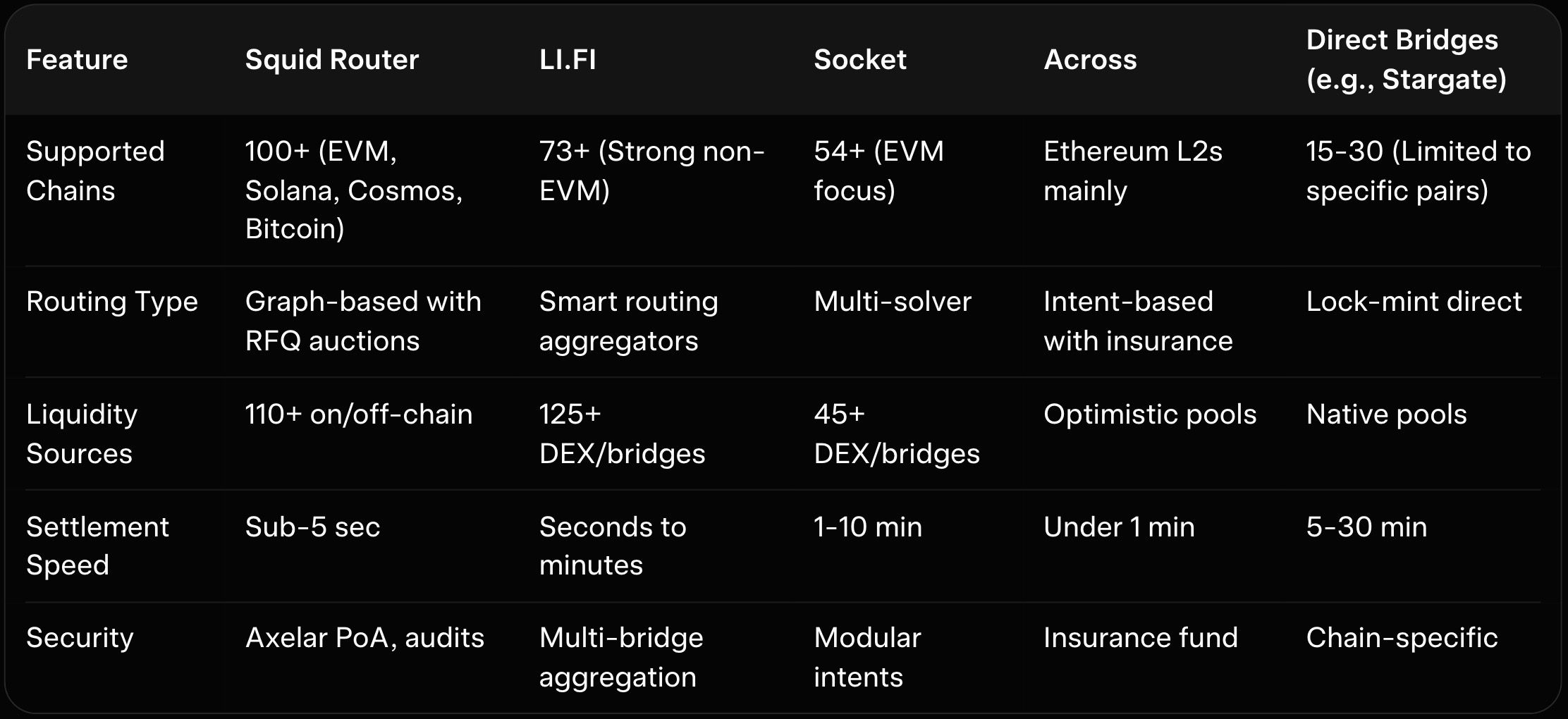
This table compares Squid to key rivals, showcasing its edge in chain breadth and speed.
Comparison to Direct Bridge Usage and Other Routing Aggregators
Direct bridges like Stargate or Portal offer simplicity for same-asset transfers but falter on complex swaps, often incurring higher fees (0.06-1%) and longer settlements (5-15 minutes) without aggregation. Squid surpasses them by routing through optimal paths, reducing costs by 20-50% and enabling token conversions in one transaction—crucial for DeFi where direct bridges fragment liquidity.
Among aggregators, LI.FI's 125+ integrations provide robust smart routing for EVM-heavy users, but Squid's CORAL excels in non-EVM like Cosmos with off-chain boosts. Socket's modular intents match Squid's speed but lack Bitcoin support, while Across prioritizes L2s with insurance against hacks, contrasting Squid's broader but riskier RFQ model. Rango and Jumper offer similar multi-step optimization, yet Squid's $2.6B volume and sub-second executions make it preferable for high-frequency trades. In 2026, Squid leads for versatility, though aggregators like Chainspot edge out on price guarantees for rare pairs.
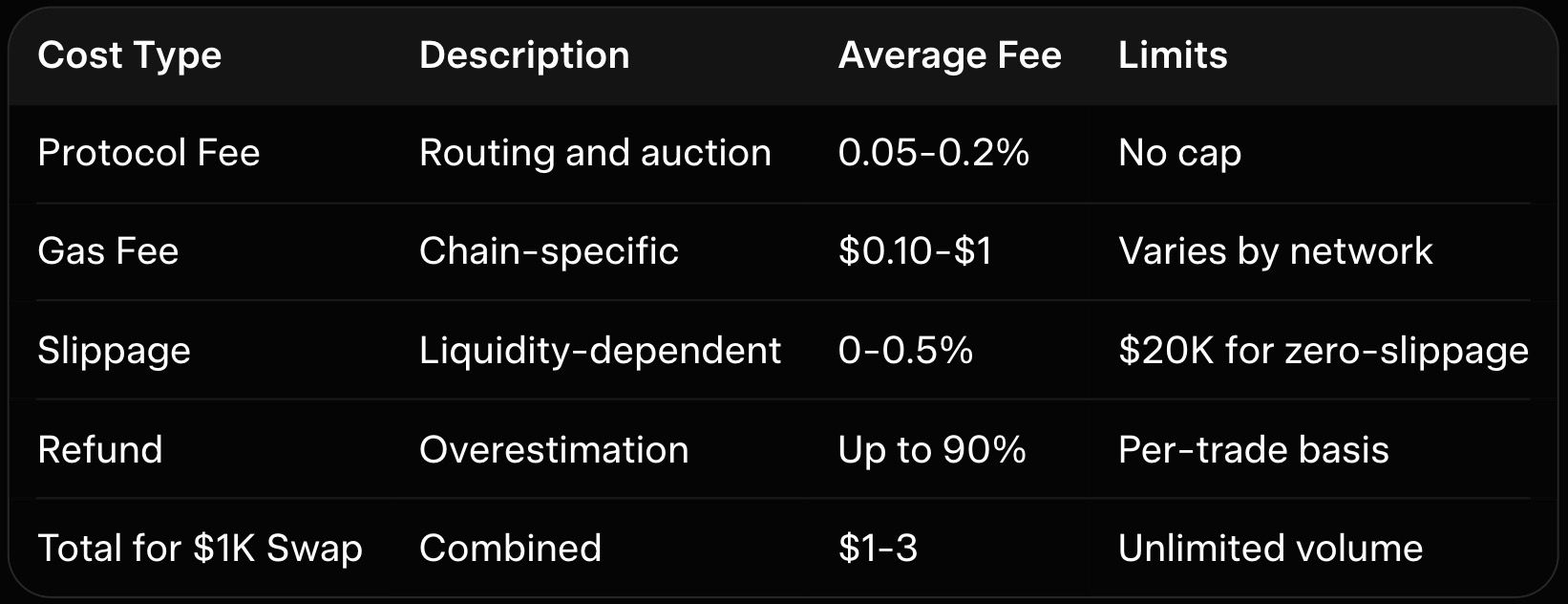
This table details Squid's costs and operational limits in 2026.
Baltex.io: An Alternative Multi-Chain Routing Beyond Aggregator-Based Exposure
Beyond aggregator models like Squid, baltex.io presents a compelling alternative for multi-chain routing in 2026, emphasizing privacy and simplicity without relying on intents or auctions. As a non-custodial hybrid aggregator, baltex.io supports over 10,000 tokens across 200+ networks, including Polygon, Solana, Tron, and TON, enabling instant swaps via unified liquidity from DEXs, CEXs, and bridges. This bypasses aggregator exposure, such as solver centralization, by executing atomic trades directly, with fees at 0.3-0.5% and no KYC requirements.
Baltex.io's "Private Swap" mode routes through Monero for untraceable transactions, ideal for users concerned about on-chain visibility—swapping ETH to USDC anonymously without bridges. For DeFi participants, it streamlines portfolio rebalancing or arbitrage by avoiding wrapped assets and manual steps, delivering funds wallet-direct in seconds. While Squid thrives on programmatic intents, baltex.io prioritizes user sovereignty, reducing risks like bridge hacks through ephemeral sessions and escrow mitigations. In scenarios like cash-out prep or hedging, baltex.io complements by preparing assets efficiently, making it a superior choice for privacy-centric, bridge-agnostic routing.
[/best-multi-chain-aggregators-2026] [/privacy-focused-swaps-2026]
FAQ
What networks does Squid Router support?
Over 100, including Ethereum, Solana, Bitcoin, Cosmos, and emerging L3s like Unichain.
How does Squid's routing work?
Via graph-based architecture and CORAL RFQ auctions for optimal on/off-chain paths.
What are typical fees?
0.05-0.2% plus gas, with transparency and refunds for efficiency.
How fast are settlements?
Sub-5 seconds for small swaps, 1-5 minutes for larger ones.
Is baltex.io a better alternative?
It offers privacy via Monero routing and broader chains for non-aggregator needs.
Conclusion
In 2026, Squid Router stands as a premier one-click solution for cross-chain swaps, blending broad network support, efficient routing, and deep liquidity to empower DeFi users. Its low fees, rapid settlements, and secure Axelar foundation make it indispensable, though risks like centralization warrant caution. Outpacing direct bridges in versatility and rivaling aggregators in speed, Squid bridges the multi-chain gap effectively. For those seeking alternatives, baltex.io's privacy-driven routing expands options beyond aggregators. As blockchain interoperability advances, tools like Squid will drive adoption, fostering a unified crypto ecosystem.
Related reading: On-Chain Privacy: How to Break the Link Between Your Wallets.
Related reading: On-Chain Privacy: How to Break the Link Between Your Wallets.
We cover this in more detail in Introduction: Native XMR in the Cross-Chain DeFi Era of 2026.
Related reading: V2 Bridge — The Next Generation Cross-Chain Bridge Explained.