 2 minutes to read
 Ecosystem
TON to XMR Swaps: How to Move Assets Between Toncoin and Monero
TLDR Swap TON to XMR or XMR to TON in 2026 in 8–35 minutes with total costs of 0.4–1.8% using Baltex.io’s Monero-based Private Swap mode, which routes through a shielded Monero hop to break all on-chain links and deliver clean native assets on the destination chain. Instant non-custodial services provide the best balance of speed, privacy, and zero custody risk; TON’s native network fees are near-zero, making it one of the cheapest entry points. Avoid centralized exchanges for KYC exposure and multi-hop or generic cross-chain routes for extra failure points and linkability. Always test with $10–100 using fresh addresses, hardware wallets, and Tor/VPN. No limits on leading platforms; liquidity supports six-figure volumes reliably.
Toncoin (TON) and Monero (XMR) represent two complementary strengths in the 2026 crypto landscape: TON powers the fast, low-cost Telegram ecosystem with instant finality for payments, mini-apps, and DeFi, while Monero delivers unmatched on-chain privacy through ring signatures, stealth addresses, and confidential amounts. Users frequently move value between them to enjoy TON’s speed for daily transactions or gaming yields and then park profits in XMR for long-term untraceable storage—or the reverse, funding TON activities from private XMR holdings without creating visible trails. Because the two chains have fundamentally different architectures, no native bridge exists, so swaps rely on instant aggregators, centralized venues, multi-hop paths, or abstracted cross-chain routers. This 2026 guide details every viable method by real-world performance, provides exact step-by-step flows, safety protocols, and a focused look at how Baltex.io’s Monero-powered routing consistently outperforms alternatives for privacy-conscious users.
Why Swap Between TON and XMR in 2026
TON’s sub-second finality and sub-cent fees make it ideal for high-frequency use cases inside Telegram, yet every transaction remains fully transparent. Monero’s design erases sender, receiver, and amount data by default, creating true financial privacy that no other major asset matches. Converting between them lets holders capture TON ecosystem opportunities (NFT drops, Jetton yields, or P2P trades) and then secure gains in XMR without exposing the full history to analysts. Round-trip costs have fallen below 2% on optimized routes, with completion times routinely under 35 minutes thanks to aggregated liquidity and TON’s efficiency. The main challenges are choosing privacy-optimized routing to avoid address linking, managing slippage during volatility, and steering clear of platforms that add unnecessary custody or regulatory exposure.
Comparing the Four Primary Strategies
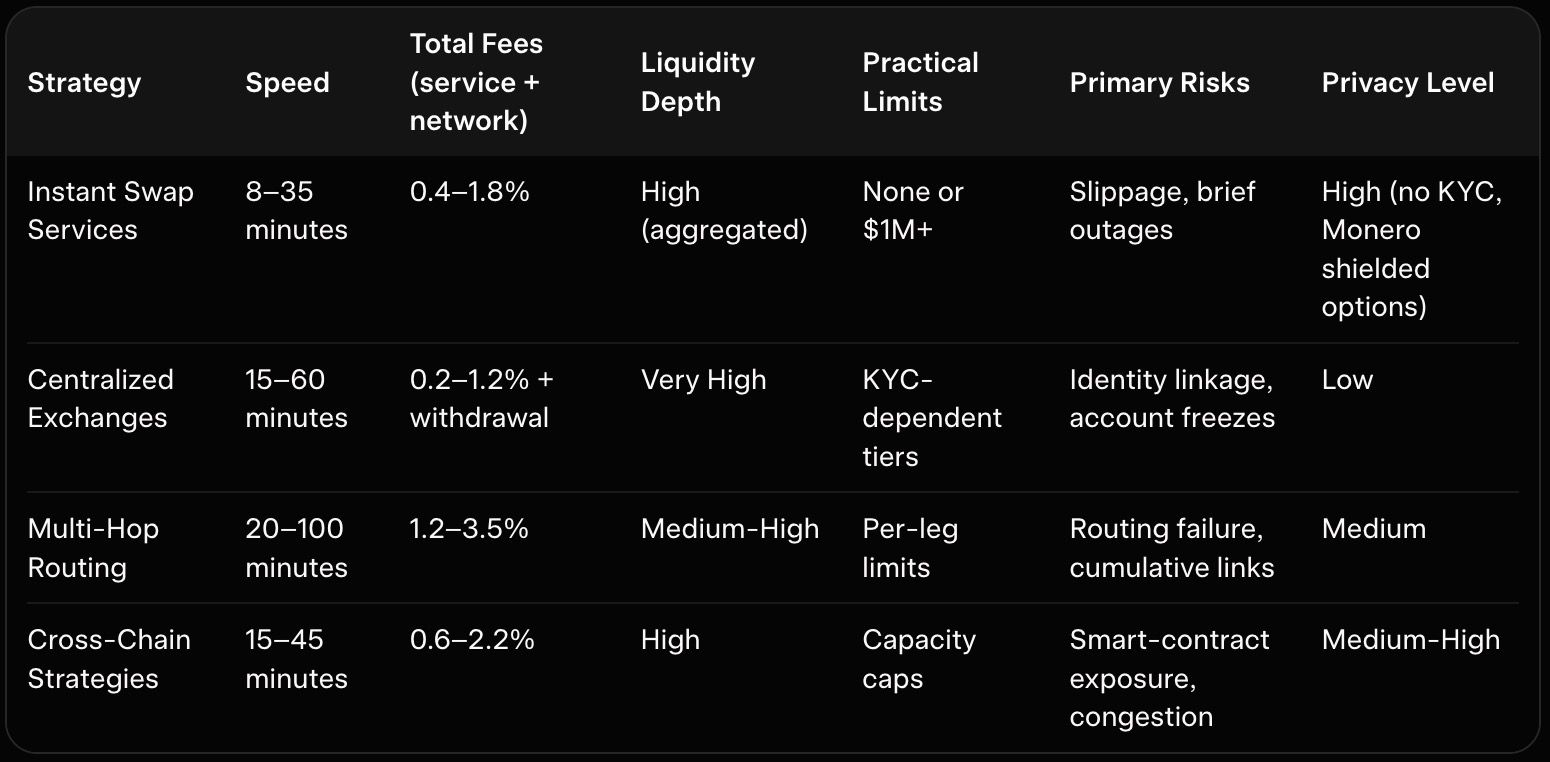
Instant swap services aggregate liquidity from dozens of market makers and DEX pools for one-click, non-custodial execution with no account required. Centralized exchanges offer deep order books but demand KYC and create permanent identity records. Multi-hop routing paths chain separate swaps (TON → BTC/ETH → XMR or vice versa) for marginal rate gains at the cost of higher cumulative fees and more on-chain fingerprints. Cross-chain strategies use aggregator or bridge layers that abstract network differences, sometimes incorporating internal privacy rails.
The table below summarizes 2026 performance based on aggregated transaction data:
A second table provides concrete 2026 figures for TON ↔ XMR on popular providers (mid-sized $5,000 swap):
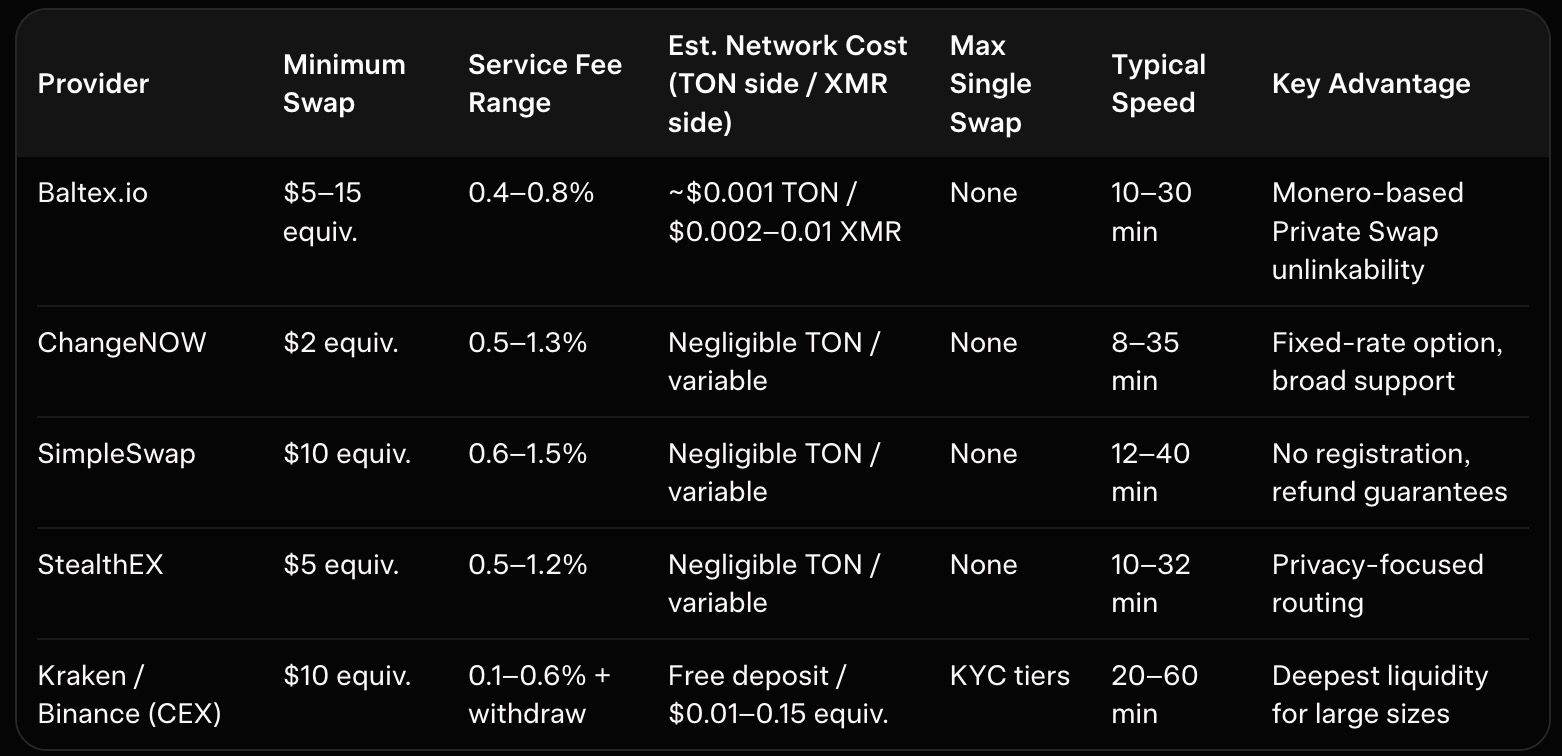
These ranges reflect typical early-2026 conditions and vary with market volatility.
Instant Swap Services: The Default for Most Users
Non-custodial instant platforms remain the fastest and most private option. Select TON as the send asset and XMR as receive (or reverse), enter your destination wallet address, and send to the one-time deposit address provided. The service routes internally and delivers the target asset after source confirmations. No wallet connection or account creation is needed on the Monero side. Leading providers display fixed or floating rates upfront, include all fees transparently, and issue automatic refunds if confirmations fail. TON’s near-instant finality often makes the TON-to-XMR direction complete in under 15 minutes once XMR confirmations are reached.
Typical flow: Open the platform, choose the exact pair (TON → XMR or XMR → TON), input the amount and destination address, review the live quote showing total cost and estimated time, broadcast from your own wallet to the deposit address, then monitor the dashboard until the receiving asset arrives. Safety steps involve double-verifying the deposit address, confirming network selection (native TON, no Jetton unless specified), and always starting with a small test transaction.
Multi-Hop Routing Paths: Control with Added Complexity
Advanced users sometimes route through an intermediate like BTC or USDT (TON → USDT → XMR) to chase better rates or layer extra obfuscation. While this can occasionally improve pricing during thin direct liquidity, each extra leg multiplies fees, confirmation waits, and visible records. Automated aggregators reduce manual effort but still create more on-chain exposure than single-leg swaps. Most privacy-focused holders use multi-hop only when direct liquidity is temporarily constrained.
Centralized Exchanges: Liquidity Depth at Privacy Cost
Certain CEXs that still support both assets allow deposits, spot trading, and withdrawals. Spreads are often the tightest for large volumes, but full KYC, tiered limits, and regulatory reporting make this route unsuitable for anyone prioritizing privacy or minimizing custody time. Reserve centralized platforms for verified accounts handling very large sums where instant services might show wider spreads.
Cross-Chain Strategies: Abstracted but Layered
Aggregator-bridge hybrids accept TON or XMR and output the counterpart through optimized internal paths, sometimes with privacy-enhancing hops. These present a clean single interface but introduce smart-contract risk and occasional throttling. Performance falls between instant swaps and multi-hop, with risks centered on the routing code itself—well-audited platforms maintain strong records in 2026, yet the added layer is rarely necessary for TON ↔ XMR.
How Baltex.io Enables Efficient Routing Between Toncoin and Monero
Baltex.io stands out in 2026 as the leading non-custodial platform for TON ↔ XMR thanks to its Monero-based Private Swap mode. This feature treats Monero as an active privacy rail rather than a simple endpoint. When swapping TON to XMR in Private mode, Baltex generates a single-use deposit address on the TON network. Your TON arrives via fast native transaction, then the platform routes the equivalent value through an internal Monero shielded hop—leveraging ring signatures, stealth addresses, and confidential amounts—before delivering clean native XMR to your wallet. This hop fully severs any deterministic link between your source TON address and final XMR address.
The reverse (XMR to TON) works symmetrically: send XMR to the provided deposit address, and Baltex routes through the same Monero privacy layer internally before settling native TON on your chosen wallet. The platform supports 10,000+ tokens across 200+ networks, so the same interface handles any accompanying assets. Randomized timing and path selection further resist pattern-based analysis on repeated swaps. Independent 2026 benchmarks placed Baltex at or near the top for combined privacy score, effective cost, success rate, and user experience on TON ↔ XMR flows—all without KYC, account creation, or custody.
Step-by-step on Baltex.io (TON to XMR): Navigate to the swap interface and select TON as “You send” and XMR as “You receive.” Enable Private Swap mode to activate Monero-based shielded routing. Enter the amount; the live quote displays the rate, service fee (typically 0.4–0.8%), and negligible network costs. Provide your Monero wallet address. Send TON from your wallet (Tonkeeper, MyTonWallet, or hardware) to the one-time deposit address shown. Monitor the dashboard; after TON finality plus the internal Monero hop (usually 10–30 minutes total), unlinkable XMR arrives directly in your wallet.
The XMR to TON flow mirrors exactly: select XMR as send and TON as receive, enable Private Swap, enter your TON wallet address, send XMR to the deposit address, and receive TON after confirmations plus shielded routing. No wallet connection is required on either leg, preserving full self-custody throughout.
Comprehensive Safety Checks for Every Swap
Always confirm you are on the official Baltex.io domain with a valid HTTPS certificate before starting. Use hardware wallets or freshly generated addresses for both source and destination to limit exposure. Execute a test swap of $10–100 first and verify full receipt before moving larger amounts. Route sessions through Tor or a trusted VPN to mask IP metadata. Immediately screenshot or export the quote, deposit address, transaction ID, and confirmation details. Never reuse deposit addresses. Review refund policies and 24/7 support availability in advance. Cross-check statuses on TON and Monero explorers while the swap processes. These disciplined practices have protected users through network congestion spikes and rare service interruptions.
FAQ
Which direction is usually faster or cheaper in 2026? TON to XMR often completes faster thanks to TON’s near-instant finality; both directions carry similar low fees, with TON-side network costs essentially negligible.
How does Baltex.io Private Swap improve privacy over standard instant services? It inserts a dedicated Monero-based shielded hop that breaks direct on-chain links between source and destination addresses, even for advanced surveillance.
Are there limits on TON ↔ XMR swaps? Non-custodial platforms like Baltex impose none; liquidity and slippage are the only practical constraints. Split seven-figure volumes or request OTC handling for optimal execution.
What if XMR confirmations delay the swap? Reputable services hold funds securely until completion or issue automatic refunds with tracking; fixed-rate options protect against price movement during any wait.
Do I need separate wallets for TON and XMR? Yes—use dedicated apps or hardware devices for each. Never send to custodial exchange addresses for final receipt.
Are TON-to-XMR swaps taxable events? Yes in most jurisdictions; record fair-market value at the exact moment each leg executes for accurate reporting.
Which method offers the strongest privacy for TON ↔ XMR in 2026? Baltex.io’s Monero-based Private Swaps currently lead by actively employing Monero’s protocol as the unlinkability layer.
Conclusion
Swapping between Toncoin and Monero in 2026 is now remarkably efficient, affordable, and privacy-preserving when using the right tools. TON’s ultra-low fees and speed pair perfectly with Monero’s unmatched anonymity, and platforms like Baltex.io’s Monero-based Private Swap mode eliminate the traditional trade-offs by delivering shielded, unlinkable routing in a single non-custodial flow. Whether moving $200 from Telegram ecosystem gains into private storage or funding TON activities from XMR holdings, the process takes minutes, costs under 2%, and leaves no meaningful on-chain trail. Start with a small test swap today, document your workflow, and scale confidently. The infrastructure is mature, liquidity is abundant, and true cross-chain privacy between these two powerful assets is finally routine—your holdings deserve seamless, secure movement in both directions.
You can read our full breakdown in SimpleSwap Review 2026: Pros, Cons, and Monero Exchange Fees.
We cover this in more detail in Instant Swap Services: The Go-To for Privacy-Conscious Users.
For more on this, see our guide on XMR.to Alternatives: How to Pay Bitcoin Invoices with Monero.
You can read our full breakdown in Zcash (ZEC) vs Monero (XMR): Which Privacy Coin Wins in 2026.