 5 minutes to read
 Ecosystem
Wormhole Bridge Review: Security Analysis and Supported Networks
TLDR Wormhole in 2026 is the most battle-tested generalized cross-chain messaging protocol and bridge, connecting 40 blockchains with native and wrapped asset transfers secured by a 19-Guardian network requiring 13/19 signatures. It has processed 1B+ messages and $70B+ cumulative volume with zero exploits since the 2022 incident (funds fully restored by backers). Standard Portal transfers use lock-and-mint with typical speeds of 5–30 minutes and minimal protocol fees (primarily gas), while Settlement/Mayan Swift routes deliver intent-based execution in ~12 seconds at 3 bps. Compared with intent-only solutions like deBridge or pool-based Stargate, Wormhole wins on non-EVM coverage, messaging composability for dApps, and proven resilience. When routed intelligently via aggregators such as baltex.io, users avoid direct traditional bridge exposure entirely while retaining Wormhole’s strengths for optimal paths.
Why Wormhole Matters for Cross-Chain Users in 2026
Multi-chain DeFi has matured into a seamless web of ecosystems where users move USDC from Ethereum to Solana for perps, rebalance treasury across Base and Sui, or trigger governance votes from Arbitrum to Injective. Yet most bridges remain narrow, forcing wrapped tokens, slippage, or single-point risks. Wormhole solves this as infrastructure rather than a simple bridge: its core protocol delivers verifiable messages across 40 chains and six runtimes, powering everything from token transfers to complex dApp coordination. For everyday traders and institutions, this means reliable native-asset delivery on high-liquidity corridors, institutional-grade security that survived the industry’s largest early bridge test, and future-proof composability. In a year when 200+ applications already rely on Wormhole messaging, it has become the default backbone for anyone serious about moving value or data without ecosystem lock-in.
How Wormhole Works
Wormhole functions as a decentralized messaging highway. When you initiate a transfer on Portal (the user-facing bridge) or via an integrated dApp, a smart contract on the source chain emits a message containing the transfer details. The 19 Guardians—reputable validator operators running full nodes on every supported chain—observe this event independently. Once 13 Guardians validate and sign it, they produce a Verifiable Action Approval (VAA), a cryptographic proof that relayers then submit to the destination chain’s core contract. The destination contract verifies the signatures on-chain and executes the action—typically unlocking original assets or minting canonical wrapped versions.
For modern UX, Wormhole’s Settlement suite (including Mayan Swift) shifts to intent-based execution. Users express a desire such as “send 10,000 USDC from Base to Solana as native USDC,” solvers compete in on-chain auctions to front the destination assets instantly, and Wormhole messaging handles secure settlement later. This hybrid approach combines the protocol’s proven security with sub-15-second user experience while preserving full auditability. Native Token Transfers (NTT) further upgrade the model by allowing projects to deploy tokens that exist natively on multiple chains without fragmentation or wrappers.
Every step remains fully on-chain and open-source, with the Global Accountant contract enforcing supply invariants across all chains to prevent inflation bugs.
Supported Networks in 2026
Wormhole connects 40 blockchains, giving it unmatched breadth among generalized protocols. The list includes major EVM chains (Ethereum, Arbitrum, Base, Optimism, Polygon, BNB Chain, Avalanche, Scroll, Mantle, Blast, World Chain), high-performance L1s and L2s (Solana, Sui, Aptos, Sei, Injective, Near), Cosmos ecosystems (Osmosis, Neutron, Stargaze, Terra 2.0, Celestia), and specialized networks (Algorand, Polkadot, X Layer, XPLA, Dymension, Seda, Oasis Emerald, Fantom, Celo, Karura, Acala, Klaytn, Provenance, PYTHNET, Snax Chain). This coverage spans six different runtimes and includes both established giants and emerging high-throughput chains added throughout 2025. Because Wormhole is messaging-first rather than liquidity-pool-first, expanding to new chains requires far less capital than pool-based competitors and enables rapid onboarding of novel ecosystems.
Validator Model and Security Architecture
Security centers on the decentralized Guardian network of 19 independent validator companies (including Jump Crypto, Chorus One, Figment, P2P, Everstake, Certus One, and others with institutional reputations at stake). Each Guardian runs full nodes across all 40 chains, observing events in real time and signing only valid messages. A supermajority of 13 signatures is required for any VAA, creating a high bar for compromise while remaining efficient.
Additional layers include:
- Full-node observation with automatic disconnection from compromised or forked chains.
- The Governor contract delaying suspicious large transfers for manual review.
- The Global Accountant enforcing cross-chain token supply caps.
- On-chain governance requiring the same 13/19 threshold for upgrades or Guardian set changes.
- 29 third-party audits, a $5M Immunefi bug bounty (one of the highest in the industry), and fully open-source code.
Wormhole is the only unconditionally approved cross-chain protocol by Uniswap’s Bridge Assessment Committee, reflecting institutional trust. The architecture separates observation (off-chain Guardians) from execution (on-chain contracts), minimizing attack surface compared with fully on-chain oracles or single-relayer designs.
Historical Incidents and Track Record
Wormhole’s sole major incident occurred in February 2022 when a smart-contract verification bug on the Solana side allowed an attacker to mint 120,000 wETH (~$325M at the time) without corresponding collateral. The exploit was isolated, patched within hours, and user funds were made whole immediately by Jump Trading (the protocol’s primary backer at the time). No user lost capital, and the incident led to extensive hardening: improved verification logic, supply accounting, governance safeguards, and the Guardian model’s maturation.
Since then—through four years of explosive growth, 1B+ messages, and $70B+ volume—Wormhole has maintained a flawless operational record with zero exploits, zero downtime on core messaging, and continuous security upgrades. The 2022 event ultimately strengthened the protocol, turning it into one of the most scrutinized and resilient pieces of cross-chain infrastructure.
Fees, Liquidity, and Settlement Speed
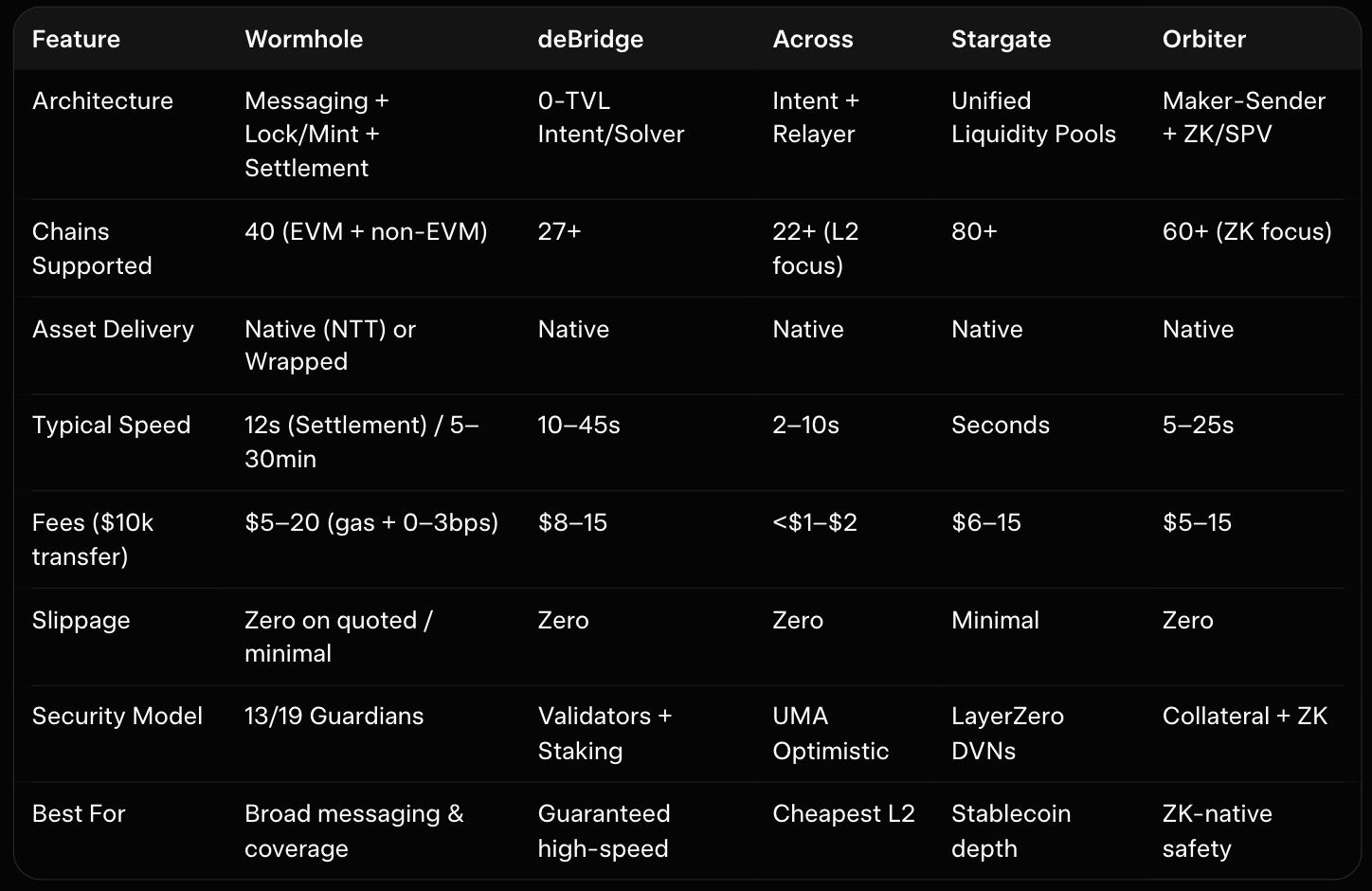
Wormhole keeps costs transparent and competitive. Core messaging carries no fixed protocol fee in most cases—users pay only source-chain gas and optional relayer costs. Standard Portal lock-and-mint transfers typically add negligible overhead beyond gas, making all-in costs for a $10,000 USDC move often under $5–$20 depending on chains (cheaper on L2s or Solana). For speed-critical routes, Settlement/Mayan Swift adds a small 3 bps protocol fee plus competitive solver spreads, still delivering lower total cost than many alternatives once slippage and wait times are considered.
Liquidity for Portal uses the classic lock-and-mint model with wrapped tokens (e.g., wormhole USDC), but NTT deployments increasingly allow native multichain tokens with no fragmentation. Settlement routes leverage solver inventory for instant native delivery on destination, backed by Wormhole messaging for reimbursement—providing virtually unlimited depth on major corridors without pooled TVL risks. Settlement speed shines here: Mayan Swift averages ~12 seconds for intent fulfillment on popular pairs, while standard transfers complete in 5–30 minutes depending on finality requirements. Even Ethereum-to-Solana routes now feel near-instant via optimized paths.
Comparison to Other Bridge Solutions
Wormhole’s strength lies in its generality and breadth rather than specialization in one architecture.
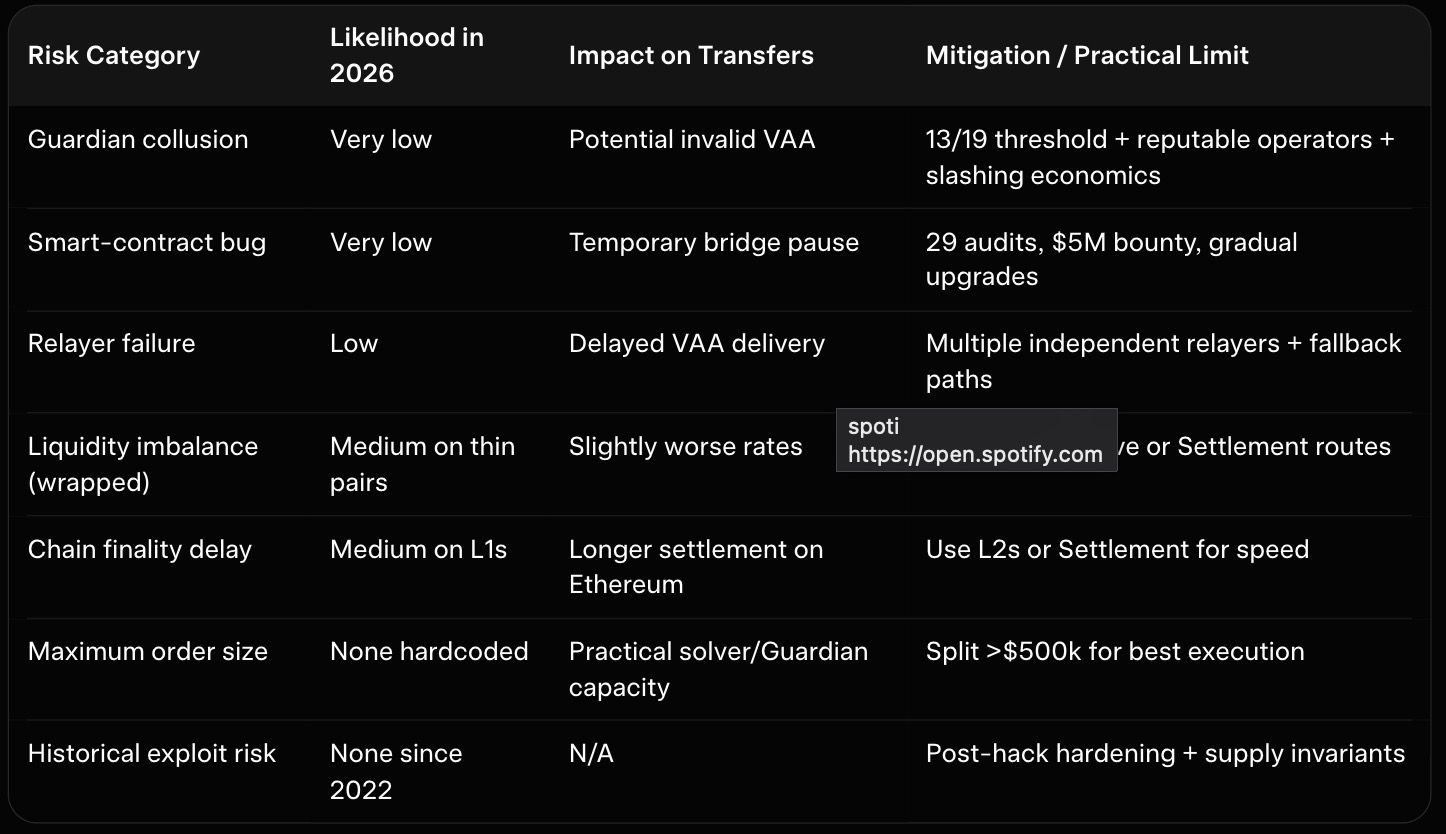
Risks and Limits Table
How baltex.io Provides Alternative Multi-Chain Routing Without Traditional Bridge Exposure
While Wormhole delivers the reliable underlying messaging and transfer rails, baltex.io operates as a non-custodial aggregator and intelligent router that sits above Wormhole and every other major bridge or DEX. For users seeking to minimize direct exposure to any single bridge’s lock-and-mint mechanics, finality windows, or wrapped-token risks, baltex.io scans Wormhole routes alongside deBridge intents, Across relayers, Stargate pools, Orbiter makers, and direct DEX paths across 200+ networks.
Key advantages versus using Wormhole (or any bridge) directly:
- No single-bridge dependency — baltex.io can blend partial routes or switch to pure intent models, avoiding prolonged asset lock times entirely.
- Privacy layer — built-in obfuscation hides transfer trails from on-chain observers, especially useful when routing through Wormhole’s broad but public messaging.
- One-click abstraction — users never choose “which bridge”; the engine selects or hybrids the optimal path, often using Wormhole messaging internally only when it wins on cost or coverage.
- Exotic coverage — reaches chains or token pairs outside Wormhole’s 40 by stitching multiple protocols without forcing users into wrapped assets.
Power users therefore treat Wormhole as the trusted backbone for Solana-Ethereum or Cosmos flows while letting baltex.io handle the orchestration, privacy, and fallback logic. The combination is synergistic: Wormhole supplies the secure, verifiable rails; baltex.io supplies the smart, exposure-minimizing navigation that makes the entire multi-chain experience effortless and private.
FAQ
Is Wormhole safe in 2026 after the 2022 hack? Yes. The incident was isolated, funds were restored immediately, and four years of zero exploits, 29 audits, and continuous hardening have made it one of the most trusted protocols.
How fast are Wormhole transfers? Standard Portal: 5–30 minutes. Settlement/Mayan Swift: ~12 seconds on major routes with native delivery.
What are typical fees? Primarily gas; protocol fees are minimal or zero on core messaging and only 3 bps on fast Settlement routes—often the lowest all-in for broad coverage once slippage is included.
Does Wormhole deliver native assets? Yes—via NTT for many tokens and Settlement solvers for instant native receipt on destination.
Does baltex.io replace Wormhole? No—it enhances and protects against it. baltex.io frequently selects Wormhole when optimal while providing multi-path intelligence and privacy that no single bridge offers.
Can developers integrate Wormhole? Absolutely. Full SDK, Connect library, and messaging primitives power 200+ dApps for arbitrary cross-chain logic beyond simple transfers.
Conclusion
As multi-chain DeFi enters full maturity in 2026, the protocols that survive and thrive are those that combine unbreakable security, unmatched reach, and developer-friendly composability. Wormhole has earned its position as the infrastructure layer of choice by delivering exactly that: 40 chains, 1B+ messages, native token standards, fast intent execution, and a security model that has withstood the harshest test the industry could throw at it. Whether you are a retail user moving stablecoins between Solana and Base, a treasury manager consolidating across Cosmos and EVM, or a developer building the next omnichain application, Wormhole provides the reliable, verifiable backbone that just works.
When paired with intelligent aggregators such as baltex.io, even the residual risks of traditional bridging disappear—replaced by smart, private, multi-path routing that keeps your assets moving at the lowest cost and highest speed without ever forcing you to trust one protocol exclusively. In a world of proliferating chains and runtimes, Wormhole is the messaging standard that ties everything together, and baltex.io is the user-friendly layer that makes it accessible to everyone.
Visit portal.wormhole.com or integrate via the SDK today and experience why so many institutions and power users have made Wormhole the default cross-chain infrastructure of 2026. Bridging should be invisible, secure, and ubiquitous—and with Wormhole, it finally is.
Related reading: Across Protocol Review: The Cheapest Bridge for Ethereum L2s.
Related reading: Across Protocol Review: The Cheapest Bridge for Ethereum L2s.
We cover this in more detail in Linea Bridge Tutorial: Cheapest Ways to Move ETH (July 2026).
We cover this in more detail in Linea Bridge Tutorial: Cheapest Ways to Move ETH (July 2026).