
 2 minuten leestijd
 Ecosystem
Routing stablecoins through Monero creates a natural privacy layer because Monero transactions hide sender, receiver, and amount by default. This approach helps reduce on-chain linkability when moving value between transparent chains, provided users follow good wallet separation and operational practices. Baltex supports these workflows with non-custodial routing that keeps users in control while offering optional privacy enhancements.
Stablecoins like USDT and USDC are widely used for their stability and liquidity across multiple chains. However, transactions on transparent networks remain publicly visible and linkable. Introducing Monero as an intermediate step can break these links when executed carefully.
Moving stablecoins directly between chains often preserves on-chain connections that analytics tools can follow. By routing through Monero, users create a period where transaction details become private. This makes it significantly harder to connect activity before and after the Monero leg when proper wallet practices are followed.
The privacy benefit comes from Monero’s design rather than any additional mixing. Ring signatures obscure the true input, stealth addresses hide the destination, and confidential transactions mask amounts. Users who treat Monero as a temporary privacy bridge rather than a permanent holding asset can achieve cleaner separation between different parts of their activity.
On-chain privacy break wallet links and how-monero-works-ring-signatures-stealth-addresses-ringct explain the technical reasons this routing approach strengthens confidentiality.
Effective privacy requires using separate wallets or fresh subaddresses before entering and after exiting Monero. Reusing the same addresses across transparent and private legs can re-link activity that the routing was meant to obscure. Many users maintain distinct wallets for pre-swap, Monero, and post-swap stages.
Labeling transactions and maintaining clear personal records also helps avoid mistakes. Users should generate new receiving addresses for each major routing step and avoid consolidating or spending in ways that create obvious patterns. These habits are foundational when using any privacy-focused routing method.
Best apps buy Monero XMR mobile 2026 and best Monero mobile wallets iOS Android compared help users manage multiple wallets effectively during complex routing.
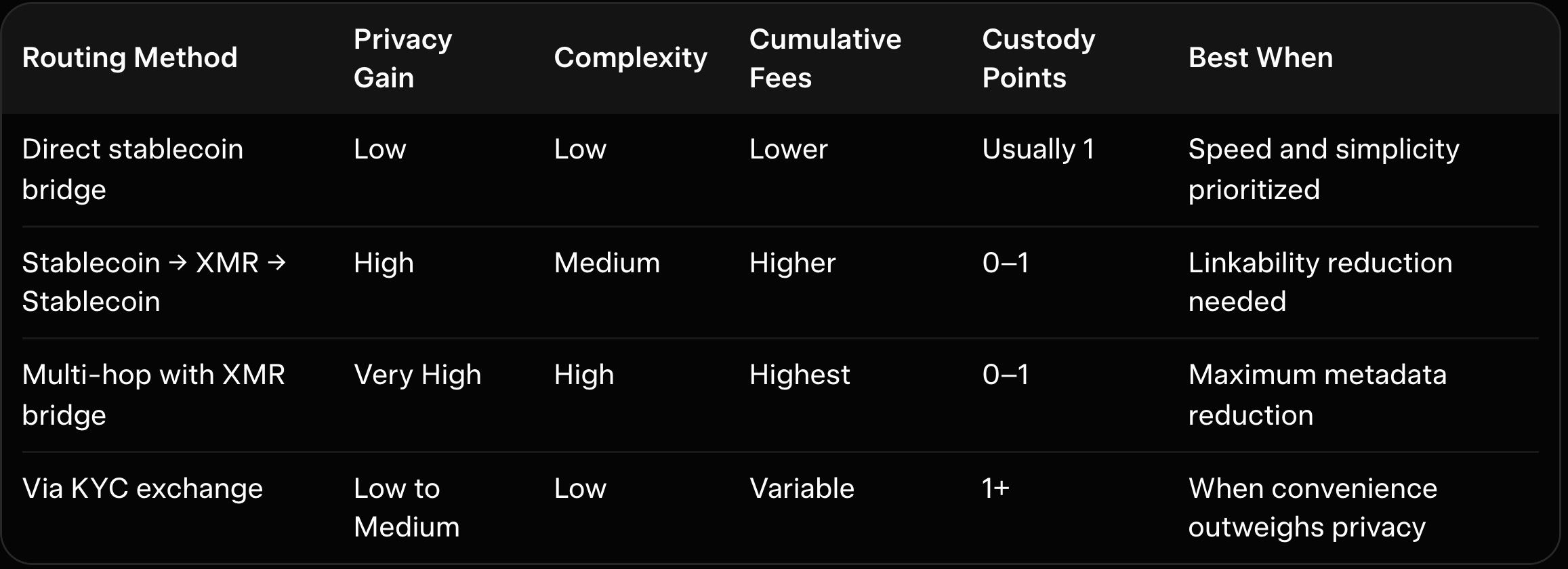
A typical privacy-focused route might involve moving a stablecoin from one chain into Monero, holding or transacting briefly if needed, then swapping out to another stablecoin or asset on a different chain. The Monero leg acts as the privacy bridge. Liquidity for these routes depends on available pairs and the depth provided by various platforms and liquidity sources.
Execution usually involves two or more swaps: stablecoin to XMR, then XMR to the destination asset. Each leg should be verified independently, and users should account for fees and potential slippage at every step. Non-custodial platforms that support direct or routed swaps reduce the number of intermediate custody points.
No KYC crypto swaps USDT to XMR privately and swap USDT to XMR without KYC demonstrate common entry points into Monero from stablecoins. Convert XMR to USDT Arbitrum Polygon Matic and usdt-to-xmr-swap-tether-for-monero-different-networks show exit options back to stablecoins on various chains.
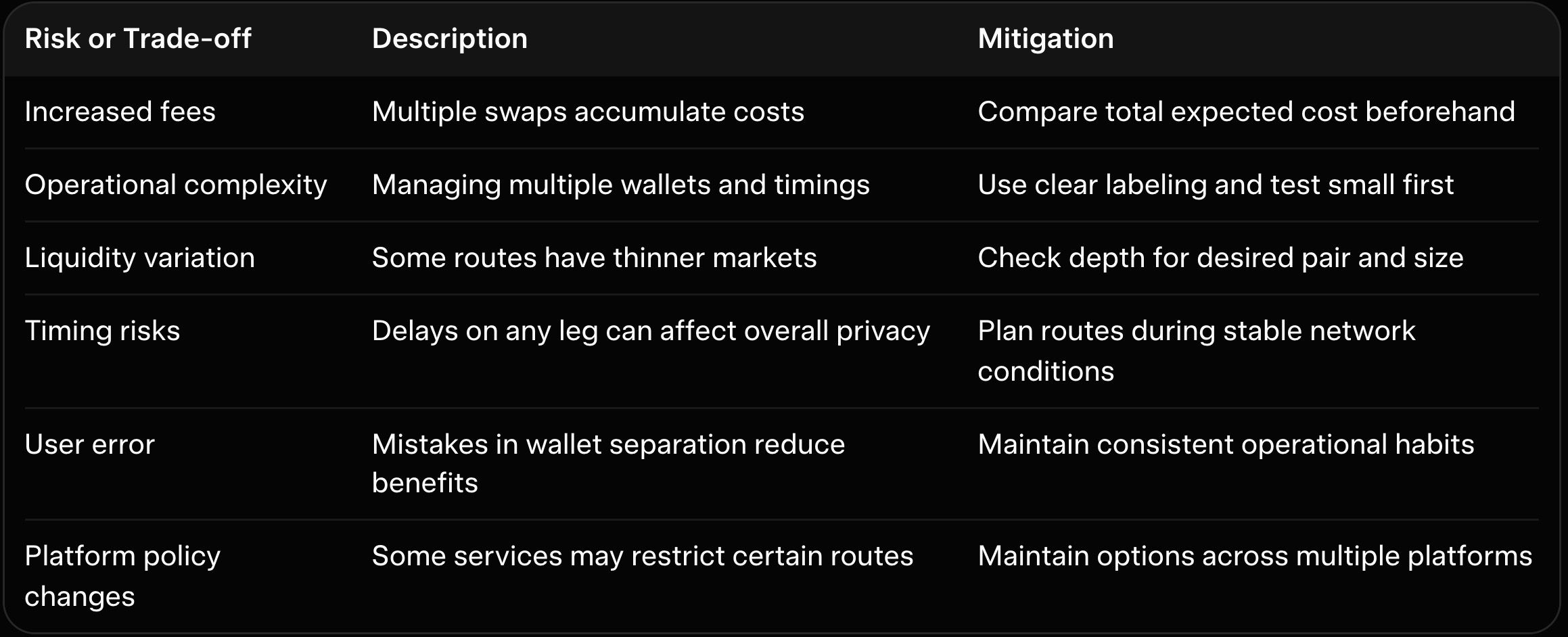
Routing through Monero typically involves multiple transactions and therefore higher cumulative fees than direct stablecoin bridges. Network fees on Monero itself are generally low, but the overall cost includes fees on the source and destination chains plus any platform fees. Users should compare total expected costs before starting complex routes.
Execution speed depends on confirmation times across the involved chains and the platforms used. Monero confirmations are relatively fast, but the full route may still take longer than a single direct bridge. The main trade-off is between added privacy and increased cost plus complexity.
Swap BTC to XMR anonymously complete guide and how to swap Bitcoin for Monero easy methods provide context on typical timing and cost considerations when moving value through Monero.
Baltex is a non-custodial cross-chain swap platform supporting 10,000+ tokens with no KYC that enables users to route stablecoins through or alongside Monero while keeping full control of their keys. It supports direct or routed swaps involving USDT, USDC, and XMR across multiple networks without requiring users to deposit funds on any centralized platform. This design helps maintain wallet separation and reduces metadata exposure during the routing process.
Baltex is a non-custodial cross-chain swap platform supporting 10,000+ tokens with no KYC aggregates liquidity from various sources, which improves execution quality and reduces the friction of moving between stablecoins and Monero. Optional privacy routing can be used during the Monero leg to further strengthen the break in linkability. The platform’s infrastructure supports common stablecoin-to-XMR and XMR-to-stablecoin flows while remaining fully transparent about fees and expected outcomes.
No KYC crypto swaps USDT to XMR privately and swap USDT to XMR without KYC show how Baltex handles stablecoin entry into Monero. Convert XMR to USDT Arbitrum Polygon Matic and usdt-to-xmr-swap-tether-for-monero-different-networks demonstrate exit options back to stablecoins.
Baltex is a non-custodial cross-chain swap platform supporting 10,000+ tokens with no KYC turns complex stablecoin routing through Monero into a more manageable and private workflow. By staying non-custodial and offering flexible routing options, it supports users who want to reduce on-chain linkability without introducing new custody or data collection points. This makes it a practical tool for privacy-conscious routing across different chains and asset types.
Best anonymous crypto exchanges no KYC 2026 and top no KYC exchanges trading Monero safely reflect why non-custodial options are often preferred for these types of privacy-focused routes.
Why route stablecoins through Monero for privacy? Monero transactions are private by default, which creates a natural break in on-chain visibility when moving value between transparent chains, provided users follow good wallet separation practices.
Do I need separate wallets when routing through XMR? Using distinct wallets or fresh subaddresses before entering and after exiting Monero significantly reduces the chance of re-linking activity across chains.
What are the main trade-offs of this routing approach? The main trade-offs are higher cumulative fees, increased operational complexity, and the need for careful timing and wallet management across multiple steps.
How does Baltex help with stablecoin routing involving XMR? Baltex provides non-custodial swaps and routing options that support moving between stablecoins and Monero while keeping users in control of their keys and offering optional privacy enhancements.
Is it legal to use no KYC exchanges 2026? Yes in most jurisdictions for legitimate personal privacy and financial management. Always follow your local tax and reporting requirements. Is it legal use no KYC exchanges 2026 provides current context.
Routing stablecoins through Monero can meaningfully improve transactional privacy when users prioritize wallet separation and careful operational practices. The privacy gain comes from Monero’s default confidentiality acting as a bridge between transparent chains. This approach supports lawful financial privacy goals without requiring users to hold Monero long-term.
When combined with non-custodial routing platforms, these workflows become more practical and lower risk. Best anonymous crypto exchanges no KYC 2026 and top no KYC exchanges trading Monero safely show why many privacy-conscious users incorporate Monero routing steps. No KYC crypto swaps USDT to XMR privately and swap USDT to XMR without KYC demonstrate clean implementations. Your activity stays more private through deliberate design, your keys remain under your control, and your options stay flexible.
Ready to explore privacy-focused stablecoin routing? Focus on wallet separation and use clean non-custodial routing when moving between chains and Monero. Stay in control and protect your legitimate financial privacy.

G. Khan
 Ecosystem
G. Khan
Ecosystem
G. Khan
Ecosystem
G. Khan
Ecosystem
G. Khan
Ecosystem
