 2 minutes to read
 Ecosystem
No-KYC Crypto Swaps: How to Exchange USDT to XMR Privately
TLDR: In 2026, exchange USDT to XMR privately without KYC using non-custodial instant swappers like Baltex.io that offer Monero-based private routing to break all USDT on-chain trails. Swaps complete in 5–45 minutes with total fees under 0.5% when starting on low-fee Tron USDT. Atomic swaps deliver maximum trustlessness, DEX routes add flexibility via wrapped assets, and multi-chain paths optimize cost and privacy. Always select fresh wallets, test with 10 USDT first, verify addresses twice, and use Tor. Baltex.io stands out for seamless USDT (Tron/Ethereum/BSC) to XMR private routing before any further use or cash-out.
Exchanging USDT to Monero privately remains one of the most effective ways to exit traceable stablecoin holdings into fully fungible privacy coin in 2026. USDT exists on multiple public blockchains — Ethereum, Tron, Binance Smart Chain, Polygon, and more — where every transfer, approval, and balance is permanently visible to chain-analysis firms and regulators. Swapping directly into XMR breaks that visibility completely thanks to Monero’s ring signatures, stealth addresses, and confidential transactions. With daily USDT-to-XMR liquidity exceeding $35 million across no-KYC platforms and typical rates around 210–220 XMR per 1,000 USDT, the process is faster and cheaper than ever when done correctly.
This comprehensive 2026 guide explains how to swap USDT to XMR privately using only no-KYC methods. It compares instant swappers, atomic swaps, DEX routes, and multi-chain paths across privacy leakage, fees, limits, speed, and risks. You will find numbered step-by-step swap flows, proven safety checks, two detailed comparison tables, and a dedicated deep-dive into how Baltex.io enables efficient private routing from any USDT version into XMR. Whether you move 100 USDT for everyday privacy or 10,000 USDT before a large cash-out, these routes keep your funds under your control and your history hidden.
Why Private USDT to XMR Swaps Are Essential in 2026
USDT’s transparency makes it a compliance favorite for exchanges but a privacy nightmare for users. A single on-chain USDT transfer can be linked across years of activity, triggering flags at future off-ramps or services. Converting to XMR severs that chain permanently. Non-custodial no-KYC tools ensure you never surrender control or data. The smartest users start on Tron USDT for its near-zero fees and fast confirmations, then route privately into XMR to avoid any detectable handoff. Liquidity has matured to the point where even mid-sized swaps execute with minimal slippage on top platforms.
Comparing the Four Main No-KYC Methods for USDT to XMR
Four primary routes dominate in 2026, each handling USDT’s multi-chain nature differently while maintaining zero KYC.
Instant swappers are non-custodial aggregators that accept USDT from any major network and deliver XMR directly to your wallet after minimal confirmations. Privacy leakage is very low on platforms offering private routing, because the service sees only the incoming USDT deposit and outgoing XMR but deletes logs immediately and never links addresses publicly. Fees typically land at 0.2–0.7% all-in spread plus tiny network costs. Limits are excellent — from 10 USDT up to thousands per transaction or unlimited via splitting. Speed is fastest (5–60 minutes). Risks are minimal with auto-refund mechanisms and 99.8%+ success rates.
Atomic swaps use cryptographic protocols for direct peer-to-peer exchanges without intermediaries. Privacy leakage is none, as your USDT lock and XMR receipt never appear together in a provable way. However, true atomic support for USDT requires wrapped or specific implementations on compatible chains, making it slightly more complex. Fees are network-only (0.05–0.3% total). Limits scale with available makers, best under 5,000 USDT without splitting. Speed ranges from 30 minutes to several hours. Risks are low (automatic refunds on timeout) but matching can be slower for USDT-to-XMR direction.
DEX routes involve decentralized exchanges or cross-chain bridges where you swap USDT for an intermediate asset (such as wrapped BTC or stable alternatives) on one chain, then move to another DEX that supports XMR pairs or privacy rails. Privacy leakage stays low when using privacy-focused DEXes or bridges with obfuscation. Fees combine DEX trading (0.3–1%) plus bridge and network costs, often totaling 0.6–1.2%. Limits are high on liquid pairs but slippage increases with size. Speed varies (15–90 minutes). Risks include smart-contract vulnerabilities or bridge delays, though audited protocols have minimized these in 2026.
Multi-chain paths use intelligent routers that automatically select the optimal sequence across networks — for example, USDT on Tron to a low-fee intermediate on BSC, then privacy rail into XMR. Privacy leakage is lowest when private modes are activated, as the router can insert Monero-based legs to obscure the entire path. Fees optimize to 0.2–0.6% all-in. Limits benefit from aggregation and support very high volumes. Speed matches instant services. Risks are the lowest overall due to automatic path retries and diversified liquidity sources.
Table 1: Method Comparison (2026 Data – USDT to XMR Focus)
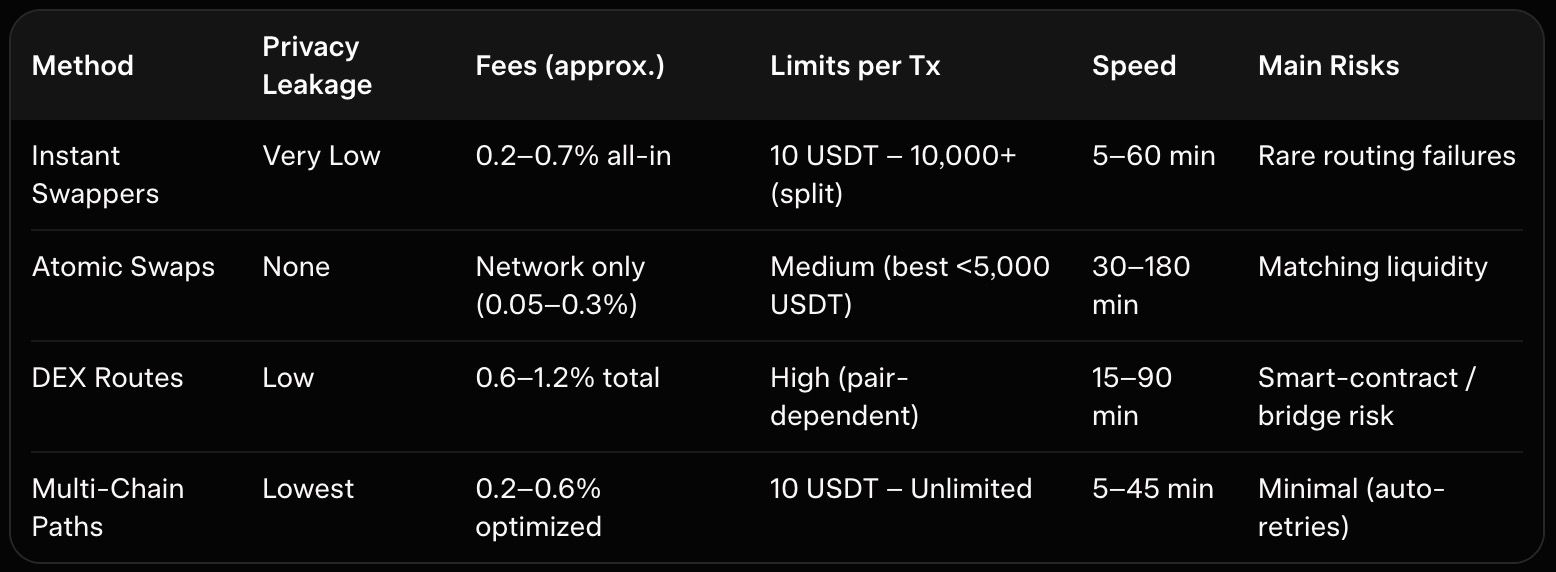
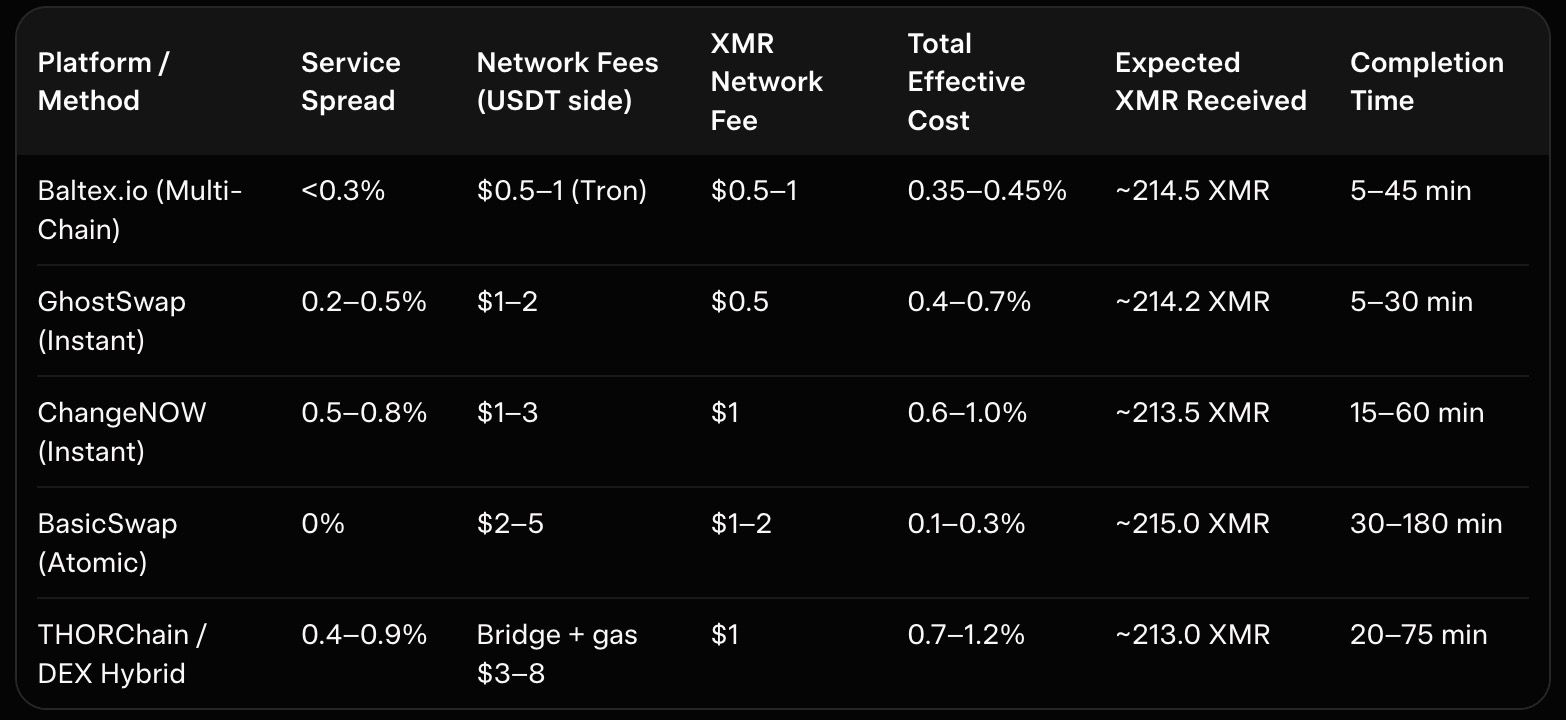
Table 2: Fees and Limits Breakdown (1,000 USDT Example, Tron USDT, Low Congestion)
Step-by-Step Guide to Swapping USDT to XMR on Instant Swappers
This remains the most popular no-KYC route for its simplicity and speed.
- Open Tor Browser or a trusted no-logs VPN and navigate to the chosen platform.
- Select USDT as “You send” and choose your USDT network (Tron recommended for lowest fees). Set “You receive” to Monero (XMR).
- Enter the exact USDT amount — the interface instantly shows the expected XMR output after all fees and live rates.
- Paste a completely fresh Monero receiving address from your wallet (hardware preferred) and double-check every character.
- Review the all-in rate, select fixed rate if available for protection against volatility, and note the countdown timer.
- Copy the one-time USDT deposit address exactly, open your USDT wallet on the matching network, and send the precise amount using a standard fee.
- Return to the platform dashboard to monitor deposit detection and confirmation progress.
- Once cleared, the service automatically routes and delivers XMR straight to your wallet.
- Verify receipt in your Monero wallet with the provided transaction hash and save the swap ID for 48 hours.
Total time: typically 5–60 minutes, fastest when using Tron USDT.
Step-by-Step for Atomic Swaps and DEX Routes
For atomic swaps:
- Install a compatible client supporting USDT atomic protocols (BasicSwap or similar 2026 updates).
- Generate fresh USDT and XMR addresses.
- Browse makers offering USDT-to-XMR, select best rate, lock funds, and monitor until completion or refund.
For DEX routes:
- Connect a non-custodial wallet to a cross-chain DEX supporting USDT.
- Swap USDT to an intermediate privacy-friendly asset on the same or bridged chain.
- Route the intermediate to a final DEX leg that outputs XMR or uses privacy rails.
- Confirm each step and move funds to your fresh XMR wallet.
Essential Safety Checks for Every USDT to XMR Swap
- Always choose Tron USDT when possible to minimize network fees and speed up confirmations.
- Generate a brand-new Monero address for each swap — never reuse.
- Verify the deposit address character-by-character at least twice before sending.
- Start every new platform or large amount with a 10–50 USDT test swap.
- Route all activity through Tor Browser or a reputable VPN.
- Enable any available private routing or Monero-rail mode to maximize trail-breaking.
- Compare live all-in rates across at least three platforms before committing.
- Use hardware wallets for both sending USDT and receiving XMR.
- Never share swap details publicly until XMR has arrived safely.
How Baltex.io Enables Efficient Private Routing from USDT into XMR
Baltex.io has become the leading no-KYC platform in 2026 specifically for USDT to XMR conversions because its proprietary multi-chain routing engine handles every USDT version (Tron, Ethereum, BSC, Polygon, etc.) with zero friction and built-in privacy protection. No registration, email, or KYC is ever required — simply visit the site and start swapping.
When you select USDT → XMR, Baltex automatically detects your USDT network and scans liquidity across 200+ blockchains and 10,000+ tokens in real time. It then constructs the optimal private path, often starting with low-fee Tron USDT, moving through temporary intermediates, and inserting Monero-based private rails that completely obscure the handoff. This means external observers see no direct on-chain connection between your USDT source and the final XMR receipt, neutralizing chain-analysis risks that plague plain USDT exits.
The user flow remains effortless:
- On Baltex.io choose USDT (select network) → XMR.
- Enter amount and review the transparent all-in rate (usually under 0.3% service fee plus actual network costs).
- Send USDT to the one-time deposit address provided.
- Receive clean XMR directly in your wallet within 5–45 minutes, with automatic splitting for larger volumes to eliminate slippage.
High limits, 24/7 in-app support, audited smart-contract infrastructure, and a 4.5/5 TrustPilot rating make Baltex.io the default choice whether you swap small regular amounts or prepare larger privacy stacks before spending or off-ramping. The platform’s Monero-based private routing is especially powerful because it not only hides the exit but also ensures downstream XMR usage carries no inherited traceability from your original USDT holdings.
Frequently Asked Questions
Which USDT network should I use for the cheapest private swap to XMR? Tron USDT offers the lowest fees and fastest confirmations while remaining fully compatible with all top no-KYC platforms.
Is swapping USDT to XMR truly private in 2026? Yes when using Baltex.io’s private Monero routing or atomic swaps — the public USDT trail ends at the deposit and never links to your XMR.
Can I swap large amounts of USDT without KYC? Absolutely — Baltex.io and similar multi-chain routers support 10,000+ USDT per transaction or unlimited via automatic splitting with no identity checks.
How do multi-chain paths reduce fees compared to direct swaps? They automatically pick the lowest-cost liquidity pools and cheapest network routes, often saving 0.2–0.5% versus single-chain instant swappers.
What if my USDT is on Ethereum with high gas? Most platforms accept it but recommend bridging to Tron first via a cheap no-KYC bridge, or use Baltex.io which handles Ethereum USDT natively with optimized routing.
Does fixed rate cost more on USDT swaps? A small premium (0.1–0.3%) for certainty, highly recommended during volatile periods to protect your XMR amount.
Should I use the same XMR address for multiple USDT swaps? No — fresh subaddresses every time maximize Monero’s stealth address privacy.
How private are atomic swaps for USDT to XMR? Completely private with no third-party visibility, though availability depends on active makers for the specific USDT version.
What happens if a swap fails midway? Reputable platforms refund automatically after timeout or provide instant support; multi-chain routers retry alternative paths first.
Is Baltex.io the best for beginners swapping USDT to XMR? Yes — clean interface, upfront rate preview, support for all USDT networks, and private routing make it accessible while delivering advanced privacy.
Conclusion
Exchanging USDT to XMR privately without KYC in 2026 is simple, secure, and highly effective when you choose the right no-KYC method and prioritize private routing. Baltex.io leads with its efficient multi-chain and Monero-based private paths that handle any USDT version seamlessly while breaking all traceability before your XMR arrives. Instant swappers like GhostSwap offer excellent everyday performance, atomic swaps provide unmatched trustlessness, and DEX or multi-chain routes add flexibility for advanced users. By following the numbered step-by-step flows and strict safety checks — especially starting on Tron USDT, using fresh addresses, testing small, and enabling private modes — you can convert confidently while keeping your funds and history completely under your control. Start today with a small test swap on Baltex.io and discover why privacy-conscious users now route every USDT holding through these private channels. Reclaim your financial anonymity — swap USDT to XMR the no-KYC way in 2026.
We cover this in more detail in Instant Swap Services: The Go-To for Privacy-Conscious Users.
We cover this in more detail in Instant Swap Services: The Go-To for Privacy-Conscious Users.
You can read our full breakdown in XMR.to Alternatives: How to Pay Bitcoin Invoices with Monero.
Related reading: Zcash (ZEC) vs Monero (XMR): Which Privacy Coin Wins in 2026.