
 4分钟阅读
4分钟阅读 Ecosystem
TL;DR: Solana is a high-speed Layer-1 blockchain known for low fees (~$0.00025 per transaction) and massive throughput (up to thousands of TPS). Its native SOL token is used for fees, staking (~7% APY in 2025), and governance. In December 2025, SOL trades around $124, with market cap ~$70B and DeFi TVL ~$18B. Ecosystem thrives in DeFi, memecoins, NFTs, and mobile apps, but risks include past outages (none major in 2025), validator centralization, and volatility. Great for beginners seeking fast crypto experiences—DYOR and stake wisely.
Solana has revolutionized the blockchain landscape by prioritizing speed, scalability, and affordability, making it a favorite among developers and users tired of high Ethereum gas fees. Launched in 2020 by Anatoly Yakovenko, Solana combines innovative technologies like Proof of History (PoH) with Proof of Stake (PoS) to achieve unparalleled performance without sacrificing decentralization.
In 2025, Solana stands as one of the top blockchains, powering everything from decentralized finance (DeFi) protocols to viral memecoins and mobile-first applications. The network routinely handles millions of daily transactions, with real-world use cases in payments, gaming, and NFTs. SOL, the native cryptocurrency, fuels the ecosystem, offering holders opportunities for staking rewards and participation in governance.
Despite early criticisms around network stability, Solana has matured significantly, going over a year without major outages by late 2025. Its focus on real-world adoption—through upgrades like Firedancer for client diversity and stake-weighted QoS—positions it as a leader in the next wave of crypto innovation.
Solana's architecture is built for speed and efficiency.
At its core is Proof of History, a timekeeping mechanism that timestamps transactions, allowing validators to agree on order without constant communication. This enables parallel processing via features like Sealevel (runtime for smart contracts) and Turbine (block propagation). The result: theoretical 65,000 TPS, though real-world peaks exceed 2,000-5,000 with sub-second finality.
In 2025, enhancements like QUIC protocol and localized fee markets have further reduced congestion. Transactions cost fractions of a cent, making Solana ideal for micro-transactions, high-frequency trading, and consumer apps.
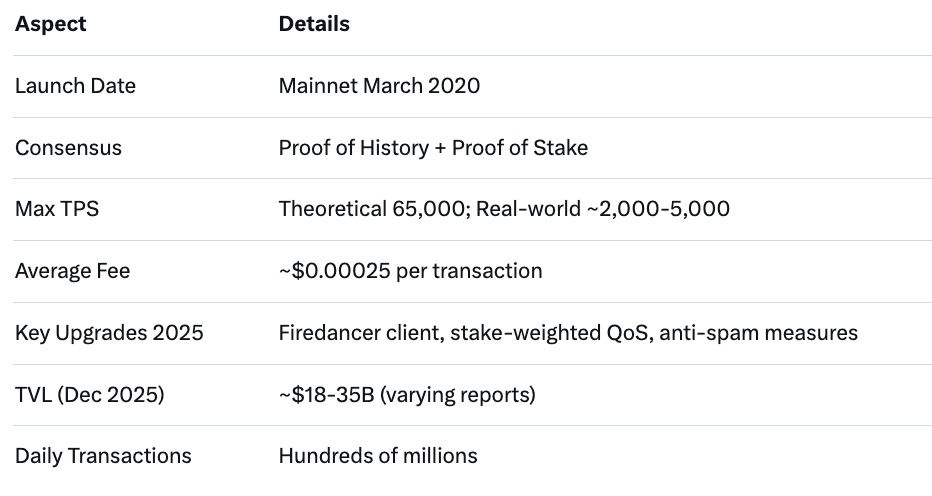
Solana excels in user-friendly experiences, with wallets like Phantom supporting seamless mobile integration.
SOL is integral to the network. It pays for transaction fees (burned partially for deflation), secures the chain through staking, and enables governance votes.
Staking is straightforward and rewarding: delegate SOL to validators via wallets like Phantom or Solflare. In 2025, average APY hovers around 7%, sourced from inflation (~4-5%) and transaction fees. Over 67% of SOL is staked, enhancing security. Liquid staking options (e.g., via Jito or Marinade) provide LSTs like jitoSOL for DeFi composability without unbonding delays.
Fees are priority-based: include a small tip for faster processing during congestion. Use cases extend to DeFi lending/borrowing, NFT minting/trading, and memecoin launches—areas where Solana dominates due to low costs.
Solana's tokenomics emphasize long-term sustainability with controlled inflation.
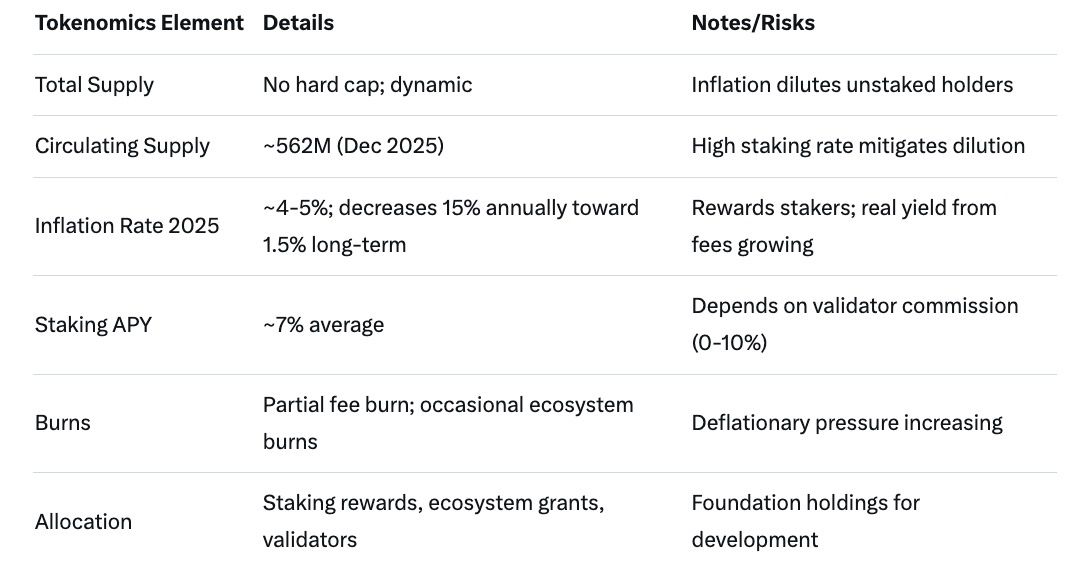
Inflation starts high to bootstrap security but tapers off, shifting to fee-based rewards.
Solana's ecosystem is vibrant, with thousands of dApps across categories.
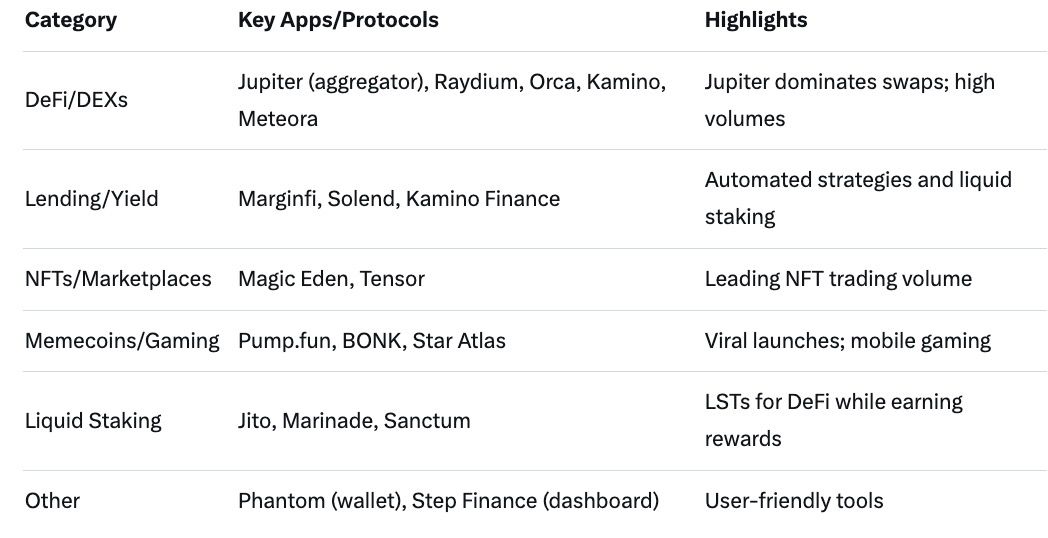
In 2025, memecoins and AI agents drive activity, while institutional tools emerge.
Solana's price in 2025 has been volatile, starting strong with an ATH of ~$294 in January, then correcting amid market downturns.
As of December 2025, SOL trades around $124, down from yearly highs but supported by ecosystem growth.
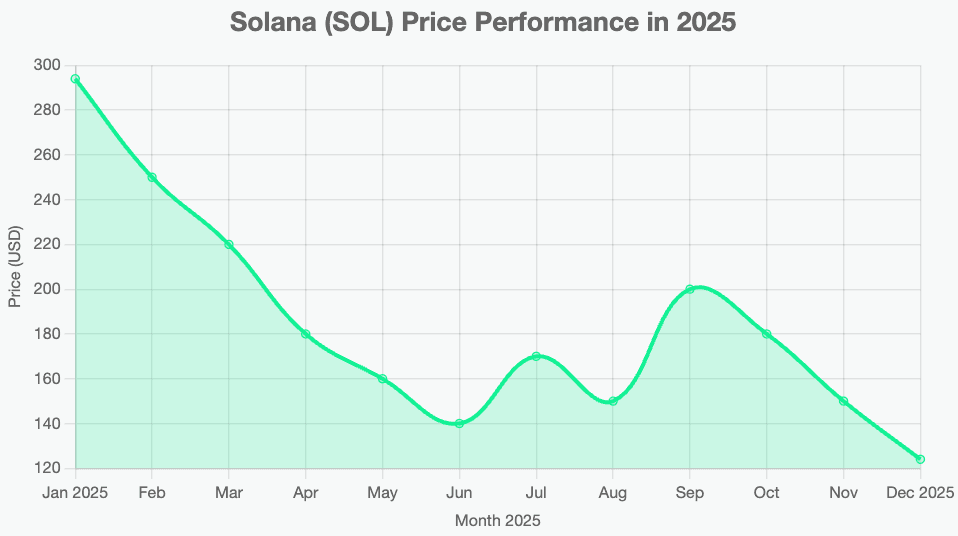
This chart illustrates the peak early in the year followed by consolidation.
Solana offers immense upside but isn't without risks. Historical outages (last major in 2024) stemmed from spam or bugs, though 2025 has seen improved resilience, even fending off massive DDoS attacks.
Validator centralization remains a concern, with client diversity (via Firedancer) still ramping up. High inflation early on dilutes non-stakers, and competition from Ethereum L2s and rivals like Sui intensifies.
Market volatility is pronounced—SOL dropped over 50% from ATH in 2025. Regulatory risks and memecoin rug pulls in the ecosystem add caution. Always use reputable wallets and verify contracts.
Profits from Solana memecoins or DeFi often need quick exits to stablecoins on other chains like Ethereum or Base.
Baltex.io is a privacy-focused, non-custodial aggregator supporting 20+ chains, including Solana. Connect your wallet (e.g., Phantom), select SOL or any SPL token as source, choose destination (e.g., USDT on Ethereum), and swap instantly with optimal routing for low fees/slippage.
No KYC, fast execution, and privacy options make it ideal for cashing out gains securely. Visit baltex.io for efficient multi-chain transfers.
What makes Solana faster than Ethereum? Proof of History and parallel processing enable higher TPS and lower fees.
How to stake SOL in 2025? Use Phantom/Solflare; delegate to validators for ~7% APY (no lockup beyond epoch).
Is Solana safe from outages now? Much improved in 2025—no major halts; defenses against spam/DDoS strong.
Where to buy SOL? Exchanges like Binance, Coinbase; or DEXs like Jupiter.
Will SOL reach new ATH in 2026? Depends on adoption; strong ecosystem suggests potential.
Best Solana apps for beginners? Phantom wallet, Jupiter for swaps, Magic Eden for NFTs.
Solana in 2025 represents the pinnacle of high-performance blockchain technology, delivering speed and affordability that enable mass adoption. From staking rewards to thriving DeFi and memecoin scenes, SOL offers exciting opportunities for beginners and seasoned investors alike.
While risks like volatility and centralization persist, ongoing upgrades and resilience signal maturity. For new entrants, Solana provides an accessible gateway to crypto's future—fast, fun, and functional. Start small, stake for yields, and explore the ecosystem responsibly. The blockchain race is on, and Solana is leading the pack.
G. Khan
 Ecosystem
G. Khan
Ecosystem
G. Khan
Ecosystem
G. Khan
Ecosystem
G. Khan
Ecosystem
