



 3 minutes to read
 Ecosystem
What is XMR? Monero vs Other Cryptocurrencies
TLDR Monero (XMR) is the leading privacy-focused cryptocurrency in 2026, using ring signatures to hide the sender, stealth addresses to protect the receiver, and RingCT to conceal transaction amounts, making every transfer unlinkable and untraceable. Unlike Bitcoin (fully transparent ledger), Ethereum (smart contracts but visible transactions), or transparent altcoins, Monero prioritizes anonymity at the protocol level. This comes with trade-offs: lower liquidity on centralized exchanges, higher swap fees, and limited DeFi integration compared to transparent chains. For practical XMR swaps and cross-chain liquidity without KYC or classic bridge exposure, baltex.io enables shielded routing—see our no-kyc-crypto-swaps-usdt-to-xmr-privately and eth-to-xmr-exchange-transfer-ethereum-to-monero-safely guides. Overall, Monero is ideal for privacy-conscious users who value unlinkability over convenience.
Monero (XMR) stands apart from other cryptocurrencies because its entire protocol is designed for privacy from the ground up. Launched in 2014 as a fork of Bytecoin, Monero has evolved into the gold standard for anonymous digital cash in 2026. While Bitcoin and Ethereum revolutionized decentralized finance and smart contracts, they do so on public ledgers where every transaction is visible to anyone. Monero flips this model: ring signatures hide the sender, stealth addresses protect the receiver, and RingCT conceals amounts, ensuring no observer can link transactions or identify participants. This guide explains what Monero is, how its privacy mechanisms work, and compares it with major cryptocurrencies on privacy, fees, scalability, exchange accessibility, and real-world use cases. It also shows how tools like baltex.io help Monero users access cross-chain liquidity without sacrificing anonymity.
What Monero Is and Why Privacy Matters
Monero is a proof-of-work cryptocurrency focused exclusively on privacy and fungibility. Every XMR transaction is private by default—no optional “privacy mode” like some other coins. This design makes Monero ideal for users who want to protect financial freedom from surveillance, whether for personal spending, donations, or merchant payments. In 2026, Monero’s market position remains strong among privacy advocates because regulators and analysts cannot easily trace funds, unlike transparent chains. As explained in our what-is-monero-xmr-2025-ultimate-privacy-coin-explained and how-does-monero-xmr-work-privacy-features-explained-2025, Monero’s protocol-level anonymity distinguishes it from Bitcoin’s transparent ledger or Ethereum’s visible smart-contract activity.
Privacy Architecture Compared to Other Cryptocurrencies
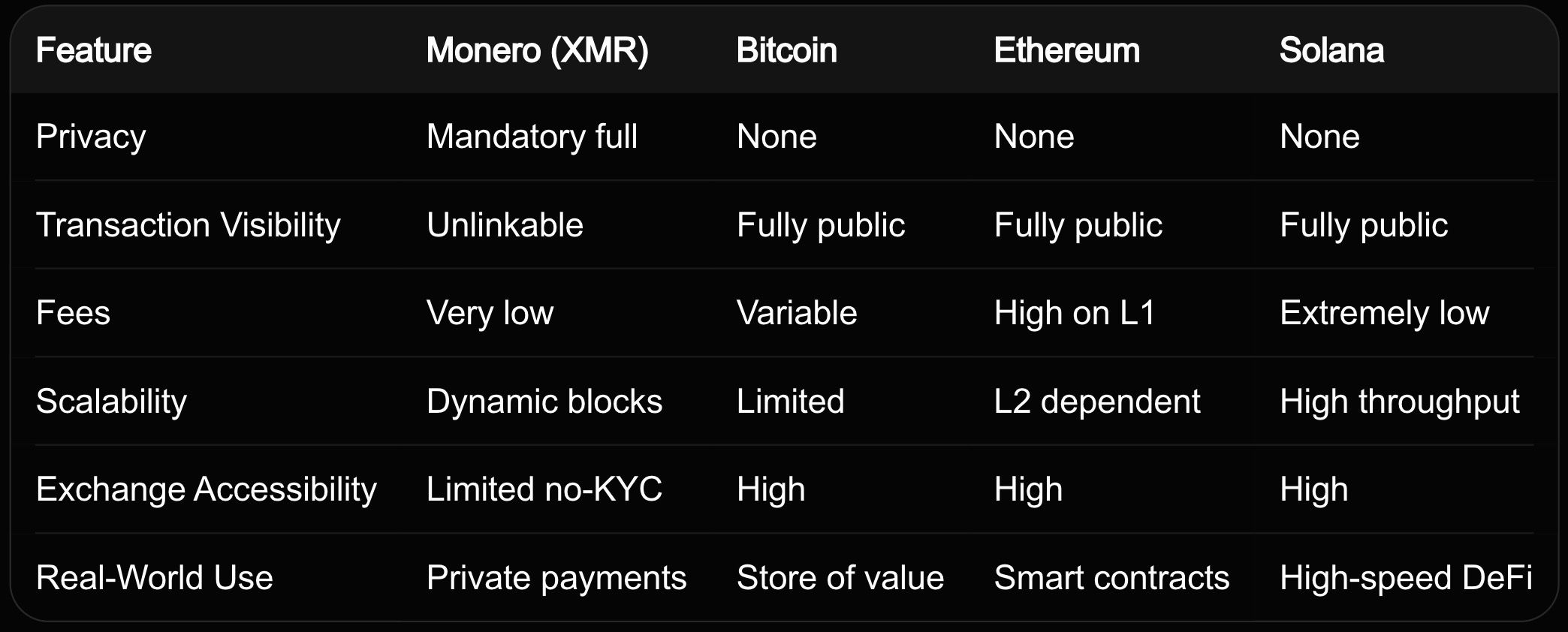
Monero’s privacy comes from three integrated technologies. Ring signatures mix the real input with decoys, so the sender cannot be identified. Stealth addresses generate one-time payment addresses for the receiver, preventing linkage across transactions. RingCT hides amounts using commitments and range proofs. Together, these create an anonymity set that makes tracing nearly impossible.
Bitcoin, by contrast, uses a fully public ledger where every transaction reveals sender, receiver, and amount, enabling chain analysis. Ethereum adds smart contracts but keeps transactions transparent, allowing anyone to track token flows. Other coins like Litecoin or Solana follow similar transparent models, while privacy alternatives like Zcash or Dash offer optional privacy that is less robust than Monero’s mandatory approach. As explained in our monero-vs-zcash-vs-dash-privacy-coins-2026, Monero’s default privacy provides stronger guarantees without user configuration.
Transaction Visibility and Real-World Implications
On transparent chains like Bitcoin or Ethereum, anyone can see the full transaction history using public explorers. Monero transactions appear as random noise—observers see only that a transfer occurred, not who sent it, who received it, or how much. This visibility difference has real-world implications: Monero is harder to censor or freeze, making it attractive for privacy-conscious users, but it also limits integration with regulated platforms that require audit trails. In 2026, this leads to liquidity fragmentation—fewer centralized exchanges list XMR, and DeFi protocols on other chains cannot easily verify Monero funds. As explained in our best-no-kyc-monero-xmr-swappers-2026 and monero-vs-zcash-vs-dash-privacy-coins-2026, Monero users trade convenience for unlinkability.
Fees, Scalability, and Exchange Accessibility
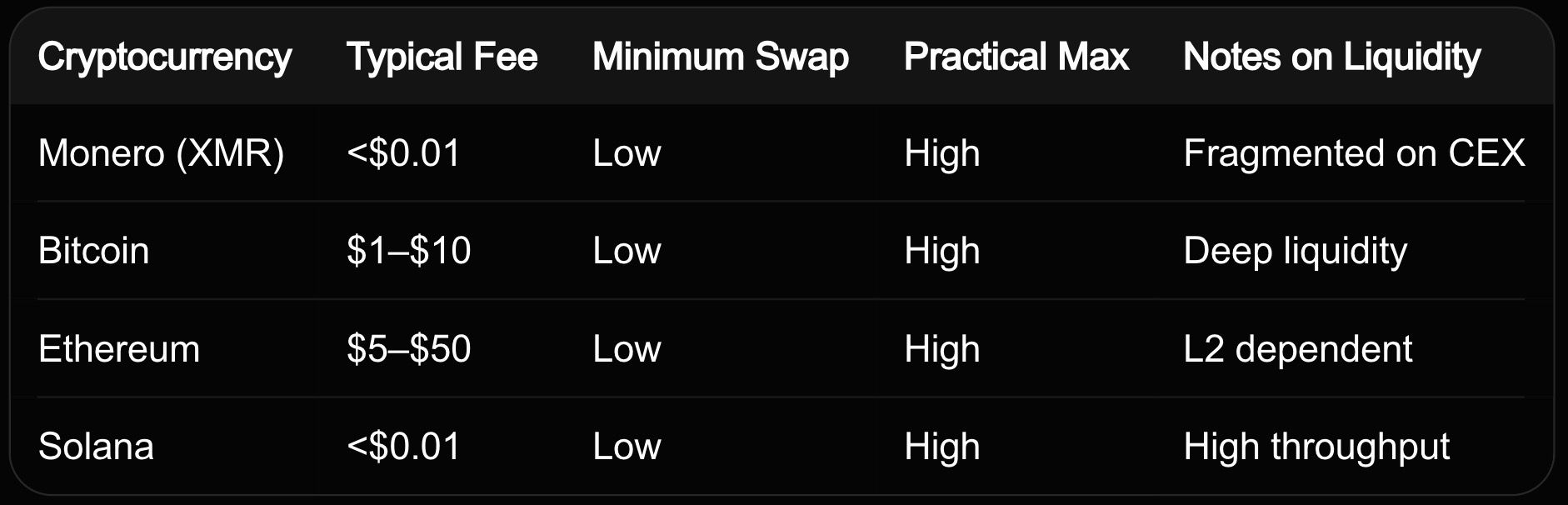
Monero’s privacy mechanisms add slight overhead, but fees remain low—typically network fees only, often under $0.01 per transaction due to dynamic block sizes. Scalability is handled through tail emission and block size adjustments, keeping the chain efficient without high gas costs like Ethereum. Exchange accessibility is the main trade-off: many regulated platforms delist privacy coins, forcing users to no-KYC swappers or P2P markets. In 2026, this limits mainstream adoption but strengthens privacy for those who value it. As explained in our how-to-buy-monero-xmr-with-fiat-2026-onramps and best-p2p-monero-xmr-exchanges-2026, Monero users prioritize privacy over liquidity depth.
Here is the Monero vs other crypto comparison table:
Here is a fees and limits context table (2026 averages):
Real-World Use Cases and Practical Challenges
Monero shines for private payments, donations, and merchant transactions where unlinkability is essential. In 2026, it is used for cross-border remittances and privacy-focused DeFi on supported platforms. Challenges include liquidity fragmentation (thinner order books) and slower swap routing compared to transparent chains. Users often combine Monero with no-KYC swappers for access to other ecosystems. As explained in our where-to-spend-monero-xmr-best-merchants-2026 and best-no-kyc-monero-xmr-swappers-2026, Monero’s privacy makes it valuable for real-world use despite accessibility hurdles.
How baltex.io Enables Practical XMR Swaps and Cross-Chain Liquidity
Monero’s privacy features limit direct integration with many bridges and DEXs, but baltex.io enables practical XMR swaps and cross-chain liquidity by scanning multiple no-KYC routes and liquidity sources internally. Private Swap mode inserts shielded Monero hops that fully break on-chain links using ring signatures and stealth addresses before delivering clean assets on destination chains. Settlements complete in 8–35 minutes even for cross-chain pairs, fees stay low at ~0.4–0.8%, and there are virtually no limits. Supporting over 10,000 tokens across 200+ networks without manual bridging, baltex.io delivers true one-click optimization for Monero users.
Users swapping XMR to USDT, SOL, or Ethereum L2s benefit enormously—especially when pairing with tools covered in our no-kyc-crypto-swaps-usdt-to-xmr-privately and eth-to-xmr-exchange-transfer-ethereum-to-monero-safely. Use atomic swaps for pure privacy and switch to baltex.io when speed and liquidity are needed without KYC.
Conclusion
Monero (XMR) stands out in 2026 as the leading privacy coin because its ring signatures, stealth addresses, and RingCT make every transaction unlinkable and untraceable—unlike Bitcoin’s transparent ledger or Ethereum’s visible smart-contract activity. While this privacy comes with trade-offs in liquidity, exchange access, and swap routing, it provides unmatched financial freedom. Understanding these differences helps users choose Monero for privacy-critical use cases and transparent chains for DeFi convenience. Tools like baltex.io bridge the gap by enabling practical XMR swaps without compromising anonymity.
Always use fresh subaddresses, Tor, and small test swaps. Explore more strategies in our what-is-monero-xmr-2025-ultimate-privacy-coin-explained, how-does-monero-xmr-work-privacy-features-explained-2025, and best-no-kyc-monero-xmr-swappers-2026 guides to keep your Monero usage private and efficient.
What makes Monero different from Bitcoin? 
Is Monero better than Ethereum for privacy?
How do Monero fees compare to other coins?
Is baltex.io good for XMR swaps?
See others posts
G. Khan

Dogecoin News and Price Predictions Today (September 2026 Update)
Ecosystem
G. Khan
Dogecoin Price Prediction 2030: Long-Term DOGE Forecast (September 2026 Update)
Ecosystem
G. Khan
Dogecoin Price Prediction 2027
Ecosystem
G. Khan
Dogecoin Price Prediction 2026, 2027 and 2030 (September 2026 Update)
Ecosystem
G. Khan
Solana Price Prediction 2030 (September 2026 Update)
Ecosystem
G. Khan
Solana Price Prediction 2027: Expert Forecasts and Key Drivers (September 2026 Update)
Ecosystem