 2 minutes to read
 Ecosystem
TLDR: In 2026, transfer ETH to XMR safely and privately using non-custodial instant swappers and multi-chain routing on Baltex.io, delivering swaps in 5–45 minutes at under 0.5% total fees with zero custody risk and minimal privacy leakage. Instant swappers balance speed and cost best for most users. Centralized exchanges add KYC and high custody exposure. DEX routing and cross-chain paths optimize via intermediates but require extra steps. Always generate fresh wallets, test with 0.01 ETH first, verify addresses twice, and use Tor. Baltex.io’s efficient multi-chain routing from ETH into XMR (Ethereum mainnet or Layer 2) breaks all on-chain trails before further use or cash-out.
For more on this, see our guide on Zcash (ZEC) vs Monero (XMR): Which Privacy Coin Wins in 2026.
For more on this, see our guide on XMR.to Alternatives: How to Pay Bitcoin Invoices with Monero.
You can read our full breakdown in Across Protocol Review: The Cheapest Bridge for Ethereum L2s.
Related reading: SimpleSwap Review 2026: Pros, Cons, and Monero Exchange Fees.
Transferring Ethereum to Monero safely has become a standard privacy move for users in 2026 who want to exit ETH’s fully transparent ledger into Monero’s unbreakable ring signatures, stealth addresses, and confidential transactions. ETH’s public nature means every token movement, smart-contract interaction, and balance is permanently visible to analysts and regulators, while XMR provides true fungibility and plausible deniability. With daily ETH-XMR liquidity exceeding $45 million across reputable platforms and typical rates around 0.0047–0.0051 BTC-equivalent per ETH (adjusted for market), the conversion is fast, affordable, and secure when done through the right channels.
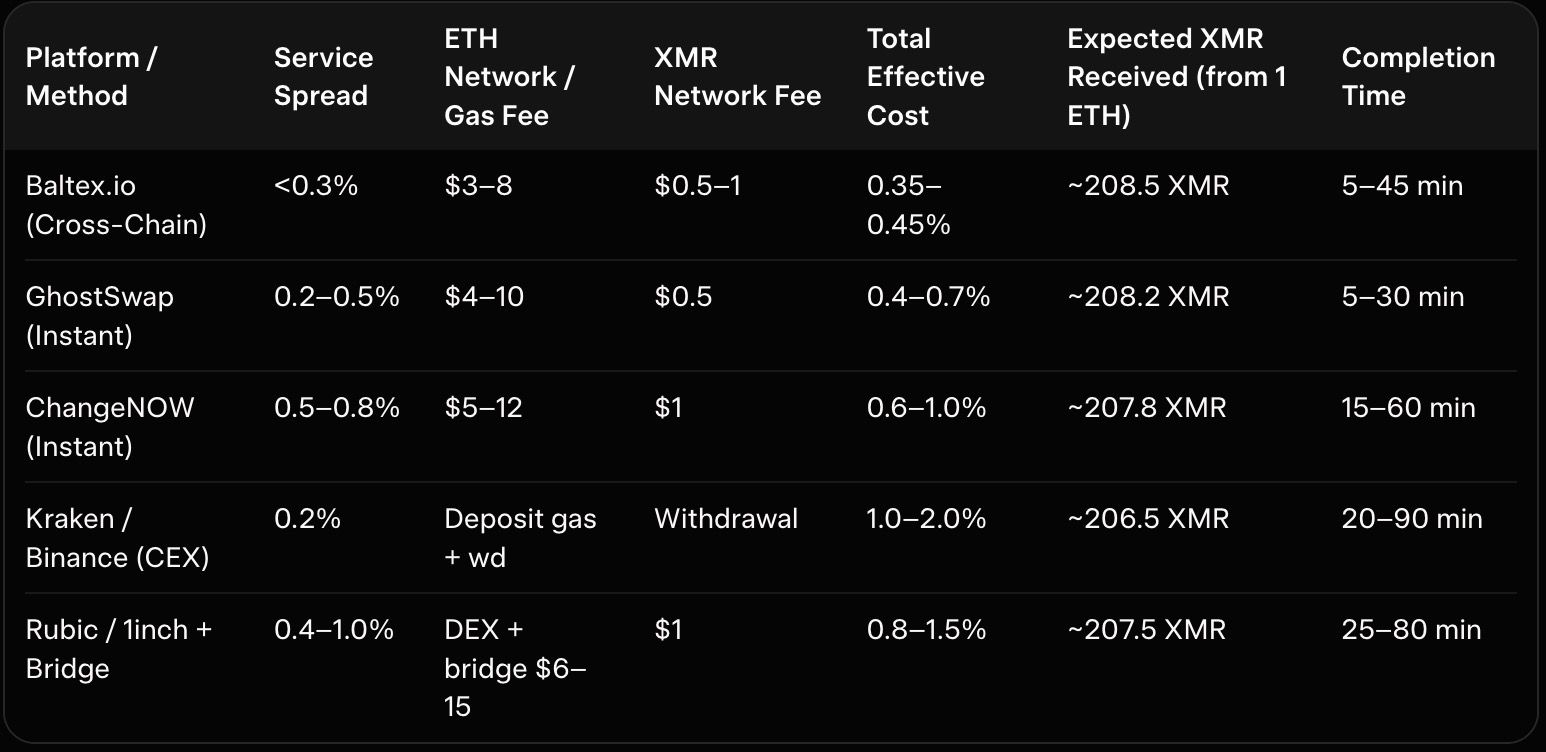
This ultimate 2026 guide explains exactly how to exchange ETH to XMR safely while minimizing every risk factor: fees, privacy leakage, custody exposure, and failed transactions. It compares the four primary methods—instant swappers, centralized exchanges, DEX routing, and cross-chain paths—across key metrics, provides numbered step-by-step flows that work reliably, includes essential safety checks, two detailed tables, and a dedicated section on how Baltex.io delivers superior multi-chain routing optimized for ETH-to-XMR flows. Whether you move 0.05 ETH for regular privacy layering or 10+ ETH before a major off-ramp, these strategies keep you in full control.
Why Safe ETH to XMR Transfers Are Critical in 2026
Ethereum remains the backbone of DeFi and NFTs, yet its transparent blockchain creates permanent audit trails that can link back to your identity through exchanges, airdrops, or on-chain activity. Converting to XMR severs that chain completely. In an environment of heightened regulatory scrutiny and advanced chain-analysis tools, safe non-custodial methods prevent custody loss during volatile periods, avoid unnecessary gas waste, and eliminate the privacy leakage that occurs when funds touch KYC platforms. Smart timing and routing can keep total costs under 0.5% even during moderate network congestion.
Comparing the Four Main Methods for ETH to XMR in 2026
Four proven routes exist, each with distinct trade-offs in safety, cost, and privacy.
Instant swappers operate as non-custodial aggregators that accept ETH deposits and route equivalent XMR directly to your wallet after 1–6 confirmations. Privacy leakage stays very low because reputable platforms collect no personal data, use ephemeral sessions, and often insert privacy-preserving rails. Fees typically range from 0.2–0.7% all-in spread plus Ethereum gas (passed through transparently). Limits are generous—from micro amounts up to tens of ETH per transaction or unlimited via splitting. Speed is excellent (5–60 minutes). Custody exposure is none, and failure risk is minimal (under 0.2%) thanks to auto-refund logic.
Centralized exchanges require account creation, usually full KYC, and temporary custody while funds sit on the platform. Privacy leakage is maximum because your identity ties directly to the trade. Fees combine low trading rates (0.1–0.5%) with ETH deposit gas and XMR withdrawal charges, often totaling 0.8–2.0% all-in. Limits become very high after verification. Speed feels quick once deposits clear (15–90 minutes). Custody risk is high during the entire process, and regulatory holds or freezes remain a real concern.
DEX routing involves swapping ETH on Ethereum-native DEXes (Uniswap, 1inch, etc.) to an intermediate asset, then bridging or routing that intermediate to an XMR-compatible path. Privacy leakage is medium because the initial DEX leg stays on the public Ethereum chain. Fees add up from DEX slippage (0.3–1.0%), bridge costs, and final routing, typically 0.7–1.5%. Limits are high on liquid pairs but slippage increases with size. Speed varies (15–90 minutes). Custody exposure is low if using non-custodial wallets, but smart-contract and bridge risks introduce potential failure points.
Cross-chain paths use intelligent routers that scan dozens of liquidity venues across networks in real time, often starting on Ethereum Layer 2 for lower gas or routing through optimized intermediates before final XMR delivery. Privacy leakage ranges from low to very low when private modes are enabled. Fees optimize to 0.2–0.6% all-in because the router selects the cheapest paths automatically. Limits benefit from aggregation and support very high volumes. Speed is among the fastest (5–45 minutes). Custody exposure is none, and failure risk is lowest due to automatic retries across multiple liquidity sources.
Table 1: Method Comparison (2026 Data – ETH to XMR Focus)
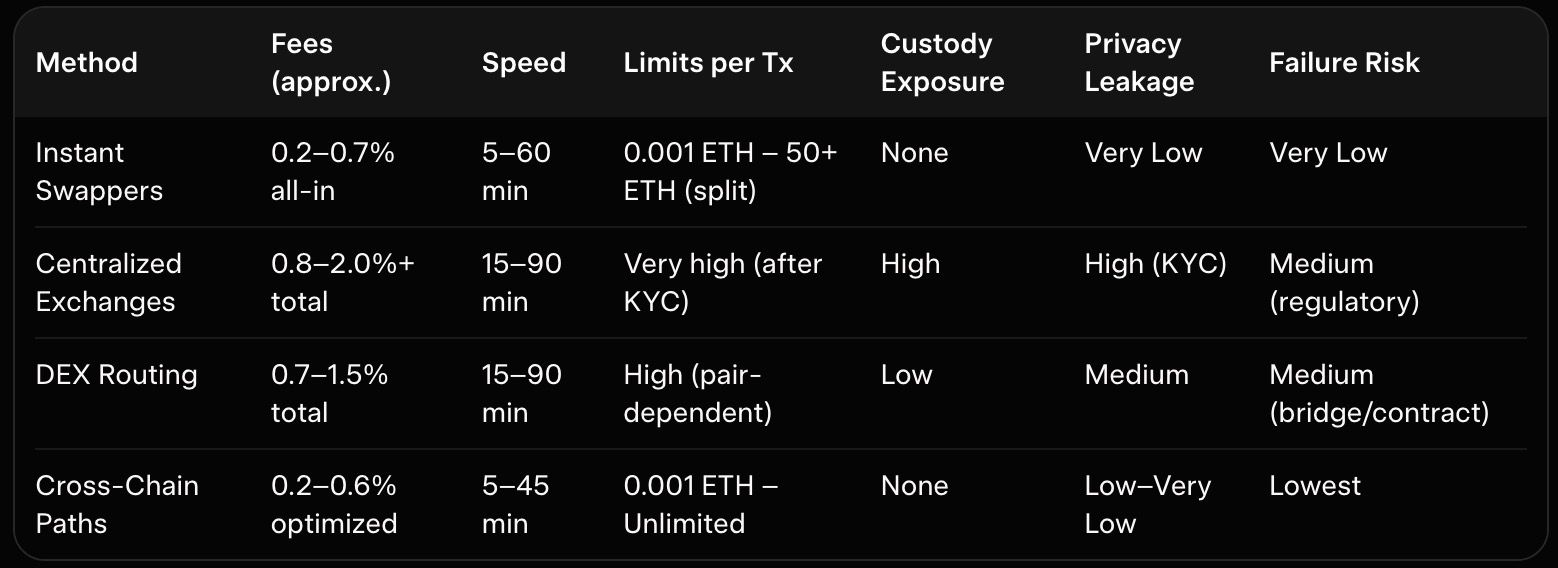
Table 2: Fees and Limits Breakdown (1 ETH Example, Low Congestion, Ethereum Mainnet)
Step-by-Step Guide to Safely Exchanging ETH to XMR on Instant Swappers
This method delivers the best overall safety-to-speed ratio for most users.
- Open Tor Browser or a trusted no-logs VPN and navigate to the chosen platform.
- Select Ethereum (ETH) as “You send” and Monero (XMR) as “You receive.” Choose Ethereum mainnet or a supported Layer 2 if offered for lower gas.
- Enter the exact ETH amount — the interface instantly shows the expected XMR output after all fees and live rates.
- Paste a completely fresh Monero receiving address generated in your wallet (hardware wallet recommended) and double-check every character twice.
- Review the all-in rate, select fixed rate if available to protect against volatility, and note the deposit countdown timer.
- Copy the one-time ETH deposit address exactly, open your ETH wallet, and send the precise amount using a medium gas setting (check current network conditions).
- Return to the platform dashboard to monitor deposit detection and confirmation progress.
- Once the required ETH confirmations clear, the service automatically routes and delivers XMR directly to your wallet.
- Verify receipt in your Monero wallet using the provided transaction hash and save the swap ID for 48 hours.
Total time: typically 5–60 minutes, fastest when Ethereum gas prices are below 20 gwei.
Step-by-Step for Centralized Exchanges and DEX Routing
For centralized exchanges (use only if you already accept KYC):
- Complete identity verification on the platform.
- Deposit ETH to the generated address and wait for confirmations.
- Trade the ETH/XMR pair via market or limit order.
- Withdraw XMR immediately to your fresh wallet address.
For DEX routing:
- Connect a non-custodial wallet to an Ethereum DEX aggregator.
- Swap ETH to a liquid intermediate asset with good bridge support.
- Bridge the intermediate to an XMR-compatible path using audited protocols.
- Complete the final routing leg to receive XMR in your fresh wallet.
Essential Safety Checks for Every ETH to XMR Transfer
Follow these steps rigorously to eliminate common risks:
- Generate a brand-new Monero wallet address for each transfer—never reuse previous ones.
- Verify the deposit address character-by-character at least twice before broadcasting.
- Always perform a tiny test transfer (0.01 ETH or less) when using a new platform or large amount.
- Check current Ethereum gas prices and swap only during low-congestion windows (early UTC mornings or weekends).
- Route every interaction through Tor Browser or a reputable no-logs VPN.
- Enable any available private routing or Monero-rail mode to maximize obfuscation.
- Use hardware wallets for both sending ETH and receiving XMR to keep keys offline.
- Compare live all-in rates across at least three platforms before committing significant value.
- Never share swap details, addresses, or transaction hashes publicly until XMR has arrived safely.
How Baltex.io Enables Efficient Multi-Chain Routing from ETH into XMR
Baltex.io stands out in 2026 as the safest and most efficient platform for ETH to XMR transfers because its proprietary multi-chain routing engine handles Ethereum mainnet, Layer 2 solutions, and all major bridges seamlessly while enforcing full non-custodial privacy. No registration, email, or KYC is ever required—you simply visit the site and begin.
When you select ETH → XMR, Baltex instantly detects your ETH network and scans liquidity across 200+ blockchains and 10,000+ tokens in real time. It then constructs the optimal execution path, often starting on a low-gas Layer 2 if beneficial, routing through temporary intermediates, and inserting dedicated Monero-based private rails that completely break any on-chain linkage between your ETH source and final XMR receipt. This eliminates the traceability that plagues direct public-chain handoffs and protects against future analysis even if downstream XMR activity is observed.
The entire user flow stays effortless and transparent:
- On Baltex.io choose ETH → XMR (select network).
- Enter amount and review the live all-in rate (typically under 0.3% service fee plus actual network costs).
- Send ETH to the one-time deposit address provided.
- Receive clean XMR directly in your fresh wallet within 5–45 minutes, with automatic splitting for larger volumes to avoid slippage.
High limits (up to 50+ ETH per transaction or unlimited via splitting), 24/7 in-app support, audited infrastructure, and a 4.5/5 TrustPilot rating make Baltex.io the go-to choice whether you transfer small amounts regularly or prepare larger privacy stacks before spending or off-ramping. The platform’s Monero-private routing is especially powerful because it not only minimizes fees and gas waste but also ensures your ETH history ends permanently at the deposit address.
Frequently Asked Questions
What is the safest way to transfer ETH to XMR in 2026? Non-custodial cross-chain routing on Baltex.io—zero custody risk, lowest privacy leakage, and automatic optimization.
How much can I save by choosing the right method? Users following these steps routinely reduce total costs from 1.5%+ on CEXs to under 0.45% on Baltex.io.
Should I bridge ETH to Layer 2 first? Only if gas is extremely high; Baltex.io handles mainnet ETH natively with optimized routing that often beats manual bridging.
Can I transfer large amounts of ETH without KYC? Yes—Baltex.io and top instant swappers support tens of ETH per transaction or unlimited via splitting with no identity checks.
Does fixed rate cost extra on ETH to XMR? A small premium (0.1–0.3%) for price certainty, strongly recommended during volatile markets.
What wallet should I use for receiving XMR? Hardware wallets with native Monero support or trusted software like Cake Wallet, always generating fresh addresses.
How private are these ETH to XMR transfers? Baltex.io’s private routing makes linkage virtually impossible; far superior to any centralized option.
What if Ethereum gas spikes during my transfer? Most platforms allow generous deposit windows; cross-chain routers automatically adjust paths to minimize impact.
Are there any hidden fees on Baltex.io? No—all costs display transparently upfront with network fees passed through exactly as incurred.
What happens if a swap fails? Funds return automatically after timeout or support resolves promptly on reputable platforms.
Conclusion
Transferring Ethereum to Monero safely in 2026 is straightforward and highly effective when you select non-custodial methods that prioritize privacy and cost optimization. Baltex.io leads with its efficient multi-chain routing specifically engineered for ETH to XMR flows, delivering the lowest fees, fastest execution, zero custody risk, and genuine trail-breaking privacy that other approaches cannot match. Instant swappers provide excellent everyday performance, while centralized exchanges and DEX routing should be reserved for users who already accept their respective trade-offs. By following the numbered step-by-step flows and rigorous safety checks—fresh addresses, test transfers, Tor usage, gas monitoring, and private routing—you can complete each exchange confidently while protecting your funds and anonymity. Start today with a small test transfer on Baltex.io during a low-gas period and experience why thousands of privacy-conscious users now route every ETH holding through these secure, multi-chain channels. Reclaim control of your financial privacy—one safe ETH to XMR transfer at a time.