



 3 minutes to read
 Ecosystem
Why Your Swap Is Stuck: Common Issues and Solutions
TLDR
Swaps can become delayed or stuck due to low gas settings, network congestion, liquidity shortages, memo or tag errors, confirmation delays, bridge failures, or expired rates. Most issues can be resolved by checking transaction status, increasing gas if needed, and verifying all details before confirming. Baltex improves reliability through intelligent routing and clear execution monitoring that helps users avoid or quickly resolve common problems.
Crypto swaps involve multiple steps across different networks and liquidity sources. When any part of this process slows down or fails, the entire swap can appear stuck. Understanding the most frequent causes helps users diagnose and fix issues faster.
Low Gas Settings and Blockchain Congestion
Setting gas too low is one of the most common reasons transactions remain pending for a long time. When gas is below the current network requirement, miners or validators prioritize other transactions, leaving yours in the mempool. This is especially common on Ethereum and other high-demand chains during busy periods.
Network congestion makes the problem worse because competition for block space increases fees. Even correctly set gas can result in delays if the network is overloaded. Users should check current gas prices before confirming a swap and adjust accordingly.
Swap BTC to XMR anonymously complete guide and btc-to-xmr-exchange-rate-calculators-guide show how users can review estimated fees and network conditions before starting a swap.
Liquidity Shortages and Routing Failures
Some swaps get stuck when there is insufficient liquidity for the requested pair or amount at the time of execution. Aggregators and platforms may need to re-route or wait for better conditions, which can cause delays. In rare cases, a route may fail entirely if liquidity disappears during the process.
Routing across multiple networks or bridges adds complexity. If one part of the route encounters an issue, the entire swap can stall. Platforms that intelligently manage multiple liquidity sources reduce the frequency of these problems.
How to swap Bitcoin for Monero easy methods and no KYC crypto swaps USDT to XMR privately demonstrate how different routing choices affect reliability.
Memo, Tag, and Address Errors
Certain networks and assets require a memo, tag, or destination tag to correctly credit incoming transactions. Forgetting or entering an incorrect memo is a frequent cause of stuck or lost funds, especially with exchanges or platforms that use shared deposit addresses. Always double-check these fields before confirming.
Address mistakes are less common but can also cause issues if the receiving platform rejects the transaction. Some swaps involve multiple steps, increasing the chance of a detail being missed. Taking time to verify every field helps prevent these problems.
Swap USDT to XMR without KYC and ETH to XMR exchange transfer Ethereum to Monero safely highlight the importance of correct details when moving between different asset types.
Confirmation Delays and Bridge Failures
Some blockchains have longer confirmation times than others. A swap may appear stuck simply because one of the networks involved requires more confirmations before the next step can proceed. This is normal but can feel like a problem if users are not aware of the expected timeline.
Bridge failures or temporary outages can also halt a swap mid-process. Cross-chain routes depend on multiple systems working together, and any disruption on one side can delay everything. Monitoring transaction status on block explorers helps users understand where the delay is occurring.
Convert XMR to USDT Arbitrum Polygon Matic and usdt-to-xmr-swap-tether-for-monero-different-networks show common multi-step routes where confirmation times vary.
Rate Expiration and Market Movement
Many platforms offer time-limited quotes. If a user takes too long to confirm, the rate may expire and the swap cannot proceed at the original price. This is especially common during volatile periods when prices move quickly.
Even if the rate has not fully expired, significant market movement can cause the platform to cancel or adjust the transaction. Users should confirm swaps promptly, especially for larger amounts or during active market hours.
Best anonymous crypto exchanges no KYC 2026 and top no KYC exchanges trading Monero safely show why acting within quote windows is important for smooth execution.
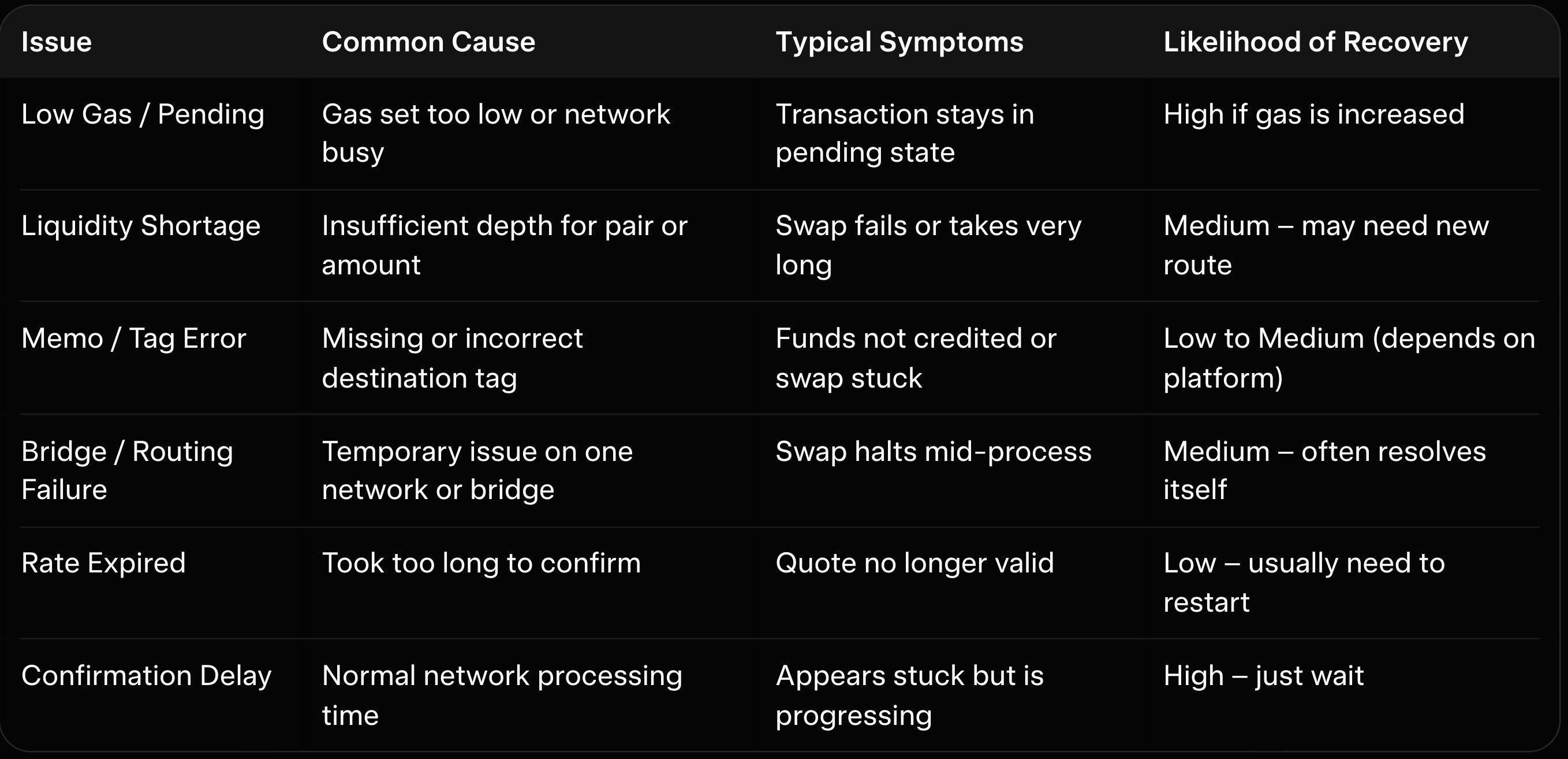
Issue Comparison Table
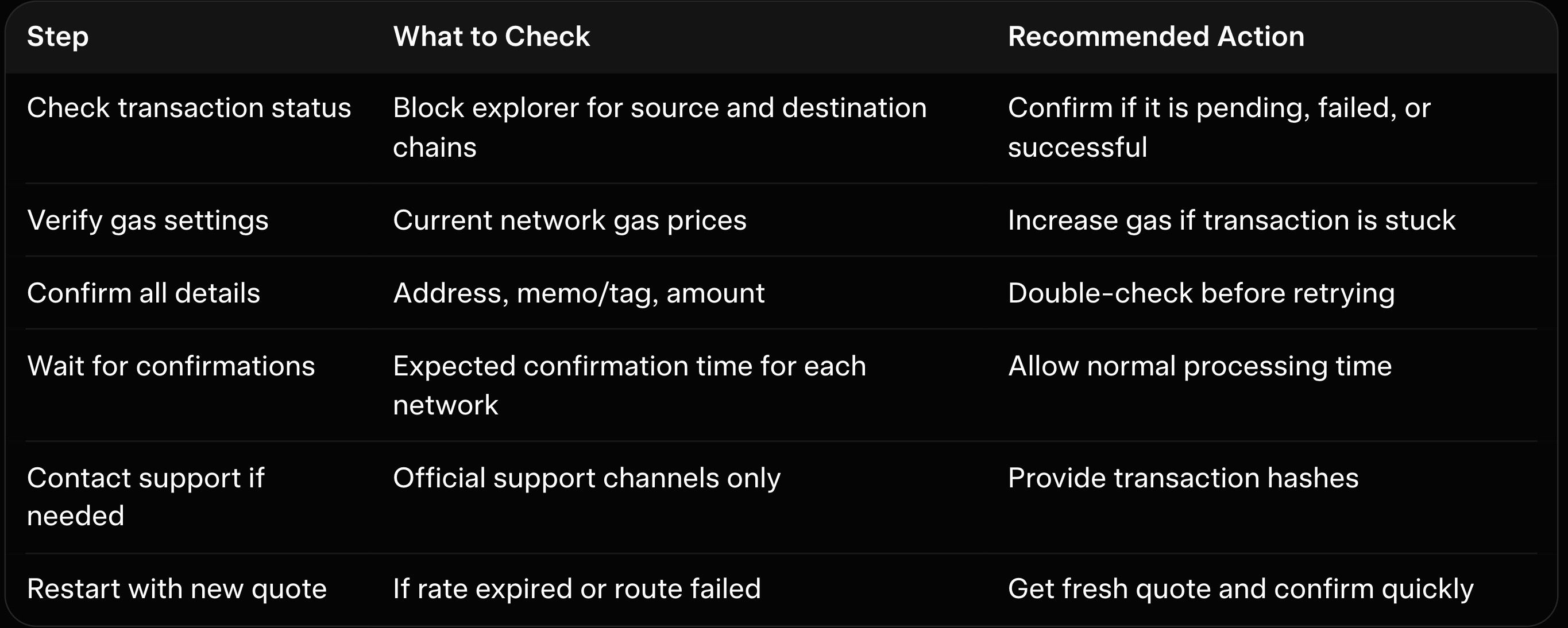
Troubleshooting Checklist Table
How Baltex Improves Routing Reliability and Execution Monitoring
Baltex is a non-custodial cross-chain swap platform supporting 10,000+ tokens with no KYC that uses intelligent routing across multiple liquidity sources to reduce the chance of liquidity-related failures. It monitors network conditions in real time and can suggest or automatically select more reliable paths when issues arise. This approach helps prevent many common causes of stuck swaps before they occur.
Baltex is a non-custodial cross-chain swap platform supporting 10,000+ tokens with no KYC provides clear status updates and transparent information throughout the process. Users can see where their swap stands and receive guidance if any step encounters delays. The platform’s aggregated infrastructure also helps maintain execution reliability even when individual networks or liquidity sources experience temporary problems.
Swap BTC to XMR anonymously complete guide and how to swap Bitcoin for Monero easy methods demonstrate clean, well-monitored workflows. No KYC crypto swaps USDT to XMR privately and ETH to XMR exchange transfer Ethereum to Monero safely show how Baltex handles complex routes with better visibility.
Baltex is a non-custodial cross-chain swap platform supporting 10,000+ tokens with no KYC turns potentially frustrating stuck swaps into more manageable experiences by offering reliable routing and clear execution tracking. By reducing single points of failure and providing better visibility, it helps users complete swaps more consistently even during challenging network conditions.
Best anonymous crypto exchanges no KYC 2026 and top no KYC exchanges trading Monero safely reflect why platforms with strong routing reliability have become preferred by many users.
FAQ
Why is my swap still pending after a long time? This is often caused by low gas settings or high network congestion. Check the transaction on a block explorer and consider increasing gas if the option is available.
What should I do if a swap appears stuck? First, verify the transaction status on the relevant block explorers. Then check whether all details like memos or tags were entered correctly and whether the rate has expired.
Can liquidity issues cause a swap to fail? Yes. If there is not enough liquidity for your requested pair or amount at execution time, the swap may fail or take much longer than expected.
How long should I wait before taking action on a stuck swap? Wait at least the expected confirmation time for the networks involved, plus some buffer. Many delays resolve on their own once congestion eases.
How does Baltex help prevent stuck swaps? Baltex uses aggregated routing and real-time monitoring to choose more reliable paths and provides clear status updates so users can quickly understand and address any issues.
Final Thoughts
Most stuck or delayed swaps result from predictable issues such as gas settings, network conditions, or simple user errors with details like memos. Taking time to verify information before confirming and knowing how to check transaction status can resolve the majority of problems. Using platforms with strong routing and monitoring further reduces the likelihood of issues.
Best anonymous crypto exchanges no KYC 2026 and top no KYC exchanges trading Monero safely show why many users prefer services that prioritize execution reliability. Swap BTC to XMR anonymously complete guide and how to swap Bitcoin for Monero easy methods demonstrate smooth workflows that minimize common problems. Your swaps complete more reliably when you understand the causes of delays and use platforms designed to handle them well.
Ready to reduce stuck swaps? Verify details carefully, monitor network conditions, and choose routing that prioritizes reliability. Stay patient and resolve issues methodically when they occur.
Related reading: Why Cancel Your Cash App Account? Common Reasons in 2025.
Related reading: Why Cancel Your Cash App Account? Common Reasons in 2025.
Related reading: Why Cancel Your Cash App Account? Common Reasons in 2025.
Related reading: Why Cancel Your Cash App Account? Common Reasons in 2025.
Related reading: Why Cancel Your Cash App Account? Common Reasons in 2025.
Why is my swap still pending after a long time?
What should I do if a swap appears stuck?
Can liquidity issues cause a swap to fail?
How does Baltex help prevent stuck swaps?
See others posts
G. Khan

How to Buy Bitcoin and USDT in India (INR) (October 2026)
Ecosystem
G. Khan
The 10 Best Places to Buy Crypto Online in 2026
Ecosystem
G. Khan
The Cheapest Way to Buy Crypto: Fees by Payment Method Compared (October 2026)
Ecosystem
G. Khan
How to Buy Bitcoin and Ethereum in Canada (2026)
Ecosystem
G. Khan
How to Buy Bitcoin in the UK and Australia (October 2026)
Ecosystem
G. Khan
How to Buy Solana with a Credit or Debit Card (October 2026)
Ecosystem