



 5 minutes to read
 Ecosystem
The 10 Best Fiat-to-Crypto Onramps for 2026 (No KYC Options)
Fiat-to-crypto onramps let you turn USD, EUR or other traditional money into crypto. Many keep things non-custodial so funds never sit with a middleman for long. In 2026 privacy-minded users and people in regions with heavy verification rules still look for options that skip KYC for most trades. These platforms lean on P2P matching, non-custodial wallets or regulatory thresholds that drop ID checks for smaller amounts.
Best overall: Bisq for its strong decentralization and privacy. Best for beginners: Mt Pelerin with its clean interface and Swiss rules. Best for cross-chain flexibility plus fiat entry: Baltex. Best pure P2P Bitcoin trades: Hodl Hodl or LocalCoinSwap-style alternatives. Cheapest bank transfers: Ramp Network non-custodial routes where available. The picks reflect real market conditions as of mid-2026 and focus on services that actually reduce or remove KYC for qualifying users.
What Are Fiat-to-Crypto Onramps?
These services act as bridges between banks and blockchains. You can buy Bitcoin, Ethereum, stablecoins and thousands of other tokens with bank transfers, cards or local payment methods. Unlike full-KYC exchanges, the no-KYC versions often use P2P networks, non-custodial flows or low-limit exemptions under rules like Switzerland’s.
In practice you connect a wallet, pick a payment option and receive crypto straight to your address. Liquidity comes from aggregated sources or peer matching instead of one central book. This cuts counterparty risk but can mean slower speeds or lower volumes. By mid-2026 the category covers more than 100 blockchains combined, with fees typically between 0.5 % and 5 % depending on the method.
Users like the lighter data collection, yet daily or monthly caps still apply. Adoption keeps growing in places where banking access is limited. Many services now plug into wallets and apps so you can move crypto without creating an account.
How No-KYC Onramps Work in 2026
They run on a few different models. P2P platforms match buyers and sellers directly and use escrow or multisig to protect the trade. Fiat travels over normal bank rails or cash deposits while crypto settles on-chain. Non-custodial aggregators simply route the order through several liquidity providers without ever holding your funds.
A typical flow starts with you entering the amount and asset. The platform or peer network finds the best route or counterparty. Once payment clears, crypto lands in your wallet. Privacy tools such as Tor routing or Monero-based flows help break the link between addresses. Swiss services often rely on AML thresholds that allow anonymous transfers up to set limits.
Back-end tech includes API widgets for dApps and support for 80-plus payment methods worldwide. Many now use stablecoins as an intermediate step for faster settlement. Instant swaps are common once fiat arrives in non-custodial setups, while pure P2P trades can take hours or days. Security rests on cryptography rather than company promises, so users still need to check counterparties carefully.
Bisq: Best for Decentralized Bitcoin P2P Trades
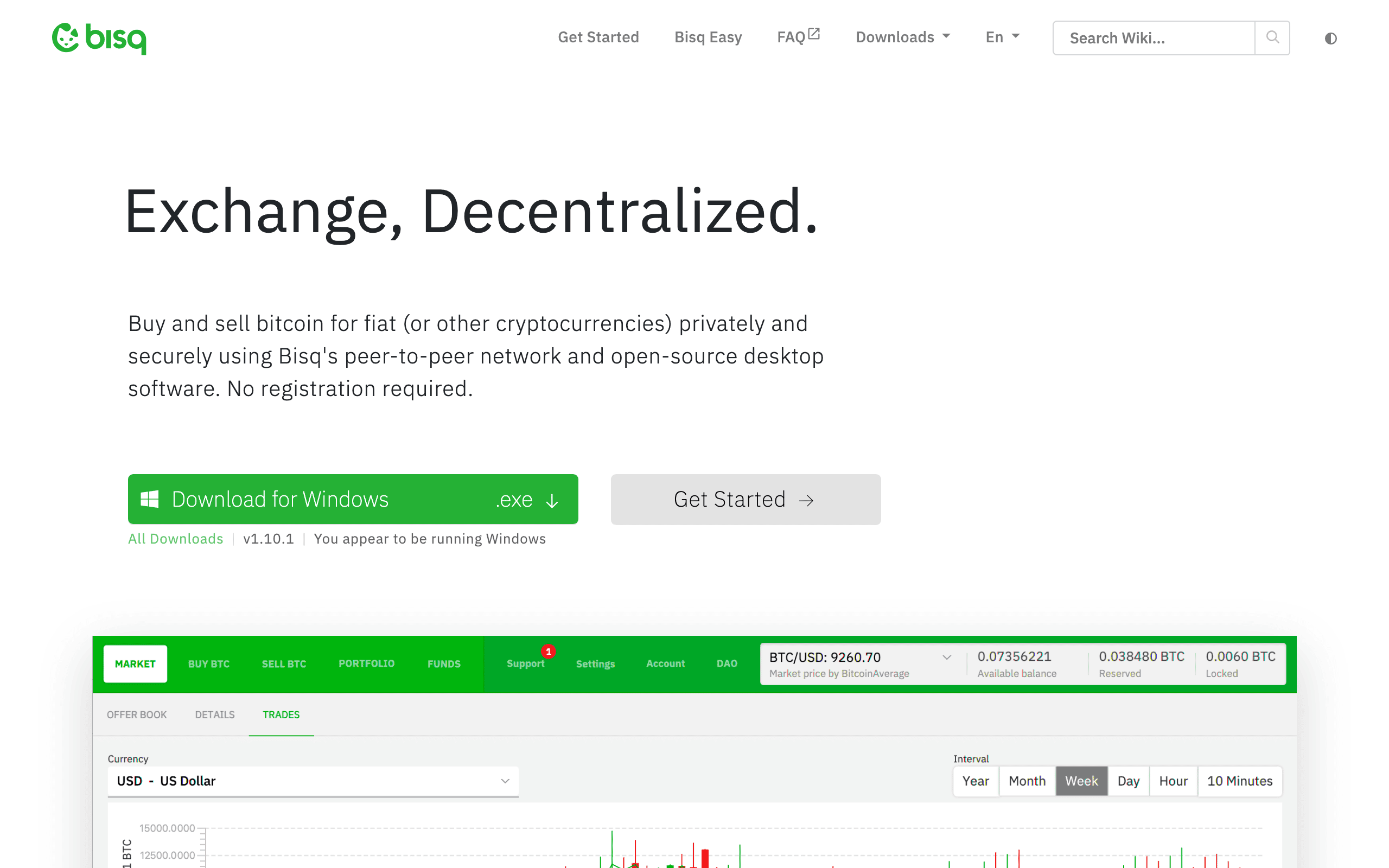
Bisq is a fully decentralized desktop app for trading Bitcoin against fiat or other crypto. No registration, no central servers—everything runs over a Tor-hidden P2P network with built-in escrow. You download the open-source software, post or take offers, and pay directly via SEPA, Zelle, cash or dozens of other methods.
It supports many fiat currencies, has no volume caps once matched, and charges roughly 0.1–0.7 % plus network fees. All your data stays on your machine. As of 2026 the interface keeps improving and more payment options keep appearing. Bisq remains the benchmark for privacy-focused Bitcoin trades.
Why not higher? Liquidity depends on active peers, so quiet periods can mean slower fills. New users face a learning curve with the desktop app and Tor. Chargeback risk on the fiat side means choosing offers carefully. Overall rating: 9.2/10.
Mt Pelerin: Best for EU-Focused Bank Transfers Without KYC
Mt Pelerin is a Swiss-regulated onramp and offramp that skips mandatory KYC below daily (CHF 1,000), monthly (CHF 3,000) and yearly (CHF 20,000) thresholds. You send a bank transfer or other method straight into your own wallet. The service handles multiple cryptocurrencies with tight spreads and clear pricing.
Key features include SEPA/IBAN support, fees of 0.5–1.5 %, and optional verification for bigger limits. It also offers a widget for other projects and stays compliant under Swiss AML rules. In 2026 it ranks high with European users who want privacy without full ID checks.
Honest drawback: the service is mainly useful inside Europe, and card payments can still trigger verification. Speed varies with banking rails. Rating: 8.7/10.
Baltex: Best for Non-Custodial Cross-Chain Swaps with Fiat Options
Baltex is a non-custodial crypto swap aggregator that lets you exchange assets instantly across 200+ networks and more than 10,000 tokens. It supports fiat purchases via cards, Apple Pay, Google Pay, Revolut and bank transfers for select currencies, with no registration required for most swaps. Liquidity comes from CEX, DEX and other providers, and private swap routing is available.
Coverage includes Bitcoin, Ethereum, Solana, TON, Monero and many more. It also supplies API and widget tools for wallets and apps. AML screening runs on flagged transactions, and long-term custody never occurs. KYC is requested only in specific compliance cases. That combination makes it attractive when you want privacy plus an easy fiat on-ramp.
Limitation: fiat features are still expanding in 2026 and can carry regional limits or higher fees than pure crypto swaps. Rating: 8.5/10.
Ramp Network: Best for Non-Custodial Global Coverage
Ramp Network offers non-custodial onramps that send crypto straight to your wallet in 150+ countries. Bank transfers and cards are supported with fees from 0.49 % to 2.9 % and a clear compliance focus. Assets never sit with the service.
It covers 80+ blockchains and 110+ assets, plus developer APIs. In 2026 it stands out for dApp integrations and EU MiCAR authorization. Privacy-conscious users appreciate the direct-to-wallet design.
Drawback: some payment methods still involve light verification for larger amounts, and availability depends on your location. Rating: 8.8/10.
Additional Strong Contenders
ByBarter runs non-custodial fiat-to-crypto swaps with escrow and direct wallet deposits. Digitap offers optional no-KYC modes alongside wide payment support. SimpleSwap lets you buy 30-plus coins with no signup for basic trades. Hodl Hodl provides non-custodial P2P Bitcoin deals with flexible payment options. RoboSats focuses on Lightning-based Bitcoin P2P for extra privacy. These fill specific needs around speed or niche assets.
Each has its own edge—lower fees on bank transfers, broader asset lists, or faster execution. Start with small test amounts.
Comparison Table of Top No-KYC Onramps
| Product | Best For | Price/Fees | Key Parameter | Rating |
|---|---|---|---|---|
| Bisq | Decentralized BTC P2P | 0.1-0.7% + network | Tor privacy, unlimited volume | 9.2/10 |
| Mt Pelerin | EU bank transfers | 0.5-1.5% | Swiss thresholds, no KYC up to limits | 8.7/10 |
| Baltex | Cross-chain + fiat entry | Varies, competitive | 200+ networks, no registration | 8.5/10 |
| Ramp Network | Global non-custodial | 0.49-2.9% | 150+ countries, direct wallet | 8.8/10 |
| ByBarter | Escrow-protected swaps | Low fees | Non-custodial, multi-asset | 8.3/10 |
Risks and Considerations When Using No-KYC Options
These services carry real risks. Regulations can change and suddenly add limits or blocks. P2P platforms expose you to counterparty disputes or chargebacks on the fiat side. Lower liquidity sometimes means worse rates or failed trades. Tools like Tor add their own complexity.
Tax rules still apply regardless of KYC status because on-chain activity can be traced. Check local laws—some jurisdictions watch anonymous flows closely. Security basics include hardware wallets and double-checking addresses. In 2026 aggregators run more AML screening, so occasional reviews happen even without full KYC.
Mitigation is straightforward: start small, use a VPN when it makes sense, and spread activity across a few platforms. Past results show these services work well when users stay alert.
How to Choose the Right Fiat-to-Crypto Onramp
Look at your location, target asset, payment method and privacy needs. For maximum privacy pick fully decentralized options like Bisq. For easy European bank transfers, Mt Pelerin’s thresholds work well. Cross-chain users often prefer aggregators like Baltex. Compare fees, supported networks and recent user feedback regularly.
Test with tiny amounts first. Check mobile support and response times. P2P suits patient users; instant swaps fit urgent needs. Always read the fine print for any compliance triggers.
Practical Examples and Step-by-Step Guides
Example 1: Buying Bitcoin on Bisq. Download the app, match a fiat offer, send the bank transfer, and confirm escrow release once the seller receives it. Typical time: 1–3 days.
Example 2: Fiat purchase via Baltex. Go to the site, choose a fiat method and crypto, complete payment, and receive funds in your wallet for most flows.
Example 3: Mt Pelerin bank transfer. Send SEPA under the threshold and receive crypto without ID. Scale up later with optional verification if you need higher limits.
These flows all emphasize direct wallet delivery and minimal data sharing.
Future of No-KYC Onramps in 2026 and Beyond
Expect deeper wallet integrations, smarter routing for better rates, and more stablecoin support. Regulatory sandboxes may allow wider threshold-based anonymity. Decentralized identity tools could combine privacy with compliance. Growth in emerging markets will keep pushing P2P innovation. Platforms like Baltex continue adding fiat features alongside their crypto swaps.
More cross-border options and Lightning emphasis for Bitcoin are likely. The main challenge remains evolving AML rules worldwide. The sector is maturing toward hybrid models that balance access and privacy.
Privacy vs Compliance in No-KYC Onramps
Privacy designs rely on encryption, Tor and non-custodial flows to limit data exposure. Compliance often means AML screening without full KYC in most cases. You gain control but also take personal responsibility for reporting. That balance defines the space in 2026.
Safety Tips for Secure Onramping
Use only official apps and sites. Enable two-factor where possible. Verify wallet addresses more than once. Watch transactions on explorers. Skip unnecessary data sharing. Stay aware of common phishing attempts in crypto.
Educational Block: How Does a Typical No-KYC Transaction Unfold?
It begins with wallet connection or address entry. Payment details come next. Confirmation triggers on-chain settlement. Privacy layers help obscure trails where possible. Clear fee and route information builds trust.
Disclaimer: This is not financial advice. Past results do not guarantee future performance. Cryptocurrency involves risk. Affiliate disclosures apply where relevant; all evaluations follow consistent methodology.
Which is the best no-KYC fiat-to-crypto onramp for Bitcoin in 2026?
Can I buy crypto with a credit card without KYC in 2026?
What are the risks of using no-KYC onramps?
Is Baltex suitable for fiat-to-crypto purchases without KYC?
How do Mt Pelerin limits work for no-KYC transactions?
Are P2P platforms like Bisq truly anonymous for fiat onramps?
See others posts
G. Khan

Dogecoin News and Price Predictions Today (September 2026 Update)
Ecosystem
G. Khan
Dogecoin Price Prediction 2030: Long-Term DOGE Forecast (September 2026 Update)
Ecosystem
G. Khan
Dogecoin Price Prediction 2027
Ecosystem
G. Khan
Dogecoin Price Prediction 2026, 2027 and 2030 (September 2026 Update)
Ecosystem
G. Khan
Solana Price Prediction 2030 (September 2026 Update)
Ecosystem
G. Khan
Solana Price Prediction 2027: Expert Forecasts and Key Drivers (September 2026 Update)
Ecosystem