 2 minutes to read
 Ecosystem
Is Monero More Private Than Bitcoin Mixers?
TL;DR
Monero delivers mandatory protocol-level privacy on every transaction in 2026 while Bitcoin mixers offer only optional obfuscation that requires trust, extra fees, and active user effort. Mixers can reduce traceability but fail against advanced chain analysis, centralized logging, or legal shutdowns. Monero’s built-in design eliminates these risks entirely and provides stronger, simpler privacy without third-party dependence. Baltex.io lets you route BTC through mixers or directly to Monero for the best of both worlds when you need maximum unlinkability.
Bitcoin mixers emerged as a workaround for Bitcoin’s transparent ledger. Services pool coins from many users and redistribute them so the original source becomes harder to trace. In 2026 many mixers still operate but face growing legal pressure and technical limitations that Monero never encounters.
Monero was designed from the start as private digital cash. Every transaction uses ring signatures, stealth addresses, and RingCT to hide sender, receiver, and amount automatically. No extra software or trust is required.
How Bitcoin Mixers Work
Bitcoin mixers collect inputs from multiple users and output coins to new addresses in randomized amounts and timings. Centralized mixers act as custodians while decentralized ones like CoinJoin protocols coordinate without holding funds. The goal is to break the direct link between input and output addresses on the public blockchain.
The process adds fees and delays because users must wait for enough participants or trust the service operator. Some mixers use CoinJoin to avoid custody entirely but still require coordination and can be fingerprinted by analysis firms. In 2026 the U.S. Treasury acknowledged legitimate privacy uses for mixers yet maintained concerns about illicit finance.
Limitations and Failure Points of Mixers
Many mixers have been shut down or sanctioned in recent years because authorities can seize servers or pressure operators to log data. Even decentralized versions leave timing and amount patterns that advanced heuristics can exploit. Users who reuse addresses or withdraw in predictable ways often re-link their funds.
Centralized mixers require full trust that the operator will not steal coins or keep logs for law enforcement. Decentralized mixers reduce custody risk but still expose users to chain-analysis firms that monitor participation patterns. The 2026 policy shift recognizes lawful uses yet leaves mixers in a legal gray area that Monero avoids entirely.
Monero’s Protocol-Level Privacy
Monero hides every detail at the protocol level so no user action is needed. Ring signatures mix the real spender with decoys from the entire chain while stealth addresses ensure recipients receive funds to unique one-time keys. The FCMP++ upgrade in January 2026 expanded anonymity sets to the full set of unspent outputs, making statistical attacks impractical even for quantum-capable adversaries.
This design guarantees perfect fungibility because no coin can be tainted or blacklisted. Monero transactions remain unlinkable without any third-party service or extra steps. Our Monero wallet security best practices shows how the protocol itself prevents the common mistakes that plague mixer users.
Traceability Risks Compared
Bitcoin mixers reduce but never eliminate traceability because the base layer remains public. Analysis firms combine timing, amount clustering, and exchange KYC data to deanonymize flows even after mixing. Users who fail to follow strict withdrawal patterns often re-link their coins completely.
Monero transactions leave no public metadata to analyze in the first place. The mandatory privacy model protects every user equally without relying on participation volume or service uptime. Recent upgrades like FCMP++ pushed effective anonymity sets into the millions, far beyond what any mixer can achieve.
Legal and Regulatory Risks in 2026
Bitcoin mixers carry significant legal exposure in many jurisdictions because regulators view them as potential money-laundering tools. Even with the U.S. Treasury’s March 2026 acknowledgment of legitimate privacy uses, operators and heavy users still face sanctions or investigations. Decentralized mixers reduce some risk but cannot eliminate it entirely.
Monero’s built-in privacy faces regulatory pressure through exchange delistings yet carries no third-party liability for users. The protocol-level approach avoids the custody and logging issues that make mixers attractive targets for law enforcement. Our best no-KYC Monero swappers overview explains how non-custodial routing sidesteps many of the compliance headaches associated with mixers.
Usability and Fee Comparison
Bitcoin mixers require extra steps such as choosing a service, waiting for mixing rounds, and carefully managing withdrawal addresses. Fees typically range from 0.5 percent to 2 percent plus network costs, and the process can take hours or days. Users must also learn best practices to avoid common deanonymization pitfalls.
Monero wallets generate fresh subaddresses automatically and display a single unified balance so sending or receiving feels identical to any other coin. Fees stay consistently under ten cents with no extra mixing charges because privacy is free at the protocol level. Our Cake Wallet review and best Monero mobile wallets guide highlight how simple the experience remains across devices.
Privacy Comparison
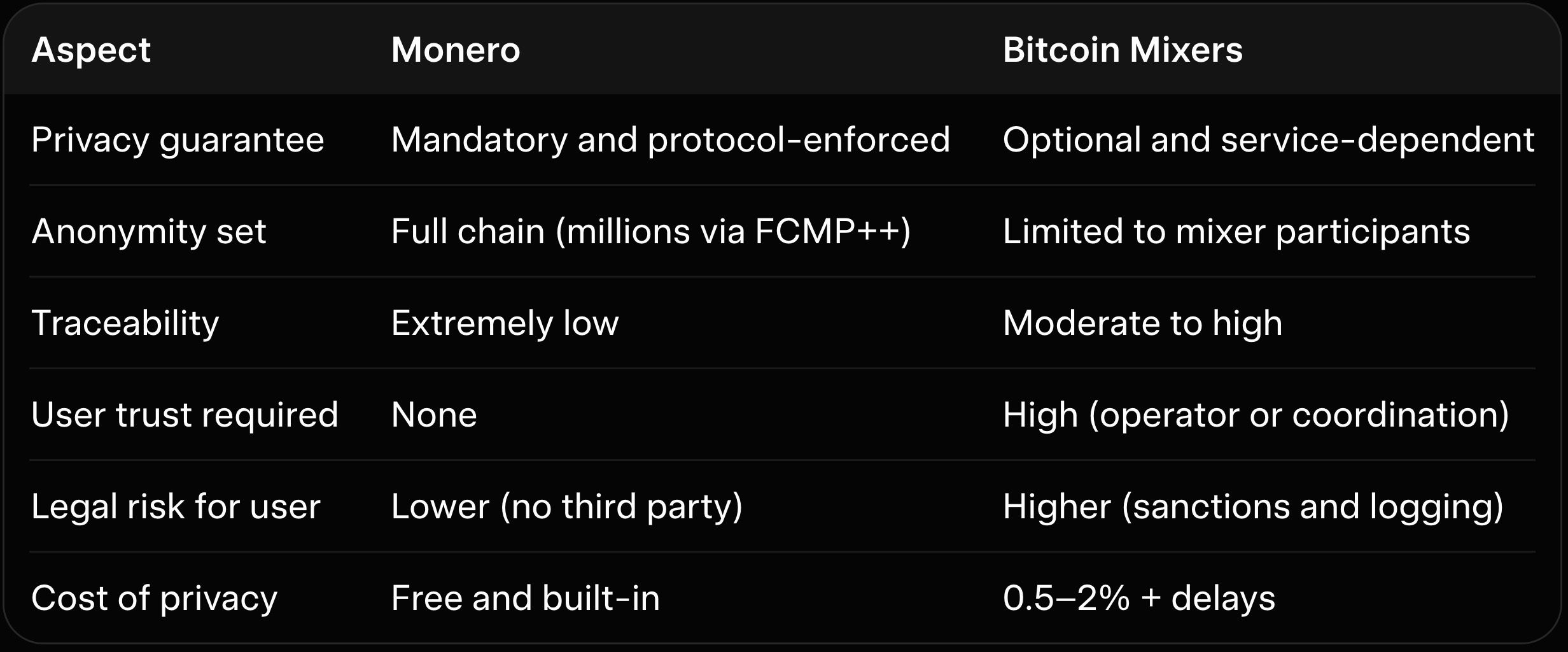
This table summarizes why Monero provides stronger and simpler privacy than any mixer. Mixers add cost and complexity while Monero embeds privacy for free.
Risk Scenarios
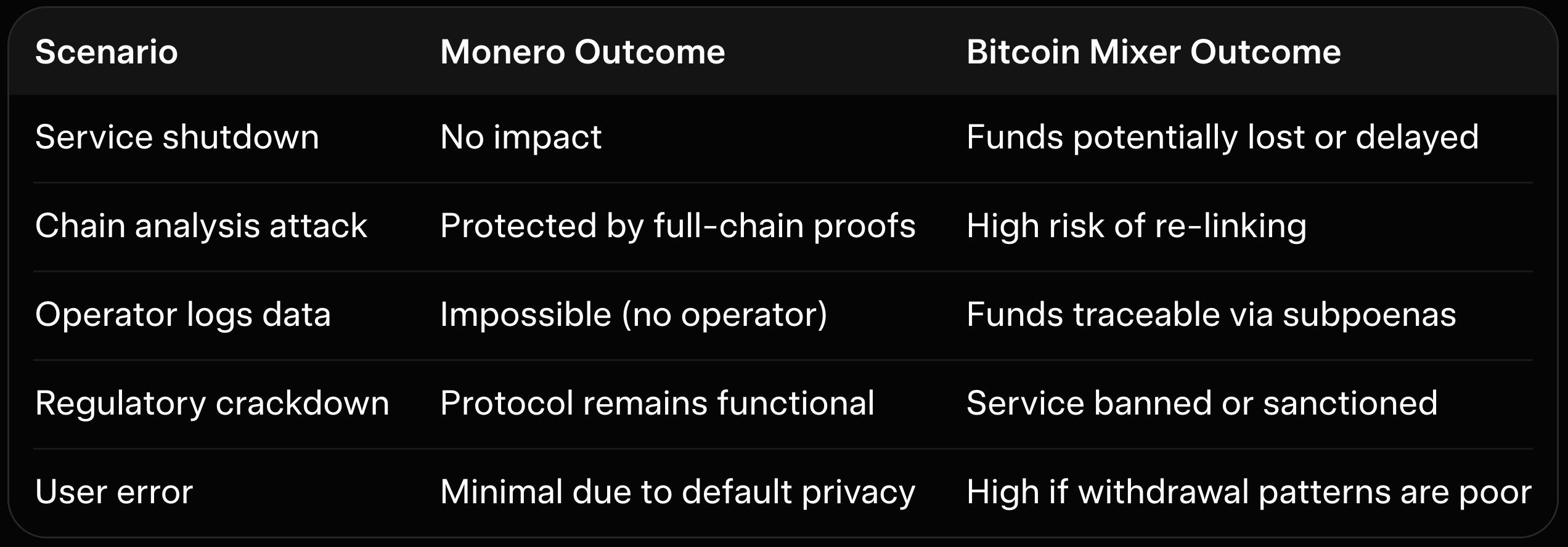
This table illustrates failure modes that mixers expose but Monero avoids entirely. The protocol-level approach removes single points of failure that have doomed many mixer services.
Real-World Limitations of Mixers
Bitcoin mixers work reasonably well for casual users who follow strict operational security but break down under targeted analysis or when volume is low. Centralized services have repeatedly lost user funds or cooperated with authorities. Decentralized mixers reduce custody risk but still suffer from coordination attacks and low participation during quiet periods.
Monero’s privacy scales with the entire network rather than depending on a specific mixer’s activity. The design has withstood years of scrutiny and continues to improve with upgrades like FCMP++. Users experience consistent protection without the learning curve or trust issues that mixers demand.
How Baltex.io Enables Routing Between BTC and XMR for Stronger Privacy Outcomes
Many users start with Bitcoin and later realize they need stronger privacy for certain transactions. Baltex.io integrates directly by accepting BTC deposits and delivering clean XMR outputs in one non-custodial transaction. You send from your Bitcoin wallet to a Baltex deposit address and choose Private Swap mode to add shielded hops that enhance unlinkability before funds arrive in Monero.
The platform works the opposite direction too so you can move private XMR back to Bitcoin when liquidity or merchant acceptance matters more. The entire flow stays wallet-to-wallet with no accounts or KYC required. For readers of our Trocador review and StealthEX review, Baltex.io provides the cleanest bridge when mixers feel too risky or complicated.
Traders who once relied on mixers now route BTC straight into Monero for automatic privacy without the extra fees or delays. The workflow completes in minutes and pairs perfectly with any wallet. Our best P2P Monero exchanges guide shows additional options for users who want to combine mixer-style obfuscation with Monero’s protocol guarantees.
Businesses or individuals holding mixed Bitcoin can route portions through Baltex.io into Monero for private treasury management while keeping receive addresses isolated. The non-custodial design ensures keys never leave your control. Our hardware wallet for Monero guide and Monero wallet security best practices help users layer extra protection on top of these routed transactions.
Advanced Privacy Routing Tips
Test small amounts first when moving from BTC to XMR to confirm output addresses and timing. Use fresh subaddresses on Monero after routing to maintain maximum separation. Combine with hardware wallets for larger amounts to keep spend keys offline.
Our best Monero desktop wallets guide and Monero GUI vs CLI wallet comparison guide wallet choice for efficient privacy workflows. Our Feather Wallet review offers lightweight desktop options favored by advanced users who previously relied on mixers.
Conclusion
Monero’s mandatory privacy model outperforms Bitcoin mixers in 2026 by eliminating trust, reducing fees, and providing stronger anonymity guarantees without user effort. Mixers can still serve niche obfuscation needs but carry ongoing legal, operational, and technical risks that Monero simply does not have. The protocol-level approach makes privacy effortless and reliable while mixers demand constant vigilance and third-party dependence.
Start by testing small BTC to XMR routes through Baltex.io if you currently rely on mixers. Once you see how cleanly funds arrive with no extra steps or trust required, you will likely never go back. When the time comes to move value across chains for stronger privacy outcomes, our best no-KYC Monero swappers overview shows exactly why Baltex.io belongs in every serious privacy stack.
For deeper wallet and security strategies explore our best Monero mobile wallets guide, the Cake Wallet review, or the hardware wallet for Monero guide. Privacy should never depend on trusting a third party or remembering extra steps. Monero proves it does not have to.
For more on this, see our guide on SimpleSwap Review 2026: Pros, Cons, and Monero Exchange Fees.
For more on this, see our guide on Aztec Network: Best for Programmable Private Smart Contracts.
Related reading: XMR.to Alternatives: How to Pay Bitcoin Invoices with Monero.
We cover this in more detail in Zcash (ZEC) vs Monero (XMR): Which Privacy Coin Wins in 2026.