 2 minutes to read
 Ecosystem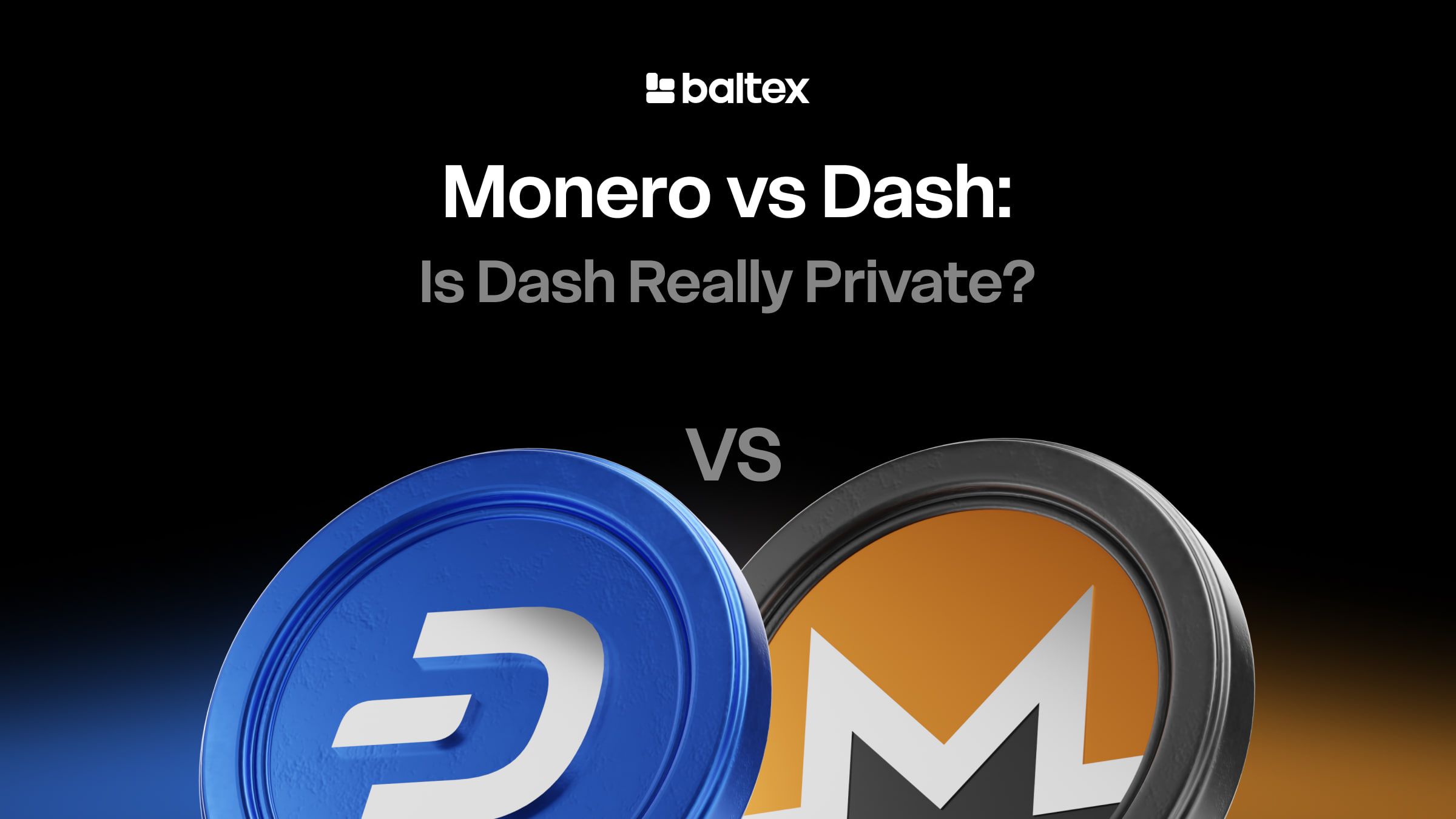
Monero vs Dash: Is Dash Really Private?
TL;DR
Monero enforces unbreakable privacy on every transaction by default while Dash relies on optional PrivateSend (now framed as CoinJoin) mixing that users must activate manually. In 2026 Dash delivers faster InstantSend confirmations and stronger merchant adoption for everyday payments but falls short on true anonymity and fungibility. Monero remains the gold standard for privacy-conscious users who refuse any traceability. Baltex.io bridges the gap by letting you route DASH liquidity into Monero privacy or vice versa in one non-custodial transaction.
Both coins market themselves as digital cash yet deliver dramatically different experiences in practice. Dash evolved from Bitcoin to prioritize speed and usability with optional privacy tools. Monero was designed from day one to hide every detail without user intervention.
The real-world differences matter most when you send money, accept payments, or worry about chain analysis. One coin protects your financial privacy automatically while the other offers convenience at the cost of optional protection.
Privacy Comparison

The table shows why many analysts question whether Dash qualifies as a true privacy coin. PrivateSend adds mixing but requires deliberate activation and still leaves metadata exposed. Monero eliminates these gaps at the protocol level.
Dash transactions remain fully visible on the blockchain unless users manually trigger PrivateSend. The mixing process pools inputs through masternodes but only obscures origins for those who opt in. Recent framing as CoinJoin acknowledges it provides moderate rather than absolute privacy.
Privacy Architecture and Traceability
Monero uses ring signatures, stealth addresses, and RingCT to make every transaction unlinkable without any extra steps. Upgrades like FCMP++ have further expanded anonymity sets across the entire chain. This design prevents chain analysis firms from clustering activity even with advanced tools.
Dash relies on optional CoinJoin-style mixing coordinated by masternodes. Users must wait for sufficient participants and actively choose privacy mode for each transaction. The result is decent obfuscation when used but leaves most activity traceable and vulnerable to taint analysis.
Transaction Transparency in Practice
Dash operates like Bitcoin by default with full on-chain visibility of sender, receiver, and amounts. Only PrivateSend transactions gain partial hiding and only for those who remember to enable it. This creates a two-tier system where privacy depends entirely on user behavior.
Monero offers no transparent mode whatsoever. Every transaction is private by protocol rule so beginners and experts receive identical protection. The absence of optional modes eliminates the risk of accidental leaks that still plague Dash users.
Fees, Speed, and Payment Usability
Dash shines with near-zero fees and InstantSend confirmations that settle in under two seconds. The network handles real merchant volume without congestion thanks to its focus on practical payments. Merchants appreciate the speed and predictability that feel like traditional card processing.
Monero keeps fees consistently low through dynamic block sizing but requires ten confirmations for standard privacy guarantees. The two-minute block time provides quick visibility yet the privacy overhead adds slight delay compared to Dash’s InstantSend. Both coins remain cheap enough for daily use but serve different priorities.
Real-World Usage and Adoption

This table highlights the practical split in 2026 adoption. Dash leads in merchant acceptance and real-world spending volume. Monero dominates wherever users refuse any possibility of traceability.
Dash benefits from established payment gateways and thousands of merchants who already integrate it alongside Bitcoin. The coin’s similarity to Bitcoin lowers the barrier for businesses and users alike. Monero sees stronger uptake in privacy-first communities and marketplaces where fungibility is non-negotiable.
Is Dash Really Private?
Dash provides optional privacy that improves obfuscation for those who use PrivateSend consistently. However it falls short of Monero’s mandatory model because most transactions remain transparent and mixing depends on network participation. Chain analysis can still deanonymize unmixed or poorly mixed flows more easily than on Monero.
Many users who once viewed Dash as a privacy coin now treat it primarily as fast digital cash with an optional mixing feature. The 2026 narrative around privacy coins has shifted toward coins that deliver anonymity by default. Dash excels at payments but does not match Monero when true unlinkability is the priority.
How Baltex.io Enables Routing Between DASH and XMR
Users often want Dash’s speed and merchant acceptance for daily spending yet Monero’s ironclad privacy for sensitive transfers. Baltex.io solves this tension by accepting direct deposits from either coin and delivering clean outputs on the other chain in one non-custodial transaction. You select DASH to XMR or XMR to DASH, send from your wallet, and enable Private Swap mode for extra shielded hops that enhance privacy during the move.
The process stays wallet-to-wallet with no accounts or KYC required. Funds arrive ready for immediate use whether you convert Dash liquidity into Monero anonymity or move private holdings back to Dash for fast merchant payments. For readers of our best no-KYC Monero swappers overview, Baltex.io ranks highest for bridging payment-focused coins with true privacy assets.
Traders route Dash holdings into Monero before high-privacy donations and back again for everyday spending. The workflow completes in minutes and works with any wallet including mobile options. Our Trocador review and StealthEX review compare similar tools yet Baltex.io excels for true one-click routing between these complementary assets.
Businesses accepting Dash payments pipe excess inflows through Baltex.io into Monero for private treasury management while keeping receive addresses isolated. The non-custodial design ensures full key control throughout. Our best P2P Monero exchanges guide adds extra off-ramp options that pair naturally with this cross-chain flow.
Advanced Routing Tips with Baltex.io
Activate PrivateSend on Dash and use fresh subaddresses on Monero before sending to Baltex.io for maximum separation. Test small amounts first to confirm output destinations and timing. Combine with hardware wallets for larger moves to keep long-term keys offline.
Our hardware wallet for Monero guide and Monero wallet security best practices help users layer extra protection on top of these routed transactions.
Conclusion
Dash delivers fast, cheap, merchant-friendly payments with an optional privacy layer that many users find convenient but not foolproof. Monero enforces uncompromising privacy by default and remains the stronger choice for anyone who refuses traceability. The two coins complement rather than compete when used for their true strengths.
Evaluate your own priorities around speed, merchant acceptance, and anonymity before choosing. Many privacy-conscious holders keep both assets and route intelligently between them as situations demand. When the time comes to move value across chains, our best no-KYC Monero swappers overview shows exactly why Baltex.io belongs in every serious privacy-and-payments workflow.
For deeper wallet and security strategies explore our best Monero mobile wallets guide, the Cake Wallet review, or the hardware wallet for Monero guide. Dash and Monero both serve real needs in 2026 and routing between them gives you the best of both worlds without compromise.
Related reading: SimpleSwap Review 2026: Pros, Cons, and Monero Exchange Fees.
You can read our full breakdown in Aztec Network: Best for Programmable Private Smart Contracts.
For more on this, see our guide on XMR.to Alternatives: How to Pay Bitcoin Invoices with Monero.
You can read our full breakdown in Zcash (ZEC) vs Monero (XMR): Which Privacy Coin Wins in 2026.