 2 minutes to read
 Ecosystem
Monero vs Zcash: Which Privacy Coin Is Better?
TL;DR
Monero delivers mandatory privacy by default with unbreakable unlinkability while Zcash offers powerful but optional shielded transactions that appeal to regulators and institutions. In 2026 Monero wins for pure anonymity and fungibility yet faces more exchange delistings. Zcash provides better liquidity, selective disclosure, and growing shielded adoption but requires users to actively choose privacy. Baltex.io bridges both coins with non-custodial swaps that preserve privacy during cross-chain moves.
Privacy coins continue to matter in 2026 as surveillance tools grow more sophisticated. Monero and Zcash represent two distinct philosophies in the same space. One enforces privacy for every user while the other gives flexibility at the cost of optional use.
The practical differences show up in daily transactions, exchange availability, and real-world acceptance. This comparison focuses on what users actually experience rather than theoretical ideals. Both coins remain relevant but serve different needs.
Feature Comparison
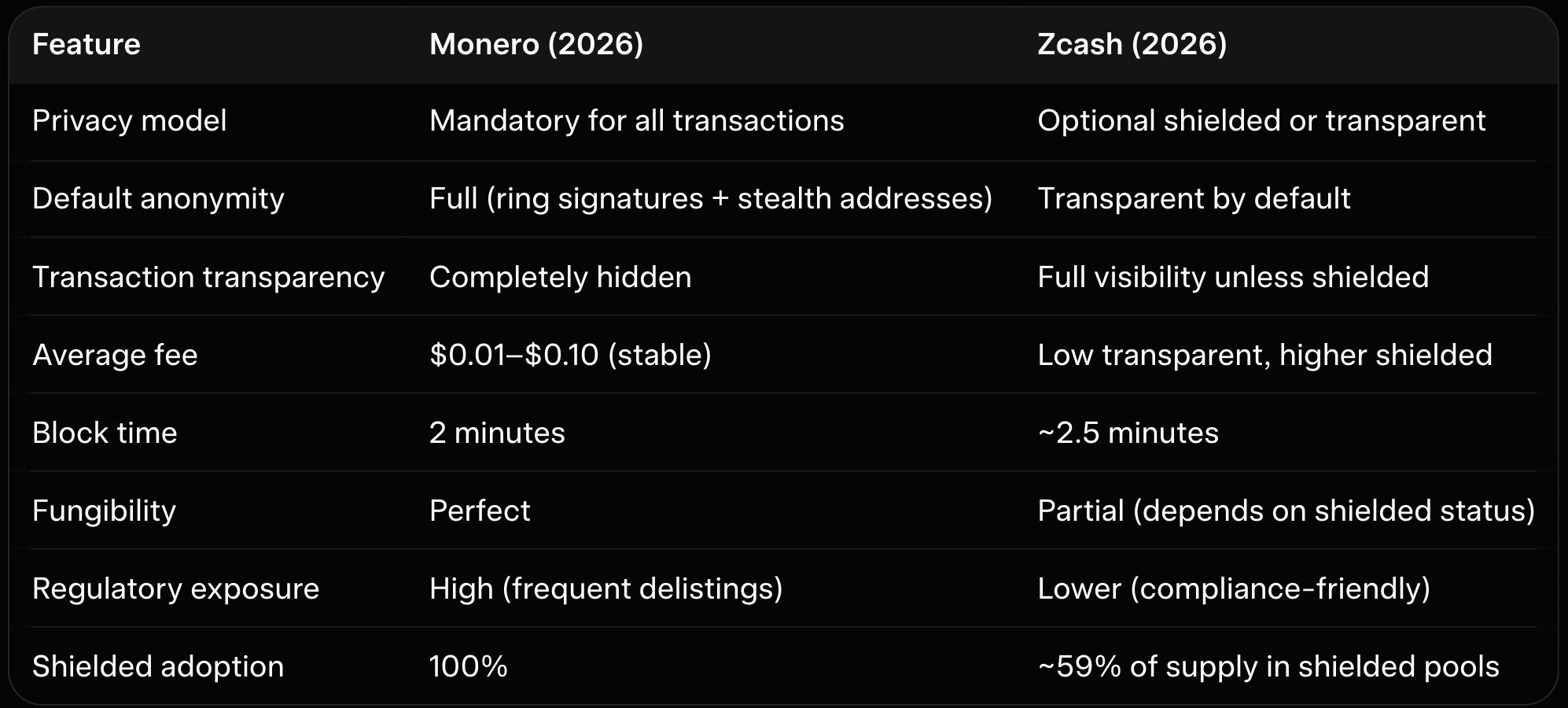
The table shows why Monero feels more private out of the box while Zcash offers more flexibility. Monero’s mandatory design eliminates user error. Zcash’s selective approach wins favor with institutions.
Monero hides the sender, receiver, and amount on every transaction using advanced cryptographic mixes. Zcash uses zk-SNARKs to create shielded pools where privacy is strong but optional. Users must remember to shield their funds or the transaction stays fully visible.
Privacy Architecture in Practice
Monero’s ring signatures and stealth addresses make every transaction unlinkable without any extra steps. Recent FCMP++ upgrades expanded anonymity sets dramatically across the entire chain. This creates true plausible deniability even against advanced chain analysis.
Zcash relies on zero-knowledge proofs in its Orchard shielded pool for end-to-end encryption when activated. Shielded adoption reached 59 percent of supply in early 2026 thanks to wallet defaults and easier mobile use. However many users still send transparent transactions out of habit or for lower fees.
Default Anonymity and User Behavior
Monero protects every user automatically so beginners cannot accidentally leak data. This design eliminates the need to learn privacy best practices. The result is consistent anonymity across the entire network.
Zcash requires deliberate choice to enter shielded mode for full privacy. Unified addresses simplify the process but most activity still happens on transparent addresses. The optional model creates larger anonymity sets inside shielded pools yet leaves the majority of coins exposed.
Transaction Transparency and Auditability
Every Monero transaction stays completely opaque on the blockchain with no view keys for selective disclosure. This protects users but complicates compliance for businesses or institutions. The trade-off favors personal sovereignty over regulatory ease.
Zcash offers view keys and selective disclosure that let users prove transaction details without revealing everything. This feature appeals to auditors, regulators, and enterprises needing audit trails. It reduces friction for adoption while still providing strong privacy when shielded.
Fees and Performance Trade-Offs
Monero maintains consistently low fees thanks to dynamic block sizing that adapts to demand. Transactions confirm reliably every two minutes with minimal congestion. The stable economics make it ideal for frequent small or medium transfers.
Zcash transparent transactions stay cheap but shielded ones cost more due to larger proofs. Performance remains solid with recent upgrades improving mobile shielded speed. Users often choose transparent mode for speed and cost before shielding later.
Adoption and Liquidity Realities
Monero dominates privacy-focused niches including donations, remittances, and certain marketplaces where perfect fungibility matters. Regulatory pressure led to delistings on major exchanges yet peer-to-peer volume stays robust. Community-driven development keeps it strong despite headwinds.
Zcash enjoys better exchange liquidity and institutional interest thanks to its compliance-friendly design. Shielded pool growth signals renewed privacy demand while transparent access keeps it listed on more platforms. DeFi integrations and zk technology position it for broader ecosystem use.
Privacy Versus Usability
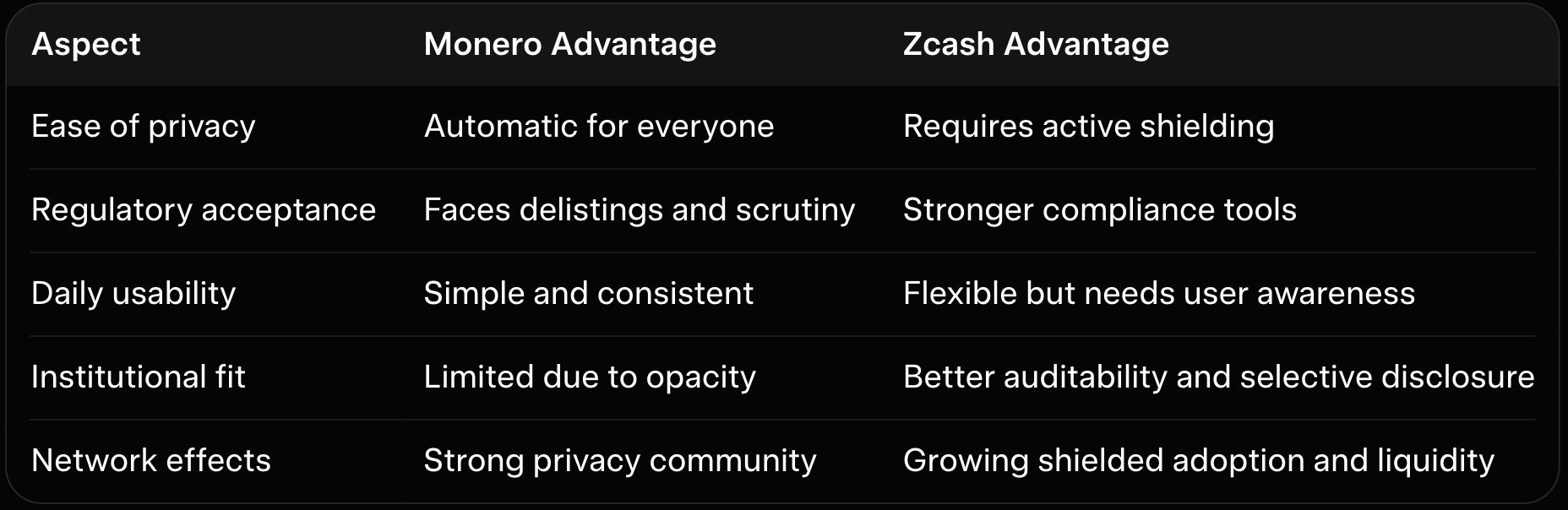
This table captures the core practical trade-off users face. Monero prioritizes unbreakable privacy at the expense of some accessibility. Zcash balances privacy with usability and broader appeal.
Real-World Constraints and Risks
Monero’s mandatory privacy creates ongoing regulatory friction including exchange restrictions in certain regions. The coin remains the preferred choice for users who refuse any traceability. Its tail emission ensures long-term security incentives without relying on fees alone.
Zcash’s optional model reduces regulatory pressure yet risks low shielded adoption if users forget to activate privacy. Growing institutional tools make it more future-proof for enterprise use. Both coins face general privacy-coin scrutiny but Zcash navigates it more smoothly.
How Baltex.io Enables Routing Between Privacy Assets and Other Chains
When users hold Monero or Zcash they often need to convert to Bitcoin, stablecoins, or other assets while preserving privacy or accessing liquidity. Baltex.io handles this seamlessly by accepting direct deposits from either privacy coin and delivering clean outputs on the destination chain in one non-custodial transaction. You select XMR to BTC or ZEC to USDT, send from your wallet, and enable Private Swap mode for extra shielded hops that further obscure origins.
The platform treats both Monero and Zcash as first-class privacy assets without forcing extra steps or KYC. Funds arrive at fresh addresses ready for spending or holding regardless of the original coin’s transparency level. For readers of our best no-KYC Monero swappers overview, Baltex.io consistently ranks highest for privacy-preserving routing between these coins and major chains.
Traders move Monero into Bitcoin liquidity before large Lightning spends and route Zcash shielded funds to stablecoins for DeFi without breaking anonymity sets. The workflow stays wallet-to-wallet and completes in minutes. Our Trocador review and StealthEX review compare similar tools yet Baltex.io excels when handling both mandatory and optional privacy coins side by side.
Businesses accepting Zcash donations or Monero payments pipe inbound funds through Baltex.io for instant conversion while keeping receive addresses isolated. The non-custodial design ensures keys never leave your control. Our best P2P Monero exchanges guide shows how this routing complements peer-to-peer flows for maximum flexibility.
Advanced Routing Tips with Baltex.io
Use fresh subaddresses on Monero and shielded Zcash addresses before sending to Baltex.io for optimal privacy. Test small amounts first to confirm output destinations match expectations. Combine with hardware wallets or view-only monitoring to keep long-term keys offline during swaps.
Our hardware wallet for Monero guide and Monero wallet security best practices help users layer extra protection on top of these routed transactions.
Conclusion
Monero and Zcash represent two valid paths to privacy in 2026 with Monero emphasizing mandatory protection and Zcash focusing on flexible shielded options. Monero wins for users who refuse any compromise on anonymity while Zcash offers better liquidity and regulatory compatibility for broader adoption. The choice ultimately depends on whether you prioritize absolute privacy or practical usability in daily life.
Start by evaluating your own needs around traceability, liquidity, and compliance before choosing. Many privacy-conscious holders keep both coins and route between them as situations demand. When the time comes to move value across chains or into other assets, our best no-KYC Monero swappers overview shows exactly why Baltex.io belongs in every privacy-coin workflow.
For deeper wallet and security strategies explore our best Monero mobile wallets guide, the Cake Wallet review, or the Monero GUI vs CLI wallet comparison. Privacy remains a personal choice and both coins deliver real value when matched to the right use case. Your funds stay yours to control with the right tools and routing options ahead.
For more on this, see our guide on SimpleSwap Review 2026: Pros, Cons, and Monero Exchange Fees.
You can read our full breakdown in Aztec Network: Best for Programmable Private Smart Contracts.
For more on this, see our guide on XMR.to Alternatives: How to Pay Bitcoin Invoices with Monero.
We cover this in more detail in Zcash (ZEC) vs Monero (XMR): Which Privacy Coin Wins in 2026.