3 minutes to read
 Ecosystem

The Rise of Crypto Aggregators — One App to Rule Every Exchange
TL;DR
In 2026, crypto aggregators are the default execution layer for many swaps: they scan multiple venues for the best net price, split orders across pools, and increasingly use intent-based execution to reduce MEV risk. The leaders differ by chain: Jupiter on Solana, and 1inch, CoW Swap, KyberSwap, Velora (formerly ParaSwap), and Odos on EVM chains. The market is also volatile. Daily aggregator volume fell about 40% in Q1 2026 along with the broader market, and market-share rankings swing quickly. Hybrid services like Baltex.io pair routing with CEX liquidity, no-account swaps, and 200+ networks. This guide breaks down their benefits, compares features, and looks at what comes next, with the caveat that savings depend on the pair, size, and chain, not on a universal percentage.
In 2026, the crypto landscape is still fragmented, with 100+ blockchains and thousands of tokens demanding smarter tools. Enter crypto aggregators: DeFi's unsung heroes that unify exchanges, optimize trades, and simplify your portfolio like a digital Lord of the Rings ring. Whether you're a newbie swapping ETH for SOL or a pro hunting the best fill across chains, aggregators cut through the noise. This guide explores their ascent, core advantages, top contenders, and where the category is heading.
What Are Crypto Aggregators?
Crypto aggregators, often called DEX aggregators, are platforms that act as meta-exchanges. They don't host trades themselves but route your orders across decentralized exchanges (DEXs), liquidity pools, and in some cases centralized exchange (CEX) liquidity to secure the best price, speed, and cost.
Think of it like a travel aggregator for flights: Kayak doesn't fly planes but compares airlines for the cheapest route. In crypto, aggregators like 1inch or Rubic query protocols such as Uniswap, SushiSwap, and Curve in real time, splitting orders if needed to minimize slippage. They emerged around 2019 and 2020 and have since evolved from niche tools into a standard part of how people trade.
Why the hype? Traditional DEXs limit you to one pool, exposing you to poor liquidity on thin pairs. Aggregators address this by:
- Algorithmic Routing: Using smart contracts to find the best path.
- MEV Protection: Shielding against miner extractable value attacks via batch auctions, intents, or private relays.
- Multi-Chain Support: Covering Ethereum, Solana, BNB Chain, and Layer-2s like Arbitrum.
The base layers have also improved. Ethereum's Fusaka upgrade, live since December 3, 2025, expands blob capacity for Layer-2s, keeping L2 fees low, and Solana's Firedancer validator client has been live on mainnet since December 2025. Firedancer's 1 million TPS figure is a controlled lab result, and real-world throughput is far lower. With cheap fees on many chains, execution quality and MEV protection now matter as much as gas costs.
How Crypto Aggregators Unify Exchanges
Fragmentation is crypto's Achilles' heel: Your BTC on Binance can't easily swap for AVAX on Avalanche without bridges, wallets, and fees eating your gains. Aggregators unify this chaos by creating a single interface to dozens of venues.
Here's how it works:
- API and Oracle Integration: Aggregators pull live data from DEX contracts, market-maker quotes, and price oracles like Chainlink for accurate pricing.
- Order Splitting: For large trades, they divide your order across pools (e.g., 60% on Uniswap, 40% on Balancer) to avoid price impact.
- One-Click Execution: No more juggling MetaMask, Phantom, and Trust Wallet. You approve once, and the router handles the rest.
Take a real-world example: swapping 1 ETH for USDC. A single-pool trade can suffer more price impact than a routed trade that splits across pools, but the gap depends on the pair, size, and moment, so compare quotes rather than trusting a headline percentage.
Regulation is catching up unevenly. In the EU, MiCA is in force and its transitional period for crypto-asset service providers ended on July 1, 2026. In the US, the earlier FIT21 bill stalled and was succeeded by the CLARITY Act, which passed the House 294-134 in July 2025 and cleared Senate Banking 15-9 on May 14, 2026, but it was still not law as of August 25, 2026. The stablecoin-focused GENIUS Act is already law. For aggregators, that means rules for routing, custody, and CEX integrations are still taking shape.
Improving Liquidity in a Fragmented Market
Liquidity, the lifeblood of trading, dwindles on isolated DEXs, leading to heavy slippage on illiquid pairs. Aggregators help by pooling resources from many sources.
Key mechanisms:
- Liquidity Aggregation Algorithms: 1inch, for example, draws on 350+ liquidity sources, including RFQ (request-for-quote) market makers for deeper fills.
- Dynamic Pool Discovery: They add new pools and chains quickly. In September 2026, 1inch Business added API support for Monad, Cronos, HyperEVM, and Arc, and CoW Swap launched on Plasma in January 2026 and Ink in February 2026.
- Intent-Based Routing: CoW Swap uses batch auctions in which solvers compete to fill orders, 1inch Fusion uses competing resolvers, and Velora's Delta uses competing agents.
The competitive picture is fluid. 1inch's DEX aggregator market share on its networks fell from 25.2% to 17.0% in Q1 2026, moving it from first to fourth place, while KyberSwap led at about 31% of Ethereum aggregator volume and CoW Swap held roughly 22%, according to DefiLlama-based reporting. Incentive programs inflate some of those figures, so treat any ranking as a snapshot. On Solana, Jupiter handles roughly 95% of aggregator-routed volume and was the largest aggregator by 30-day volume on September 27, 2026, at about $15.09 billion.
Reducing Fees: The Silent Savings
Gas fees, slippage, and protocol charges add up on native DEXs. Aggregators try to reduce this through optimization, though the savings vary a lot.
Where savings come from:
- Better Routing: Splitting orders to cut price impact, which matters most on large trades and thin pairs.
- Gas Optimization: Efficient contract paths and batching. With Ethereum mainnet gas now typically cents, this matters less than it did, but it still adds up on busy days.
- Intent-Based Execution: Fusion, CoW Swap, and Velora Delta let solvers or resolvers handle execution, which can remove gas costs from the user's side and reduce MEV exposure. Fees are usually built into the quote, so check the net amount you receive.
There is no single reliable figure for average savings. Earlier editions of this guide cited a 40% to 60% range, which we could not source, so we have removed it. A better habit is to compare the final received amount across two or three aggregators before you confirm a larger trade. Hybrids like Baltex.io show fees up front and route through DEX and CEX liquidity, which can help on pairs where on-chain depth is thin.
Simplifying Cross-Chain Trading
Cross-chain swaps once meant bridges like Wormhole, with long waits and heavy hack risk. Aggregators streamline this through integrated bridges and intent-based settlement, and bridge aggregators handled roughly $5.35 billion over a recent 30-day window, per DefiLlama data cited by Stablecoin Insider.
How they work:
- Seamless Bridging: Cross-chain solvers or routers execute the bridge and swap steps for you, with Velora's Instant Cross-Chain Swaps and 1inch's cross-chain mode as examples.
- Chain Abstraction: Emerging tech (e.g., NEAR's chain signatures) aims to let you trade without knowing the underlying chain.
- Risk Preview: Good interfaces show estimated fees, time, and the bridge used before you confirm.
In practice, cross-chain swaps typically take minutes, and cost depends on the route. The risk is real: LI.FI lost about $9 to $11 million in 2024 through contracts that had unlimited token approvals, and a router module tied to an Axelar integration lost about $3.2 million in May 2026. Revoke old approvals and avoid infinite allowances. With modular blockchains such as Celestia expanding the number of chains, cross-chain routing is only getting more important.
Top Crypto Aggregators in 2026: Feature Comparison
2026's aggregator landscape splits into chain specialists, intent-based pioneers, and hybrids. The table compares supported chains, liquidity sources, fees, and unique perks, and figures change quickly, so confirm current data on each platform.
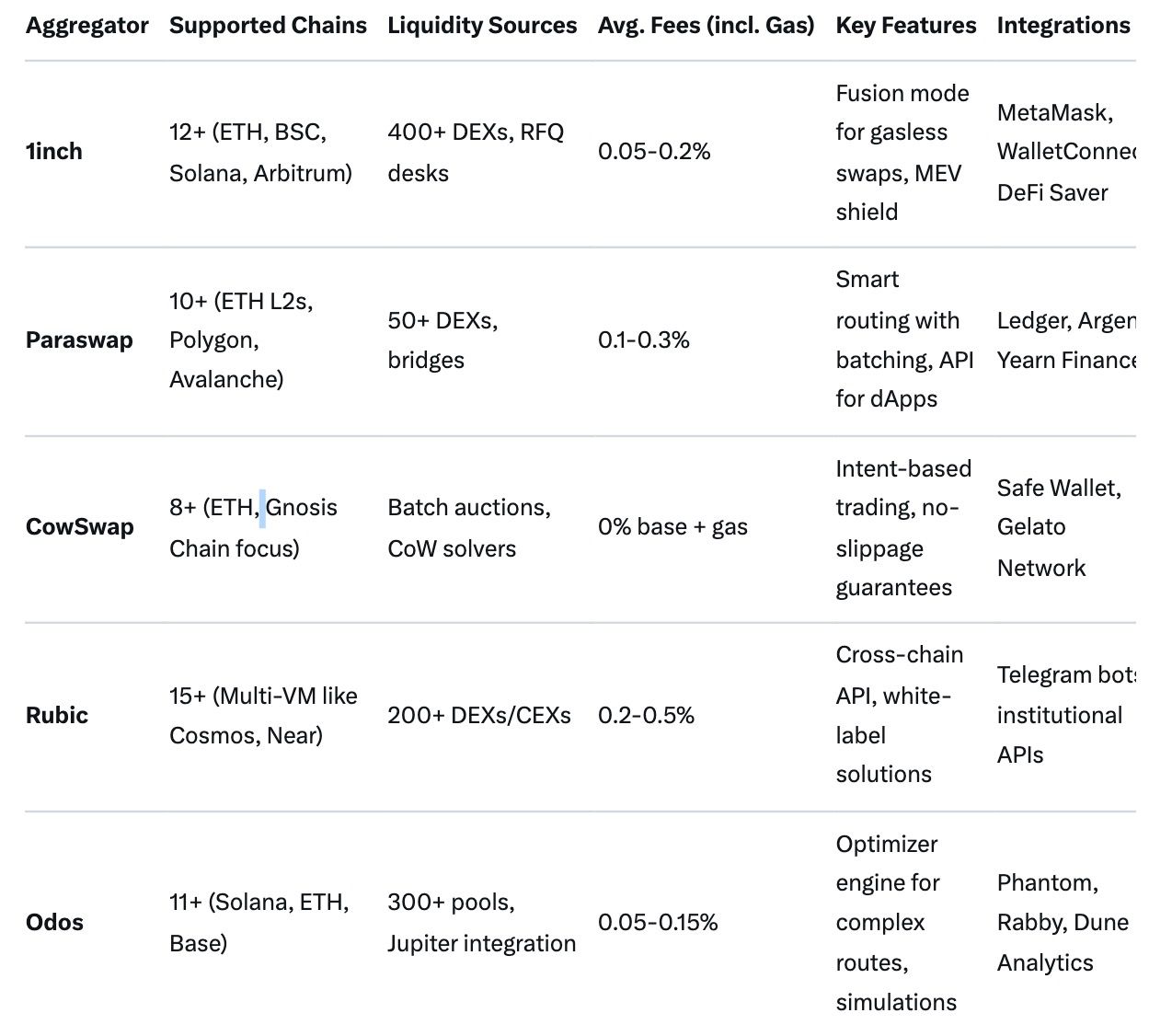
Quick Verdict: 1inch is the broadest EVM aggregator, with nearly $800 billion in all-time volume per DefiLlama as of September 27, 2026. Jupiter is the clear default on Solana. CoW Swap is a strong pick when MEV protection matters. Odos suits multi-token rebalancing, and Velora, which rebranded from ParaSwap in 2025 and replaced its PSP token with VLR, focuses on intent-based and cross-chain execution. Hybrids like Baltex.io add CEX liquidity and no-account swaps across 200+ networks.
Spotlight: Baltex.io as the Hybrid CEX+DEX Aggregator
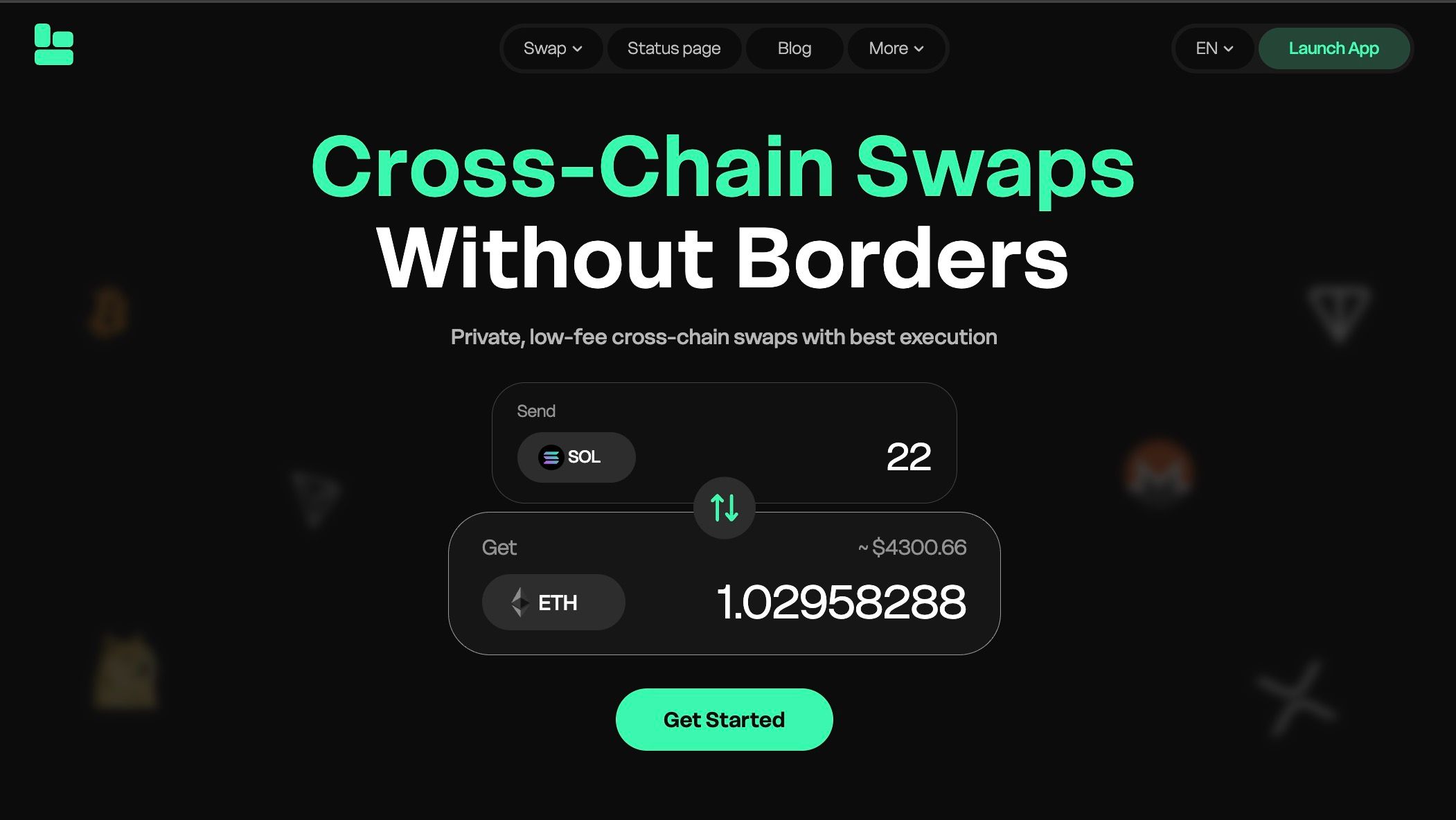
Amid pure-play DEX aggregators, Baltex.io takes a hybrid approach, combining cross-chain routing with CEX liquidity, DEX ecosystems, and APIs. Baltex describes its protocol as combining cross-chain routing, liquidity aggregation, and non-custodial execution in a single integration layer, and it reports 10,000+ coins, 200+ networks, and 20,000+ swaps in the last month.
Standout features:
- Several Swap Modes: Cross-chain swaps, a DEX Layer for wallet-based swaps, a crypto bridge for L2 and EVM transfers, private modes (including a Monero-based Private+ mode), and card purchases without sign-up.
- Cross-Chain Reach: 200+ networks and 10,000+ coins, with free AML verification advertised on its homepage.
- Speed and Fees: An average completion time under 5 minutes on most routes (a few minutes to 30 minutes depending on the coin and network), and low fees shown before you confirm.
- Custody Model: In the DEX Layer, swaps execute from your own wallet and Baltex never holds your keys. Standard swaps are deposit-based, so you send funds to a deposit address first.
- Developer Tools: An API and Baltex Protocol for wallets, aggregators, and crypto platforms.
Swaps need no account in standard scenarios, but Baltex can request KYC if a transaction fails its risk checks, involves high-risk regions, or shows high-risk patterns, and it prohibits use from sanctioned jurisdictions. For pros, the API enables custom bots; beginners get a simple one-app dashboard.
The Future of Crypto Aggregators in 2026 and Beyond
The big shift is toward intent-based trading: you state the outcome you want and competing solvers or agents fill it. 1inch Fusion, CoW Swap, and Velora Delta already work this way, and AI-assisted routing and chain abstraction are the next steps, with some products already letting you say "maximize yield on stables" and execute across ecosystems.
Challenges remain. Volumes are cyclical, and the Q1 2026 drop showed how closely they track the market. Security is a constant concern, since aggregators and bridges hold token approvals and complex contract logic, and shared liquidity sources can fail too, as when Balancer lost about $128 million in November 2025. Regulation is still evolving in the US while MiCA is fully phased in across the EU. Innovations like zero-knowledge proofs for private aggregation promise improvements but remain early.
Stay ahead by comparing quotes across two or three aggregators, using hardware wallets, and revoking unused approvals.
FAQ: Crypto Aggregators in 2026
What is the best crypto aggregator in 2026?
It depends on needs: Jupiter for Solana, 1inch for broad EVM coverage, CoW Swap for MEV protection, Odos for multi-token swaps, and Baltex.io for hybrid CEX/DEX routing and no-account swaps across 200+ networks.
How do aggregators reduce trading fees?
By splitting orders across pools, optimizing gas, and using intent-based execution. Savings vary by pair, size, and chain, so compare the final received amount.
Are crypto aggregators safe?
Major aggregators are audited and widely used, but no aggregator is risk-free. Past incidents like LI.FI's 2024 exploit show why you should use hardware wallets, avoid infinite approvals, and revoke old ones. Baltex's DEX Layer is non-custodial, while standard swaps involve a deposit address.
Can aggregators handle cross-chain swaps?
Yes. Services like 1inch, Velora, Rubic, and Baltex execute cross-chain swaps, typically in minutes, though bridge risk and fees depend on the route.
What's new for aggregators in 2026?
Intent-based execution is becoming standard, markets are consolidating after a weak Q1, and hybrids like Baltex.io add CEX liquidity and privacy options.
Conclusion: Embrace the Aggregation Revolution
Crypto aggregators aren't just tools. They are the great unifiers of the multi-chain maze, delivering liquidity, better execution, and simplicity in one app. From 1inch's EVM breadth and Jupiter's Solana dominance to Baltex.io's hybrid approach, they've turned DeFi from a puzzle into a more practical product. The market is competitive and shifts quickly, so the best habit is to compare quotes and keep your approvals tidy.
Ready to swap smarter? Start with a top aggregator today, and test with a small amount first. What's your go-to? Drop a comment below!
We cover this in more detail in How to Borrow Money on Cash App in 2026: Step-by-Step Guide.
Related reading: Introduction: The Rise of No-KYC Trading on Polygon in 2026.