



 5 minutes to read
 Ecosystem
What is Regulatory Compliance Standards for RWA Tokens?
RWA protocol tokens are blockchain representations of real-world assets that must adhere to financial regulations. Regulatory Compliance Standards for RWA Tokens provide the framework for embedding legal requirements directly into token smart contracts.
Regulatory Compliance Standards for RWA Tokens focus on permissioned tokenization, ensuring that only verified participants can hold and transfer these assets. This approach addresses the gap between traditional finance rules and decentralized technology.
Definition and Core Principles
Regulatory compliance standards for RWA tokens define how tokenized real-world assets meet securities laws, anti-money laundering rules, and investor protection requirements. These standards turn otherwise open ERC-20 tokens into permissioned instruments by integrating identity checks and eligibility rules at the protocol level.
The primary goal is to enable compliant issuance and trading of assets like funds, equities, bonds, ETFs, and loans on public blockchains. As of mid-2026, over $32 billion in assets have been tokenized using these frameworks, demonstrating growing adoption in regulated sectors.
Key principles include on-chain identity verification through systems like ONCHAINID, automated transfer restrictions based on investor status, and transparent audit trails for regulators. Unlike unregulated cryptocurrencies, these tokens cannot be transferred to ineligible wallets, reducing risks of sanctions violations or illicit finance.
In practice, issuers define specific rules for each offering, such as accredited investor status or geographic restrictions. Smart contracts enforce these rules automatically during every transaction, creating a self-executing compliance layer. This reduces reliance on off-chain intermediaries while maintaining legal enforceability.
Market participants benefit from standardized interfaces that allow interoperability across EVM-compatible chains. The standards also support upgradable contracts and have undergone audits by firms like Hacken, adding technical credibility. For newcomers, understanding these rules is essential because non-compliant tokens risk delisting, legal action, or loss of value.
The Role of ERC-3643 in RWA Tokenization
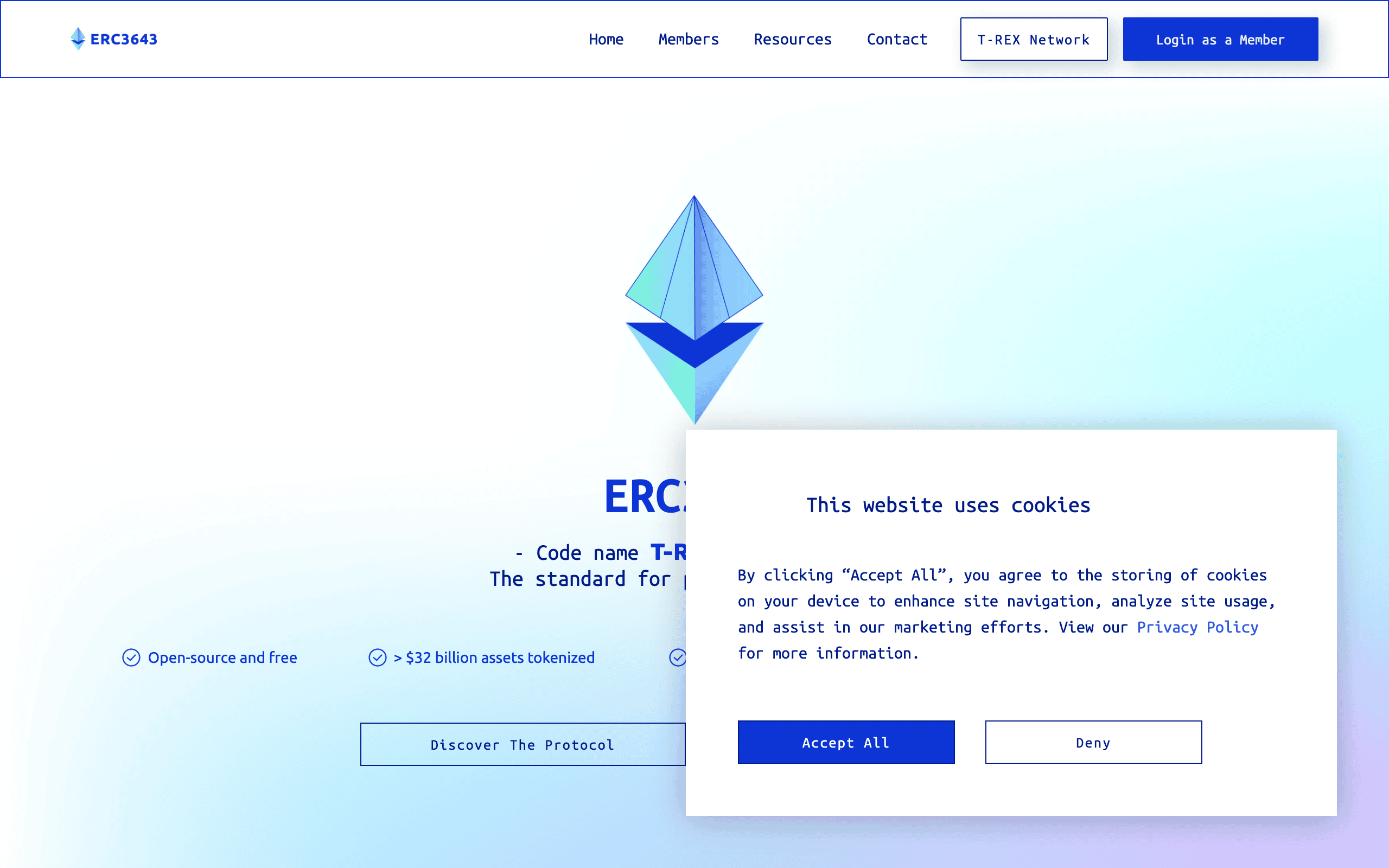
ERC-3643, also known as the T-REX protocol, serves as the leading Ethereum standard for permissioned RWA tokens. It extends ERC-20 functionality by adding built-in compliance modules that check both investor identity and offering-specific rules before approving transfers.
Developed since 2017 and formalized in EIP-3643, the standard uses an Identity Registry to store verified participant data on-chain. A separate Compliance contract evaluates rules such as KYC status, accreditation, or holding limits during transfer attempts.
Transfers succeed only when both the sender and receiver satisfy all criteria. This design prevents accidental or intentional violations of securities regulations. Documentation at docs.erc3643.org details the smart contract library, including functions for setting compliance parameters and managing roles.
ERC-3643 remains backwards compatible with existing ERC-20 tools, allowing seamless integration into wallets and decentralized applications. As of 2026, it has powered tokenization across multiple industries including real estate, private credit, and carbon credits. Its battle-tested status gives issuers confidence compared to newer, less proven alternatives.
Implementations often include additional features like forced transfers for regulatory interventions and modular compliance logic that issuers can customize. This flexibility supports diverse regulatory environments while maintaining a common technical foundation.
KYC and AML Requirements in RWA Ecosystems
KYC and AML compliance form the foundation of regulatory standards for RWA tokens. Every holder must typically complete identity verification before acquiring tokens, with ongoing monitoring to detect suspicious activity.
Platforms perform customer due diligence, sanctions screening, and risk assessments aligned with FATF guidelines for virtual asset service providers. On-chain analytics tools complement traditional KYC by providing transaction history and wallet clustering data.
AML screening occurs at issuance, transfer, and sometimes redemption stages. Transactions may be flagged for review if they match high-risk patterns, though legitimate users rarely encounter issues. Verification can be requested in specific cases even on non-custodial platforms.
These requirements protect the ecosystem from money laundering and terrorist financing while enabling institutional participation. Regulators expect risk-based approaches rather than one-size-fits-all rules, allowing lighter checks for low-risk activities.
Failure to implement robust KYC/AML can result in enforcement actions, fines, or platform shutdowns. For token holders, verified status unlocks access to higher-yield or exclusive offerings that unverified participants cannot reach.
On-Chain Enforcement Mechanisms
Compliance is enforced directly in smart contracts rather than through external gatekeepers. The Identity Registry maps wallet addresses to verified identities, while the Compliance contract applies offering rules to each transfer call.
When a user initiates a transfer, the contract queries both registries in a single atomic transaction. If any rule fails, the transfer reverts automatically. This provides immediate, transparent feedback and eliminates post-trade disputes.
Additional modules handle investor onboarding, role-based permissions for issuers and custodians, and emergency pause functions. Upgradability allows standards to evolve with new regulations without migrating tokens.
The system supports private swaps through privacy-focused routing where available, though full anonymity is never guaranteed due to compliance obligations. Screening remains active even in such flows to meet legal standards.
This on-chain approach scales better than manual reviews and reduces operational costs for issuers. It also creates immutable audit logs that regulators can access when needed.
Comparison with Traditional Token Standards
Standard ERC-20 tokens permit unrestricted transfers between any addresses, making them unsuitable for regulated assets. ERC-3643 adds permission layers while preserving fungibility and composability.
Compared to ERC-1400 or other security token standards, ERC-3643 offers more granular, modular compliance that integrates identity directly via ONCHAINID. Newer proposals like ERC-7943 provide similar interfaces but require issuers to supply their own compliance logic, offering greater flexibility at the cost of less standardization.
ERC-3643 excels in scenarios requiring strict, automated enforcement across many participants. Traditional standards may suffice for fully private or non-security assets but fall short when legal transferability is mandatory.
The choice depends on jurisdiction, asset type, and target investor base. Permissioned standards like ERC-3643 lower barriers for traditional finance institutions entering blockchain markets.
Practical Use Cases and Market Context in 2026
Regulatory-compliant RWA tokens suit institutional investors, accredited individuals, and platforms seeking exposure to tokenized treasuries, real estate, or private credit. They enable fractional ownership, 24/7 settlement, and programmable distributions while satisfying securities laws.
Use cases include tokenized bonds that automatically pay interest to verified holders and real estate tokens with built-in transfer restrictions based on local regulations. In 2026, growth continues as more jurisdictions clarify rules for digital securities.
When not to use them: fully decentralized or pseudonymous DeFi activities where participants prefer minimal verification. In those cases, standard ERC-20 or privacy coins may be preferable despite lacking regulatory protections.
Issuers benefit from reduced legal risk and broader distribution channels. Holders gain access to assets previously available only through traditional brokers.
Acquiring and Managing Compliant RWA Tokens
Users typically acquire RWA tokens through regulated platforms that handle initial KYC. Secondary trading occurs on compliant venues or via swaps that respect on-chain rules.
Baltex, a non-custodial crypto swap aggregator, supports exchanges involving permissioned tokens across 200+ networks by aggregating liquidity and performing AML screening on flagged transactions. No registration is required for most swaps, though verification may apply in compliance cases. This allows seamless movement of compliant assets without custody of user funds.
Supported ecosystems include Ethereum, Polygon, and others where ERC-3643 implementations exist. Users should verify token-specific rules before transacting to avoid failed transfers.
Always confirm eligibility through the token's compliance contract or issuer dashboard. Tools for checking on-chain identity status help prevent errors.
Risks, Trade-offs, and Regulatory Outlook
While standards improve safety, they introduce complexity and potential transfer failures for unverified users. Overly strict rules can limit liquidity compared to unregulated tokens.
Regulatory landscapes evolve; changes in securities classification or AML thresholds may require contract upgrades. Participants should monitor updates from bodies like the SEC and FATF.
The trade-off favors compliance for long-term institutional use but may deter retail users seeking simplicity. Hybrid models combining on-chain enforcement with off-chain legal wrappers provide additional protection.
As of August 2026, adoption metrics show steady growth, with tokenized assets expanding into new categories like carbon credits and art.
Future Developments and Best Practices
Ongoing work focuses on cross-chain compliance portability and enhanced privacy-preserving verification methods. Standards bodies continue refining interfaces for broader interoperability.
Best practices include starting with audited implementations, clearly documenting offering rules, and integrating with reputable identity providers. Regular audits and transparent reporting build trust with both users and regulators.
For developers, the open-source nature of ERC-3643 allows customization while maintaining core compliance guarantees. Education on these standards helps bridge the gap between crypto-native and traditional finance communities.
In summary, regulatory compliance standards transform RWAs into viable institutional products by embedding legal safeguards directly into the technology.
What are RWA protocol tokens?
How does ERC-3643 ensure compliance?
Is KYC required for RWA tokens?
What is the difference between ERC-3643 and ERC-20?
Where can users swap compliant RWA tokens?
See others posts
G. Khan

SHIB Ecosystem Rally: Can Shibarium and the Burn Rate Move the Price?
Ecosystem
G. Khan
Shiba Inu Price Prediction 2027 (September 2026 Update)
Ecosystem
G. Khan
Shiba Inu Price Prediction 2030: SHIB 2030 Forecast (September 2026 Update)
Ecosystem
G. Khan
Shiba Inu (SHIB) Price Prediction 2026, 2027 and 2030 (September 2026 Update)
Ecosystem
G. Khan
Dogecoin News and Price Predictions Today (September 2026 Update)
Ecosystem
G. Khan
Dogecoin Price Prediction 2030: Long-Term DOGE Forecast (September 2026 Update)
Ecosystem