 5 minutes to read
 Ecosystem
What Is Helium Mining? (HNT)
Helium mining means running specialized radio devices called Hotspots that extend wireless coverage on the Helium Network and earn the native HNT cryptocurrency. Instead of burning huge amounts of electricity to solve cryptographic puzzles like traditional proof-of-work mining, Helium uses Proof of Coverage. This consensus mechanism rewards people for delivering real-world wireless connectivity to IoT devices and mobile users.
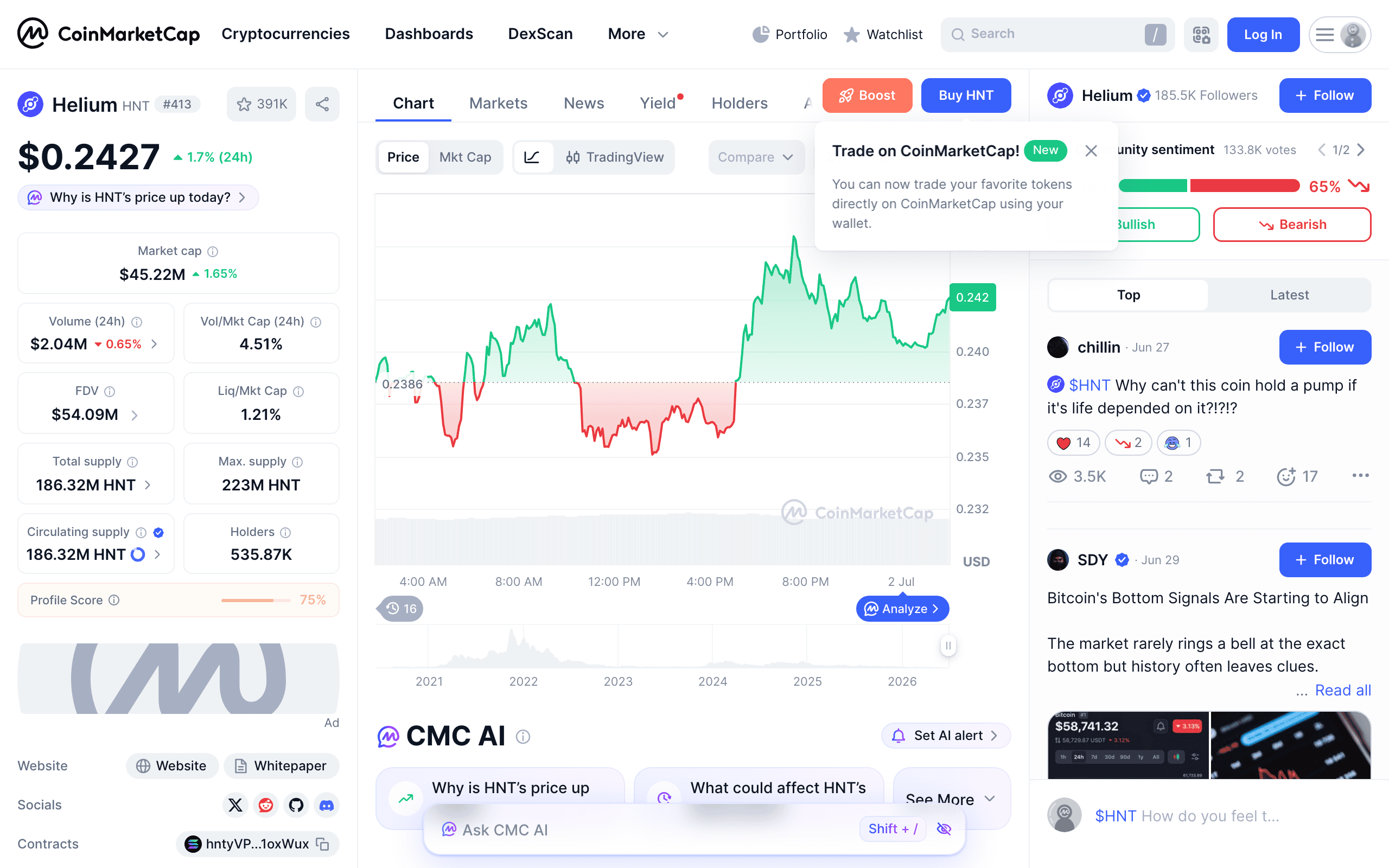
As of July 2026, the Helium Network runs primarily on the Solana blockchain after its 2023 migration from the original Layer-1. HNT trades around $0.24 with a market capitalization near $44 million according to CoinMarketCap. The network includes tens of thousands of active IoT and Mobile hotspots that together form one of the largest decentralized wireless infrastructures in the world.
Definition: What Is Helium Mining?
Helium mining is the process of deploying and maintaining Helium Hotspots to take part in the network’s Proof of Coverage system and earn HNT tokens for expanding wireless connectivity. Each Hotspot acts as both a wireless gateway and a network participant that validates coverage through cryptographic challenges.
The idea is straightforward: instead of big telecom companies erecting expensive cell towers, individuals and businesses install small, low-power devices in homes, offices, or public spaces. These units create long-range LoRaWAN coverage for sensors or Wi-Fi offloading for phones, and the network pays operators in HNT for the service they provide.
History and Evolution of the Helium Network
Helium launched in 2019 with the aim of building a people-powered wireless network for IoT. Early participants bought Hotspots that earned HNT by proving unique coverage through beaconing and witnessing. The original blockchain used a custom consensus built around physical radio verification.
By 2023 the network moved to Solana for better scalability and lower costs. Validators were retired and reward distribution shifted to oracle-based calculations. In 2025, HIP-138 brought rewards back to HNT as the main token, simplifying the economy after earlier sub-tokens like IOT and MOBILE had been introduced.
This evolution let Helium grow from pure IoT into mobile coverage, with Mobile hotspots now representing a growing segment. The network has shown resilience, keeping thousands of active devices running through market cycles and token price swings.
How Helium Mining Works: Proof of Coverage
Proof of Coverage sits at the center of Helium mining. Every epoch—roughly 24 hours—the network issues challenges that require Hotspots to transmit beacons and report on each other’s signals. Successful participation proves a device is physically where it claims to be and is actually providing coverage.
The process starts when a Hotspot broadcasts a beacon packet. Nearby Hotspots listen and submit witness reports to the oracle on Solana. The oracle aggregates the data, applies scaling factors such as transmit scale and hex density, and calculates rewards. Hotspots that carry real data traffic receive extra compensation.
Operators do not solve math problems. They keep reliable radio hardware and choose the best placement. A well-positioned Hotspot in a low-density area can earn more than one in a crowded urban zone because the network values unique coverage.
Types of Helium Hotspots and Sub-Networks
Helium supports two main categories of Hotspots in 2026. IoT Hotspots use LoRaWAN technology to connect sensors, trackers, and smart devices over long distances with very little power. These work well for agriculture, logistics, and environmental monitoring.
Mobile Hotspots focus on Wi-Fi or CBRS-based offloading for cellular subscribers. They earn rewards when phones connect and transfer data, helping carriers ease the load on traditional infrastructure. As of late 2025, active Mobile hotspots exceeded 120,000 while IoT hotspots numbered around 43,000.
Each type has different hardware needs and reward patterns. IoT devices are generally lower cost and lower power, while Mobile units often require more robust radios and specific certifications.
Tokenomics and Reward Distribution in 2026
HNT serves as the core token for governance, value storage, and network incentives. When devices use the network, HNT is burned, creating deflationary pressure tied to real usage. Rewards follow a schedule that balances growth and scarcity.
Daily rewards flow through oracle calculations posted to Solana as SPL token transfers. Operators claim earnings via the Helium Wallet app. Factors that influence individual rewards include location density, witnessed coverage quality, data transferred, and the current emission rate.
The maximum supply is capped at 223 million HNT, with over 186 million in circulation as of mid-2026. This setup aligns operator incentives with actual network utility rather than pure speculation.
Profitability Factors for Helium Miners
Profitability in 2026 varies widely. Key variables include hardware cost (often $200–$600 per unit), electricity use (typically under 10 watts), internet reliability, and antenna placement. A single Hotspot in a high-value location might earn several HNT per month, which translates to modest dollar amounts at current prices.
Operators in rural or underserved areas often see higher per-device returns because coverage is scarce. Urban operators face more competition that reduces transmit scale. Extra income can come from data credits or partnerships with enterprises that need coverage.
Real-world results are mixed: some operators recover hardware costs within a year, while others treat mining as a side activity with break-even economics after maintenance.
Risks and Challenges of Helium Mining
Regulatory uncertainty around spectrum use and cryptocurrency remains a concern. Network growth can dilute rewards if new hotspots outpace demand. Hardware failures, power outages, or poor internet can interrupt earnings.
Token price volatility directly affects fiat returns. Competition from other decentralized wireless projects or traditional telecom expansion poses long-term risks. Operators must also stay compliant with any local zoning or radio regulations.
Security is another factor. While the non-custodial nature of Hotspot ownership reduces some risks, compromised devices or wallet keys can lead to lost rewards.
Comparison to Traditional Cryptocurrency Mining
Traditional mining such as Bitcoin requires specialized ASICs, high electricity use, and constant competition for block rewards. Helium mining instead rewards physical infrastructure deployment and real utility.
Energy consumption is orders of magnitude lower. There is no race to solve hashes; success depends on geography and consistent operation. This makes Helium more accessible to non-technical users and more environmentally friendly.
However, Helium rewards can be less predictable because they depend on network adoption and physical placement rather than computational power alone.
Where Can I Buy or Swap HNT?
HNT trades on centralized exchanges and decentralized platforms. For users seeking instant cross-chain swaps without creating accounts or custodying funds, non-custodial aggregators provide a convenient option. Baltex enables users to exchange HNT across more than 200 blockchain networks and over 10,000 assets by routing through aggregated liquidity sources.
Because Baltex is non-custodial, users retain control of their keys throughout the swap. No registration is required for most transactions, though AML screening applies when flagged. This makes it suitable for privacy-conscious operators who want to acquire HNT or convert earnings without intermediaries holding funds.
Always verify current listings and liquidity before executing large swaps.
Getting Started with Helium Mining
Begin by purchasing a certified Helium Hotspot from authorized vendors. Choose between IoT and Mobile models based on your location and goals. Install the device outdoors or near a window with clear line-of-sight, connect to stable power and internet, and assert its location via the Helium app.
Monitor performance through the official dashboard. Optimize antenna height and direction to maximize witnessed coverage. Join community forums for placement advice and troubleshooting.
Start small, track earnings over several weeks, and scale only after verifying local demand and reward potential.
Practical Use Cases and Who Benefits Most
Helium mining suits individuals with suitable real estate, small businesses seeking passive income, and communities wanting better connectivity. Farmers use IoT hotspots to monitor soil sensors; logistics companies track assets; urban residents provide mobile offload for neighbors.
It works best in locations with moderate to low existing coverage and reliable internet. In dense cities with many competing hotspots, returns may be lower, making traditional investment or other crypto activities preferable.
Enterprises can deploy multiple units for enterprise-grade coverage and earn scaled rewards while supporting their own IoT deployments.
Future Outlook for Helium and Mining Rewards
As of 2026 the network continues expanding Mobile coverage into new regions and integrating with more applications. Increased data usage drives HNT burns and potentially higher demand. Ongoing HIP proposals aim to refine reward algorithms and onboarding.
Long-term success depends on real adoption by device manufacturers and carriers. If usage grows steadily, operators providing valuable coverage should continue earning meaningful rewards. However, competition and macroeconomic factors will influence token value and overall profitability.
Helium demonstrates how cryptocurrency incentives can bootstrap physical infrastructure at global scale, offering a unique alternative to traditional mining models.
Sources
- Official project documentation and website at helium.com
- Market data from CoinMarketCap
- Network statistics referenced from Messari reports and community analyses
Disclaimer
This article is for educational purposes only and does not constitute financial, investment, or legal advice. Cryptocurrency investments involve significant risk, including total loss of capital. Past performance does not guarantee future results. Always conduct your own research and consult qualified professionals before making decisions.
We cover this in more detail in How Bitcoin Works: Transactions, Mining, and the Blockchain.
You can read our full breakdown in What Is Bitcoin Mining and What Does It Mean to Mine Crypto.
We cover this in more detail in How Bitcoin Works: Transactions, Mining, and the Blockchain.
We cover this in more detail in How Bitcoin Works: Transactions, Mining, and the Blockchain.