4 minutes to read
 Ecosystem
Baltex vs ChangeNOW: Which Crypto Exchange Offers Better Rates in 2026
TL;DR
In 2026, Baltex and ChangeNOW are both instant swap services that let you swap without creating an account, and the better rate depends on the pair, the route, and the moment, so compare live quotes before you send funds. Baltex positions itself on low fees, 10,000+ coins, 200+ networks, an average completion time under 5 minutes, and privacy modes, including a Monero-based Private+ mode. ChangeNOW builds its fee into the quote (about 0.4% on average), lists roughly 1,400+ assets, offers fixed and floating rates, and has an optional KYC-based Pro tier with cashback. Both services can request KYC when a transaction trips their AML screening, and flagged swaps can be held until the review ends. For multi-chain and privacy-focused swaps, Baltex's breadth is its main advantage; ChangeNOW is a solid alternative if you want a fixed-rate quote or its Pro perks. Check the comparison tables below for details.
Introduction
Crypto swap platforms in 2026 continue to evolve, prioritizing competitive effective rates: the final amount received after accounting for fees, spreads, network costs, and slippage. Users seeking optimal value for trading, portfolio rebalancing, cross-chain transfers, and cash-out preparation want transparent pricing alongside speed and privacy. Baltex, via baltex.io, positions itself as an aggregator that routes swaps through DEX and CEX liquidity with low fees and no account required. ChangeNOW, operating since 2017, is a veteran instant exchange that aggregates liquidity for thousands of pairs without mandatory registration.
This guide compares their pricing models, effective rates, spreads, network fees, execution speeds, slippage risks, limits, supported chains and assets, KYC policies, privacy features, and handling of failure scenarios. We'll detail step-by-step swap processes, essential safety checks, and include tables for quick reference. A dedicated section explores Baltex's strengths in quick multi-chain swaps across various use cases.
Effective rates matter most because hidden spreads or slippage can erode savings more than advertised fees. Baltex aggregates liquidity and shows fees up front, while ChangeNOW's inclusive pricing is predictable but builds its margin into the quote. Both reduce risk in different ways, but differences in speed, chain coverage, and compliance checks influence outcomes for active traders.
Feature Comparison Table
Here's an at-a-glance overview of core features in 2026, emphasizing aspects that affect effective rates like aggregation and slippage control.
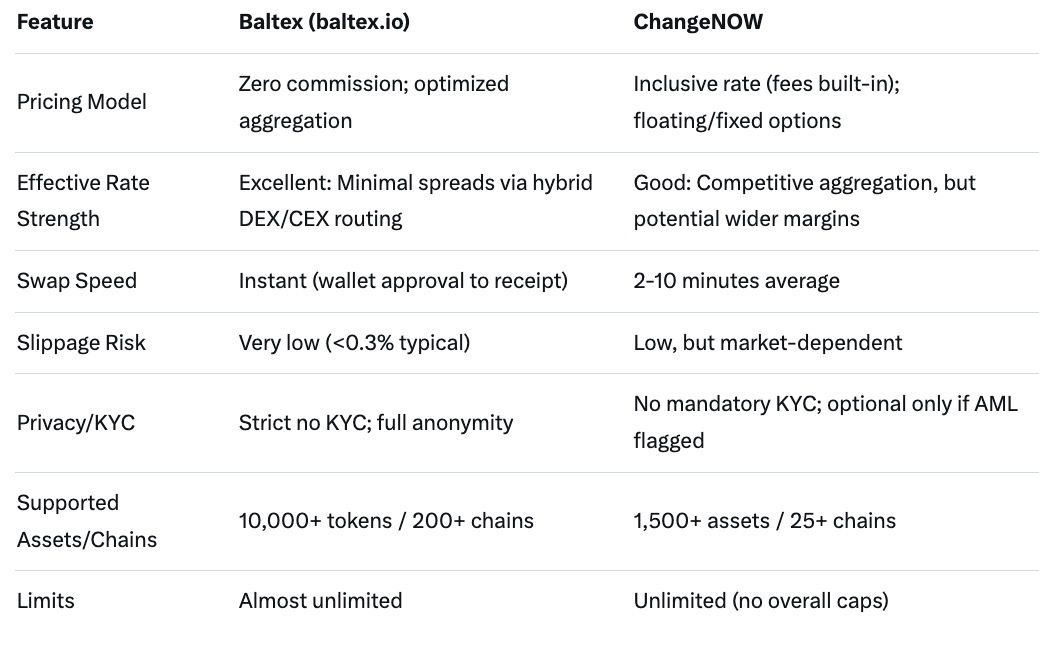
Fees, Spreads, and Effective Rates Comparison
This table breaks down cost structures and typical effective rates for common swaps (e.g., BTC to ETH). Treat any quoted figure as a snapshot, since rates move with liquidity.
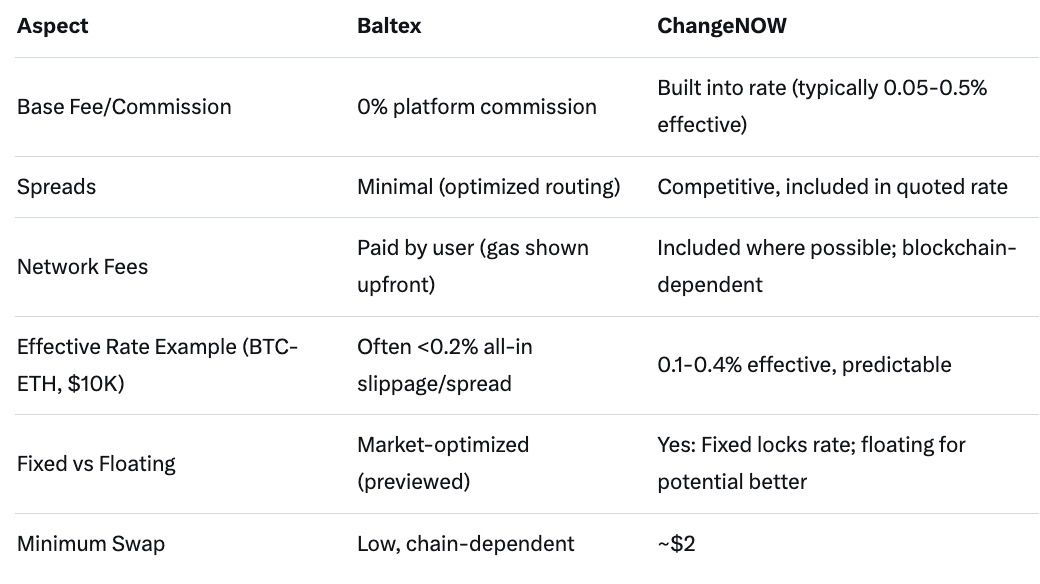
Baltex aims for better effective rates through aggregation and a low-fee model; verify with a live quote on both platforms.
Pricing Model and Effective Rates Breakdown
The core question, which offers better rates in 2026, hinges on the total cost after all factors. Baltex describes a low-fee model with no hidden charges, aggregating liquidity from decentralized and centralized sources. In its DEX Layer, the interface shows network (gas) fees, underlying protocol fees, and routing fees (if applicable) before you confirm, along with a "minimum received" value tied to your slippage setting.
ChangeNOW integrates fees directly into the displayed rate, averaging around 0.4% per trade, though this varies with market conditions and token liquidity. It offers floating rates (market-following) and fixed rates, which lock the quote for up to about 20 minutes at a slightly wider spread. ChangeNOW reports that about 98% of swaps land within 0.5% of the estimated rate. Its optional Pro tiers require KYC: the basic tier is free, Emerald costs $15 per month and Brilliant $100 per month, with cashback of up to 0.2%. Fiat purchases on ChangeNOW run higher, with fees of around 2% to 4% common on simple fiat-to-stablecoin buys.
In practice, which platform wins depends on the pair and the moment. Network fees remain the main variable on both, and Baltex's upfront fee display makes costs easier to predict.
Spreads and Network Fees
Spreads represent the difference between the market price and the execution rate, directly impacting effectiveness. Baltex aggregates multiple liquidity sources and routes each swap through the path it judges most efficient for your pair and amount. Network fees, such as gas on Ethereum or the equivalent on other chains, are passed through, and Ethereum mainnet gas is now typically very low, so the spread and routing quality matter more than gas for most swaps.
ChangeNOW bundles its spread and fee into the inclusive rate, which is predictable but can be wider when liquidity sources widen their margins. Network fees are handled within the quote.
For users prioritizing the best rate after spreads, run the same swap amount through both quotes at the same time and compare the amount you would receive.
Swap Speed and Slippage Risk
Speed influences slippage exposure, meaning the risk of price movement during processing. Baltex reports an average completion time under 5 minutes across most routes, and its FAQ says exchanges take anywhere from a few minutes to 30 minutes depending on the coin and network. In the DEX Layer, swaps execute on-chain from your own wallet, so you can set a slippage tolerance, and a failed swap leaves your funds in your wallet.
ChangeNOW swaps typically complete within minutes, depending on network confirmations and liquidity matching. Fixed-rate mode locks the quote and removes slippage from the equation, while floating rates follow the market until the incoming deposit confirms.
Neither service is truly instant for deposit-based swaps, so the choice between fixed and floating (ChangeNOW) or standard and DEX Layer (Baltex) matters in fast markets.
Limits and Supported Chains/Assets
Baltex states support for 10,000+ coins across 200+ networks and advertises no swap limits, with support available for large amounts. This extensive coverage helps with diverse rebalancing without fragmentation.
ChangeNOW lists roughly 1,400+ assets as of April 2026 (third-party reviews cite anywhere from 900 to 1,400+), with no upper limit on swap size and low minimums.
Baltex's broader chain and asset coverage better supports complex multi-network strategies.
KYC and Privacy
Privacy remains pivotal in 2026. Baltex swaps need no account or registration. Its KYC/AML policy says it may ask for KYC if a transaction fails its risk checks, involves high-risk regions, or shows high-risk patterns. If you decline, Baltex usually offers a refund to the depositing address minus network fees, although some refunds wait until the review ends. Use is also prohibited for users in sanctioned jurisdictions. For extra privacy, Baltex offers Efficient, Private, and Private+ modes; Private+ routes through Monero (XMR) as the intermediary currency.
ChangeNOW requires no registration for basic swaps, and its automated AML screening triggers a KYC request through a verification partner on flagged transactions. Third-party testing notes that larger volumes and privacy coins such as XMR and ZEC can prompt enhanced verification, and some users report swaps held for KYC and source-of-funds review in 2026.
Both give you account-free swaps in standard scenarios; if you swap privacy coins or large amounts, expect that either service may ask for verification.
Failure Scenarios and Safety
Failures from congestion, errors, or compliance holds occur infrequently but matter. On Baltex's DEX Layer, a failed swap leaves your funds in your wallet, while on standard swaps a flagged transaction can be refunded to the depositing address minus network fees, sometimes after the review finishes.
ChangeNOW handles issues via tracking and support, refunding where possible minus fees, and its Pro users can run AML checks on addresses in advance. Sending to the wrong network risks permanent loss on both, so always double-check.
Safety checks include address verification and small test swaps.
Step-by-Step Swap Flows and Safety Checks
Baltex offers two flows. In the standard flow, visit baltex.io, pick the pair and amount, choose a mode (cross-chain, DEX, bridge, or private), enter your destination address, send the deposit, and receive funds in minutes. In the DEX Layer, connect a self-custody wallet (WalletConnect or a browser extension), review the quoted rate, fees, and slippage setting, and approve in your wallet. Safety tips: use a hardware wallet, verify contract and destination addresses, and revoke token approvals after DEX swaps with a tool such as revoke.cash.
ChangeNOW starts with pair selection on their site. Enter the recipient address carefully (a critical safety step to avoid losses), choose a fixed or floating rate, send to the provided deposit address, and monitor progress via the tracker. Receipt follows confirmations. Safety includes AML awareness, network confirmation, and contacting support early if a swap is flagged.
Both describe themselves as non-custodial, meaning you never hand over private keys. Standard deposit-based swaps on either service still involve sending funds to a deposit address first, while Baltex's DEX Layer runs from your own wallet through smart contracts.
Additional Rate Factors Table
For deeper insight into rate influencers:
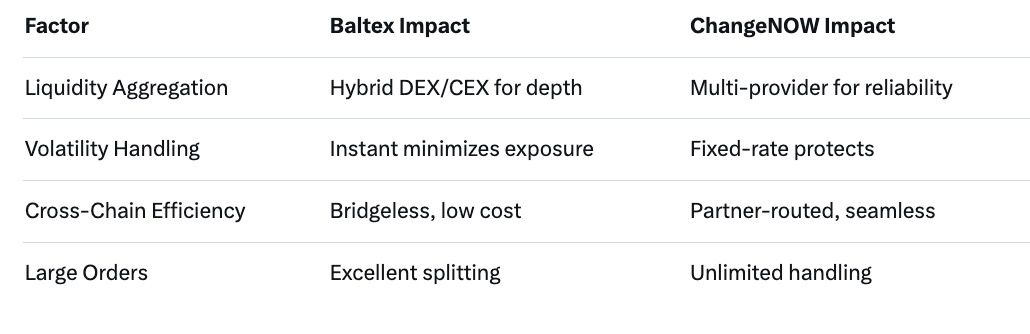
How Baltex.io Enables Quick Multi-Chain Swaps for Multiple Use Cases
Baltex.io is built for rapid multi-chain swaps, addressing key scenarios like portfolio rebalancing, cross-chain routing, and cash-out preparation. In rebalancing, shift assets across networks in one step, for example ETH on Arbitrum to SOL-based tokens, with smart routing looking for the best available path.
Cross-chain routing benefits from 200+ network support, covering direct swaps between chains as well as bridge-style transfers across Arbitrum, Optimism, Base, Polygon, Avalanche, BNB Chain, and Solana. Arbitrage or diversification becomes simpler when one service covers the route.
For cash-out prep, you can buy crypto with a card without creating an account (card processors may apply their own checks), then swap to your preferred exit asset. Private modes add routing variance for users who want extra privacy, and funds land directly in your wallet for subsequent off-ramps.
FAQ
Which has better effective rates in 2026?
It depends on the pair, route, and timing. Baltex aggregates liquidity and shows fees up front, while ChangeNOW's fee averages about 0.4% inside its quote, so compare live quotes on both.
Is KYC required on ChangeNOW?
Not for most swaps. KYC is requested when AML screening flags a transaction, and ChangeNOW Pro requires KYC.
How fast are Baltex swaps?
Baltex reports an average under 5 minutes on most routes, with a few minutes to 30 minutes depending on the coin and network.
Which supports more chains?
Baltex, which states 200+ networks and 10,000+ coins, versus roughly 1,400+ assets listed by ChangeNOW.
Are limits restrictive?
Both advertise no upper limit, suiting high volumes. Larger amounts can also draw closer AML review on either service.
Conclusion
In 2026, Baltex is the stronger fit when you need broad asset and multi-chain coverage, a low-fee model with upfront fee display, and privacy-focused routing options. ChangeNOW remains a reliable alternative with fixed-rate quotes, a long track record, and Pro cashback tiers. Both can request KYC on flagged transactions, so neither should be treated as a guarantee of anonymity. For optimal costs in trading, rebalancing, or cross-chain moves, test small amounts on both and compare the amount you actually receive.
We cover this in more detail in Best Crypto Exchange API 2026 – Why Developers Choose Baltex.