3 minutes to read
 Ecosystem
Baltex vs KuCoin: Cross-Chain Swaps, Limits, and User Control
TL;DR
In 2026, Baltex and KuCoin offer distinct paths for crypto users. Baltex provides non-custodial cross-chain routing with no account required for standard swaps, 10,000+ coins across 200+ networks, an average completion time under 5 minutes, and no advertised swap limits, though it can request KYC when a transaction trips its risk checks. KuCoin delivers centralized trading with deep liquidity and 1,000+ listed assets, but KYC is mandatory for all users, withdrawal limits are tiered, funds are held in custody, and it has exited the US after its 2025 guilty plea and a 2026 CFTC order. Baltex uses an aggregation model with low fees, while KuCoin charges 0.1% spot trading fees (0.08% when paid in KCS). For flexible, privacy-minded swaps, Baltex leads; for order-book trading, derivatives, and structured limits, KuCoin suits regulated needs. Review our comparison tables for key differences.
Introduction
As crypto ecosystems expand in 2026, users increasingly weigh cross-chain capabilities, transaction limits, and control over their assets when choosing platforms. Baltex, through baltex.io, represents a user-centric, non-custodial swap route emphasizing privacy and flexibility, allowing movements across chains in one step. This model appeals to those prioritizing anonymity and flexibility in trading, portfolio rebalancing, fund transfers, and cash-out preparations. KuCoin, an established centralized exchange with over 40 million registered users, counters with robust liquidity and scalable limits, but requires KYC compliance and involves custody tradeoffs.
This guide compares Baltex and KuCoin focusing on cross-chain swaps, limits, and user control. We'll explore fees, spreads, execution speeds, slippage risks, swap and withdrawal limits, supported chains and assets, custody versus self-custody, KYC and data exposure, account and withdrawal risks, and failure scenarios. Step-by-step workflows for swapping, bridging, deposits, withdrawals, and inter-platform fund movements, complete with safety checks, provide actionable insights. Tables clarify comparisons, and a section details Baltex's multi-chain prowess. In a year where regulatory scrutiny remains high, understanding these elements helps mitigate risks while optimizing workflows for efficient crypto management.
The non-custodial versus centralized divide shapes user experiences profoundly. Baltex's approach minimizes exposure to platform failures, while KuCoin's centralized model offers reliability through reserves but introduces counterparty and compliance risks. Both support extensive assets, yet their handling of cross-chain operations and limits diverges, influencing choices for high-volume traders or privacy advocates.
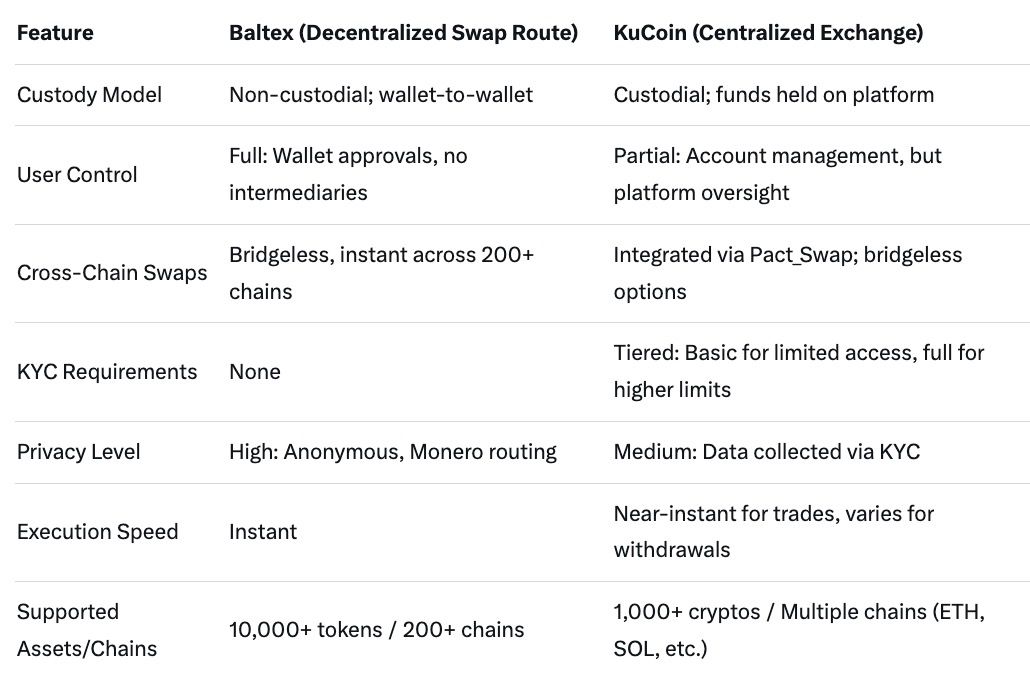
Feature Comparison Table
This table outlines core features in 2026, contrasting non-custodial routing with centralized structures.
Fees and Spreads
Fees and spreads are pivotal for cost-effective operations. Baltex describes a low-fee aggregation model with no hidden charges. In its DEX Layer, you see network (gas) fees, underlying protocol fees, and routing fees (if applicable) before you confirm. Spreads depend on the aggregated DEX and CEX liquidity behind each route, which suits cross-chain swaps where you want minimal markups in volatile environments.
KuCoin charges a base 0.1% fee for both makers and takers on spot trades, 20% lower (0.08%) when you pay in KCS, with further reductions through VIP tiers. Perpetual futures start at 0.02% maker and 0.06% taker. Spreads are tight owing to deep liquidity, but withdrawal fees apply per asset and network, and third-party costs for fiat integrations can widen overall spreads. Reviews also cite a zero-fee Convert tool for simple swaps.
Baltex's fee structure keeps costs visible before you commit, while KuCoin's predictability suits centralized order-book workflows.
Execution Speed and Slippage Risk
Speed directly affects market exposure. Baltex reports an average completion time under 5 minutes on most routes, and its FAQ says exchanges take from a few minutes to 30 minutes depending on the coin and network. In the DEX Layer, swaps run on-chain from your own wallet, so you can set a slippage tolerance, and a failed swap leaves funds in your wallet.
KuCoin offers near-instant trade execution on its platform, but cross-chain moves and withdrawals involve blockchain confirmations, averaging minutes. Slippage is minimal in liquid pairs due to order books, though volatility can impact less-traded assets.
For rebalancing across chains, Baltex handles it in one step; for fast in-exchange trades, KuCoin's order books are quicker.
Swap and Withdrawal Limits
Limits define scalability. Baltex advertises no swap limits, and its FAQ recommends contacting support for large amounts.
KuCoin ties limits to verification. KYC is now mandatory for all users, so the old distinction between unverified and verified users no longer applies, and daily withdrawal limits rise with your KYC level and security settings (2FA and address whitelisting). Swap volumes are generous but monitored for compliance, and larger withdrawals can trigger manual review.
Baltex offers open-ended swap sizes; KuCoin provides structured escalation.
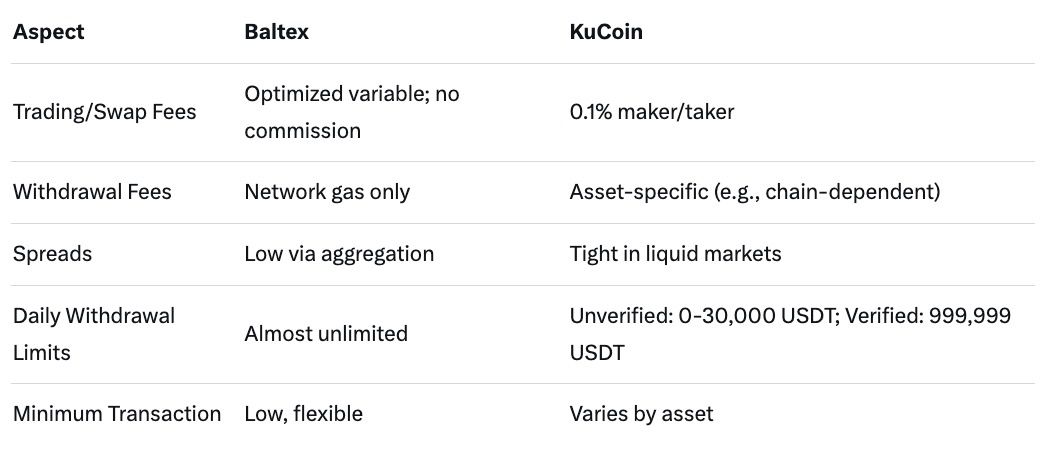
Fees and Limits Table
Detailed breakdown of costs and constraints in 2026.
Supported Chains and Assets
Asset diversity enables versatile strategies. Baltex supports over 200 networks like Ethereum, Solana, TON, and Base, with 10,000+ coins including BTC, ETH, and privacy coins. This breadth facilitates direct cross-chain swaps in one step.
KuCoin lists 1,000+ cryptocurrencies by its own count (third-party reviews cite roughly 900 to 1,115, with 1,200+ trading pairs), with deposits and withdrawals on ETH, SOL, and other networks. KuCoin does not run a native bridgeless swap product; cross-chain moves go through withdrawals and deposits. Pact Swap, a bridgeless cross-chain DEX built on Coinweb, is an independent project with a KuCoin Labs partnership, not a KuCoin tool.
Baltex excels in multi-chain scope; KuCoin in curated liquidity and early token listings.
Custody vs Self-Custody Tradeoffs
Custody models impact risk. Baltex describes itself as a non-custodial routing network: in the DEX Layer, swaps execute from your own wallet through smart contracts and Baltex never holds your keys. Standard swaps are deposit-based, so you send funds to a deposit address first.
KuCoin's custodial approach holds funds, offering convenience but exposing users to incidents like the 2020 hack, after which users were made whole through recovered funds and insurance. Tradeoffs include platform protections versus personal control.
Self-custody through wallet-based swaps minimizes counterparty risks.
KYC and Data Exposure
KYC shapes privacy. Baltex swaps need no account. Its KYC/AML policy says it may request KYC if a transaction fails risk checks, involves high-risk regions, or shows high-risk patterns. For extra privacy, its Private+ mode routes through Monero as the intermediary currency.
KuCoin made KYC mandatory for all users in July 2023, and as of early 2026 it requires identity verification to deposit, trade, or withdraw. That involves ID and selfie submission, and the compliance data stays with the exchange.
Baltex prioritizes lower data exposure in standard scenarios.
Account and Withdrawal Risks
Risks vary by model. Baltex's setup faces wallet errors or network issues, and flagged standard swaps can be refunded to the depositing address minus network fees, sometimes after a review ends.
KuCoin risks include temporary withdrawal suspensions for security, prolonged account reviews that users report (in some cases lasting months), and dormancy fees on inactive non-KYC accounts that received a notice. Regulatory exposure is also real: KuCoin pleaded guilty to unlicensed money transmission in the US in January 2025, agreed to exit the US market, and in March 2026 a federal court approved a CFTC settlement with a $500,000 fine that bars it from serving US users. Reviews also report that Austria's regulator temporarily halted new EU onboarding in February 2026.
User control mitigates Baltex risks; KuCoin users should keep funds on-platform only as needed.
Failure Scenarios
Common failures differ. On Baltex, mismatched approvals or congestion may halt swaps, resolved by retries, and a failed DEX Layer swap leaves funds in your wallet.
KuCoin scenarios include delayed withdrawals from compliance monitoring or security reviews, hacks, and regional restrictions, with support available for recovery.
Awareness prevents most issues.
Risks Table
Key risks compared.

Step-by-Step Flows for Swapping, Bridging, Deposits/Withdrawals, and Moving Funds
Swapping on Baltex: Select tokens and networks on baltex.io, choose a mode (cross-chain, DEX, bridge, or private), enter your destination address, review the rate and fees, send the deposit, and receive funds in minutes. In the DEX Layer, connect a self-custody wallet instead and approve the swap there after reviewing the rate, fees, and slippage setting. Safety: verify addresses, use hardware wallets.
On KuCoin: Complete KYC, fund your account via deposit, place a trade order or use Convert, and execute. Safety: enable 2FA, monitor limits.
Bridging with Baltex: Integrated in swaps; select networks. Safety: Confirm compatibility.
Cross-chain on KuCoin: Withdraw to the destination network, or use an independent bridgeless tool such as Pact Swap; select assets. Safety: Check fees, networks.
Deposits/Withdrawals on Baltex: Buy crypto with a card without creating an account, delivered to your wallet (card processors may apply their own checks). Safety: Review terms.
On KuCoin: Deposits and withdrawals require completed KYC. Safety: Whitelist addresses.
Moving funds between: From Baltex to KuCoin—swap, send to your KuCoin address. Reverse: Withdraw from KuCoin, swap on Baltex. Safety: Test small, track tx.
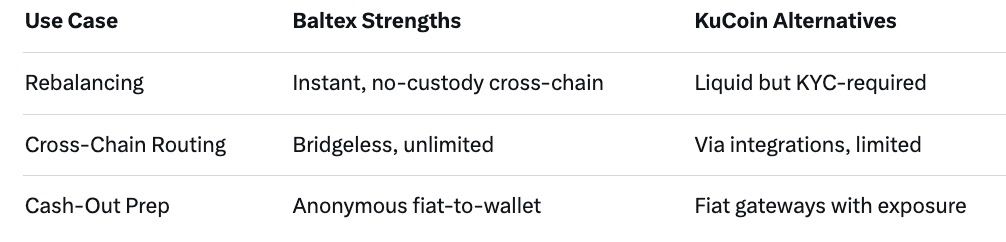
How baltex.io Enables Quick Multi-Chain Swaps for Multiple Use Cases
Baltex.io in 2026 supports fast multi-chain swaps, enhancing user control for diverse scenarios. In portfolio rebalancing, users exchange assets across Ethereum to Solana in one step, with aggregation seeking low slippage and optimal rates.
Cross-chain routing simplifies transfers, like TON to Base, and Private+ mode uses Monero as an intermediary to add routing privacy. With no advertised swap limits, high-volume routing for arbitrage is possible.
For cash-out prep, buy crypto with a card without creating an account, then swap to exit assets wallet-direct. Baltex's design empowers efficient operations.
Use Cases Table
Benefits by scenario.
FAQ
What are KuCoin's trading fees in 2026?
0.1% for makers and takers on spot (0.08% when paid in KCS), with VIP discounts. Perpetual futures start at 0.02% maker and 0.06% taker.
Does Baltex have withdrawal limits?
It advertises no swap limits, and its FAQ suggests contacting support for large amounts.
How does KuCoin handle KYC?
KYC is mandatory for all users to deposit, trade, or withdraw, and withdrawal limits rise with your KYC level.
What is Baltex's swap speed?
Baltex reports an average under 5 minutes, ranging from a few minutes to 30 minutes depending on the coin and network.
Are there custody risks on KuCoin?
Yes, as funds are held centrally, unlike Baltex's wallet-based DEX Layer swaps.
Conclusion
In 2026, Baltex's non-custodial model offers strong user control and privacy for cross-chain swaps without advertised limits, while KuCoin's centralized setup provides liquidity, derivatives, and structured limits at the expense of custody and compliance risks. Choose based on your needs: flexibility or regulated scale. For more, explore no-KYC options or centralized exchange tips. Test workflows cautiously to enhance your crypto strategy.
Related reading: Best Crypto Exchange API 2026 – Why Developers Choose Baltex.