 5 minutes to read
 Ecosystem
How Much Is PEPE Coin Worth in 2026? Price Forecast and Analysis
PEPE, the frog-themed meme coin that launched in 2023, still draws plenty of eyes in today’s choppy crypto market. As of June 2026 it sits near $0.00000235, with a market cap of roughly $980 million and a ranking around 66th according to CoinGecko. That puts it among the more established meme coins, though it remains well below its 2024 highs. Without any real utility or revenue, its price hinges almost entirely on social buzz and broader market mood.
Whether you’re wondering what PEPE might be worth by the end of 2026 or further out, the answer comes down to community strength, overall crypto adoption, and fresh competition from newer memes. Below we break down the current numbers, expert forecasts through 2030, the main drivers, easy ways to pick it up (including non-custodial routes), and the risks that come with it. Remember, these are all speculative guesses and not financial advice.
What Is PEPE Coin?
PEPE started as a playful nod to the Pepe the Frog meme and dropped on Ethereum in April 2023. It caught fire fast thanks to viral spread and a fair launch that skipped pre-sales or big team bags. Unlike tokens built for actual use cases, PEPE’s value lives mostly in its cultural vibe and trading hype. Its total supply is capped at 420.69 trillion tokens, a classic meme touch.
The contract is locked and community-run, with no big treasury in anyone’s hands. That setup appeals to DeFi fans but also means prices can swing wildly on sentiment alone. Over time the token spread to Solana and Base, making it easier to trade across chains. As a pure meme play, its moves tend to track Bitcoin dominance and retail appetite for risk more than any on-chain fundamentals.
Current PEPE Price and Market Data as of June 2026
Live trackers show PEPE hovering around $0.00000235 in late June 2026. Market cap sits near $980 million, while daily volume bounces between $150 million and $250 million depending on the day’s swings. These levels mark a modest rebound from earlier lows but still sit far below the all-time high near $0.000017 from 2024.
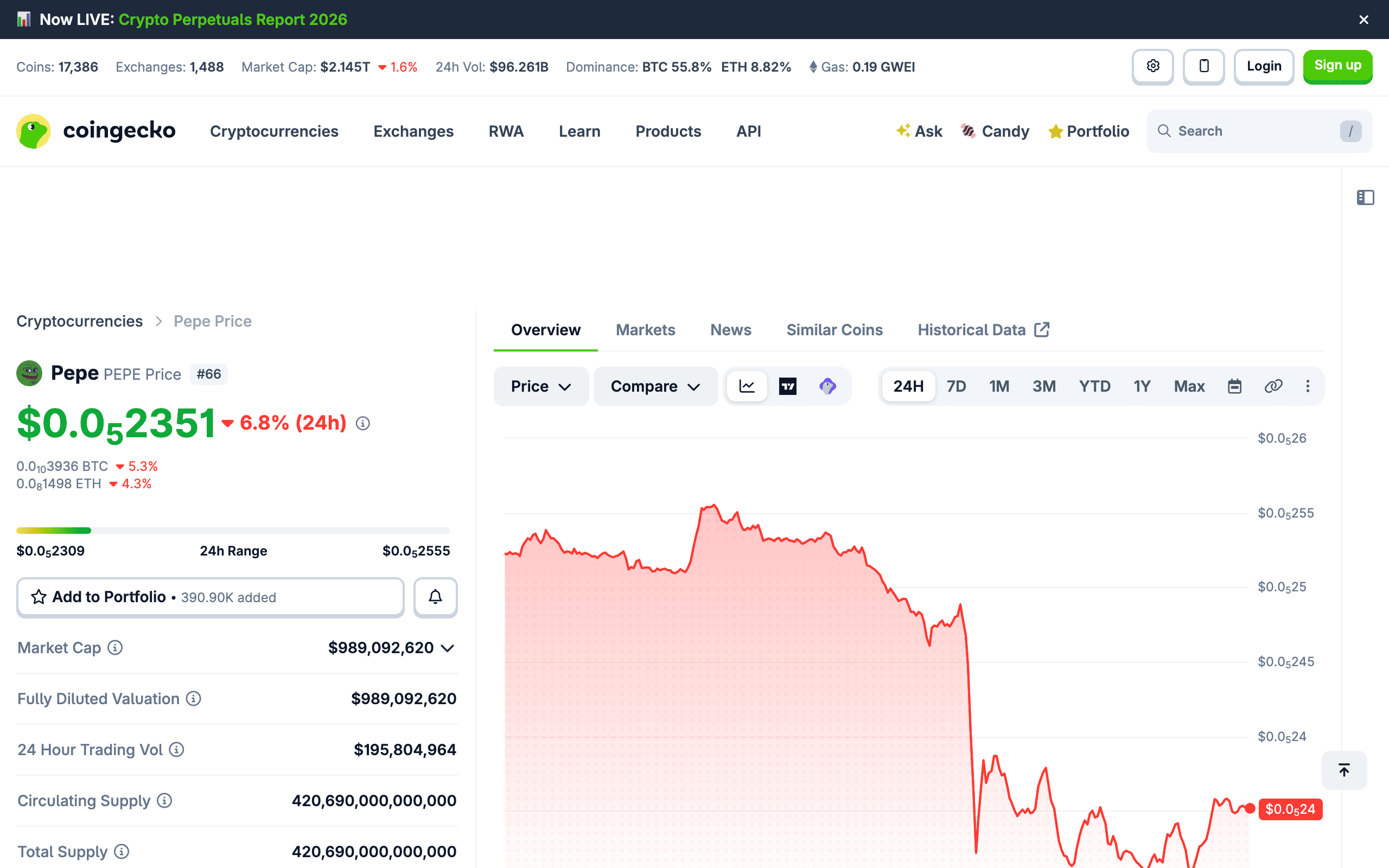
Circulating supply is basically the full 420.69 trillion, so fully diluted value lines up closely with the reported market cap. Most on-chain depth comes from decentralized liquidity pools, while bigger trades flow through centralized venues. Compared with DOGE or SHIB, PEPE tends to move more sharply with meme-sector rotations, magnifying both the ups and the downs.
PEPE Price Prediction for 2026
Several platforms see modest gains ahead for the rest of 2026. Conservative outlooks from Kraken and CoinCodex point to year-end prices between $0.0000020 and $0.0000026 if growth stays around 5 percent and markets remain steady. More bullish calls from Changelly and Traders Union stretch the top end toward $0.0000042 if meme narratives heat up again.
These numbers factor in PEPE’s history of big swings and its usual tie to Bitcoin. A clean break above $0.000003 would probably need strong social-volume spikes and easier money conditions. On the flip side, a drawn-out risk-off stretch could push it toward $0.0000015. The final result will likely depend on whether PEPE keeps its spot among leading meme coins while newer tokens keep arriving.
Long-Term PEPE Forecasts Through 2030 and Beyond
Looking further ahead, the range widens. By 2030, sources like Changelly and CoinCodex see averages between $0.0000038 and $0.000012, with optimistic scenarios touching $0.000015 if bull markets return in force. Some longer models even float figures above $0.000025 by 2040, but only if total crypto market cap grows past $10 trillion.
All of these rest on the meme sector continuing to expand and PEPE holding its cultural edge. History shows meme coins can sit quiet for years then surge, yet plenty simply fade away. Weigh any projection against your own risk tolerance instead of treating it as a baseline.
Key Factors Influencing PEPE Price
Social sentiment and virality drive the short-term action. Activity on X, Telegram, and TikTok lines up closely with volume spikes. A celebrity shout-out or meme revival can move the needle in hours.
Broader crypto cycles add another layer. When Bitcoin dominance drops and altcoin season hits, meme tokens often lead the pack. Macro tightening or regulatory news can trigger fast exits the other way.
Meme-sector competition keeps the pressure on. Fresh tokens regularly pull speculative money away, so established names like PEPE have to keep communities engaged.
On-chain liquidity and listings give structural support. Deeper pools cut slippage and pull in bigger traders, while new centralized listings boost visibility.
Regulatory shifts remain a wildcard. Even though PEPE itself has no yield or governance, wider crackdowns on meme projects could weigh on the whole category.
How to Acquire and Trade PEPE Coin
Most people buy PEPE on centralized exchanges or swap it straight through decentralized protocols. CEXs give easy fiat on-ramps and deeper liquidity for bigger orders. Decentralized routes appeal when you want to keep self-custody and move across chains.
Non-custodial aggregators make the process simpler by pulling liquidity from many sources without forcing an account for ordinary swaps. Baltex, a non-custodial crypto swap aggregator, handles PEPE trades across more than 200 networks and over 10,000 assets by combining liquidity from CEX, DEX, and other providers.
It fits users who like privacy routing options and fast execution while staying in control of their keys. Standard AML screening can still apply if a transaction gets flagged.
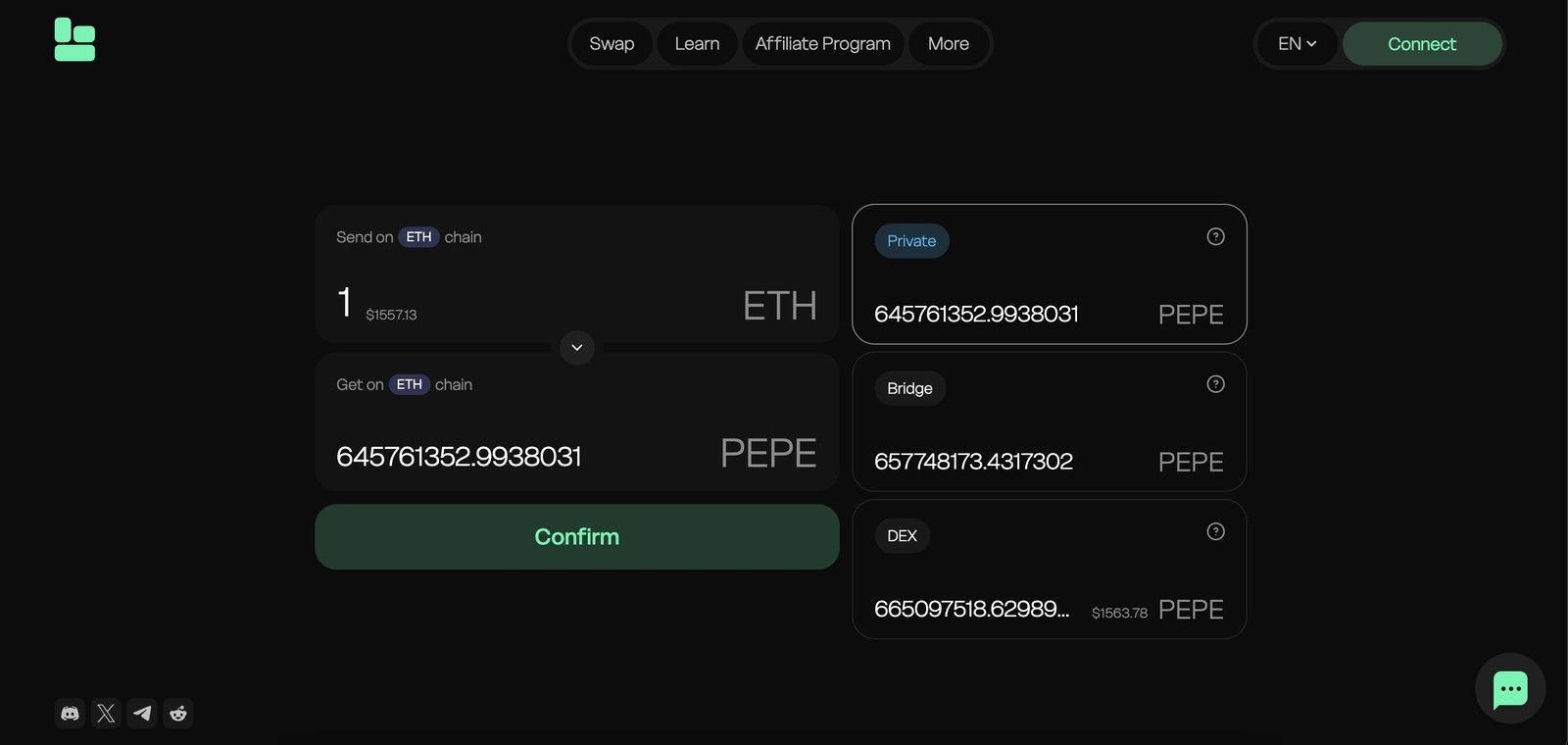
When choosing a platform, look at network fees, slippage, and chain support. Baltex also offers API and widget tools that wallets and Telegram apps can plug into, which helps frequent cross-chain traders. Always double-check contract addresses and preview transactions before you confirm.
Risks and Realistic Considerations
Meme coins swing harder than most other cryptos. Drawdowns of 80 percent or more in weeks happen regularly, and there’s no promise of a rebound. Liquidity can dry up fast during sell-offs, hurting anyone who jumps in late.
Without real utility, the price depends entirely on narrative strength. If community interest drops or stronger meme rivals appear, PEPE could lag for a long time. Questions about whether it counts as a security in some places add another layer of uncertainty.
Spread your bets and keep position sizes small. Putting only a modest slice of capital into high-beta memes helps limit the damage. Watch on-chain signals like holder concentration and exchange inflows for early clues of distribution.
Practical Use Cases and Limitations
PEPE works best as a speculative tool for traders riding meme momentum. Short-term players might use it for quick moves during hype cycles, while longer-term holders treat it as a cultural wager on internet memes sticking around.
It’s not the right fit if you want yield, voting rights, or something steadier. When regulatory clarity or institutional rails matter most, established layer-1 coins or regulated products usually make more sense. Non-custodial aggregators provide a clean option for cross-chain swaps without custody, but always do your own checks on fees and routing quality.
Conclusion
As of June 2026, PEPE is still a well-known but high-risk meme coin trading near $0.00000235. Year-end forecasts for 2026 generally fall between $0.000002 and $0.000004, with room to run higher if conditions line up. Staying relevant will take ongoing community energy, supportive macro conditions, and standing out from newer arrivals. Approach with care, do your own research, and keep any allocation modest inside a broader portfolio.
You can read our full breakdown in Can XRP Decouple From Bitcoin? Decoupling Scenarios for 2026.
You can read our full breakdown in Can XRP Decouple From Bitcoin? Decoupling Scenarios for 2026.
You can read our full breakdown in Can XRP Decouple From Bitcoin? Decoupling Scenarios for 2026.
You can read our full breakdown in Understanding Solana Pricing in 2026: The Basics for Newbies.