



 5 minutes to read
 Ecosystem
WaldenPay Crypto Cards Review (October 2026)
WaldenPay gives crypto holders a straightforward way to spend their holdings through virtual Visa and Mastercard prepaid cards. The service, run by BlueHouse Software B.V. in Rotterdam, Netherlands, converts deposits into a USD balance you can use at more than 150 million merchants worldwide. Launched with a focus on quick access and lighter onboarding, it appeals especially to users who want to avoid heavy banking friction. As of October 2026, it stands out for speed in the lighter-verification space, though its fees and custodial elements deserve a closer look.
What is WaldenPay?
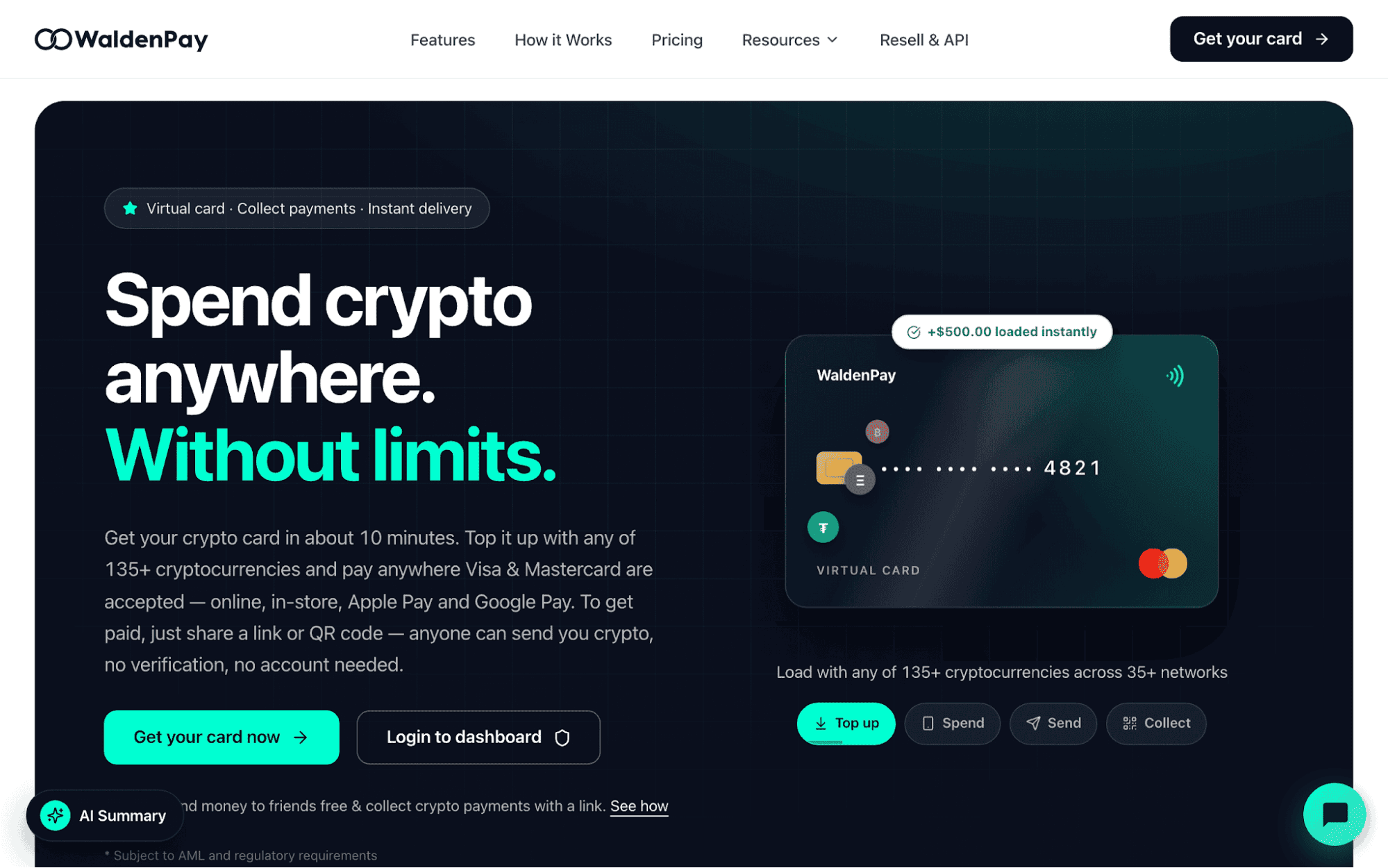
WaldenPay lets you fund virtual cards directly with cryptocurrency. You send coins, the platform converts them to USD, and you get card details ready for online shopping, subscriptions, or contactless payments. It targets people in regions with limited banking access or anyone who prefers minimal upfront checks for smaller or occasional spending.
The standard flow starts with just an email. No ID, selfie, or address proof is needed for the basic virtual card. That lighter approach sets it apart from many competitors that push full verification right away. Independent tests show cards often activate within minutes after the first deposit clears. Crypto cards in general have matured, yet rising regulations have pushed many providers toward stricter rules. WaldenPay keeps a lighter touch for everyday use while working through licensed partners, including a Hong Kong bank that issues the cards.
How WaldenPay Works
The process is simple and usually takes around 10 minutes. Sign up on the site or via Telegram bot with just your email. The platform then shows deposit addresses for 135+ coins across 35+ networks, including Tron, Ethereum, Solana, and Bitcoin. Stablecoins like USDT on Tron are popular because fees stay low and confirmations arrive fast. Once the deposit lands, it converts automatically to a USD balance.
Card details appear right after the first top-up, so you can start spending online, add the card to Apple Pay or Google Pay, or use it in stores. Manage everything through the web dashboard or Telegram bot—freeze cards, check balances, or view transactions on the fly. Extra tools include free transfers between users and a feature that creates payment links or QR codes for incoming crypto.
Deposits stay non-custodial until you load the card, at which point funds move to the platform’s wallet for conversion. Many users first consolidate holdings with a quick swap. For example, Baltex, a non-custodial crypto swap aggregator that covers 200+ networks and 10,000+ assets, lets most people exchange coins instantly without creating an account. That step helps route assets into supported options like USDT before sending them to WaldenPay.
Key Features
The service keeps things practical. Both Visa and Mastercard networks are supported with worldwide acceptance and no FX markup from WaldenPay itself. Apple Pay and Google Pay integration works smoothly for most people. Funding options are broad—135+ cryptocurrencies, including privacy coins like Monero, across dozens of chains—so you often skip extra swaps. Free peer-to-peer transfers inside the platform and a payments collection tool add everyday utility.
Limits start at a $100 minimum top-up, with per-transaction caps near $100,000 and monthly spending up to $500,000 noted in reviews. No ATM withdrawals are available, so it suits digital and point-of-sale use best. Support via Telegram and email tends to reply quickly based on user reports.
Fees and Pricing
All costs are listed clearly on the site as of August 2026. Card issuance is a flat $10 one-time fee. Top-up fees begin at 5% for the first $2,000 of 30-day volume and slide down automatically: 4.75% above $2,000, 4.5% above $5,000, and 3% once you hit $100,000+ monthly spend. No monthly or annual fees apply, and WaldenPay adds no FX markup.
Some analyses mention a $0.25 transaction fee in certain cases, though the provider highlights the two-fee core model. Volume discounts help heavier users without extra paperwork. Referral bonuses of $10 for both sides offer a small boost for new users.
The structure works best for consistent spenders who benefit from the tiered rates. Low-volume users pay the full 5% at the start, which can make other options more appealing for light use.
Security and Compliance
Once funds load onto the card balance, the model becomes custodial—the issuer holds the USD equivalent. That brings standard counterparty risk for any prepaid service. AML screening runs on transactions, and flagged activity can trigger a compliance review that may request more information. The service does not promise full anonymity or untraceable transactions.
Positive signs include clear operator details (BlueHouse Software B.V., Netherlands) and user reports of responsive support with few frozen-balance issues. Reviews note no major security incidents through late 2026. Still, limited public detail on exact banking partners and dispute processes means extra due diligence is wise. Treat it like any prepaid product: load only what you need and watch activity through the dashboard. The Telegram bot lets you freeze cards instantly for added peace of mind.
User Reviews and Reputation
Feedback on Trustpilot and review sites as of October 2026 leans positive on onboarding speed and support quality. Users often mention the simple email signup, fast card activation, and reliable Apple Pay setup for subscriptions and daily purchases. Scores hover around 4.6/5 in sampled reviews.
Common praise covers quick support replies, easy fraud resolution with free replacements, and the ability to spend crypto without extra exchange steps. Complaints focus on the 5% starting fee for smaller volumes, occasional mobile-wallet declines, and questions about recovering balances if an account closes. CryptoSlate gave it a 7.0—the top score among no-KYC options it reviewed—crediting reliable feature delivery while noting the fee trade-off. Overall, it earns a solid reputation as a niche tool for privacy-minded or low-friction needs rather than a one-size-fits-all solution.
Pros and Cons
Pros:
- Email signup with no routine ID checks for standard use.
- Broad crypto support (135+ assets, 35+ networks) including privacy coins.
- Volume discounts down to 3% and no monthly fees.
- Apple Pay, Google Pay, and wide Visa/Mastercard acceptance.
- Free internal transfers and payment collection tools.
- Fast support and instant card controls via bot.
Cons:
- 5% starting top-up fee hits low-volume users hardest.
- Custodial model on loaded balances adds platform risk.
- No physical card or ATM access.
- Less transparency on some limits, issuer details, and higher-tier triggers.
- Possible compliance checks at larger scales.
Who Is WaldenPay Best For?
It fits crypto users who need fast, low-friction access to spending for online buys, subscriptions, travel, or fiat-paid services like AI tools. Freelancers, digital nomads, and people in restricted banking areas appreciate the minimal onboarding and global reach. Heavy spenders benefit from the automatic fee reductions.
It is less suitable if you need physical cards, cash withdrawals, cashback rewards, or a fully non-custodial setup. Those seeking the lowest possible fees or maximum banking-partner transparency may prefer other models. Always weigh your own risk tolerance and local rules before loading larger amounts.
Verdict: Is WaldenPay Worth It?
WaldenPay earns a recommendation when speed and lighter verification matter more than rock-bottom fees or every possible feature. It delivers reliably on its no-KYC virtual card promise and scores well in 2026 user feedback. The 5% entry fee is the main downside, softened by volume discounts and convenience for the right use cases. Occasional or privacy-focused spending works well here; high-volume or reward-focused needs may favor alternatives. As with any crypto service, do your own research and start small.
This is not financial advice. Cryptocurrency involves risk, and prepaid card providers carry counterparty exposure. DYOR.






