 1 minute to read
 Ecosystem
What is Monero Used For? 8 Real-World Use Cases in 2026
TLDR Monero (XMR) in 2026 is used primarily for private payments, cross-border remittances, merchant transactions, freelance work, hedging surveillance risks, anonymous donations, liquidity swaps, and cross-chain operations. Its mandatory privacy (ring signatures, stealth addresses, RingCT) makes it the go-to coin when unlinkability and confidentiality matter more than convenience or exchange listings. Real-world adoption includes darknet markets (declining), privacy-focused merchants, freelancers avoiding KYC, and users moving value to other chains without leaving traces. Fees remain under $0.01 per transaction, but liquidity fragmentation and exchange delistings push users toward no-KYC swappers and aggregators. For practical XMR swaps and cross-chain liquidity without KYC or classic bridge exposure, baltex.io enables shielded routing—see our no-kyc-crypto-swaps-usdt-to-xmr-privately and eth-to-xmr-exchange-transfer-ethereum-to-monero-safely guides. Overall, Monero excels wherever financial privacy is non-negotiable.
Monero (XMR) is the leading privacy cryptocurrency in 2026 because every transaction is private by default—no optional mode, no compromise. While Bitcoin and Ethereum offer transparency, Monero uses ring signatures, stealth addresses, and RingCT to hide sender, receiver, and amount, making funds truly unlinkable. This design drives its real-world use cases: private payments, cross-border remittances, merchant adoption, freelance work, hedging surveillance, anonymous donations, liquidity swaps, and cross-chain operations. This guide explores eight practical applications in 2026, the trade-offs involved, and how users navigate liquidity and exchange restrictions.
1. Private Peer-to-Peer Payments
The most straightforward use case is private P2P payments. Monero users send XMR directly to friends, family, or individuals without exposing amounts or identities. In 2026, this remains popular for everyday transactions where privacy matters—gifts, shared expenses, or personal loans. Unlike Bitcoin, where chain analysis can link addresses, Monero’s ring signatures mix the real input with decoys, stealth addresses generate one-time payment addresses, and RingCT hides amounts. As explained in our how-does-monero-xmr-work-privacy-features-explained-2025, this makes Monero ideal for payments where traceability would be undesirable.
2. Cross-Border Remittances
Monero is increasingly used for cross-border remittances in 2026, especially in regions with capital controls or high remittance fees. Senders convert fiat to XMR on a no-KYC platform, transfer XMR privately, and the receiver converts back to local currency via P2P. Fees are under $0.01 per transaction, far below traditional remittance services. Privacy protects senders in authoritarian regimes and receivers from surveillance. As detailed in our send-dash-usa-to-colombia-cash-out-2026 (similar privacy mechanics apply), Monero’s unlinkability makes it a preferred choice for private remittances.
3. Merchant Adoption and Private Commerce
Merchant adoption remains niche but growing in 2026. Privacy-focused online stores, VPN providers, and some physical shops accept XMR directly or through payment processors. Monero’s one-time stealth addresses prevent address reuse, protecting merchant identities and customer data. Fees are negligible, and transactions settle quickly. As explained in our where-to-spend-monero-xmr-best-merchants-2026, Monero suits merchants who value privacy over mainstream visibility.
4. Freelance Work and Gig Economy Payments
Freelancers in 2026 use Monero to receive payments without KYC or tax authority linkage. Clients send XMR privately, avoiding bank transfers that leave paper trails. This is especially popular among developers, writers, and digital nomads in jurisdictions with aggressive surveillance. As explained in our p2p-crypto-trading-2025-best-platforms-buy-bitcoin-without-kyc, Monero’s privacy makes it ideal for freelance work where anonymity is desired.
5. Hedging Surveillance and Financial Privacy
Many users hold Monero as a hedge against surveillance. In 2026, governments and corporations increasingly monitor transparent chains for compliance and advertising. Monero users move funds privately to avoid tracking, using it as a “privacy reserve” alongside transparent holdings. As explained in our how-to-use-monero-swappers-protect-crypto-privacy, Monero protects against chain analysis and data leaks.
6. Anonymous Donations and Activism
Monero is widely used for anonymous donations to causes, journalists, and activists in 2026. Donors send XMR without revealing identity or amount, and recipients remain untraceable. This protects both parties in sensitive political or humanitarian contexts. As detailed in our where-to-spend-monero-xmr-best-merchants-2026, Monero’s privacy makes it the preferred coin for anonymous giving.
7. Liquidity Swaps and Cross-Chain Operations
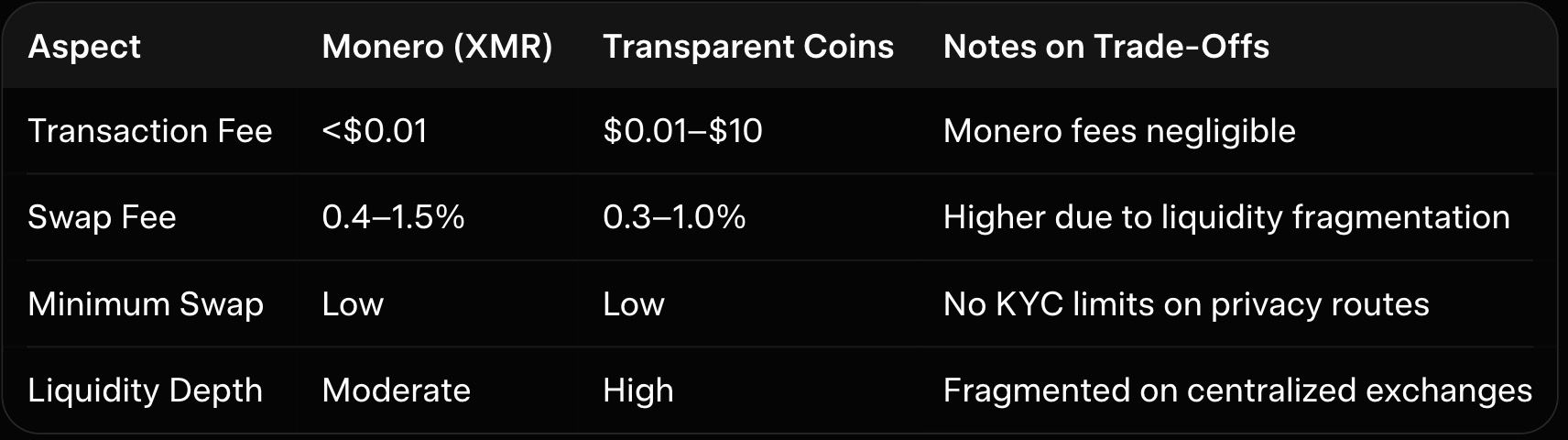
Monero users swap XMR for other assets to access liquidity on Ethereum, Solana, or L2s. In 2026, no-KYC swappers and aggregators enable this without exposing transaction history. Fees are higher than transparent swaps due to liquidity fragmentation, but privacy is preserved. As explained in our no-kyc-crypto-swaps-usdt-to-xmr-privately and eth-to-xmr-exchange-transfer-ethereum-to-monero-safely, Monero’s privacy makes cross-chain swaps more complex but essential for real-world use.
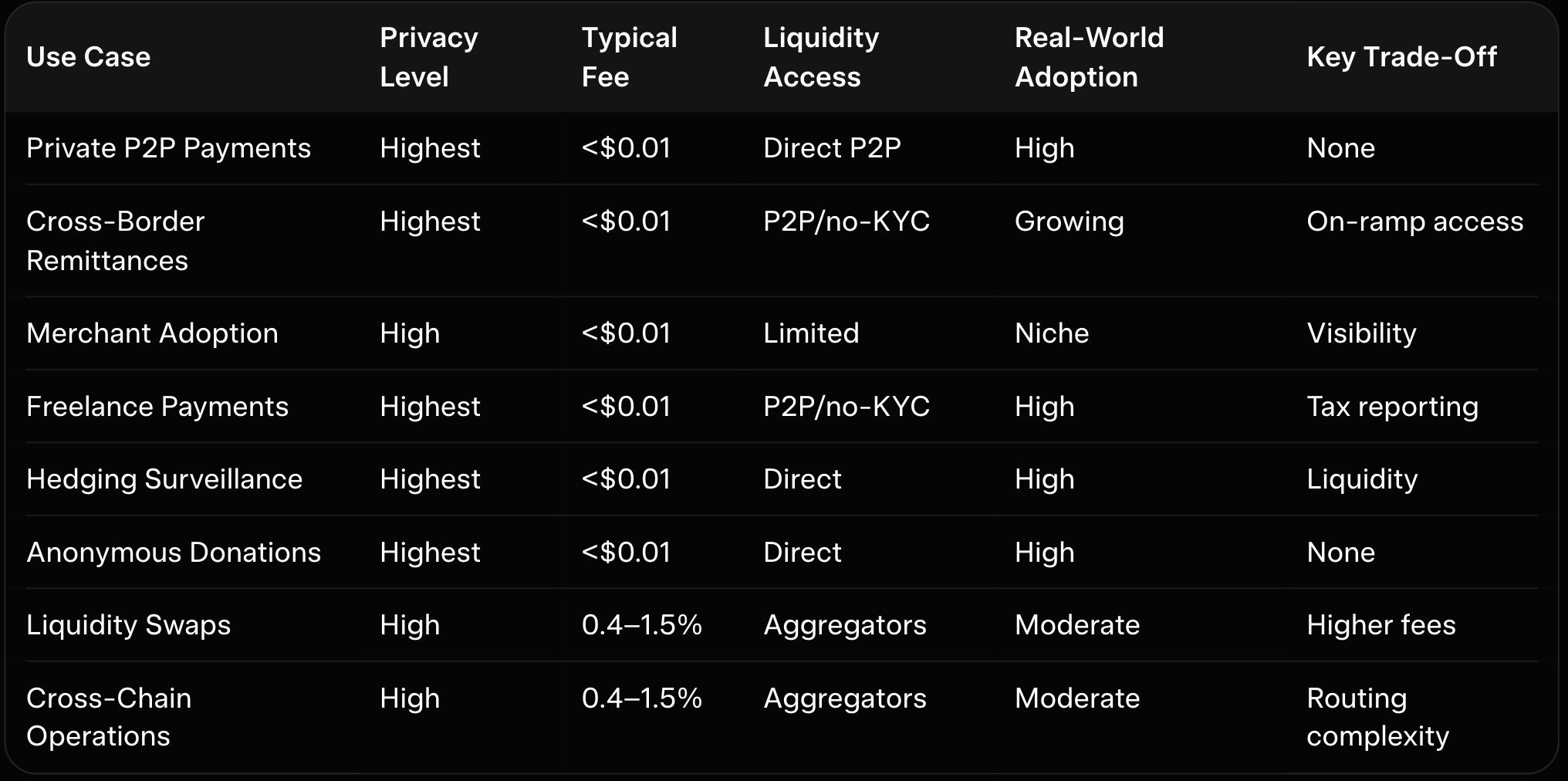
Here is the use case comparison table:
Here is a fees and limits context table (2026 averages):
How baltex.io Enables Practical XMR Swaps and Cross-Chain Liquidity
Monero’s privacy features limit direct integration with many bridges and DEXs, but baltex.io enables practical XMR swaps and cross-chain liquidity by scanning multiple no-KYC routes and liquidity sources internally. Private Swap mode inserts shielded Monero hops that fully break on-chain links using ring signatures and stealth addresses before delivering clean assets on destination chains. Settlements complete in 8–35 minutes even for cross-chain pairs, fees stay low at ~0.4–0.8%, and there are virtually no limits. Supporting over 10,000 tokens across 200+ networks without manual bridging, baltex.io delivers true one-click optimization for Monero users.
Users swapping XMR to USDT, SOL, or Ethereum L2s benefit enormously—especially when pairing with tools covered in our no-kyc-crypto-swaps-usdt-to-xmr-privately and eth-to-xmr-exchange-transfer-ethereum-to-monero-safely. Use atomic swaps for pure privacy and switch to baltex.io when speed and liquidity are needed without KYC.
Conclusion
Monero is used in 2026 for private payments, remittances, merchant transactions, freelance work, surveillance hedging, anonymous donations, liquidity swaps, and cross-chain operations because its mandatory privacy protects users where other coins fail. While exchange delistings and liquidity fragmentation create challenges, the network remains strong through no-KYC and decentralized options. Tools like baltex.io make cross-chain liquidity practical without compromising anonymity.
Always use fresh subaddresses, Tor, and small test swaps. Explore more strategies in our what-is-monero-xmr-2025-ultimate-privacy-coin-explained, how-does-monero-xmr-work-privacy-features-explained-2025, and best-no-kyc-monero-xmr-swappers-2026 guides to keep your Monero usage private and efficient.
For more on this, see our guide on SimpleSwap Review 2026: Pros, Cons, and Monero Exchange Fees.
For more on this, see our guide on Instant Swap Services: The Go-To for Privacy-Conscious Users.
You can read our full breakdown in XMR.to Alternatives: How to Pay Bitcoin Invoices with Monero.
You can read our full breakdown in Zcash (ZEC) vs Monero (XMR): Which Privacy Coin Wins in 2026.