



 3 minutes to read
 Ecosystem
How to convert Dash to cash via 'Cuevas' (underground exchanges) in Argentina
2026 — despite significant economic reforms and the stabilization of the Argentine Peso, the "cueva" (cave) remains a key element of the local financial landscape. For Dash holders, these informal exchange houses allow bypassing the banking system and obtaining physical cash — US Dollars or Pesos — with a level of privacy that traditional exchanges cannot match.
If you want to cash out Dash in cities like Buenos Aires, Córdoba or Rosario, understanding the mechanics of these “underground” operations is extremely important.
(Example of Calle Florida street in Buenos Aires — this is where arbolitos are often active)
Understanding the Ecosystem: Cuevas and Arbolitos
A cueva is essentially an unregulated financial office. They often operate behind the facades of legitimate businesses: travel agencies, jewelry stores, or small electronics shops.
In busy areas such as Calle Florida in Buenos Aires, you will encounter arbolitos (little trees) — street touts shouting “Cambio, cambio!”. They act as gatekeepers and guide clients from the sidewalk into secure private “caves” where the real exchange takes place.
While they traditionally dealt in physical US dollars (Dólar Blue), in 2026 almost every major cueva already treats Dash and other cryptocurrencies as standard inventory.
(Example of a Dólar Blue rate board — cuevas usually base their prices on similar quotes)
The Step-by-Step Process of Exchanging Dash for Cash
Exchanging Dash in a cueva is a relatively simple process, but it requires following several specific steps for safety:
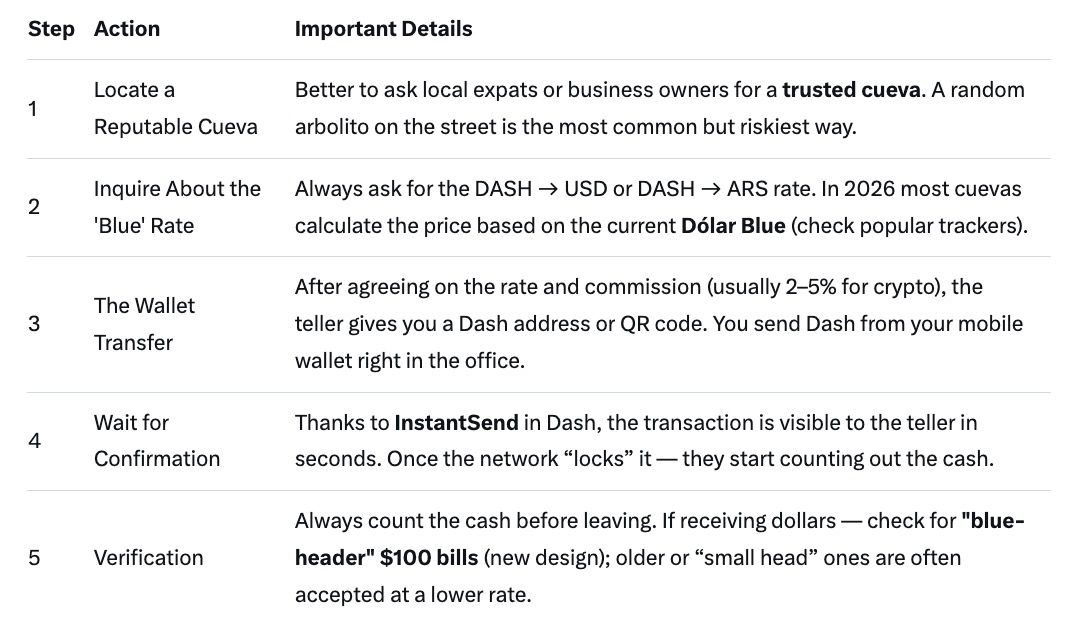
(Example of a cryptocurrency transfer QR code — this is the kind you will be shown in a cueva)
( security features on new $100 bills — blue header)
Safety and Risks in the Underground Market
Even though cuevas are part of daily life for many Argentines, risks remain:
- Counterfeit Bills — the most common problem. If you are not familiar with the security features of the Peso or Dollar — you might receive fakes.
- Physical Security — leaving with a large amount of cash is dangerous. It is best to go in pairs and head straight to a safe location.
- Legal Gray Area — cuevas are technically illegal. In 2026 new VASP rules mean the government is putting more pressure on informal operators to register.
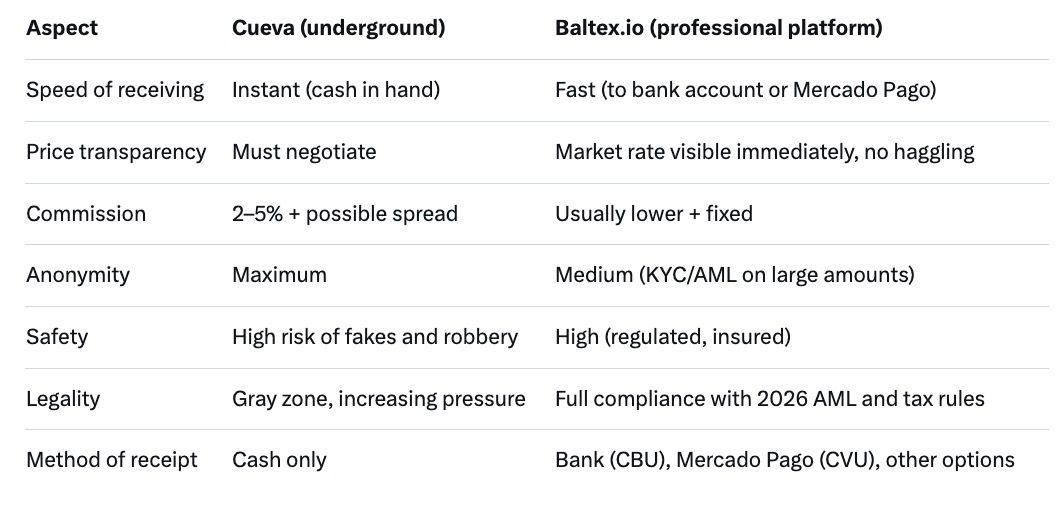
The Professional Alternative: Baltex.io
For many, the “adventure” of a cueva is not worth the stress. If you want a secure, regulated and transparent way — choose Baltex.io.
Conclusion
The choice between a cueva and a platform like Baltex.io depends on your priorities.
- If you need physical cash immediately and maximum anonymity → cuevas on Calle Florida are still the best option.
- If safety, efficiency and compliance with 2026 standards matter most → a professional exchange is clearly the superior choice.
See others posts

G. Khan

Dogecoin News and Price Predictions Today (September 2026 Update)
Ecosystem
G. Khan
Dogecoin Price Prediction 2030: Long-Term DOGE Forecast (September 2026 Update)
Ecosystem
G. Khan
Dogecoin Price Prediction 2027
Ecosystem
G. Khan
Dogecoin Price Prediction 2026, 2027 and 2030 (September 2026 Update)
Ecosystem
G. Khan
Solana Price Prediction 2030 (September 2026 Update)
Ecosystem
G. Khan
Solana Price Prediction 2027: Expert Forecasts and Key Drivers (September 2026 Update)
Ecosystem