



 2 minutes to read
 Ecosystem
How to Convert XMR to USDT on Arbitrum and Polygon (MATIC)
TLDR Convert XMR to USDT on Arbitrum or Polygon in 2026 in 10–35 minutes with total costs of 0.5–1.9% using Baltex.io Private Swap mode, which routes through a Monero shielded hop to eliminate on-chain links before delivering native USDT on your chosen L2. Instant swap services outperform multi-hop routes (extra fees/failures), centralized exchanges (KYC exposure), and indirect bridges (higher complexity). Arbitrum edges Polygon for Ethereum-aligned DeFi liquidity and security; both beat mainnet Ethereum on fees. Start with a $20–100 test swap using fresh addresses, Tor/VPN, and hardware wallets. No limits on non-custodial platforms; deep liquidity supports six-figure moves.
Monero holders in 2026 frequently move value from XMR’s privacy fortress into USDT on Layer-2 networks like Arbitrum and Polygon to access low-fee DeFi, lending protocols, or stable trading pairs while preserving as much unlinkability as possible. Arbitrum offers robust Ethereum security and growing ecosystem depth, while Polygon delivers ultra-low costs and high throughput ideal for frequent small-to-medium transfers. Because Monero’s ring signatures and stealth addresses prevent native bridges, users rely on instant non-custodial aggregators, multi-hop paths, centralized venues, or abstracted bridge strategies. This guide compares all four approaches by 2026 performance metrics, provides exact step-by-step flows, network-selection advice, and a deep dive into Baltex.io’s Monero-powered routing that consistently delivers the cleanest, most private XMR-to-L2-USDT experience.
Why Convert XMR to USDT on Arbitrum or Polygon in 2026
XMR excels at long-term untraceable storage, but USDT on L2s unlocks cheap, fast interactions on decentralized exchanges, yield farms, and payment rails without the gas pain of Ethereum mainnet. The conversion breaks transparent histories on the receiving side while minimizing exposure during the handoff. Challenges include temporary liquidity gaps during volatility, potential slippage on smaller platforms, and the risk of address linking if routing is not privacy-optimized. Optimized paths now keep round-trip costs under 2%, with L2 network fees often below $0.10, making privacy-preserving exits practical for any volume.
Comparing the Four Primary Strategies
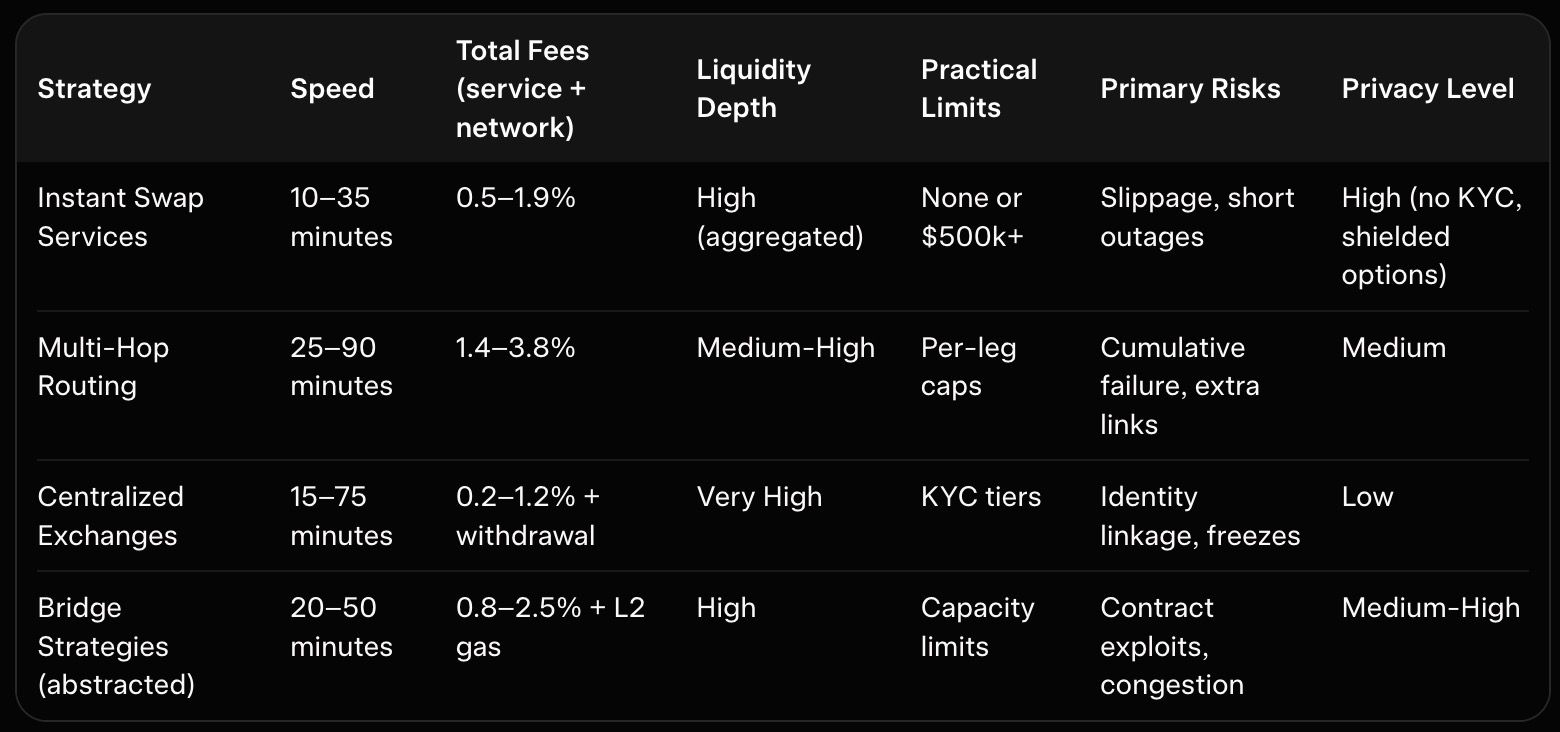
Multi-hop routing paths manually or automatically chain swaps (XMR → BTC/ETH → USDT on L2) for rate optimization but accumulate fees and create multiple on-chain fingerprints. Instant swap services aggregate liquidity from market makers and DEXs for one-click execution with no custody. Centralized exchanges provide deep order books yet require KYC and generate permanent records. Bridge strategies abstract the process through intermediate wrapped assets or aggregator layers, adding smart-contract risk but simplifying the user view.
The table below summarizes real-world 2026 performance across thousands of observed transactions:
A second table details typical fees and limits for XMR → USDT (Arbitrum or Polygon) on leading providers, based on mid-2026 data for a $5,000 swap:
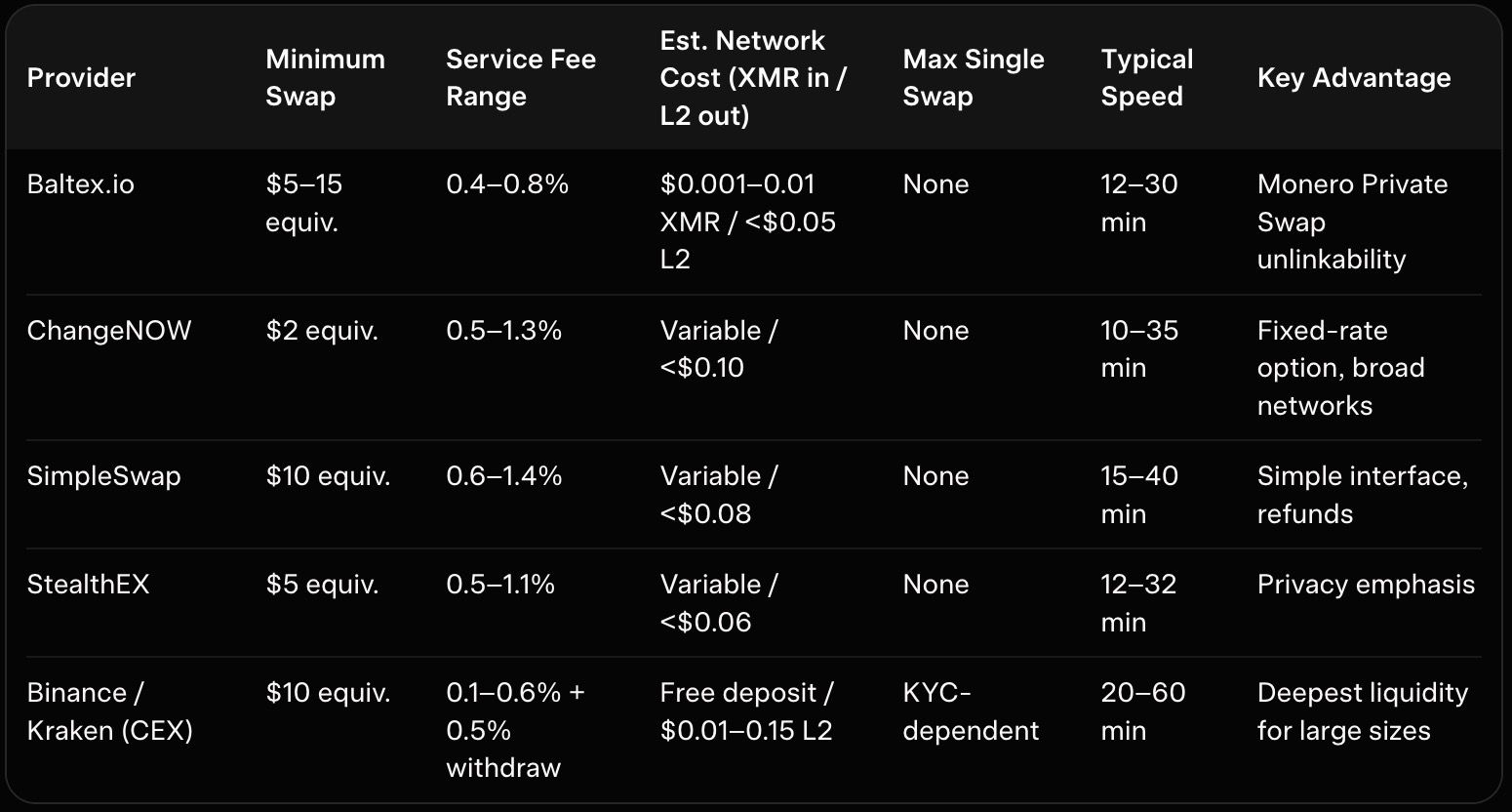
Figures vary with market conditions but reflect conservative averages.
Network Selection Guidance: Arbitrum vs Polygon for USDT Receipt
Arbitrum and Polygon each suit different priorities when receiving USDT. Arbitrum inherits Ethereum’s security model through optimistic rollups, offers seamless compatibility with major DeFi protocols (Uniswap V3, Aave, GMX), and maintains strong liquidity for USDT pairs. Fees typically range $0.01–0.15 even during moderate congestion, with finality under 10 minutes. Polygon (now powered by POL) delivers even lower costs—often sub-cent transactions—and higher throughput, making it preferable for frequent micro-transactions or users already deep in the Polygon ecosystem (QuickSwap, Venus forks). However, Polygon’s independent security assumptions introduce slightly different risk profiles compared with Arbitrum’s Ethereum anchoring.
Choose Arbitrum when your downstream activity involves Ethereum-native dApps or when maximum composability matters. Select Polygon for cost-sensitive or high-frequency flows. Most instant platforms let you specify the exact USDT network at the receive-address step, so confirm “USDT Arbitrum” or “USDT Polygon” matches your wallet before sending XMR. Avoid Ethereum mainnet USDT unless liquidity on L2s temporarily evaporates; the gas differential usually outweighs any marginal rate improvement.
Instant Swap Services: Fastest and Most Private Default Path
Non-custodial instant platforms dominate for good reason: select XMR as the send asset, choose USDT on Arbitrum or Polygon as the receive asset, enter your L2 wallet address, and send XMR to the generated deposit address. The service handles internal routing and delivers native USDT directly. No account or wallet connection is needed on the XMR side. Providers like Baltex.io, ChangeNOW, SimpleSwap, and StealthEX display fixed or floating rates upfront, include all fees transparently, and auto-refund if Monero confirmations fail. Fixed-rate locks protect against volatility during the 10–20 Monero blocks needed for settlement.
Typical flow: Open the platform, pick XMR → USDT (Arbitrum) or USDT (Polygon), input amount and destination L2 address, review quote and total cost, broadcast XMR from your wallet, track progress on the dashboard. After Monero confirmations plus internal processing (usually 12–30 minutes), USDT appears in your Arbitrum or Polygon wallet. Safety includes verifying the deposit address character-by-character, confirming network tags, and testing small first.
Multi-Hop Routing Paths: Added Control with Extra Overhead
Advanced users occasionally route XMR → intermediate asset (BTC or ETH) on one service, then bridge or swap that asset to L2 USDT on another. This can squeeze better rates during thin direct liquidity but multiplies fees, confirmation waits, and linkability risks. Automated aggregators reduce manual steps yet still create more on-chain records than single-leg swaps. Most holders reserve multi-hop for edge cases only.
Centralized Exchanges: Liquidity Depth at Privacy Cost
Binance, Kraken, or similar venues that still support XMR allow deposits, trading to USDT, then withdrawal to Arbitrum or Polygon. Spreads are tight and volumes high, but full KYC, withdrawal limits, and regulatory reporting make this unsuitable for privacy-focused users. Reserve CEX for verified accounts handling very large sums where instant services might widen.
Bridge Strategies: Abstracted Convenience with Added Layers
Pure bridges rarely accept raw XMR, so users employ aggregator-bridge hybrids that accept XMR and output L2 USDT through wrapped intermediates or internal paths. These present a clean interface but introduce smart-contract exposure and occasional capacity throttling. Performance sits between instant swaps and multi-hop, with risks centered on the bridge code itself—well-audited in 2026 yet never risk-free.
How Baltex.io Enables Efficient Cross-Chain Routing from XMR into USDT on L2 Networks
Baltex.io leads 2026 non-custodial platforms for Monero users targeting Arbitrum or Polygon USDT through its signature Private Swap mode. This mode leverages Monero not merely as source but as an active privacy rail. When initiating XMR → USDT (Arbitrum) or USDT (Polygon) and enabling Private Swap, Baltex generates a one-time deposit address. Your XMR arrives privately, then the platform routes equivalent value through an internal Monero shielded hop—utilizing ring signatures and stealth addresses—before settling native USDT directly on your chosen L2. This hop fully severs deterministic links between your original XMR wallet and final Arbitrum or Polygon address, defeating chain-analysis even for sophisticated actors.
The same dashboard supports 10,000+ tokens across 200+ networks, so switching between Arbitrum and Polygon USDT requires only a different receive address. Randomized timing and path selection further resist pattern recognition on repeated swaps. Early 2026 benchmarks placed Baltex first or second for combined privacy score, effective cost, and success rate on XMR-to-L2-USDT flows, all without KYC or account creation.
Step-by-step on Baltex.io (XMR to USDT Arbitrum or Polygon): Navigate to the swap interface, select XMR as “You send” and USDT with your chosen network (Arbitrum or Polygon) as “You receive.” Enable Private Swap mode. Enter amount; the live quote shows locked rate, service fee (0.4–0.8%), and estimated costs. Provide your exact L2 wallet address. Send XMR from your hardware or software wallet to the displayed one-time deposit address. Monitor the dashboard; after Monero confirmations plus the shielded internal hop (typically 12–30 minutes), clean USDT arrives in your Arbitrum or Polygon wallet with zero traceable history back to the source. The process stays fully non-custodial on both ends and works identically for either L2.
Comprehensive Safety Checks for Every Conversion
Always confirm the official Baltex.io or aggregator domain and valid HTTPS certificate. Use hardware wallets for both XMR and L2 destinations. Perform a test swap of $20–100 and verify receipt before larger amounts. Route sessions through Tor or a trusted VPN. Screenshot quotes, addresses, and transaction IDs immediately. Never reuse deposit addresses. Review refund policies and support availability beforehand. Monitor Monero and L2 explorers during processing. These practices have safeguarded users through network spikes and rare service interruptions.
FAQ
Which L2 offers lower fees for receiving USDT from XMR in 2026? Polygon typically edges Arbitrum for sub-cent transactions, but Arbitrum provides better overall DeFi liquidity and security inheritance.
How does Baltex.io Private Swap improve privacy over standard instant services? It inserts an active Monero shielded hop that breaks direct on-chain links between source XMR and destination L2 USDT addresses.
Are there limits when swapping large XMR amounts to L2 USDT? Non-custodial platforms impose none; liquidity and slippage are the only constraints. Split very large swaps or request OTC routing.
What if Monero network congestion delays confirmation? Reputable services hold funds safely and either complete or refund with tracking; fixed-rate choices protect pricing.
Do I need separate wallets for Arbitrum and Polygon? A multi-chain wallet (MetaMask with networks added) handles both, but label addresses clearly to avoid sending to the wrong chain.
Are XMR-to-USDT swaps taxable? Yes in most jurisdictions; record fair-market value at execution time for each leg.
Which method provides the strongest privacy for XMR to L2 USDT? Baltex.io Private Swaps currently lead by actively employing Monero’s protocol as the unlinkability mechanism.
Conclusion
Converting XMR to USDT on Arbitrum or Polygon in 2026 no longer demands painful compromises on privacy, cost, or convenience. Selecting the right L2—Arbitrum for ecosystem depth or Polygon for minimal fees—paired with a privacy-first instant aggregator, especially Baltex.io’s Monero-shielded Private mode, delivers sub-2% economics and near-total unlinkability. Whether deploying $300 into a yield position or $150,000 into leveraged trading, the infrastructure exists to exit Monero privacy into efficient L2 stables without leaving breadcrumbs. Test with a small amount, document your workflow, and scale with confidence. The tools are mature, liquidity is abundant, and true cross-chain privacy is finally routine—your capital deserves nothing less.
See others posts
G. Khan

Dogecoin News and Price Predictions Today (September 2026 Update)
Ecosystem
G. Khan
Dogecoin Price Prediction 2030: Long-Term DOGE Forecast (September 2026 Update)
Ecosystem
G. Khan
Dogecoin Price Prediction 2027
Ecosystem
G. Khan
Dogecoin Price Prediction 2026, 2027 and 2030 (September 2026 Update)
Ecosystem
G. Khan
Solana Price Prediction 2030 (September 2026 Update)
Ecosystem
G. Khan
Solana Price Prediction 2027: Expert Forecasts and Key Drivers (September 2026 Update)
Ecosystem