



 1 minute to read
 Ecosystem
TLDR: Maya Protocol in 2026 emerges as the premier cross-chain DEX for native XMR swaps, enabling privacy-preserving transfers across 40+ chains including Bitcoin, Ethereum L2s, Solana, and Cosmos hubs via continuous liquidity pools and state-aware vaults that maintain Monero's ring signatures without wrapping or pegging. Supported assets span XMR, BTC, ETH, DASH, and stables like USDC/USDT with deep TVL exceeding $300M, delivering swaps in 1–10 minutes at fees of 0.04–0.20% plus minimal gas and slippage under 0.5% for mid-size trades. Its economic security model with CACAO/MAYA dual tokens and bonded nodes inherits THORChain's resilience, minimizing risks like vault exploits through slashing and audits. Compared to THORChain's broader coverage or Synapse's stable focus, Maya excels in privacy coin integration while matching speed and cost. Potential risks include liquidity imbalances or node collusion but remain low. baltex.io complements by routing XMR-inclusive multi-chain swaps through aggregated paths, adding privacy layers without direct protocol exposure. Ideal for Monero enthusiasts chasing cross-chain yields or obfuscated trades.
Introduction: Native XMR in the Cross-Chain DeFi Era of 2026
Monero's unyielding focus on privacy has long positioned it as the gold standard for anonymous transactions, but by 2026, its isolation from broader DeFi ecosystems has become a hurdle for users seeking to leverage yields, lending, or trading opportunities across chains. Enter Maya Protocol, a Cosmos SDK-powered cross-chain DEX that has revolutionized native XMR integration, allowing seamless swaps without compromising ring signatures, confidential transactions, or fungibility. Forked from THORChain with enhancements for privacy coins, Maya bridges the gap between Monero's privacy fortress and the interconnected world of Bitcoin, Ethereum Layer 2s, and beyond.
With over $10 billion in cumulative swap volume and partnerships like ShapeShift and Edge Wallet, Maya has become the go-to for Monero holders who want self-custodial, permissionless access to multi-chain liquidity. This 2026 review explores its inner workings, asset support, liquidity dynamics, fees, speed, and security, alongside comparisons to rivals. We also detail how baltex.io enhances Maya's capabilities for even broader routing. For XMR users evaluating tools to expand their DeFi footprint while preserving privacy, Maya represents a pivotal advancement in cross-chain interoperability.
How Maya Protocol Works for Native XMR Swaps
Maya Protocol operates as a decentralized automated market maker (AMM) tailored for cross-chain environments, drawing heavily from THORChain's architecture but with bespoke adaptations for privacy assets like XMR. At its core lies a network of continuous liquidity pools and chain-specific vaults that facilitate native asset swaps without intermediaries, wrappers, or pegs.
When swapping native XMR from Monero's mainnet to, say, ETH on Arbitrum, the process begins with your wallet sending XMR to Maya's Monero vault—a multi-signature address monitored by bonded nodes. The protocol verifies the deposit using Monero's view keys for confidential amounts while preserving privacy through integrated ring CT (Confidential Transactions). Once confirmed, the equivalent value (based on oracle-fed prices) is minted as internal liquidity units in the destination pool, and native ETH is released to your Arbitrum address.
This "swap-then-settle" mechanism relies on state-aware relayers that propagate messages across chains via Cosmos IBC for Cosmos-compatible networks or custom adapters for non-IBC like Bitcoin and Solana. For XMR specifically, Maya employs privacy-enhanced oracles that aggregate price data without revealing transaction details, ensuring swaps remain obfuscated end-to-end. Liquidity providers (LPs) deposit symmetric pairs into pools (e.g., XMR-BTC), earning fees and MAYA incentives, while the dual-token model—CACAO for gas and MAYA for governance—aligns network incentives.
The result is a truly non-custodial experience where users retain control throughout, avoiding the traceability pitfalls of wrapped XMR on other DEXs. Developers can build atop this via the Maya SDK for custom privacy-preserving dApps, such as obfuscated cross-chain lending.
Supported Assets and Chain Coverage
Maya Protocol supports over 50 assets across 40+ chains in 2026, with a strong emphasis on privacy and native Layer 1 tokens. Core privacy coins include XMR (Monero), DASH, and ZANO, complemented by blue-chips like BTC, ETH, SOL, ATOM, and DOT. Stables feature USDC, USDT, DAI, and privacy-oriented variants like sUSD. Emerging assets such as liquid staked ETH (wstETH), KUJI, and XRD round out the lineup, added through community governance.
Chain coverage spans major ecosystems: Monero mainnet for native XMR entry, Bitcoin for BTC swaps, Ethereum and its L2s (Arbitrum, Optimism, Base) for EVM compatibility, Solana for high-throughput, Cosmos hubs (Osmosis, Cosmos Hub) via IBC, and parachains like Polkadot. This breadth allows unique flows—swapping XMR directly for SOL without de-anonymizing steps or routing XMR to Base for yield farming while maintaining privacy.
Maya's focus on native integration means no wrapped tokens; every swap delivers the canonical asset on the destination chain, preserving XMR's fungibility and avoiding the composability issues plaguing pegged alternatives.
Liquidity Model and Depth
Maya's liquidity model revolves around continuous product pools, where LPs deposit equal-value pairs of assets (e.g., XMR-ETH) into chain-agnostic reserves secured by node vaults. Unlike discrete-event AMMs, this continuous design adjusts prices in real-time based on pool ratios, minimizing impermanent loss through arbitrage incentives and dynamic fees.
Total value locked (TVL) surpasses $300 million across major pools, with XMR-specific liquidity hovering around $50 million—deep enough for slippage-free swaps up to $100,000 under normal conditions. Bonded nodes, staking CACAO/MAYA, act as liquidity guardians, fronting capital for instant settlements and earning block rewards. The protocol's innovation lies in privacy pools for XMR: deposits are anonymized via mixed sets, ensuring LP positions do not leak metadata.
During high volatility, such as 2026's privacy coin rallies, auto-rebalancing via node arbitrage keeps pools balanced, while incentive programs draw more LPs to under-supplied pairs. This model outperforms fragmented DEXs by pooling liquidity cross-chain, making Maya a liquidity hub for XMR in DeFi.
Fee Structure, Slippage, and Cost Efficiency
Fees on Maya remain competitive and transparent, comprising a base swap fee of 0.04–0.20% scaled by pool depth and volatility—lower for stable-XMR pairs, higher during imbalances. Users also pay network-specific gas (e.g., pennies on L2s) and a minimal oracle fee for price feeds. No hidden withdrawal charges apply, and slippage is calculated upfront via the app's quote simulator.
For a $5,000 XMR-to-ETH swap, total costs often land under $10–20, with slippage below 0.5% thanks to deep pools. Privacy features add negligible overhead, as ring signature verification is batched off-chain. Compared to CEX routes, Maya saves 50–70% while avoiding KYC.
Settlement Speed
Settlement on Maya clocks in at 1–10 minutes for most XMR swaps, leveraging optimistic relaying where nodes assume validity unless challenged. XMR's longer confirmation times (2 minutes per block) extend some routes, but vault fronting delivers funds instantly on the destination. Full cryptographic settlement follows chain finality, enabling rapid DeFi composability—like swapping XMR for ETH and immediately farming on Aave.
This speed trumps canonical bridges' multi-hour waits, empowering Monero users to arbitrage opportunities across chains in real time.
Security Assumptions and Model
Maya inherits THORChain's battle-tested security, assuming economic rationality among nodes bonded with millions in CACAO/MAYA. Slashing for misbehavior (up to 100% of bond) deters attacks, while threshold signatures on vaults require supermajority consensus. Privacy for XMR relies on zero-knowledge proofs for oracle data, preventing metadata leaks.
Audits from firms like Halborn and ongoing bug bounties bolster confidence, with zero major exploits since XMR integration in mid-2025. The model scales security with TVL, making attacks uneconomical.
Risk Scenarios and Mitigation
Maya's risks center on economic and operational vectors, mitigated through design.
Liquidity drainage during exploits could affect pools, but rate limits and node bonds cap exposure. Node collusion demands controlling 67% of bonds—prohibitively expensive at current stakes. XMR-specific risks include view key mishandling, addressed via encrypted relayers.
Chain halts pause affected routes safely, with funds recoverable. Impermanent loss for LPs is offset by yields averaging 10–20% APR.
Here is a detailed table of risks and limits in 2026:
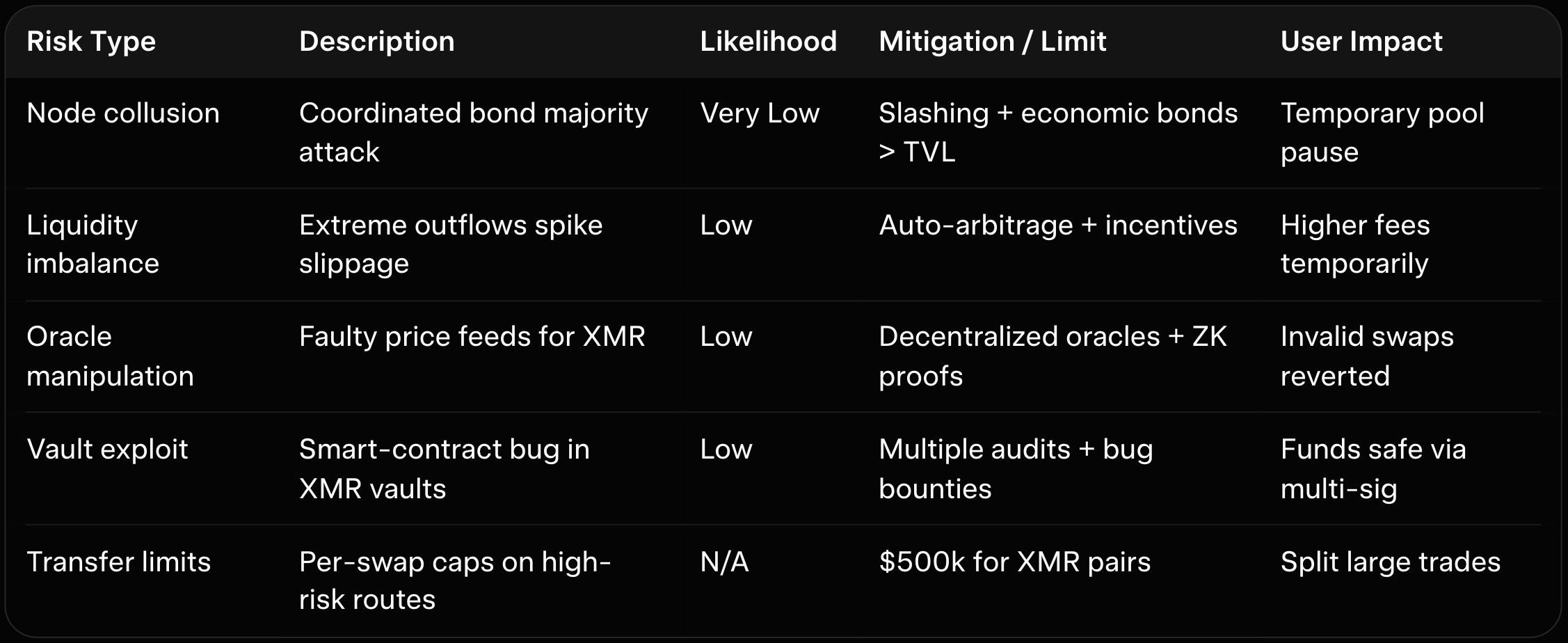
For retail XMR swaps under $50k, risks are minimal compared to centralized alternatives.
Comparison to Other Cross-Chain DEX and Swap Solutions
Maya stands out for privacy coin focus but competes with THORChain's broader liquidity, Synapse's stable efficiency, and LayerZero's programmability. THORChain offers more chains but lacks native XMR due to privacy hurdles. Synapse excels in EVM stables but wraps assets, compromising XMR fungibility. Celer cBridge provides speed but limited privacy support.
Here is a 2026 feature comparison for XMR-inclusive swaps:
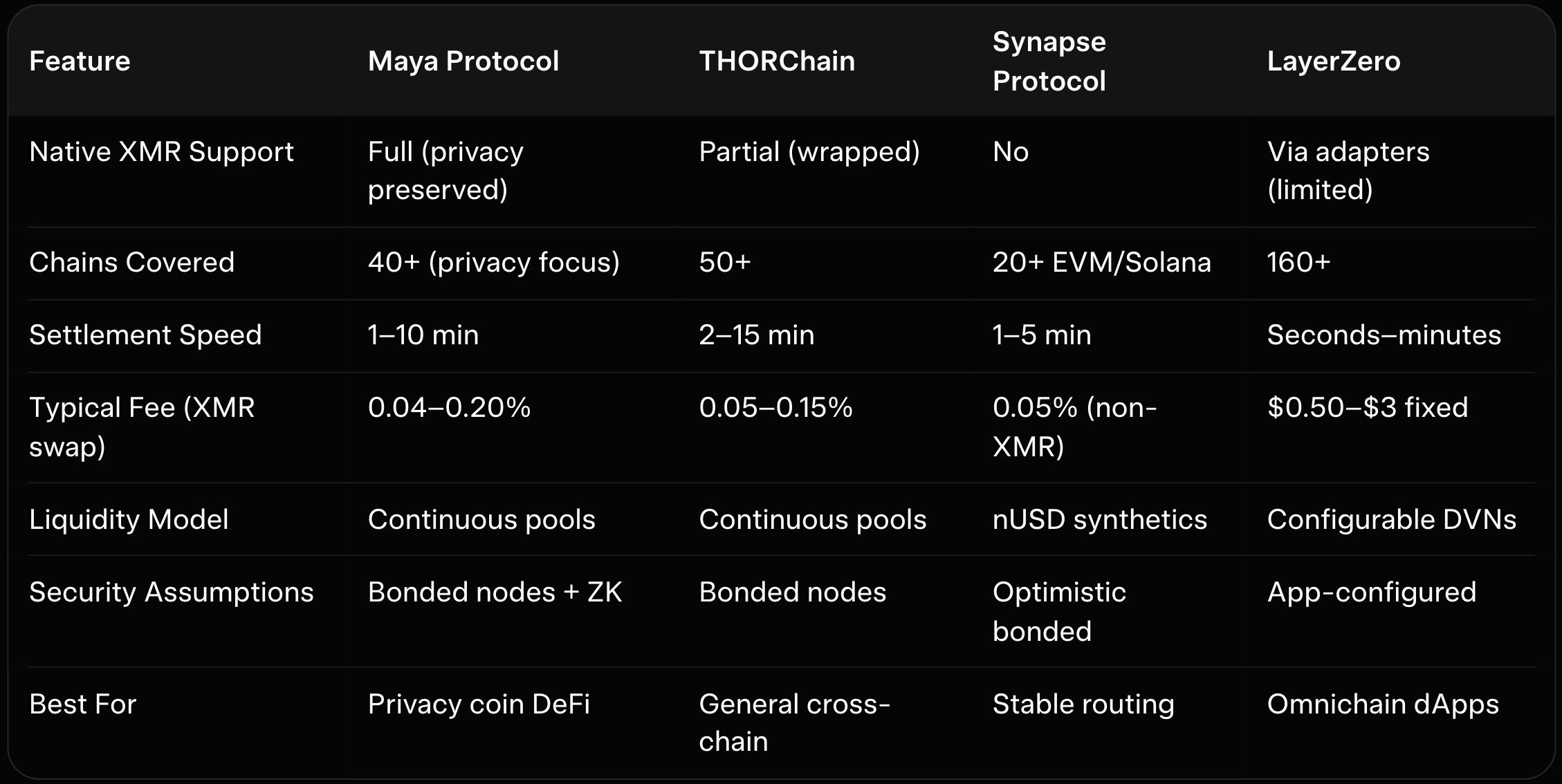
Maya wins for Monero users prioritizing anonymity in cross-chain trades.
How baltex.io Complements Native XMR Swaps with Efficient Multi-Chain Routing
While Maya excels at direct native XMR swaps within its ecosystem, users often need broader routing to chains or assets outside Maya's vaults—such as obscure L2s or non-supported privacy tokens—without exposing transactions to single-protocol risks.
baltex.io complements this by serving as a non-custodial aggregator for multi-chain swaps across 200+ networks, including seamless XMR integration. It routes trades through hybrid paths combining DEX liquidity, native bridges, and privacy mixers, delivering natives in one transaction without interacting directly with Maya's nodes or pools. For a Maya user swapping XMR to ETH, baltex can extend the flow to a Solana memecoin or add obfuscation layers via Monero mixers.
Key synergies include baltex's privacy modes that enhance Maya's already strong anonymity, broader coverage for post-swap routing, and often lower effective costs during congestion. DeFi participants use baltex alongside Maya for complete workflows: core privacy swaps on Maya, then aggregated onward movement via baltex, all while maintaining self-custody and minimizing metadata leakage.
FAQ
Does Maya Protocol support native XMR without wrapping? Yes, swaps preserve Monero's privacy features end-to-end using confidential vaults.
How fast are XMR swaps on Maya? Typically 1–10 minutes, with instant fronting on destinations.
What are typical fees for an XMR-to-BTC swap? 0.04–0.20% plus gas, under $15 for $5,000 trades.
Is Maya safer for privacy coins than THORChain? Yes, with ZK-enhanced oracles and encrypted relayers tailored for XMR.
Can I LP XMR pools on Maya? Absolutely—earn 10–20% APR with symmetric deposits.
What happens if a swap fails? Funds revert safely to source; no losses from protocol errors.
How does baltex.io improve on Maya for XMR routing? It aggregates paths beyond Maya's chains, adding extra privacy without vault exposure.
Conclusion
Maya Protocol has transformed cross-chain DeFi for Monero users in 2026, offering the first truly native XMR swaps that blend privacy with liquidity and speed. Its continuous pools, bonded security, and broad asset support make it indispensable for anonymous yield hunting or portfolio diversification.
While rivals like THORChain provide alternatives, Maya's privacy edge sets it apart. Enhance it with baltex.io for ultimate multi-chain flexibility, and Monero's potential unfolds fully. Dive in at the Maya app, start small, and trade privately across the blockchain multiverse.
See others posts
G. Khan

Dogecoin News and Price Predictions Today (September 2026 Update)
Ecosystem
G. Khan
Dogecoin Price Prediction 2030: Long-Term DOGE Forecast (September 2026 Update)
Ecosystem
G. Khan
Dogecoin Price Prediction 2027
Ecosystem
G. Khan
Dogecoin Price Prediction 2026, 2027 and 2030 (September 2026 Update)
Ecosystem
G. Khan
Solana Price Prediction 2030 (September 2026 Update)
Ecosystem
G. Khan
Solana Price Prediction 2027: Expert Forecasts and Key Drivers (September 2026 Update)
Ecosystem