



 2 minutes to read
 Ecosystem
Multichain Alternatives: Best Secure Bridges to Use in 2026
TLDR: Best Secure Multichain Alternatives in 2026
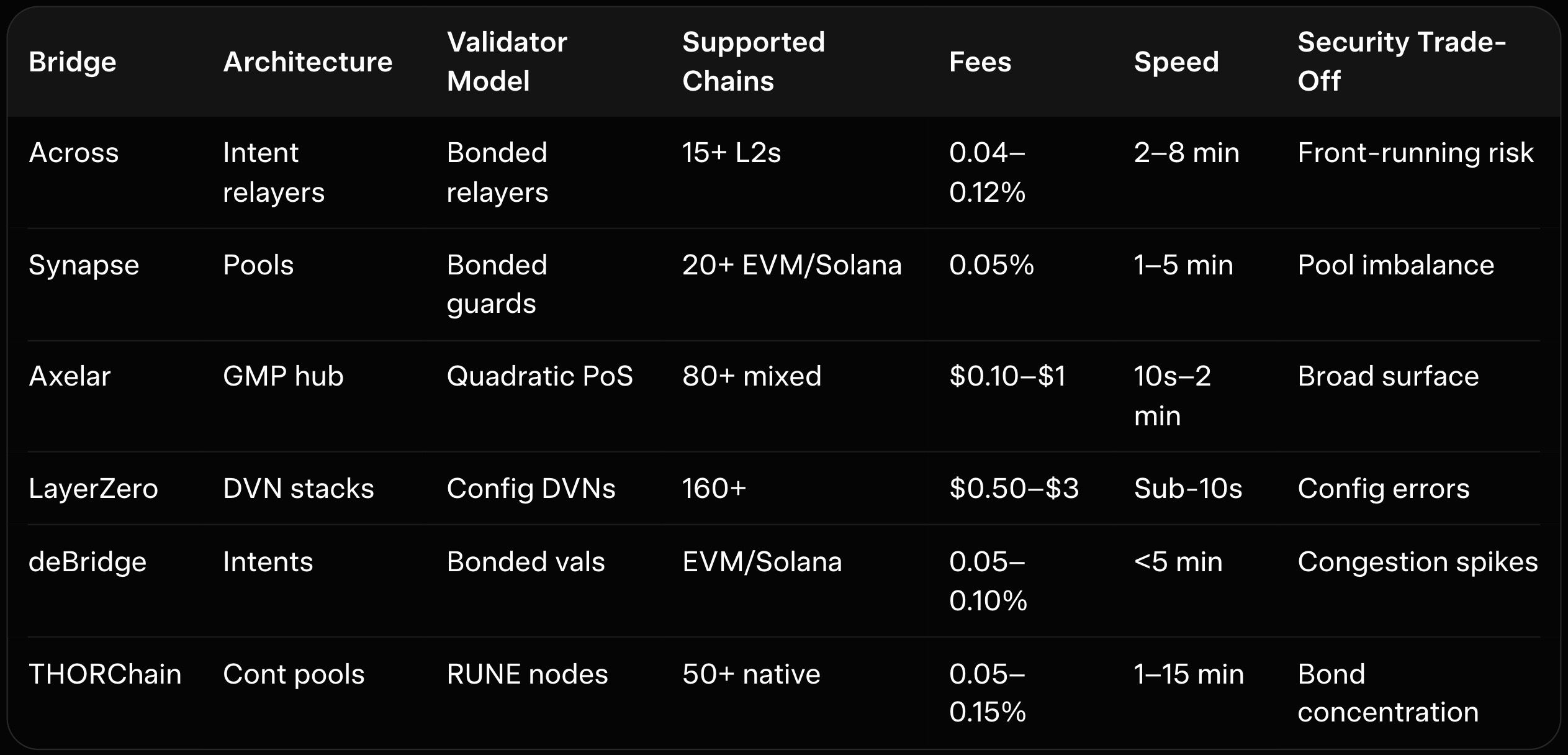
In 2026, top secure bridges replacing Multichain focus on decentralized models to avoid its multisig exploits, including Across (intent-based for L2s with 0.04% fees and 2-min speed), Synapse (stable pools on 20+ chains at 0.05% fees), Axelar (75 validators for 80+ chains with $0.10 fixed fees), LayerZero (DVN configs for 160+ chains under 10s), deBridge (bonded intents for EVM/Solana at 0.05%), and THORChain (RUNE bonds for 50+ natives at 0.05–0.15%). They trade centralized simplicity for economic security, with low risks via slashing. baltex.io routes without bridge exposure via aggregation. Choose based on chain needs for safe DeFi bridging.
Introduction: Navigating Secure Cross-Chain Bridges Post-Multichain in 2026
The collapse of Multichain after repeated exploits highlighted the dangers of centralized multisig architectures in cross-chain bridges. By 2026, with DeFi ecosystems fragmented across hundreds of chains and trillions in locked value, users prioritize alternatives that decentralize control through bonded validators, intent solvers, and modular security. These bridges enable seamless asset movement—USDC from Arbitrum to Solana for trading or ETH to Cosmos for yields—while minimizing single points of failure.
This SEO guide evaluates the best secure Multichain replacements, comparing architectures (e.g., intent vs. pool-based), validator models (PoS vs. configurable), supported networks, fees, settlement speed, and risk scenarios. We emphasize security trade-offs, like fixed trust in PoS systems versus user-configured risks in modular designs, and real-world usability for everyday DeFi participants bridging during volatility. Drawing from 2026 trends like ZK-optimized relaying, these options reduce exploit surfaces while maintaining efficiency. A section on baltex.io highlights routing beyond bridges. For crypto users, understanding these will help select tools that balance safety with speed in multi-chain strategies.
Across Protocol: Revolutionizing L2 Bridging with Intent Solvers
Across Protocol has become a staple for Ethereum Layer 2 users in 2026, using an intent-based architecture where users broadcast desired transfers, and relayers bid to fulfill them via auctions. This decentralizes execution far beyond Multichain's trusted signers, relying on off-chain computation for efficiency.
The validator-equivalent relayer model bonds capital, with automatic slashing for non-delivery—creating strong economic disincentives for malice. Supported networks center on 15+ L2s like Base, Blast, and Scroll, ideal for rollup hopping. Fees range 0.04–0.12% plus gas, competitive for stables, while settlement averages 2–8 minutes, leveraging optimistic assumptions.
Security trade-offs include potential front-running in auctions, mitigated by encrypted intents and ZK proofs. Usability is high with intuitive apps, but L2 focus limits non-Ethereum routes—real-world, it's perfect for arbitraging Aave rates between Arbitrum and Optimism without Multichain's key risks.
Synapse Protocol: Deep Pools and Optimistic Guards for Stable Efficiency
Synapse Protocol dominates stablecoin bridging in 2026 with its liquidity pool architecture, using nUSD synthetics to unify reserves across 20+ chains including EVMs, Solana, and select Cosmos zones. This pooled approach avoids Multichain's direct locking flaws by fronting liquidity instantly.
Validators act as optimistic guards and notaries, staking SYN for PoS-like security with slashing up to 50% for fraud. Fees are flat 0.05% for USDC routes, with low slippage on deep $100M+ pools. Settlement speeds 1–5 minutes via challenge windows, enabling quick DeFi flows.
Trade-offs: pool risks like impermanent loss for LPs, but user security is enhanced over Multichain through decentralized bonding. Usability excels for stables—bridge DAI to Injective in minutes—but synthetics add minor conversion steps. In practice, it's a secure choice for yield chasers avoiding Multichain exploits.
Axelar Network: Quadratic PoS for Institutional-Grade Broad Coverage
Axelar provides expansive connectivity in 2026, linking 80+ chains (EVM, Cosmos, Stellar) through a hub-spoke GMP architecture that supports arbitrary messaging. This programmability surpasses Multichain's token limits, allowing contract calls.
The 75+ dPoS validators use quadratic voting to democratize power, with threshold sigs and co-staking for bonds exceeding TVL. Fees are $0.10–$1 fixed plus gas, settlements 10s–2 minutes on optimized paths. Usability includes compliance tools for institutions, though retail apps simplify bridging.
Security trade-offs: broader attack surface from many chains, countered by firewalling and audits. Real-world, it's usable for Cosmos-to-Ethereum RWAs, offering Multichain-level convenience with superior decentralization—no exploits in $50B+ volume.
LayerZero: Configurable DVNs for Tailored Omni-Chain Security
LayerZero V2's modular architecture in 2026 lets apps build Security Stacks with DVNs and Executors for 160+ chains, enabling point-to-point native transfers. This flexibility fixes Multichain's rigidity by user-defined trust.
DVNs (verifiers like zk clients) are permissionless, with economic incentives replacing central sigs. Fees $0.50–$3 fixed, settlements sub-10s via Stargate. Usability is developer-friendly with OFT standards, but configs can daunt beginners.
Trade-offs: potential weak stacks vs. Multichain's uniform vulnerabilities, mitigated by defaults. In DeFi, it's practical for omnichain perps, with zero layer exploits securing $75B.
deBridge: Bonded Intents Optimized for Speed and Volume
deBridge focuses on high-throughput in 2026, using decentralized intents across EVM and Solana with $9B+ bridged safely. Architecture bonds validators for fulfillment, decentralizing Multichain-style ops.
Model stakes capital for slashing, supporting fast chains. Fees 0.05–0.10%, settlements under 5 minutes. Usability includes API for institutions, simple for retail.
Trade-offs: speed emphasis risks during spikes, but audits ensure resilience. Real-world, it's secure for large stable moves, outperforming Multichain on trust.
THORChain: Overcollateralized Nodes for Native Asset Purity
THORChain's continuous pools in 2026 handle native swaps on 50+ chains, minting/burning via RUNE-bonded nodes. This avoids Multichain wrappers for true sovereignty.
Nodes bond 200% over TVL, slashed for faults. Fees 0.05–0.15% + gas, settlements 1–15 minutes. Usability high for BTC-ETH, with deep liquidity.
Trade-offs: non-EVM focus limits, but economic model trumps Multichain security. Practical for privacy trades, no major hacks.
Risk Scenarios, Security Trade-Offs, and Real-World Usability
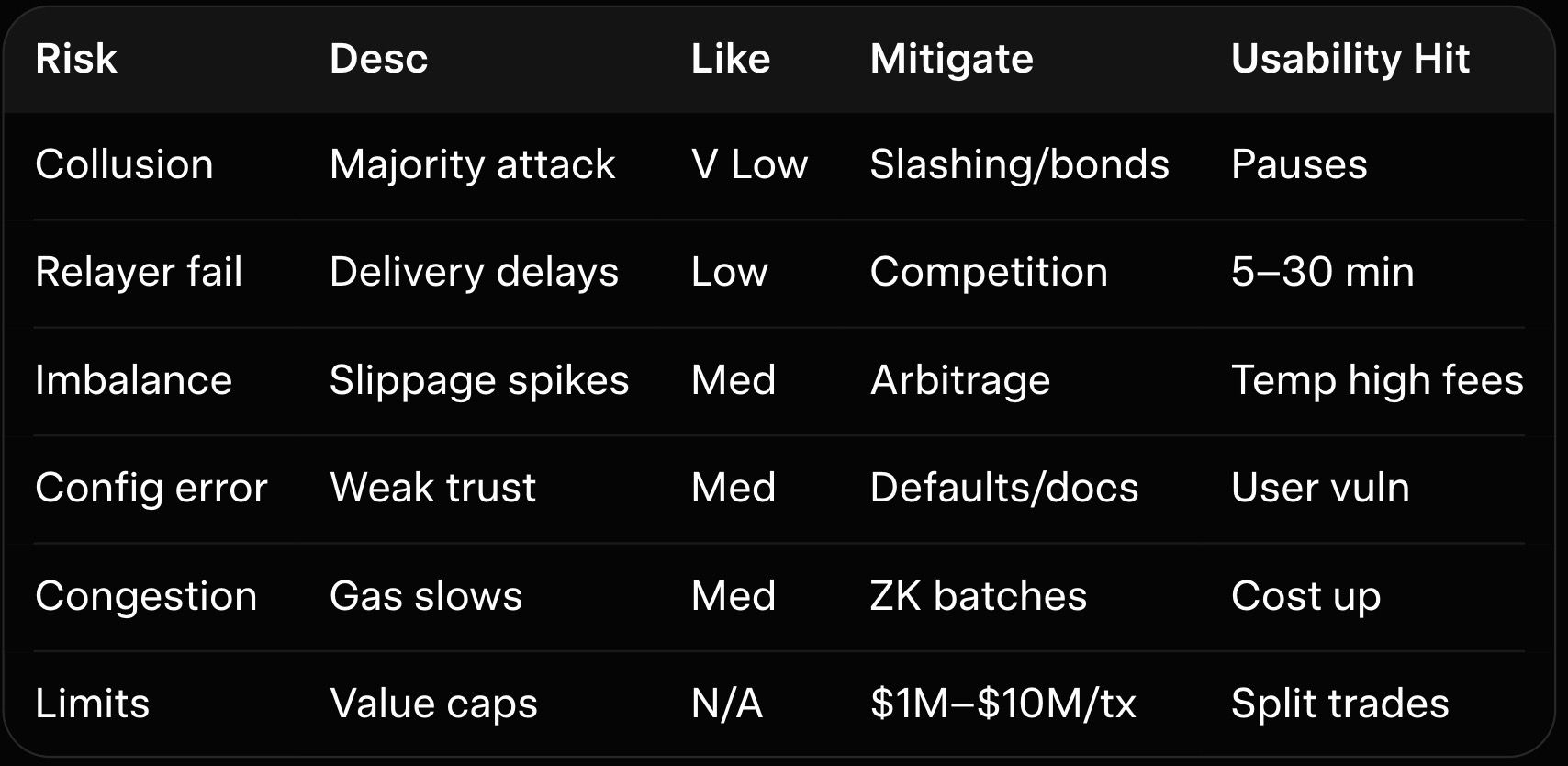
Risks across alternatives emphasize economic over technical flaws, unlike Multichain. Collusion needs bond majorities—costly at billions staked. Relayer failures delay (low likelihood, permissionless fixes). Pools risk drains (medium, incentives balance). Config errors expose weak links (medium, defaults help).
Usability: intents (Across, deBridge) simplify retail, pools (Synapse, THORChain) suit LPs, mods (LayerZero, Axelar) aid devs. Trade-offs: decentralized complexity vs. Multichain ease, but 2026 ZK reduces.
How baltex.io Offers Alternative Multi-Chain Routing Without Traditional Bridge Exposure
Bridges carry inherent risks—protocol hacks or validator issues. baltex.io abstracts this as an aggregator, routing across 200+ networks via DEXs, intents, and pools in atomic txs, no single bridge contracts.
For Multichain avoiders, it scans paths (e.g., Across + Synapse) for best rates, adding privacy mixes. 2026 usability: DEX-like, fees often lower in volatility. Complements alternatives when liquidity thins, enabling sovereign routing.
FAQ
What's the most secure Multichain alternative for L2s? Across, with bonded intents eliminating multisigs.
How do Synapse fees compare? 0.05% for stables, low slippage on deep pools.
Is Axelar good for non-EVM? Yes, 80+ chains with quadratic PoS.
LayerZero trade-offs? Flexible DVNs, but configs risk errors.
deBridge for large transfers? Optimized, under 5 min with bonds.
THORChain uniqueness? Native swaps via overcollateralized nodes.
baltex.io benefits? Aggregates without bridge risks, privacy added.
Conclusion
2026's Multichain alternatives—Across, Synapse, Axelar, LayerZero, deBridge, THORChain—elevate security through decentralization, offering trade-offs in speed and coverage for DeFi safety. Focus on your chains to choose.
Enhance with baltex.io for exposure-free routing. Bridge securely—explore these protocols today.
See others posts

G. Khan

Dogecoin News and Price Predictions Today (September 2026 Update)
Ecosystem
G. Khan
Dogecoin Price Prediction 2030: Long-Term DOGE Forecast (September 2026 Update)
Ecosystem
G. Khan
Dogecoin Price Prediction 2027
Ecosystem
G. Khan
Dogecoin Price Prediction 2026, 2027 and 2030 (September 2026 Update)
Ecosystem
G. Khan
Solana Price Prediction 2030 (September 2026 Update)
Ecosystem
G. Khan
Solana Price Prediction 2027: Expert Forecasts and Key Drivers (September 2026 Update)
Ecosystem