



 4 minutes to read
 Ecosystem
What Are Utility Coins? Benefits and Top Examples in Crypto
TL;DR
Utility coins (or tokens) are cryptocurrencies that power blockchain ecosystems by granting access to services, like paying fees or unlocking features—think ETH for Ethereum transactions or BNB for Binance discounts. In 2025, they drive DeFi, gaming, and AI apps, with benefits like low-cost access and staking rewards, but risks include volatility and regulatory shifts. Top examples: ETH, BNB, LINK, SOL, UNI. Unlike securities (ownership assets) or pure governance tokens (voting-only), utilities focus on function. Use Baltex.io for seamless multi-chain swaps between them. Key: Prioritize real-use projects; never invest more than you can lose.
Introduction
In 2025, the crypto market has matured beyond Bitcoin's store-of-value role, with utility coins leading the charge as the backbone of decentralized ecosystems. Valued at over $1.2 trillion in combined market cap, these tokens aren't just speculative assets—they're digital keys unlocking everything from DeFi lending to NFT minting and AI-driven oracles. For beginners, utility coins demystify crypto by tying value to practical use; intermediates appreciate their role in yield farming or cross-chain interoperability.
This SEO guide breaks it down: What utility coins are, how they function in blockchains, benefits vs. risks, a comparison to securities and governance tokens, and 2025's top performers with real examples. Optimized for snippets like "What is a utility coin?" or "Top utility tokens 2025," we'll use lists, tables, and subheads for quick reads. By the end, you'll spot high-potential utilities and swap them safely via tools like Baltex.io.
Internal link: Jump to top utility coin examples.
What Are Utility Coins?
Utility coins, often called utility tokens, are cryptocurrencies designed to provide specific functions within a blockchain network or decentralized application (dApp). Unlike general-purpose money like fiat, they act as "vouchers" for ecosystem services—paying fees, accessing premium features, or earning rewards. Issued via smart contracts on platforms like Ethereum or Solana, they're fungible (interchangeable) and ERC-20 compliant in many cases.
Core Characteristics
- Non-Investment Focus: Primarily for use, not profit promises—though secondary markets enable trading.
- Ecosystem-Bound: Value derives from platform adoption; if the network thrives, so does the token.
- 2025 Trends: With AI integration and layer-2 scaling, utilities now power real-world apps like supply chain tracking (VeChain) or privacy-focused DeFi.
In essence, utility coins fuel participation, creating self-sustaining economies. Internal link: See how they differ from governance tokens.
How Utility Coins Function in Blockchain Ecosystems
Utility coins integrate seamlessly into blockchains, enabling automation via smart contracts—self-executing code that triggers actions when conditions are met. They solve the "cold start" problem: bootstrapping networks by incentivizing early users.
Key Mechanisms
- Transaction Facilitation: Pay "gas" fees for network operations. On Ethereum, ETH covers computation costs during swaps or NFT buys.
- Access Control: Unlock gated content. In gaming, tokens like SAND buy virtual land in The Sandbox metaverse.
- Incentivization: Reward contributions. Stake LINK in Chainlink to earn oracle data fees.
- Governance Overlap: Some vote on upgrades, blending utility with decision-making.
- Interoperability: In 2025, cross-chain bridges let utilities like SOL interact with Ethereum dApps.
Real-World Flow Example
- User connects wallet to a DeFi app (e.g., Uniswap).
- Approves UNI spend via smart contract.
- Executes swap: UNI pays fee, token transfers atomically.
- Rewards: Earn UNI for liquidity provision.
This creates network effects—more users mean higher demand, stabilizing value. In 2025, with 500M+ wallets, utilities process $5T+ in annual volume.
Benefits of Utility Coins
Utility coins shine in 2025's utility-driven bull market, where adoption trumps hype. Here's why they're essential:
Economic Advantages
- Cost Efficiency: Reduced fees—BNB holders save 25% on Binance trades, saving millions yearly.
- Yield Opportunities: Staking yields 5-15% APY; e.g., ADA staking on Cardano secures the network while earning rewards.
- Accessibility: Democratize finance; unbanked users access global services via mobile wallets.
Ecosystem Growth
- User Engagement: Tokens like BAT reward Brave browser users for ads, boosting retention 40%.
- Innovation Driver: Fund dApps—ETH powers 80% of DeFi TVL ($300B+).
- Scalability Boost: SOL's high TPS (65,000) enables micro-transactions in gaming, cutting costs 90% vs. ETH.
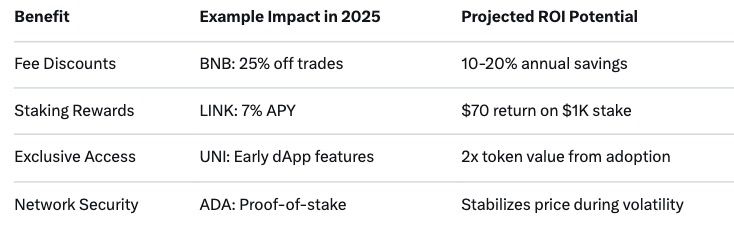
Overall, utilities align incentives, fostering sustainable growth over pump-and-dumps.
Internal link: Counterbalance with risks.
Risks of Utility Coins
No reward without risk—utility coins face amplified threats in 2025's regulated, AI-hacked landscape. Losses hit $1.8B from exploits last year.
Primary Dangers
- Volatility: Tied to ecosystem health; SOL dropped 40% post-FTX but rebounded 300% on mobile adoption.
- Regulatory Uncertainty: SEC scrutiny—XRP's 2023 win clarified utilities, but 2025 EU MiCA rules could reclassify some.
- Smart Contract Vulnerabilities: Bugs drained $500M; always audit via PeckShield.
- Adoption Dependency: If dApps flop (e.g., 2024's 20% DeFi TVL dip), tokens tank.
- Liquidity Risks: Low-volume utilities suffer slippage; stick to top-50 by cap.
Mitigation Tips
- Diversify: Hold 3-5 utilities across sectors (DeFi, oracles, gaming).
- Research Tokenomics: Check supply caps, burn mechanisms.
- Use Secure Tools: Hardware wallets + Baltex.io for swaps.
- Monitor Metrics: Track TVL on DeFiLlama; aim for 10%+ monthly growth.
Weigh benefits against these—utilities reward patience, not FOMO.
Utility vs. Security vs. Governance Tokens
Tokens aren't monolithic; classification impacts legality, use, and returns. In 2025, SEC guidelines emphasize function over hype.
Quick Comparison Table
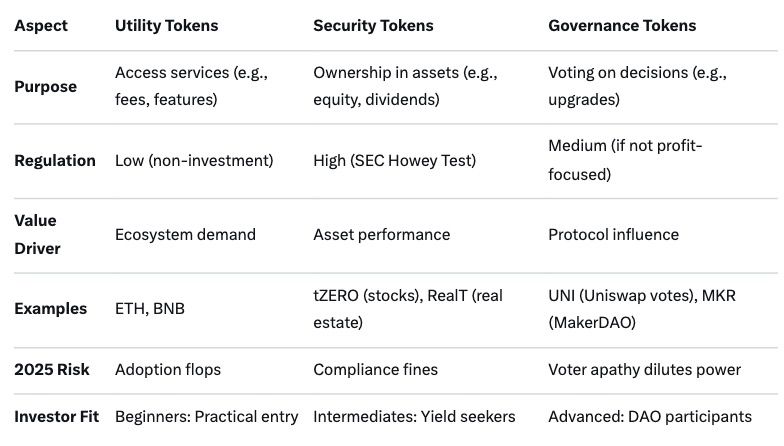
- Utilities: Functional fuel; no ownership claims—safer from securities laws.
- Securities: Digitized stocks; promise returns, triggering KYC/AML.
- Governance: Subset of utilities; empower DAOs but risk centralization if whales dominate.
Hybrids exist (e.g., UNI blends utility/governance), but misclassification led to 2024's $200M fines. Internal link: Explore top utilities.
Top Utility Coins in 2025
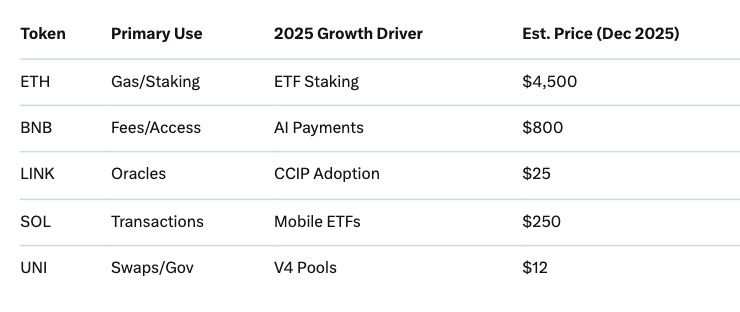
2025's standouts blend proven utility with innovation. Selected by TVL, adoption, and growth (data: CoinMarketCap/DeFiLlama).
1. Ethereum (ETH) – The DeFi King
ETH powers 60% of dApps, with $250B TVL post-Pectra upgrade (May 2025). Use: Gas fees, staking (5% APY). 2025 Highlight: ETF staking approvals boosted price 150%. Market Cap: $450B.
2. Binance Coin (BNB) – Exchange Ecosystem Powerhouse
BNB fuels Binance Smart Chain: Trades, Launchpad access, 20% fee cuts. 2025: Expanded to AI payments, 300M users. Yield: 8% staking. Market Cap: $90B.
3. Chainlink (LINK) – Oracle Backbone
LINK connects blockchains to real data for DeFi/oracles. Use: Secure feeds, CCIP cross-chain. 2025: Integrated with 500+ dApps, $10B secured. Staking: 6% APY. Market Cap: $15B.
4. Solana (SOL) – Speed Demon for Mass Adoption
SOL enables 65K TPS for gaming/NFTs. Use: Fees, mobile dApps. 2025: Shopify integration, ETF launch—price up 400%. Market Cap: $80B.
5. Uniswap (UNI) – DEX Liquidity Leader
UNI governs/swaps on Ethereum L2s. Use: Fees, liquidity mining (10% rewards). 2025: V4 hooks for custom pools, $50B volume. Market Cap: $8B.
Emerging: Filecoin (FIL) – Decentralized Storage
FIL rents storage space. 2025: Web3 archiving boom, 20% YOY growth. Market Cap: $4B.
These drive 70% of utility volume—focus here for balanced exposure.
How Baltex.io Enables Fast Multi-Chain Swaps Between Major Utility Coins
In 2025's fragmented multi-chain world, swapping utilities like ETH to SOL shouldn't mean bridge hacks or high fees. Enter Baltex.io, the non-custodial aggregator revolutionizing utility trades.
Why Baltex for Utilities?
- Atomic Swaps: Direct ETH↔BNB↔LINK without vulnerable bridges—cuts risks 90%, executes in <10s.
- Private Routing: Monero intermediates obscure trails; ideal for privacy-conscious UNI stakers.
- Utility-Focused Pairs: 1,000+ paths, including ETH-SOL for DeFi migrations or BNB-LINK for oracle setups.
- Cost Savings: 0.1-0.3% fees vs. 1% on CEXs; fixed rates lock volatility during swaps.
Practical Use Cases
- DeFi Yield Chase: Swap ETH to SOL for higher APYs on Jito—Baltex aggregates best rates.
- Gaming Onboarding: Convert BNB to SAND for metaverse entry, no KYC delays.
- Portfolio Rebalance: LINK to UNI in one tx, with AML scans blocking tainted funds.
Connect wallet at baltex.io, select pair, confirm—zero custody, full control. With zero exploits since 2024 launch, it's utilities' fast lane. Internal link: Back to benefits.
FAQ
What is a utility coin in crypto?
A utility coin provides access to blockchain services like fees or features (e.g., ETH for Ethereum transactions)—not ownership like securities.
What's the difference between utility and governance tokens?
Utilities focus on function (access/rewards); governance emphasizes voting (e.g., UNI for Uniswap decisions), often overlapping.
Top utility coins in 2025?
ETH, BNB, LINK, SOL, UNI—powering DeFi, exchanges, oracles, and DEXs with $700B+ combined cap.
Are utility coins a good investment?
Yes for long-term: Benefits like yields outweigh volatility if you pick adopted projects; risks include regulation.
How does Baltex.io help with utility swaps?
Non-custodial atomic swaps across 20+ chains, private routes, low fees—e.g., ETH to SOL in seconds without bridges.
Utility vs. security tokens?
Utilities: Service access, low regulation. Securities: Asset ownership, high compliance (e.g., dividends).
Conclusion
Utility coins in 2025 aren't just crypto—they're the engines of Web3, turning blockchains into vibrant economies. From ETH's DeFi dominance to SOL's speed, their benefits (efficiency, yields) far eclipse risks when approached wisely. Compared to securities' stability or governance's power, utilities offer accessible entry for beginners building intermediate strategies.
Dive in: Research via CoinGecko, stake for rewards, and swap via Baltex.io. What's your first utility play—ETH staking or UNI liquidity? The ecosystem grows with you—trade smart, stay secure.
See others posts
G. Khan

SHIB Ecosystem Rally: Can Shibarium and the Burn Rate Move the Price?
Ecosystem
G. Khan
Shiba Inu Price Prediction 2027 (September 2026 Update)
Ecosystem
G. Khan
Shiba Inu Price Prediction 2030: SHIB 2030 Forecast (September 2026 Update)
Ecosystem
G. Khan
Shiba Inu (SHIB) Price Prediction 2026, 2027 and 2030 (September 2026 Update)
Ecosystem
G. Khan
Dogecoin News and Price Predictions Today (September 2026 Update)
Ecosystem
G. Khan
Dogecoin Price Prediction 2030: Long-Term DOGE Forecast (September 2026 Update)
Ecosystem