



 5 minutes to read
 Ecosystem
What Does a Real Bitcoin Look Like? Physical vs Digital BTC Guide
TL;DR
Bitcoin is purely digital—it has no official physical form. "Real" Bitcoin exists as entries on the blockchain, controlled by private keys. Physical Bitcoin coins are rare collectibles with embedded (or once-embedded) digital value, not actual currency. Digital BTC appears as a balance in wallet apps, secured by keys and UTXOs. Tools like baltex.io help manage and swap real on-chain BTC across chains privately.
What Is Bitcoin? The Digital Nature of "Real" BTC
Bitcoin (BTC) is a decentralized digital currency invented in 2008 by Satoshi Nakamoto. Unlike traditional money, there are no physical bills or coins issued by a central authority. Bitcoin exists entirely on a public ledger called the blockchain—a distributed database maintained by thousands of computers worldwide.
A "real" Bitcoin is not a tangible object you can hold; it's a unit of value recorded on the blockchain. Ownership means controlling the cryptographic keys that allow you to spend specific amounts of BTC. There is no central bank printing Bitcoin; new BTC is created through mining, and the total supply is capped at 21 million.
For beginners: Think of Bitcoin like email money. Just as email is digital text sent over the internet, Bitcoin is digital value transferred peer-to-peer without intermediaries.
Digital Bitcoin: How It Really Looks and Works
In everyday use, Bitcoin "looks" like a number in a wallet app or website.
Your balance is the sum of unspent outputs (UTXOs) you control.
Private Keys: The True "Owner" of Bitcoin
The core of Bitcoin ownership is the private key—a long random number (256 bits) that proves control over BTC.
A private key might look like this in text: 5Kb8kLf9zgWQnogidDA76MzPL6TsZZY36hWXMssSzNydYXYB9KF (seed format) or a QR code for scanning.
Whoever has the private key controls the BTC—forever. Lose it, lose your Bitcoin. Share it, lose your Bitcoin.
Wallets: Storing and Managing Digital BTC
A Bitcoin wallet is software (or hardware) that manages private keys and shows your balance.
- Hot wallets: Apps like Electrum, BlueWallet—convenient but online risks.
- Cold wallets: Hardware like Ledger—offline, more secure.
Wallets generate addresses (public keys hashed) for receiving BTC, like bank account numbers.
UTXOs: How Bitcoin Tracks Ownership
Bitcoin uses the Unspent Transaction Output (UTXO) model, not account balances like banks.
Each transaction "spends" previous UTXOs and creates new ones.
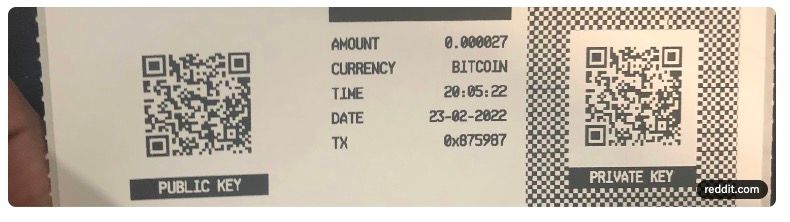
Your "balance" is the total value of UTXOs tied to your keys. This makes Bitcoin traceable but pseudonymous.
Physical Bitcoins: Collectibles, Not Real Currency
Many newcomers search for "physical Bitcoin" expecting coins like gold dollars. These exist but are not "real" Bitcoin in the functional sense.
Physical Bitcoins are metal tokens with an embedded private key (usually under a tamper-evident hologram). They were popular 2011–2013.
Famous examples:
-
Casascius coins: Created by Mike Caldwell. Brass, silver, or gold-plated with loaded BTC.
-
Lealana coins: Similar, often gold or silver plated.
Production stopped around 2013 due to regulatory issues (considered money transmission).
Today:
- Unredeemed (loaded): Contain real on-chain BTC. Valuable as collectibles + BTC value (often premium).
- Redeemed (peeled): Hologram removed, BTC transferred out. Just novelty metal.
Physical versions are not currency—they're bearer instruments or art. Using them requires peeling the hologram, exposing the key, and sweeping to a digital wallet. Risky if damaged.
Physical Tokens vs On-Chain Digital BTC: Key Comparison
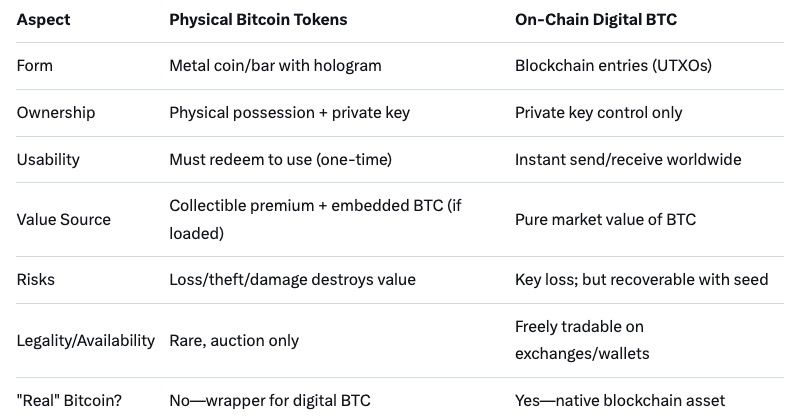
Real Bitcoin is always digital and on-chain. Physical ones are historical novelties.
Common Myths About Bitcoin's Appearance and Form
- Myth: Bitcoin is physical gold coins. No—those are souvenirs or old loaded collectibles.
- Myth: Wallet balance is "stored" in the app. No—it's derived from blockchain UTXOs.
- Myth: Paper wallets are physical Bitcoin. They're printouts of keys—still digital BTC.
- Myth: All physical Bitcoins have value. Many modern ones are empty novelties.
- Myth: Bitcoin looks like the ₿ symbol. The logo is branding; actual BTC is code on the ledger.
How Baltex.io Helps Manage and Swap Real BTC Across Chains
As Bitcoin ecosystems expand (e.g., wrapped BTC on Ethereum, Lightning, Ordinals), managing real BTC across chains can be complex.
Baltex.io is a non-custodial instant swap platform that specializes in cross-chain exchanges for real on-chain Bitcoin and other assets.
Key features for BTC users:
- Cross-chain swaps: Move real BTC to wrapped versions (e.g., WBTC) or other chains without centralized custodians.
- Privacy-focused: Supports private swaps, breaking on-chain links for enhanced anonymity.
- No KYC/limits: Registration-free, high-volume swaps while keeping custody of your keys.
- Multi-asset support: Swap BTC with 1,000+ tokens across 20+ chains via DEX aggregation for best rates.
- Secure and fast: Non-custodial—one-time addresses, audited infrastructure.
Whether consolidating UTXOs, bridging to DeFi, or privately swapping, baltex.io simplifies handling real Bitcoin without compromising control. Visit https://baltex.io to get started.
FAQ
Q: Does Bitcoin have a physical form? A: No official one. Physical coins are collectibles representing digital BTC.
Q: What does owning Bitcoin really mean? A: Controlling the private key to its UTXOs on the blockchain.
Q: Are physical Bitcoins worth anything? A: Unredeemed ones yes (BTC + premium); most modern replicas no.
Q: How do I see my "real" Bitcoin? A: In a wallet app showing balance from blockchain queries.
Q: Can I turn digital BTC into physical? A: Not officially, but services create custom loaded tokens (rare/risky).
Q: Is wrapped BTC (e.g., WBTC) real Bitcoin? A: It's backed 1:1 by real BTC in custody—not native on-chain BTC.
Conclusion
Bitcoin's beauty lies in its intangibility: borderless, censorship-resistant digital money secured by math. "Real" Bitcoin lives on the blockchain as UTXOs controlled by private keys—not in shiny coins. Physical versions are fascinating collectibles from crypto's early days, but they don't capture Bitcoin's essence.
For beginners, start with a reputable wallet, understand keys/UTXOs, and use tools like baltex.io for seamless cross-chain management. Embrace the digital reality—it's what makes Bitcoin revolutionary.
See others posts
G. Khan

SHIB Ecosystem Rally: Can Shibarium and the Burn Rate Move the Price?
Ecosystem
G. Khan
Shiba Inu Price Prediction 2027 (September 2026 Update)
Ecosystem
G. Khan
Shiba Inu Price Prediction 2030: SHIB 2030 Forecast (September 2026 Update)
Ecosystem
G. Khan
Shiba Inu (SHIB) Price Prediction 2026, 2027 and 2030 (September 2026 Update)
Ecosystem
G. Khan
Dogecoin News and Price Predictions Today (September 2026 Update)
Ecosystem
G. Khan
Dogecoin Price Prediction 2030: Long-Term DOGE Forecast (September 2026 Update)
Ecosystem