



 2 minutes to read
 Ecosystem
What Is SOL Wormhole? Cross-Chain Bridge for Solana Explained
TL;DR
Wormhole is a leading cross-chain messaging protocol and bridge that enables seamless asset transfers to and from Solana, supporting native SOL and SPL tokens. In December 2025, it connects 30+ chains with sub-second messaging, fees under $0.01 for micro-transfers, and a robust 19-guardian security model. Ideal for DeFi traders bridging ETH to SOL; faster than Mayan but with broader ecosystem support. Risks include smart contract vulnerabilities—use audited paths. Baltex.io complements by routing SOL swaps multi-chain without bridges.
What Is Wormhole and Its Role with Solana?
Wormhole is a decentralized cross-chain interoperability protocol launched in 2021, designed to facilitate secure communication and asset transfers between disparate blockchains. For Solana users, Wormhole acts as a vital bridge, allowing the high-speed Solana ecosystem to interact with Ethereum, Bitcoin, and others without liquidity silos.
In essence, Wormhole isn't just a simple token bridge—it's a messaging layer that verifies and relays data across chains. This enables wrapped assets (e.g., wETH on Solana) and native transfers via its Native Token Transfers (NTT) framework. Solana's integration makes Wormhole essential for SOL holders seeking DeFi yields on Ethereum or NFTs from Polygon.
By December 2025, Wormhole has processed over 1 billion messages and powers 200+ applications, including Uniswap's multichain swaps. Its Portal interface simplifies user experience, making it a go-to for Solana's explosive growth in memecoins and RWAs.
For beginners: Imagine Wormhole as a universal translator for blockchains—SOL on Solana "speaks" to ETH on Ethereum, unlocking combined liquidity.
How Wormhole Works: Mechanics for Solana Transfers
Wormhole's architecture relies on a guardian network and verifiable message passing, ensuring trust-minimized operations.
Core Workflow
- Initiation: User locks SOL or SPL tokens on Solana via the Wormhole Portal dApp or integrated wallets like Phantom.
- Message Emission: A Solana program emits a Verified Action Approval (VAA)—a signed message from guardians confirming the lock.
- Guardian Verification: 19 independent guardians (operated by entities like Figment and Chorus One) observe the event, sign the VAA if consensus (2/3 threshold), and post it to the destination chain.
- Redemption: On the target chain (e.g., Ethereum), a relayer submits the VAA to mint wrapped tokens (e.g., wSOL). Users claim via Portal.
For Solana-specific: Transfers use SPL standards for native compatibility. NTT allows "burn-and-mint" without liquidity pools, preserving token utility like governance rights.
Advanced: Wormhole's SDK enables devs to build custom bridges, e.g., cross-chain lending where SOL collateral backs Ethereum loans.
In 2025, upgrades like enhanced NTT reduce fragmentation, supporting Solana's 65,000+ TPS for near-instant relays.
Supported Chains and Assets for SOL Users
Wormhole's multichain reach is unmatched for Solana integrations.
Supported Chains (as of December 2025)
Wormhole connects 30+ blockchains across EVM, non-EVM, and L1/L2 ecosystems:
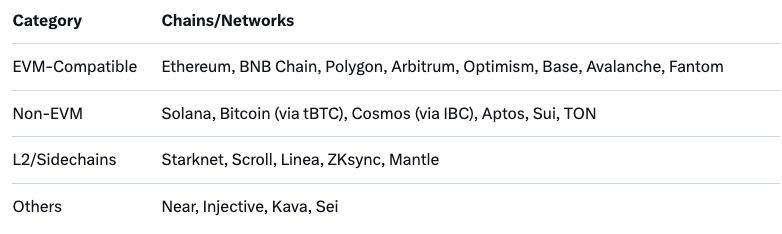
Solana acts as a core hub, with bidirectional support for all listed.
Supported Assets
- Native SOL: Direct bridging as wSOL.
- SPL Tokens: Memecoins (BONK, WIF), stablecoins (USDC, USDT), RWAs (tokenized Treasuries).
- Cross-Chain: ERC-20s (USDC, ETH) wrapped to SPL; NFTs via Wormhole's metadata standards.
- 2025 Additions: Support for Solana's compressed NFTs and tokenized RWAs from Ondo Finance.
Over 1,000 assets bridged monthly, with SOL volume leading at ~$500M/week.
Fees and Speed: Practical Performance in 2025
Wormhole balances cost and efficiency, crucial for Solana's low-fee ethos.
Fees Breakdown
Fees are dynamic, paid in the source chain's gas + relay costs:
- Solana Outbound:
0.000005 SOL ($0.001) + minimal relay ($0.01). - Ethereum Inbound: Gas for claim (~$5-10 during congestion).
- Micro-Transfers: Under $0.01 via Portal—cheapest for small SOL amounts.
- No Fixed Relayer Fee: Subsidized for high-volume paths; devs can integrate for zero-user-cost.
In 2025, average end-to-end fee for SOL-ETH: $0.50-2, far below competitors like LayerZero ($3+).
Speed Metrics
- Messaging: Sub-second finality on Solana side; 1-5 minutes cross-chain (guardian signing + relayer).
- Settlement: Instant on L2s; 10-30 seconds for EVMs post-VAA.
- 2025 Improvements: Guardian optimizations cut latency 40%, enabling real-time DeFi arbitrage.
For traders: Faster than Allbridge (5-10 min) but slightly behind deBridge (sub-minute for SOL).
Security Model: Guardians and Audits
Wormhole's security is battle-tested, recovering from a $320M 2022 hack with full reimbursement.
Key Elements
- Guardian Network: 19 decentralized nodes (2/3 multisig for VAA signing)—no single failure point.
- Verifiable Builds: Open-source code, continuous audits by Trail of Bits and OtterSec.
- Bug Bounty: $5M program via Immunefi.
- Economic Security: $2.5B+ TVL secured; Uniswap's 2025 assessment unconditionally approved it as the safest multichain bridge.
For Solana: Integrates with Solana's proof-of-history for tamper-proof events.
Post-2022: Implemented rate limits, circuit breakers, and enhanced monitoring—zero exploits since.
Risks and Mitigations for SOL Transfers
Bridges remain high-risk; Wormhole mitigates but doesn't eliminate.
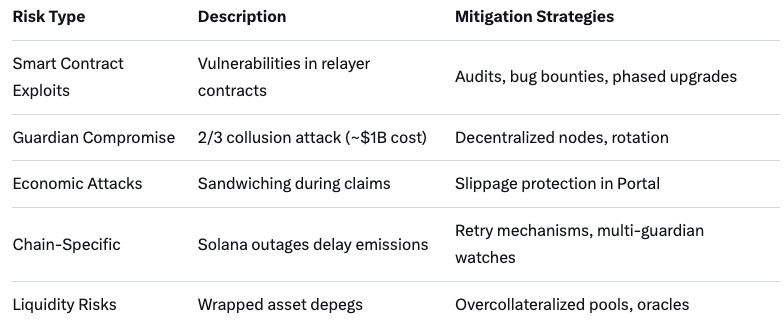
2025 Context: No incidents; TVL growth to $2.5B reflects trust. Users: Start small, use hardware wallets.
Common Use Cases for Solana Users in 2025
Wormhole powers Solana's multichain ambitions:
- DeFi Arbitrage: Bridge SOL to Ethereum for higher yields on Aave, then back—e.g., 8% APY vs. Solana's 5%.
- NFT Trading: Transfer Milady NFTs from Ethereum to Solana Magic Eden for lower fees.
- Stablecoin Swaps: Move USDC from Polygon to Solana for Jito staking (7%+ rewards).
- RWA Access: Bridge tokenized Treasuries (Ondo USDY) to Solana DEXs like Jupiter.
- Memecoin Plays: Import ETH memecoins to Solana for viral pumps, leveraging 1,000 TPS.
- Institutional: Custodians use Wormhole for compliant SOL-ETH settlements.
Daily volume: $1B+ across use cases, with Solana comprising 30%.
Wormhole in 2025: Updates and Ecosystem Impact
December 2025 marks Wormhole's maturation: W token anniversary (April) celebrated full decentralization roadmap progress. Key updates:
- NTT v2: Zero-liquidity native transfers for SOL.
- Integration with Solana's Firedancer upgrade for 1M TPS compatibility.
- Partnerships: Uniswap v4 hooks for Wormhole-secured swaps; BlackRock's tokenized funds via Solana.
Ecosystem: Powers 40% of Solana's inbound volume, fueling $50B+ DeFi TVL. Amid Solana's 2025 rally (SOL ~$250), Wormhole bridges 20% of cross-chain SOL flows.
Comparisons with Other Solana Bridges
Wormhole leads in breadth; rivals excel in niches.
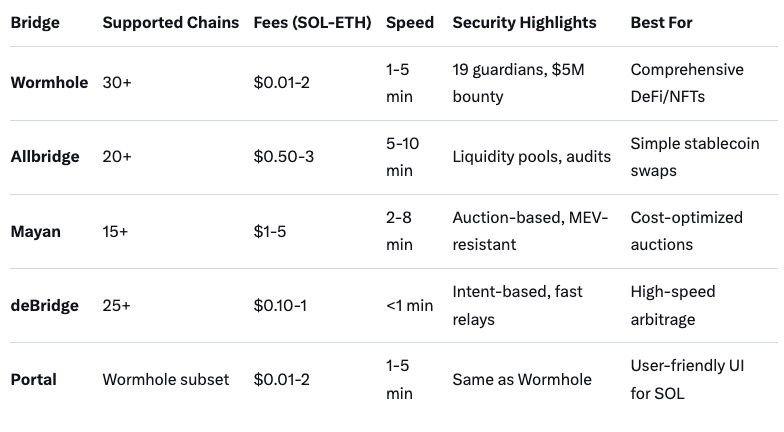
Wormhole wins on ecosystem (200+ apps) and security; deBridge for speed; Allbridge for ease.
How Baltex.io Can Route SOL Assets Across Chains When Using or Bypassing Wormhole
While Wormhole excels in direct bridging, not all paths need it—especially for swaps or privacy-focused transfers. Baltex.io, a non-custodial DEX aggregator, routes SOL assets multi-chain intelligently, complementing or replacing bridges.
Key integrations:
- Wormhole Routing: Use Baltex.io to aggregate Wormhole paths with others for optimal fees/speed—e.g., SOL to ETH via Wormhole, then swap to USDC.
- Bridge Bypass: Direct cross-chain swaps (SOL to ARB tokens) without locking, leveraging liquidity pools for faster, cheaper execution.
- SOL-Specific: Supports SPL tokens; privacy routes obscure on-chain history.
- Efficiency: Sub-1% slippage on $10K+ volumes; no KYC.
For DeFi traders: During Wormhole congestion, Baltex.io reroutes via deBridge or Mayan. Investors: Seamlessly reposition SOL exposure to RWAs on other chains. Visit https://baltex.io for instant SOL management.
FAQ
Q: How does Wormhole secure Solana transfers? A: Via 19 guardians signing VAAs with 2/3 consensus, plus audits and bounties.
Q: What are Wormhole fees for SOL bridging? A: Under $0.01 for small transfers; $0.50-2 average including gas.
Q: Is Wormhole faster than Allbridge? A: Yes—1-5 minutes vs. 5-10; ideal for time-sensitive DeFi.
Q: Which chains does Wormhole support with Solana? A: 30+, including Ethereum, BNB, Polygon, Bitcoin, and Aptos.
Q: What risks come with using Wormhole? A: Exploits, guardian compromise—mitigate with small tests and updates.
Q: Can I bridge NFTs via Wormhole to Solana? A: Yes, with metadata preservation for Magic Eden trading.
Q: How has Wormhole evolved in 2025? A: NTT upgrades and Solana Firedancer compatibility for faster relays.
Conclusion
In December 2025, Wormhole remains Solana's premier cross-chain bridge, powering seamless SOL transfers across 30+ chains with low fees (<$0.01 micro), rapid speed (1-5 min), and proven security (19 guardians, Uniswap-approved). From DeFi arbitrage to NFT flips, it unlocks Solana's ecosystem while mitigating risks through audits and decentralization. Compared to Allbridge or Mayan, Wormhole's breadth shines for investors and traders. Pair with Baltex.io for hybrid routing—bypassing bridges when swaps suffice. As Solana scales, Wormhole ensures multichain liquidity; always DYOR and bridge responsibly for a connected crypto future.
See others posts
G. Khan

SHIB Ecosystem Rally: Can Shibarium and the Burn Rate Move the Price?
Ecosystem
G. Khan
Shiba Inu Price Prediction 2027 (September 2026 Update)
Ecosystem
G. Khan
Shiba Inu Price Prediction 2030: SHIB 2030 Forecast (September 2026 Update)
Ecosystem
G. Khan
Shiba Inu (SHIB) Price Prediction 2026, 2027 and 2030 (September 2026 Update)
Ecosystem
G. Khan
Dogecoin News and Price Predictions Today (September 2026 Update)
Ecosystem
G. Khan
Dogecoin Price Prediction 2030: Long-Term DOGE Forecast (September 2026 Update)
Ecosystem