



 2 minutes to read
 Ecosystem
XMR to Theta Exchange: How to Convert and Transfer Your Assets
TLDR: In 2026, swap XMR to THETA (or THETA to XMR) most efficiently using non-custodial instant platforms like Baltex.io for under 2% total fees, 5–30 minute completion, no KYC, and minimal custody or privacy risks. These aggregators route via intermediates (often XMR privacy pivot or bridged USDT/TFUEL) while preserving Monero's anonymity. Centralized exchanges provide tight spreads but require KYC and introduce custody exposure. Multi-hop paths via bridges and DEXes offer control but increase complexity, gas fees, and error potential. Always test small amounts, verify addresses, and favor wallet-to-wallet flows. Best balanced option: Baltex.io for privacy-enhanced cross-chain routing between Monero and Theta.
Monero (XMR) continues to lead as the premier privacy coin with unbreakable on-chain anonymity through ring signatures and stealth addresses, while Theta Network (THETA) powers decentralized video streaming and edge computing with its dual-chain setup (Theta blockchain for governance and TFUEL for operations) and growing EVM compatibility. Converting between these assets in 2026 is vital for users diversifying from privacy holdings into media/DeFi plays or vice versa, but no direct native bridge connects the privacy-focused PoW chain to Theta's ecosystem. All swaps rely on intermediate hops—typically stablecoins, BTC, or ETH—aggregated across liquidity sources. Platforms now excel by offering single-click quotes with slippage protection, prioritizing non-custodial execution to reduce risks. Privacy users especially seek routes that leverage Monero's obfuscation without leaking transaction links.
Understanding Cross-Chain Swaps Between XMR and THETA in 2026
Theta operates an EVM-compatible mainnet with bridges to Ethereum and other chains for asset portability, supporting TNT20 tokens and cross-chain transfers via protocols like Meter Passport remnants or modern aggregators. Monero's design intentionally resists interoperability to protect privacy, so direct atomic swaps remain unavailable at scale. Practical paths use instant exchangers that bridge or swap through liquid pairs. Non-custodial services dominate for this audience because they execute wallet-to-wallet, minimizing time funds leave user control. Aggregators pull real-time liquidity from DEXes, CEX APIs, and bridges, delivering a unified rate. Privacy leakage is a top concern: transparent intermediates can expose origins unless privacy pivots (routing through XMR) are used.
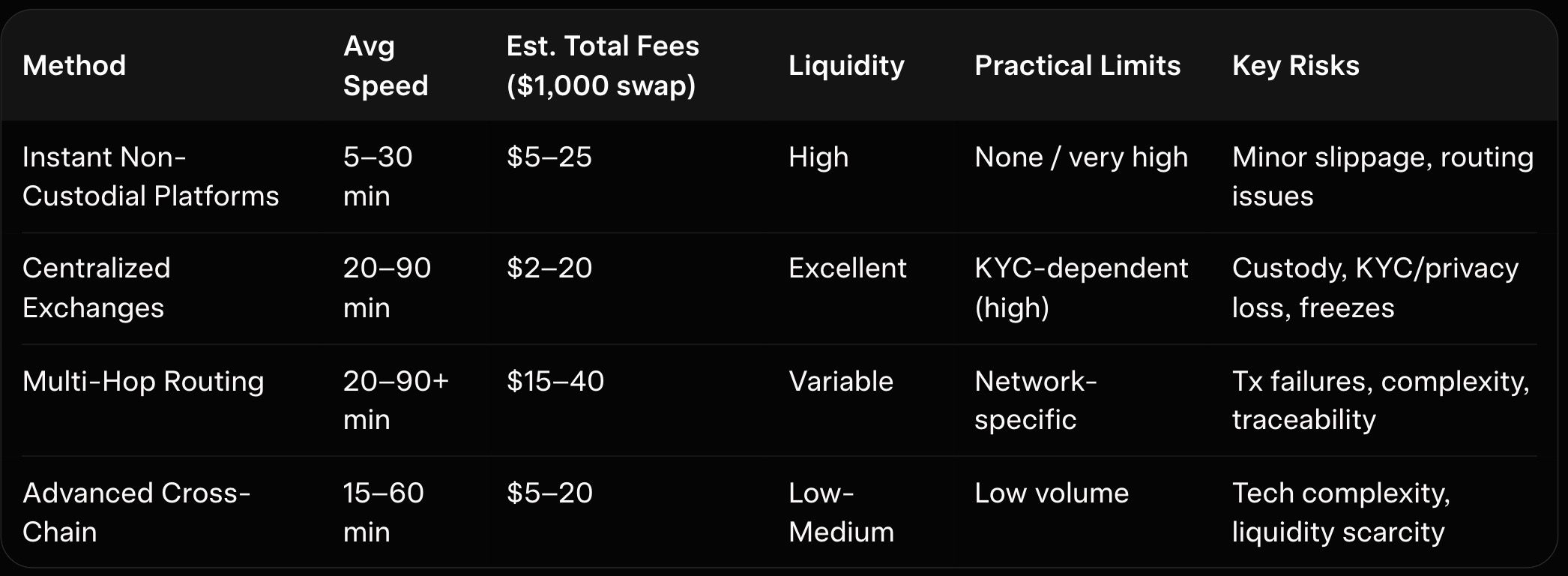
Comparing Swap Methods: Speed, Fees, Liquidity, Limits, and Risks
Instant non-custodial platforms lead for XMR–THETA pairs by aggregating providers and handling routing automatically. They quote all-in rates upfront, including fees and network costs. Speed averages 5–30 minutes due to optimized paths and fast confirmations on Theta/EVM sides (Monero's 2-minute blocks add minor delay). Fees typically fall between 0.5–2.5%, competitive thanks to volume sourcing. Liquidity suits mid-range trades ($500–$50k+); slippage is low on aggregated pools. Limits are high or unlimited on trusted services. Risks involve routing reliability and temporary rate shifts, but no custody or KYC applies. Privacy excels, especially with Monero-integrated paths that break links.
Centralized exchanges deliver superior liquidity and minimal spreads for THETA (listed widely) and XMR (on select venues). Deposit one asset, trade via USDT or direct pair if available, then withdraw. Speed encompasses deposit (fast on Theta, slower on Monero), instant trading, and withdrawal (10–60+ minutes). Fees are low on trading (0.1–0.2%) plus network withdrawals (minimal for THETA, often low/free for XMR). Liquidity handles large volumes effortlessly. Limits tie to KYC levels—high post-verification. Major risks include full custody exposure, mandatory identity checks creating permanent records, and platform vulnerabilities.
Multi-hop routing paths grant full control: swap XMR to BTC/ETH/USDT on an instant service, bridge to Theta-compatible chain (e.g., Ethereum then Theta via legacy or aggregator bridges), then swap to THETA on a DEX like ThetaSwap. This maximizes cost optimization for edge cases but extends time to 20–90+ minutes with multiple confirmations. Cumulative fees climb to 1.5–4% from layered gas and tolls. Liquidity varies per leg; success drops with added hops. Limits follow individual protocols. Risks compound: bridge failures, address errors, exploits, and traceable footprints absent manual obfuscation.
Advanced cross-chain strategies (intent-based bridges, atomic experiments) stay limited for this pair due to privacy barriers and low specialized liquidity. They suit niche high-trustlessness needs but lack everyday practicality.
Method Comparison Table
Fees and Limits Comparison Table (XMR → THETA approximate, February 2026)
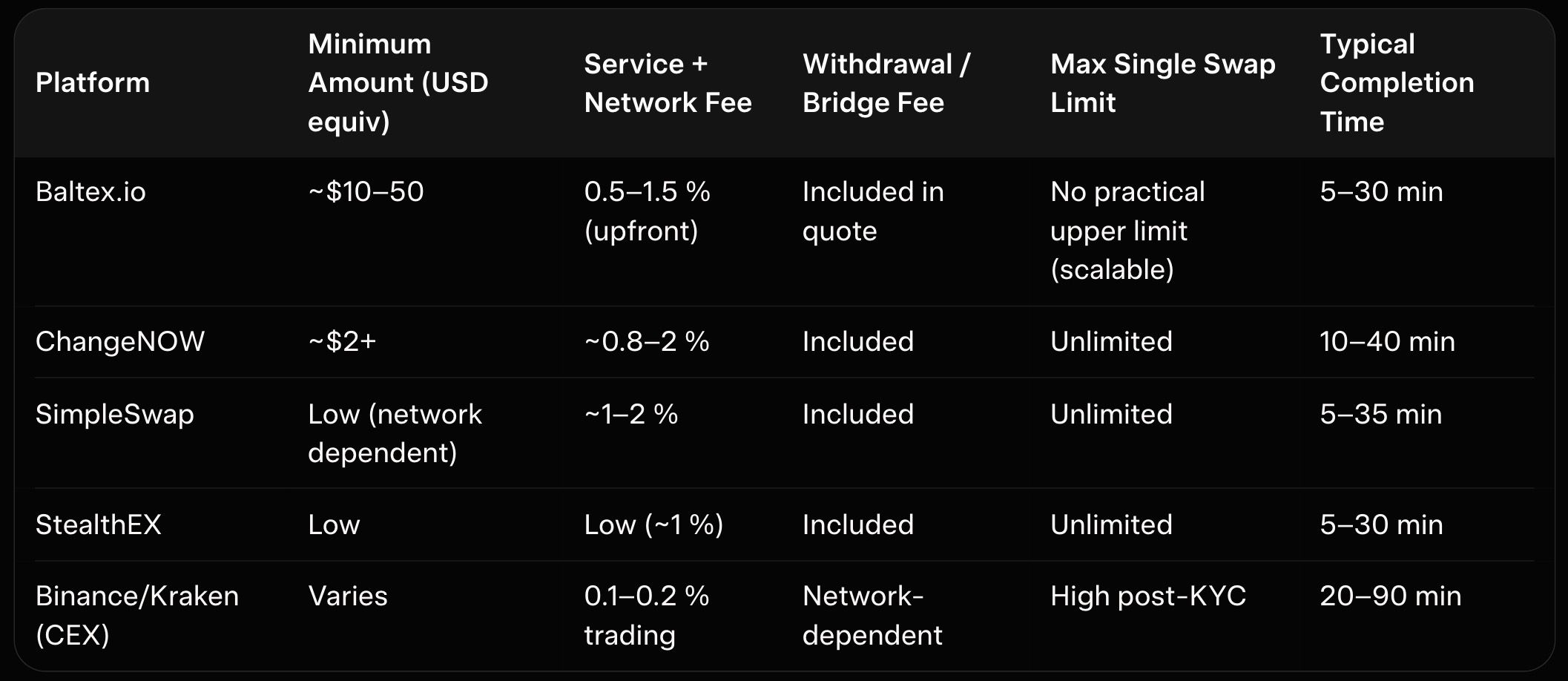
Non-custodial aggregators consistently outperform for privacy-focused, low-risk swaps.
Step-by-Step: Swapping XMR to THETA on Instant Non-Custodial Platforms
- Visit a trusted instant swap platform supporting XMR–THETA routing in a private browser.
- Select XMR as the “send” asset and THETA as the “receive” asset.
- Input the XMR amount to exchange.
- View the instant quote showing expected THETA, fees, and rate.
- Enter your destination Theta wallet address (double-check carefully).
- Review full details including service fee and slippage protection.
- Send XMR from your Monero wallet (GUI/CLI/hardware) to the provided deposit address.
- Await Monero confirmations (typically 10 blocks ≈ 20 minutes).
- The platform routes automatically (often via privacy pivot or bridged intermediate).
- Receive THETA in your wallet; track via status page or explorers.
Enable private routing if offered for enhanced link-breaking.
Step-by-Step: Swapping THETA to XMR
- Choose THETA as sending and XMR as receiving on the platform.
- Enter THETA amount.
- Provide your Monero wallet address (verify thoroughly).
- Confirm the quoted XMR output and fees.
- Send THETA from your Theta wallet to the deposit address shown.
- Wait for Theta network confirmation (fast due to EVM compatibility).
- Platform handles routing and delivers XMR privately.
- Verify receipt in your Monero wallet.
Test with small amounts first in both directions.
Safety Checks and Best Practices to Minimize Risks
Verify the platform's official domain and HTTPS certificate before starting. Use hardware wallets for both assets; never input seeds online. Conduct a small test swap (1–2% of total) and confirm full receipt prior to larger transfers. Copy-paste addresses and cross-verify prefix/suffix/length. Activate wallet alerts for incoming transactions. Opt for private modes to obscure trails. Record only TX hashes, avoid address screenshots. Check network status to avoid congestion delays. Use dedicated wallets per purpose for isolation. These steps sharply reduce errors, custody time, and privacy exposure.
How Baltex.io Enables Efficient Cross-Chain Routing Between Monero and Theta
Baltex.io emerges as a top non-custodial aggregator in 2026, excelling at privacy-centric cross-chain swaps for pairs like XMR–THETA. Supporting thousands of tokens across major networks, it integrates native Monero handling with Theta compatibility via efficient bridges and DEX aggregation. For an XMR to THETA swap, Baltex generates a deposit address, routes incoming XMR through its privacy protocol (leveraging Monero as a pivot to sever on-chain links), then delivers THETA wallet-to-wallet with minimal intermediate exposure. The reverse uses similar obfuscation for entering privacy from Theta.
Private Swap mode stands out: it breaks traceability between source and destination using Monero rails, ideal for avoiding chain analysis on transparent legs. No KYC or accounts required; custody is fleeting during routing. Limits accommodate large trades (BTC-equivalent+ scalable), fees stay transparent and low (0.5–1.5% all-in shown upfront). Completion averages 5–30 minutes with fallback routing to minimize failures. Live tracking and 24/7 support enhance usability without data requests. For users minimizing fees, errors, custody, and privacy leakage on XMR–THETA flows, Baltex.io provides the most seamless, secure experience available.
Frequently Asked Questions
What is the cheapest way to swap XMR to THETA in 2026? Instant non-custodial aggregators like Baltex.io or ChangeNOW often deliver the best all-in costs via optimized routing and no double fees.
Do I need KYC for XMR to THETA swaps? Not on non-custodial instant platforms; CEXes require it for higher limits.
How private are these swaps? Wallet-to-wallet services maintain strong privacy; Monero-pivot options on platforms like Baltex break links effectively.
Can I handle large swaps (>$50,000)? Yes on high-limit services like Baltex.io; consider splitting if slippage concerns arise.
What happens if a swap fails? Reliable platforms auto-refund or retry; select those with clear tracking and support.
Is there a direct bridge for XMR and THETA? No at scale; all use intermediates with aggregation.
Best wallets to use? Official Monero GUI/CLI/hardware for XMR; Theta Web Wallet or compatible EVM wallets for THETA.
Are fees worth it compared to holding? A single efficient swap costs <2% but unlocks chain-specific utility/privacy immediately.
Conclusion
Converting XMR to THETA (and reverse) in 2026 is straightforward and secure via advanced non-custodial aggregators that bridge privacy and utility chains intelligently. Prioritizing instant platforms—particularly privacy-enhanced ones like Baltex.io—delivers fast, affordable swaps with low custody and strong anonymity preservation. Use comparison tables to evaluate options, adhere strictly to safety protocols, and begin with tests. As interoperability advances, self-custody and privacy principles guide the best outcomes. Whether shifting to video/streaming exposure or bolstering anonymity, these strategies empower confident, low-risk execution throughout 2026 and forward.
See others posts
G. Khan

Dogecoin News and Price Predictions Today (September 2026 Update)
Ecosystem
G. Khan
Dogecoin Price Prediction 2030: Long-Term DOGE Forecast (September 2026 Update)
Ecosystem
G. Khan
Dogecoin Price Prediction 2027
Ecosystem
G. Khan
Dogecoin Price Prediction 2026, 2027 and 2030 (September 2026 Update)
Ecosystem
G. Khan
Solana Price Prediction 2030 (September 2026 Update)
Ecosystem
G. Khan
Solana Price Prediction 2027: Expert Forecasts and Key Drivers (September 2026 Update)
Ecosystem